Inspiration
Most productivity tools work well when the plan is still intact. Real field operations are different: unfinished work carries over, preparation is uneven, staffing or priorities change, and unexpected events break the expected route.
The hardest moment is often not planning the day. It is recovering orientation after the plan has already begun to collapse.
Lighthouse began as a small CLI-style navigation system already in use by March 1, 2026. Each morning, the operator entered three observations — R for remaining work, S for setup, and Y for yield margin — on a 0–2 scale. A prioritized decision rule then returned exactly one of five route commands, CMD_01 through CMD_05. A sixth exception command was later added for a collapse day.
Those first commands became the ancestors of today's push, maintain, rebuild, over-push warning, omission warning, and do-not-force navigation modes.
The system was built to answer a practical question:
Can a system show where I am, what reserve I have already prepared, and where I can restart — without managing me or pretending there is one universally correct answer?
The lighthouse metaphor defines the product. A lighthouse does not steer the ship. It stays quiet during ordinary navigation and becomes valuable when the operator needs to recover orientation, inspect the route already taken, or find another way forward.
What it does
The operator starts with a Morning Check using three observations:
- R — Remaining work
- S — Setup and accumulated preparation
- Y — Yield margin for variation and unexpected events
These establish the initial navigation state, NS, and starting HP.
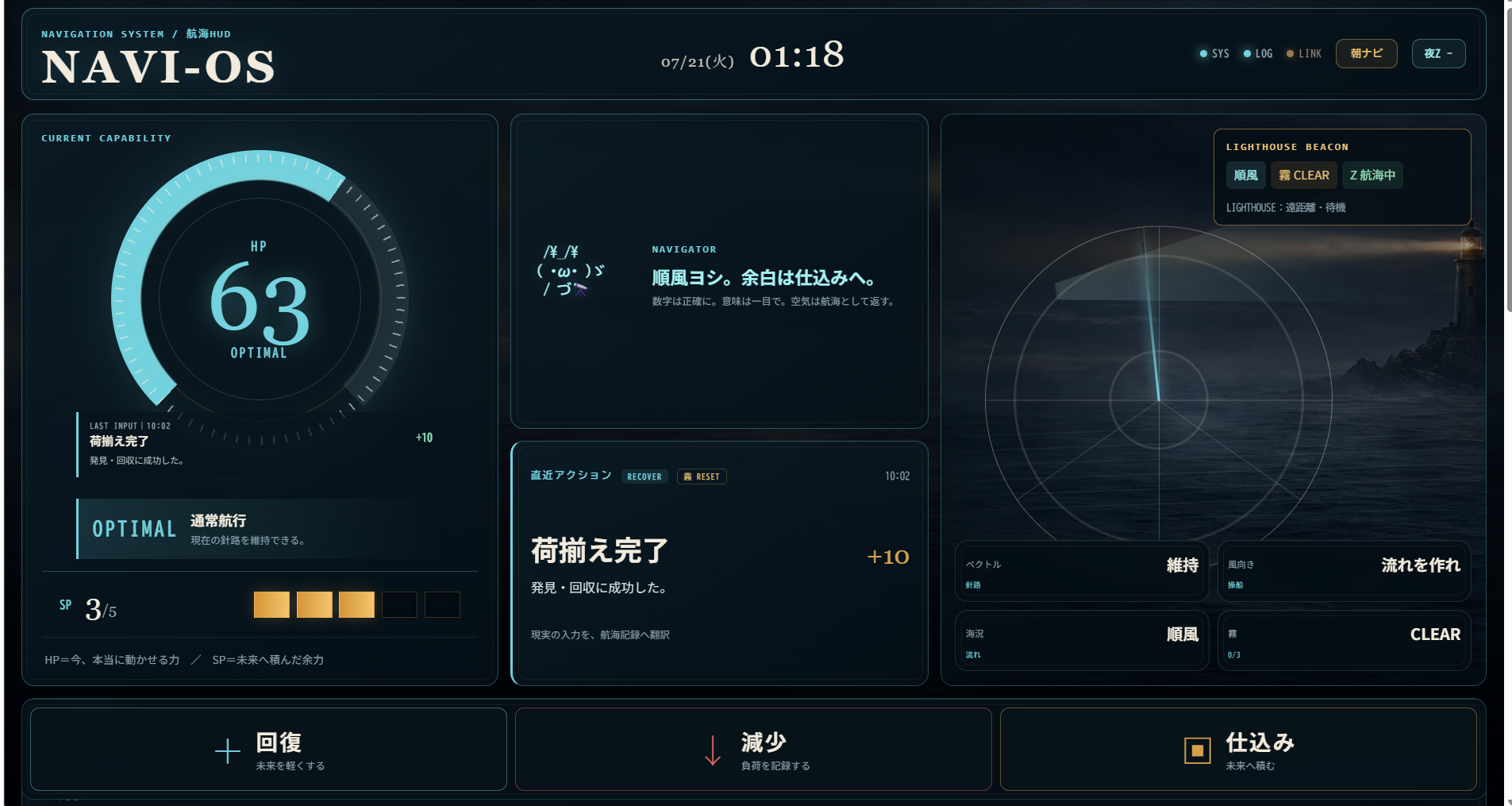
During the day, recovery, decrease, and preparation actions update:
- HP — current operating capacity
- SP — preparation stored as future reserve
- weather, fog, route visibility, and HUD status
- the recent action trajectory
When an unexpected event occurs, accumulated SP can be deliberately released to rebuild HP and the route.
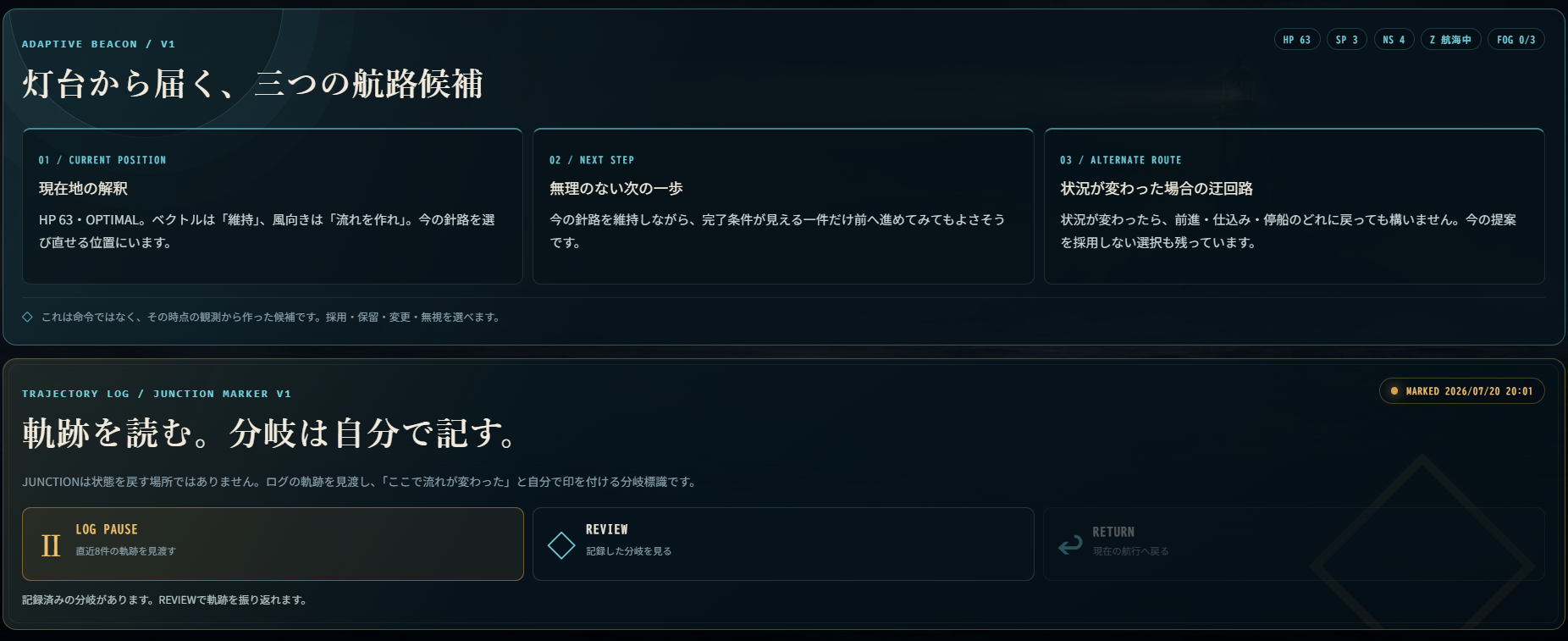
Adaptive Beacon presents multiple possible routes rather than issuing one command. LOG PAUSE / LAST 8 lets the operator inspect the latest trajectory without stopping or rewriting the log. JUNCTION marks a meaningful turning point and records one of three human choices:
- Continue
- Detour
- Decide later
The selected choice temporarily informs the next Beacon guidance. Past HP, SP, R/S/Y values, and logs are never restored or rewritten.
The public submission is a responsive Web HUD for desktop and mobile browsers.
What makes it different
Lighthouse is not an autonomous agent, a task manager, or an optimization oracle.
It is designed around selective attention:
- quiet during ordinary work;
- visible when the operator chooses to reflect;
- event-driven rather than notification-driven;
- multiple-route guidance instead of command-based automation;
- immutable past trajectory;
- human-controlled turning points and final decisions.
This means the system can remain in the background like a lighthouse keeper. When the operator wants to look back, the trajectory is still there and can be recovered as navigation context.
How GPT-5.6 was used
Lighthouse was not created as a one-week prompt-to-app exercise.
Its earliest confirmed form was already operating by March 1, 2026 in another AI environment as a small CLI-style navigator. The operator entered three morning observations — R for remaining work, S for setup, and Y for yield margin — and a prioritized rule returned one of five commands, CMD_01 through CMD_05. A later exception added CMD_06 for a collapse day.
Repeated field use then expanded that command engine into morning warnings, NS, initial HP, HP and SP separation, work-time decay, recovery and decrease events, action logs, operating bands, and the Google Sheets HUD.
During Build Week, GPT-5.6 — called ARK in this project — became the co-designer that moved this accumulated system into its next generation. GPT-5.6 was used to preserve the history and constraints of the earlier system, compare real operating evidence, challenge contradictions, and consolidate the CMD lineage into Adaptive Beacon, Trajectory Review, LOG PAUSE / LAST 8, CUT-IN, and JUNCTION.
The central evolution was from a system that returned one prioritized command into a system that can preserve the route already taken and illuminate multiple next routes without taking control from the operator.
GPT-5.6 therefore served as the reasoning, continuity, and translation layer that enabled a field-used navigation system built with earlier GPT generations to become the coherent Lighthouse experience submitted for Build Week.
How Codex was used
The primary Web HUD was created and iterated in ChatGPT Sites. Codex did not build the majority of the original Sites UI.
Codex was used in two verified stages.
The initial publication session audited the exported source, verified package integrity and secret handling, installed dependencies, ran lint, tests, and the production build, initialized Git, and published the verified repository.
A later dedicated core-engineering session rebuilt and hardened the major Build Week navigation core. In that session, Codex:
- created characterization tests for the existing navigation behavior;
- extracted the route logic into a pure TypeScript engine in
app/navigation-engine.ts; - connected Adaptive Beacon and JUNCTION to the tested engine;
- formalized exactly three route outputs: CURRENT POSITION, NEXT STEP, and ALTERNATE ROUTE;
- enforced state-dependent safety ceilings and one-action JUNCTION correction;
- preserved immutable inputs and past trajectory;
- added 3 characterization tests and 12 navigation-engine behavioral tests;
- retained 1 rendered HTML smoke test and 7 source/CSS contract tests;
- passed lint, the production build, 23 of 23 tests, and artifact validation;
- synchronized the work with the latest main branch and landed it through fast-forward operations.
Current verified Codex Session ID:
019f84c4-5008-7cd0-9156-e9978b8a4f42
Core implementation commit:
16cf48d92197f73ddba04c83da285642c7dc4f11
Codex session record commit:
ecad93bf238567b2b8df85e61a6247f2e0657ea6
Final main SHA:
e20debfba0502ddf049c3c28c559f5bea70eee1a
The public HUD remains deterministic and does not add runtime LLM inference, an external API dependency, credentials, private logs, or private workplace data.
Why the public demo does not call GPT-5.6 at runtime
The public HUD does not send every R/S/Y input or disruption to GPT-5.6 for an improvised answer at runtime.
That does not mean its guidance was designed without real-time operational context.
The development loop was longitudinal: a real field event occurred, the operator observed it, the event was brought into human–AI dialogue, the rule or wording was revised, and the system returned to operation. This repeated across unfinished work, setup failures, unexpected disruptions, recovery actions, stored preparation, hesitation, and route changes.
In other words, the navigation logic was distilled from real-time work over months rather than generated from scratch after each click.
The guidance is generated from real operational experience, even when it is not newly improvised by an LLM at every runtime event.
For the Build Week edition, deterministic state transitions provide reproducible judging, stable behavior, no API-key or latency dependency, protection of private workplace data, and less unnecessary interruption during active work.
Lighthouse uses AI as a longitudinal co-designer and reflection layer rather than as a constantly speaking runtime manager. A lighthouse does not steer the ship. It remains quiet until the operator needs the route illuminated.
How we built it
Pre-existing operational system
Smartphone / Pixel Watch → HTTP Shortcuts → Google Apps Script → Google Sheets action log → R/S/Y, NS, HP, SP, time-decay calculations → Sheets HUD and charts
Build Week submission
Operator → responsive Lighthouse Web HUD → Morning Check, HP/SP actions, Adaptive Beacon, NAVIGATOR AA, CUT-IN feedback, Trajectory Review, and JUNCTION choice
The public Build Week site uses a controlled standalone state so judges can reproduce the interaction without private Google Sheets access. Real operational time decay is paused in the public demo.
The repository includes the source, screenshots, architecture notes, testing guide, evidence methodology, anonymized aggregate data, provenance, and validation records.
Real-world evidence and impact
A retrospective analysis of the pre-existing Google Sheets action log covered March 8 through May 26, 2026:
- 57 active logging days
- 1,105 valid non-zero HP events
- recorded negative events per active logging day decreased from 10.78 in March to 2.71 in May
- a 74.8% March-to-May decrease
- a more conservative 50.6% April-to-May decrease
- low-load days increased from 8.7% to 64.3%
- recovery-event logging remained essentially stable from April to May
This is not presented as proof that productivity increased by 74.8%, and it does not establish causality. The dataset covers one operator and is not connected to production volume, cycle time, overtime, or defect data.
The accurate claim is narrower:
Recorded operational friction decreased over time while recovery behavior continued to be observed as the operator and navigation system evolved together.
Full methodology and anonymized aggregates are included in the repository.
Challenges
Translating lived field language into a public system
The original system used personal operational concepts developed through real work. The Build Week challenge was to preserve their meaning while making the interface understandable and testable by someone seeing it for the first time.
Preserving human authority
It was easy to make the system sound more advanced by claiming that AI automatically finds the optimal answer. That would contradict the project. Lighthouse had to remain a navigation layer that reveals routes without becoming a manager.
Separating the past from the next route
JUNCTION needed to influence future guidance without rewriting past values or pretending a different decision had already occurred. The resulting design preserves the trajectory as fact and treats the route choice as a new marker.
Creating a reproducible public demo
The real operating system contains private data and backend connections. The public Web HUD had to demonstrate the interaction reliably without exposing logs, credentials, or workplace information.
Accomplishments
- Transformed a private, field-used Google Sheets system into a responsive public Web HUD.
- Preserved a clear boundary between pre-existing work and Build Week additions.
- Built Adaptive Beacon, Trajectory Review, LOG PAUSE / LAST 8, CUT-IN, and JUNCTION as one coherent interaction model.
- Demonstrated SP release rebuilding HP and navigation after disruption.
- Preserved past trajectory instead of rewriting history.
- Produced a desktop/mobile demo requiring no login or API key.
- Published a verified, tested, secret-scanned repository through Codex.
- Included longitudinal evidence with explicit limitations rather than overstating impact.
What we learned
The most important result was not that AI should make more decisions.
It was that AI can help preserve context long enough for a person to make a better decision later.
Across GPT generations, the system and operator changed together. The operator learned to observe remaining work, preparation, margin, recovery, and turning points more clearly. The human–AI design process accumulated the vocabulary, constraints, and principles needed to translate those observations into a stable navigation model.
Lighthouse works because the human and AI roles remain distinct:
- AI preserves context, finds patterns, checks contradictions, and illuminates routes.
- The human assigns meaning, chooses turning points, and makes the final decision.
What's next
- Explore adaptation for another operator without erasing individual context.
- Compare operational friction against production volume, cycle time, overtime, and defect data.
- Test how much onboarding is needed for R/S/Y, HP, SP, and JUNCTION.
- Explore optional LLM-assisted language personalization while preserving deterministic core state and human authority.
- Reconnect a private operational version to the existing Google Sheets backend without exposing private data in the public demo.
Built with
- GPT-5.6 / ChatGPT
- Codex
- ChatGPT Sites
- React
- TypeScript
- Vite
- Google Sheets
- Google Apps Script
- HTTP Shortcuts
- GitHub

Log in or sign up for Devpost to join the conversation.