-
-
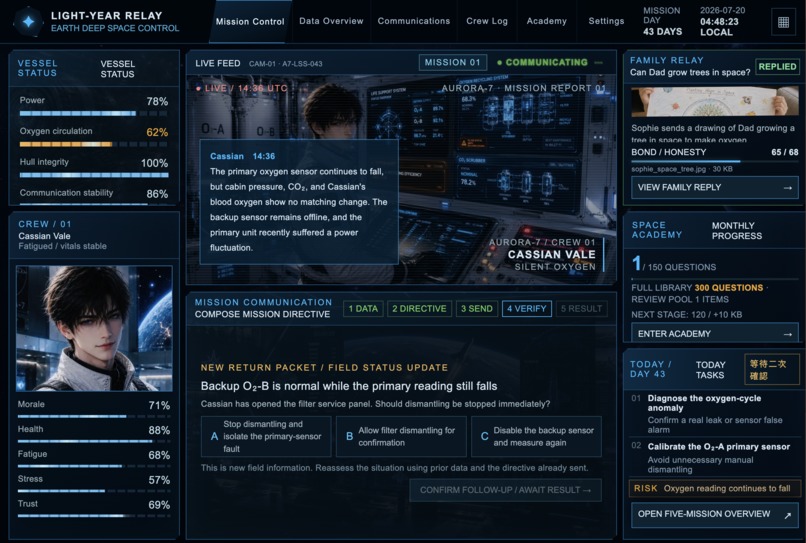
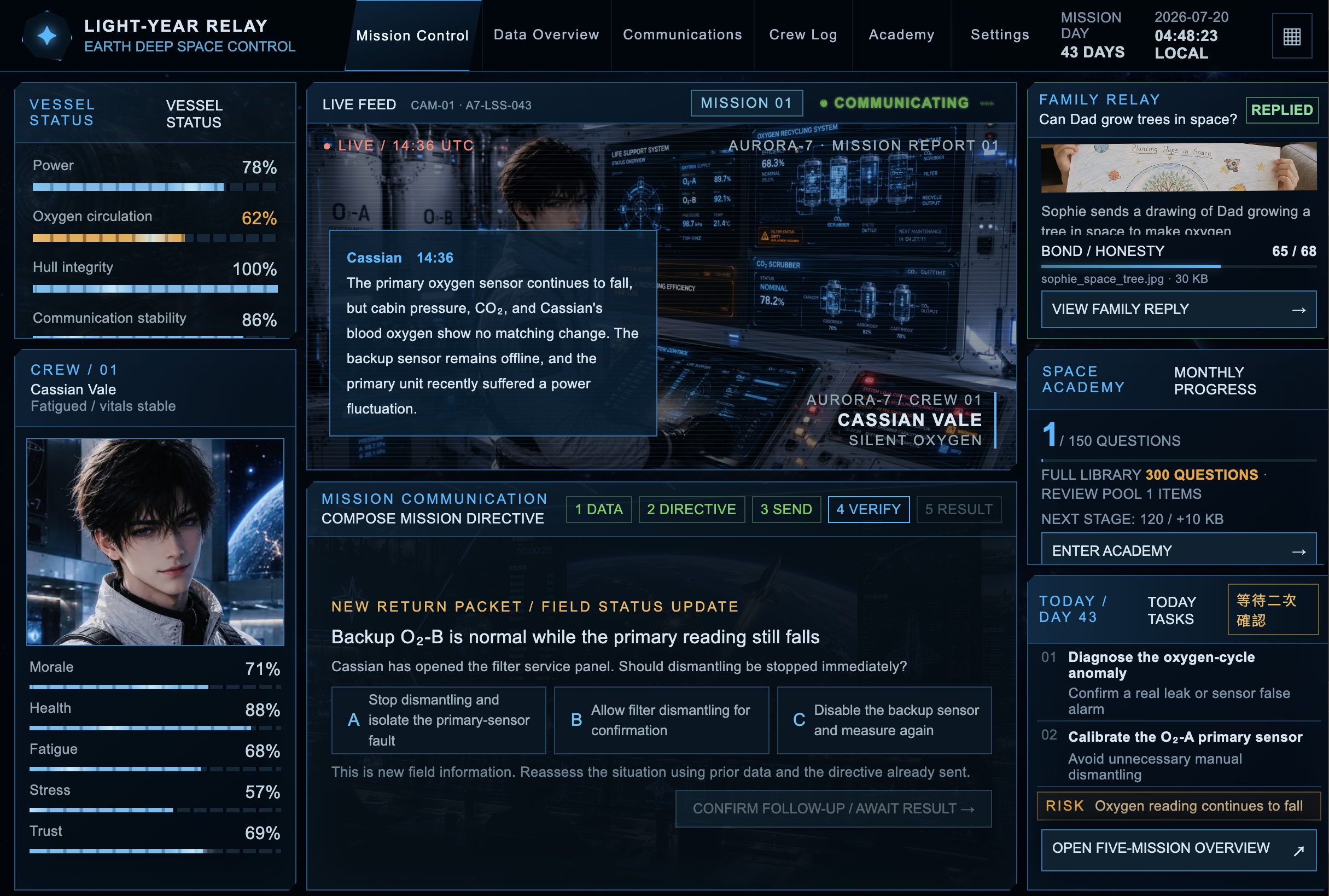
Main Game Interface
-
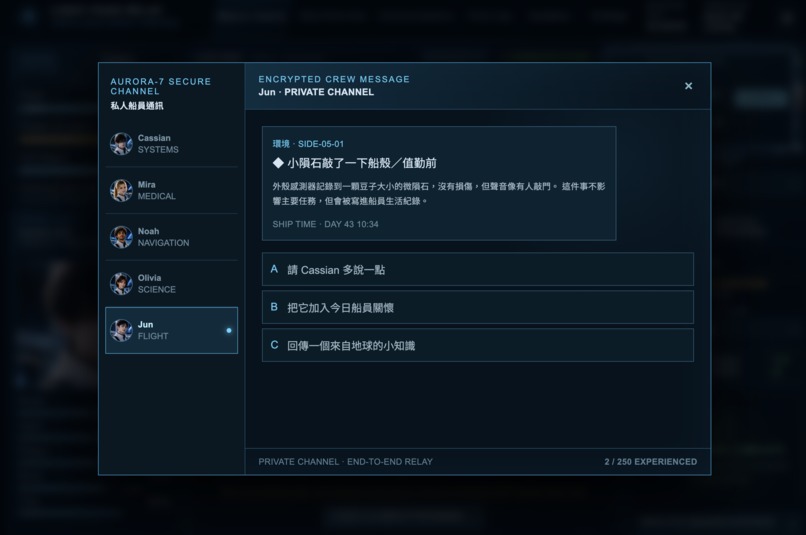
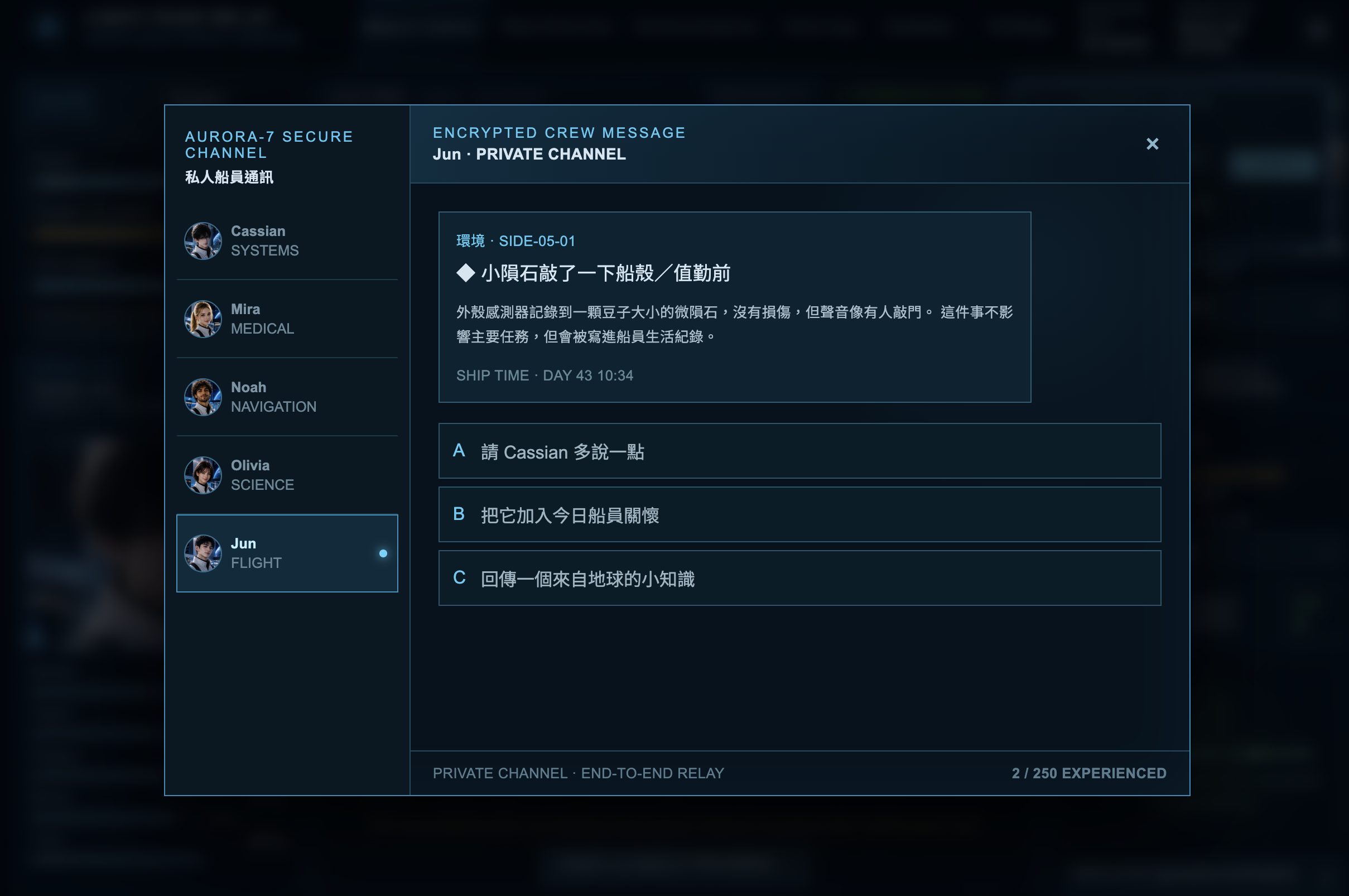
Private Messages – Everyday Life Aboard Aurora-7
-
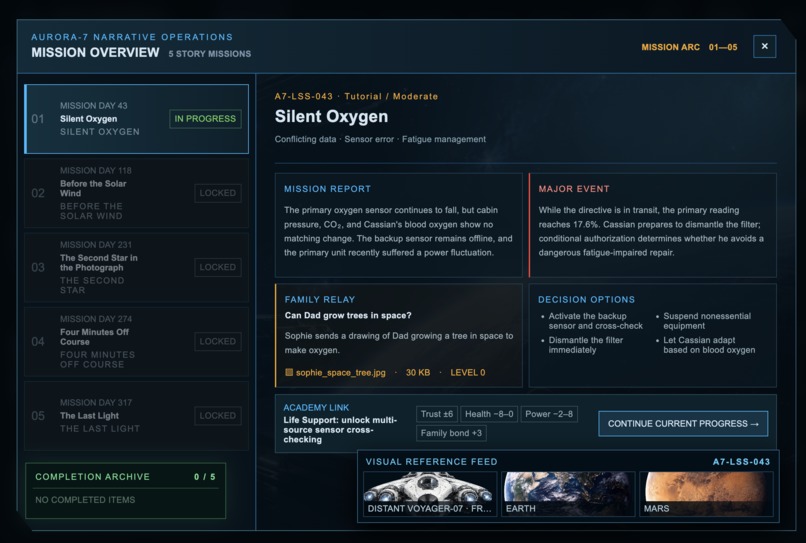
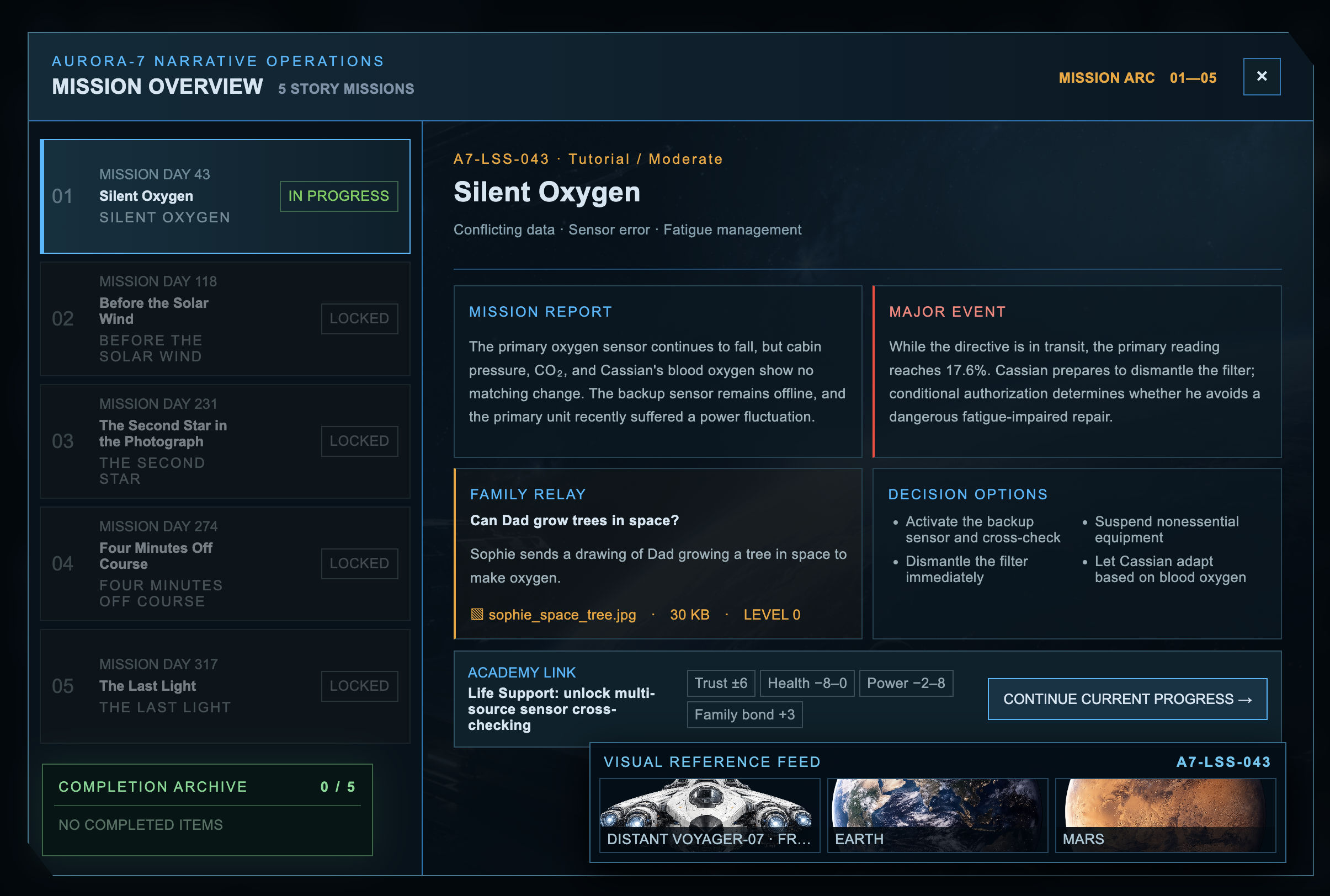
Mission Overview
-
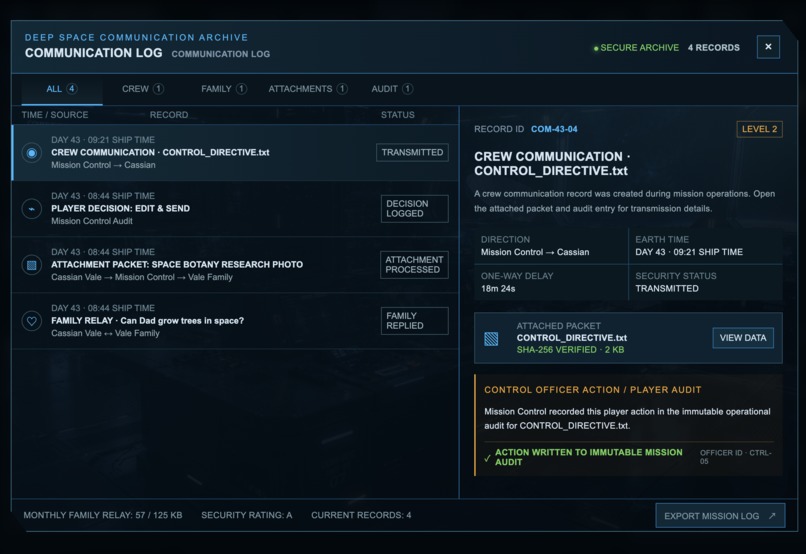
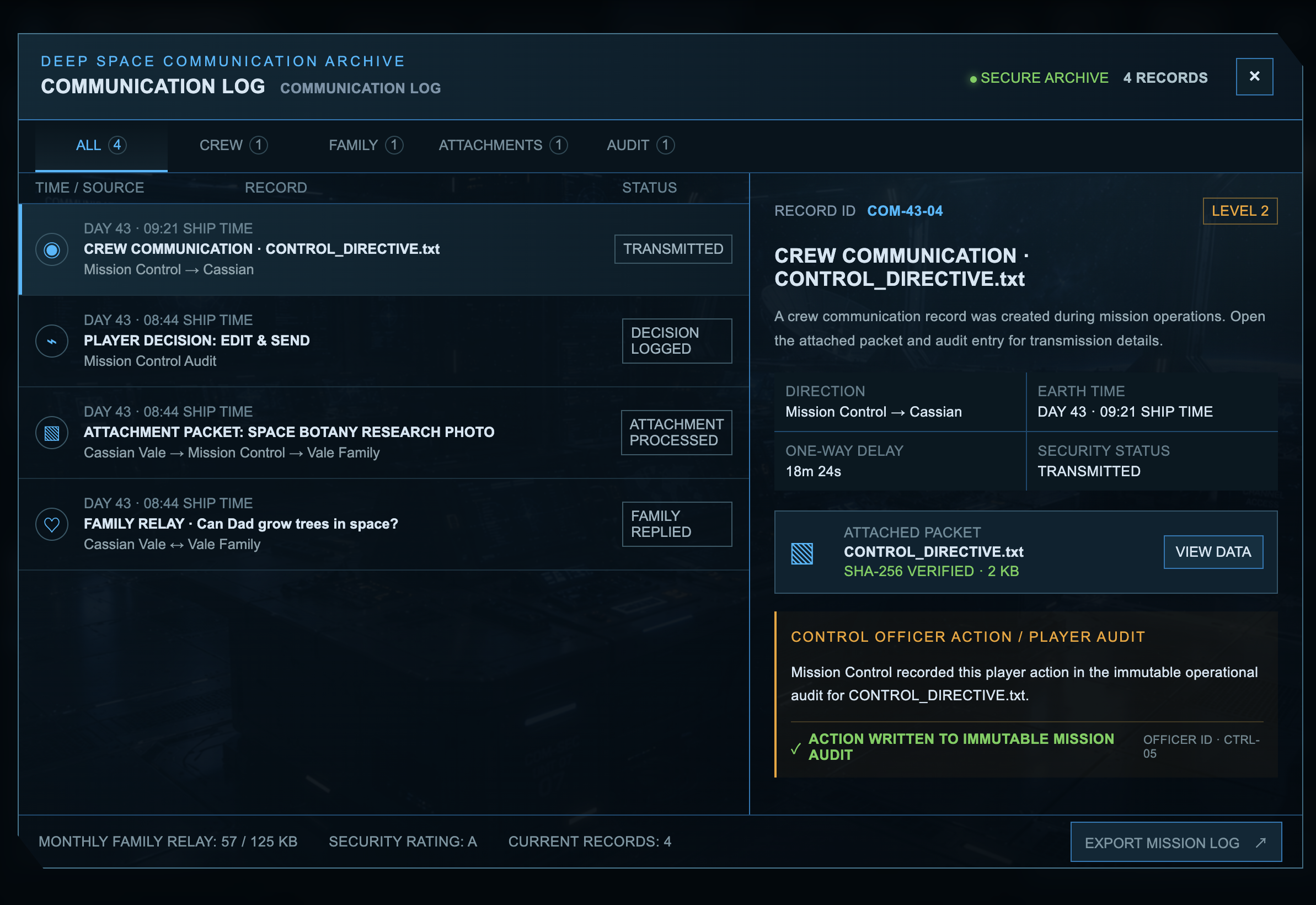
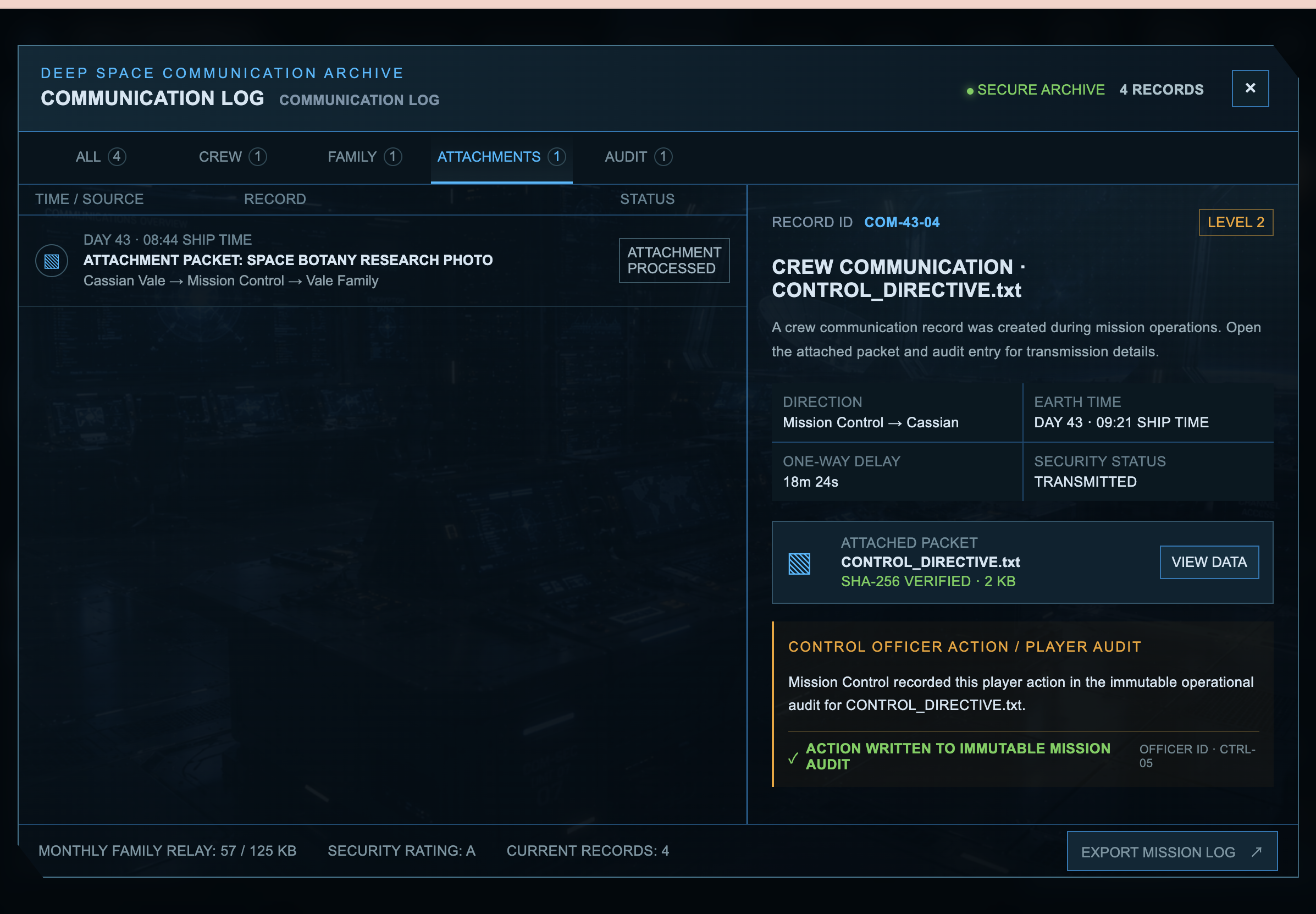
Communication Log
-
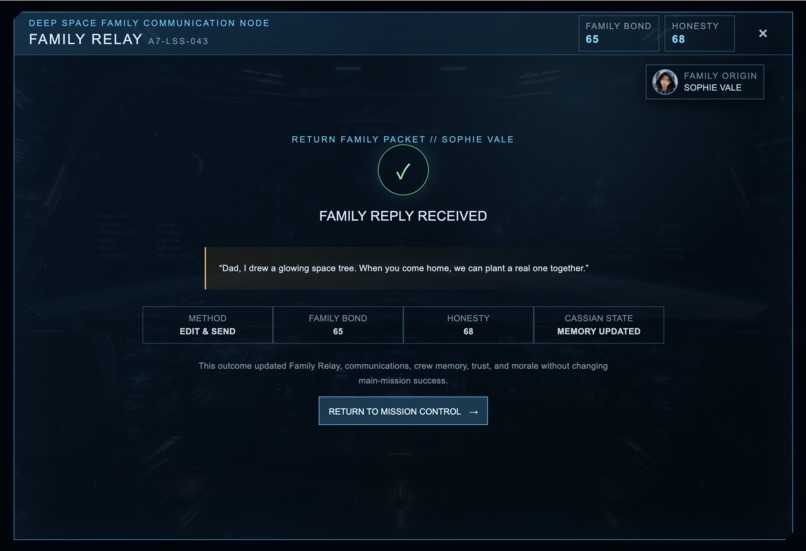
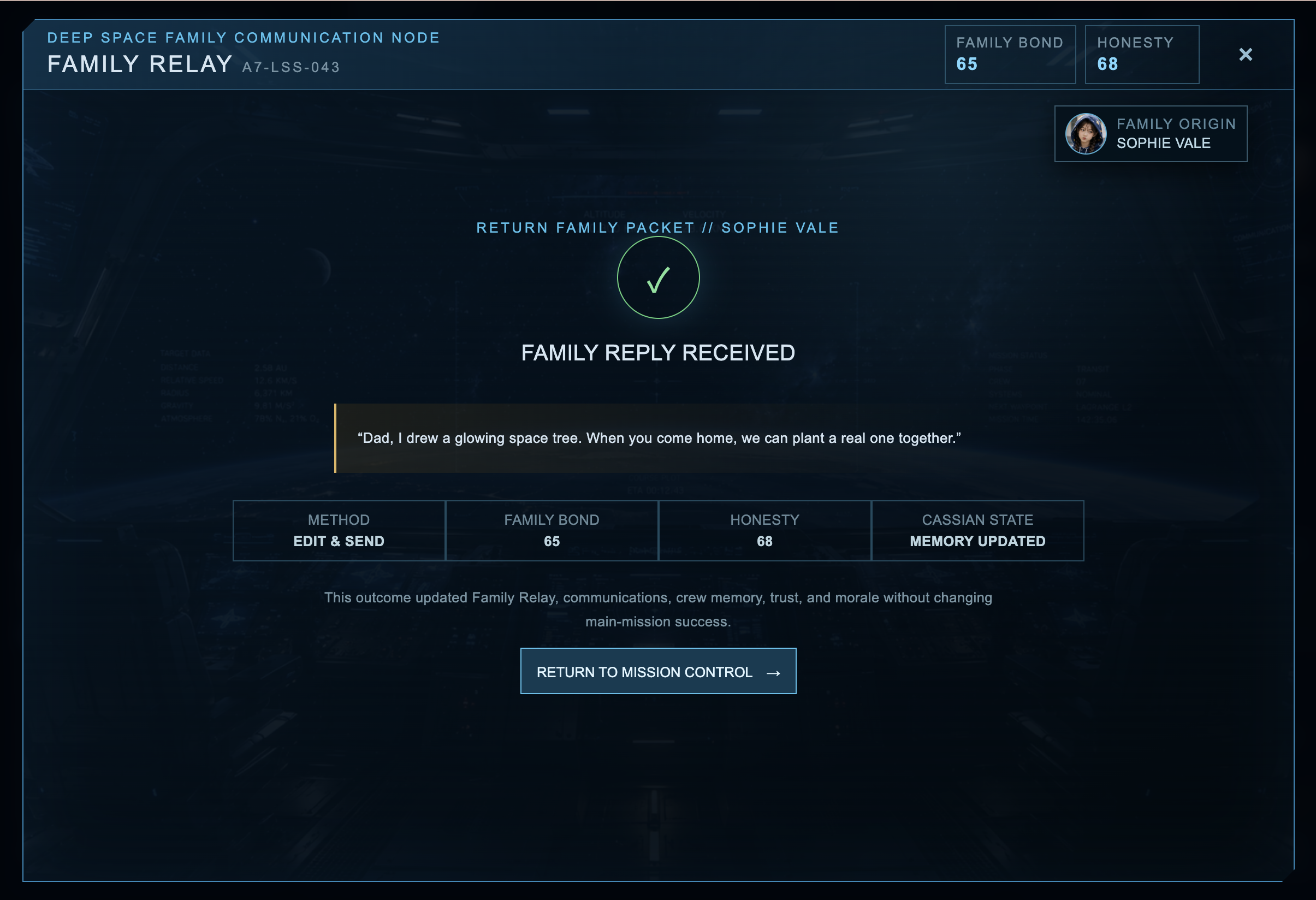
Family Relay Interface
-
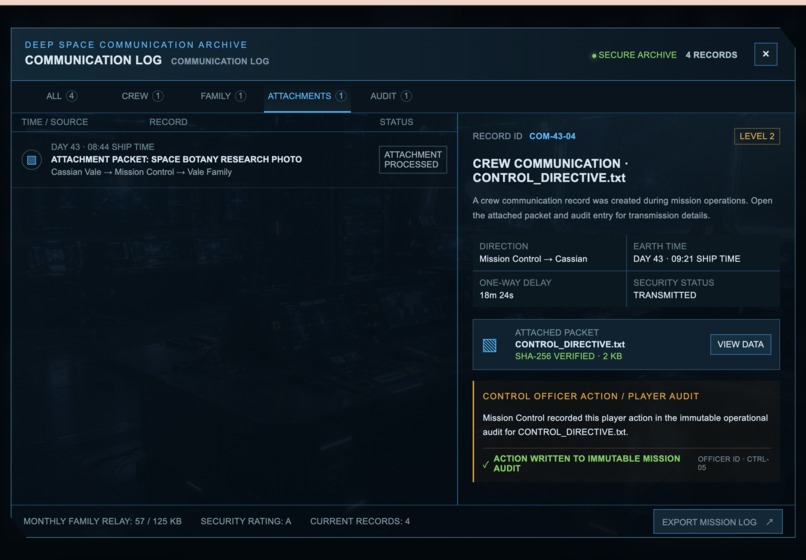
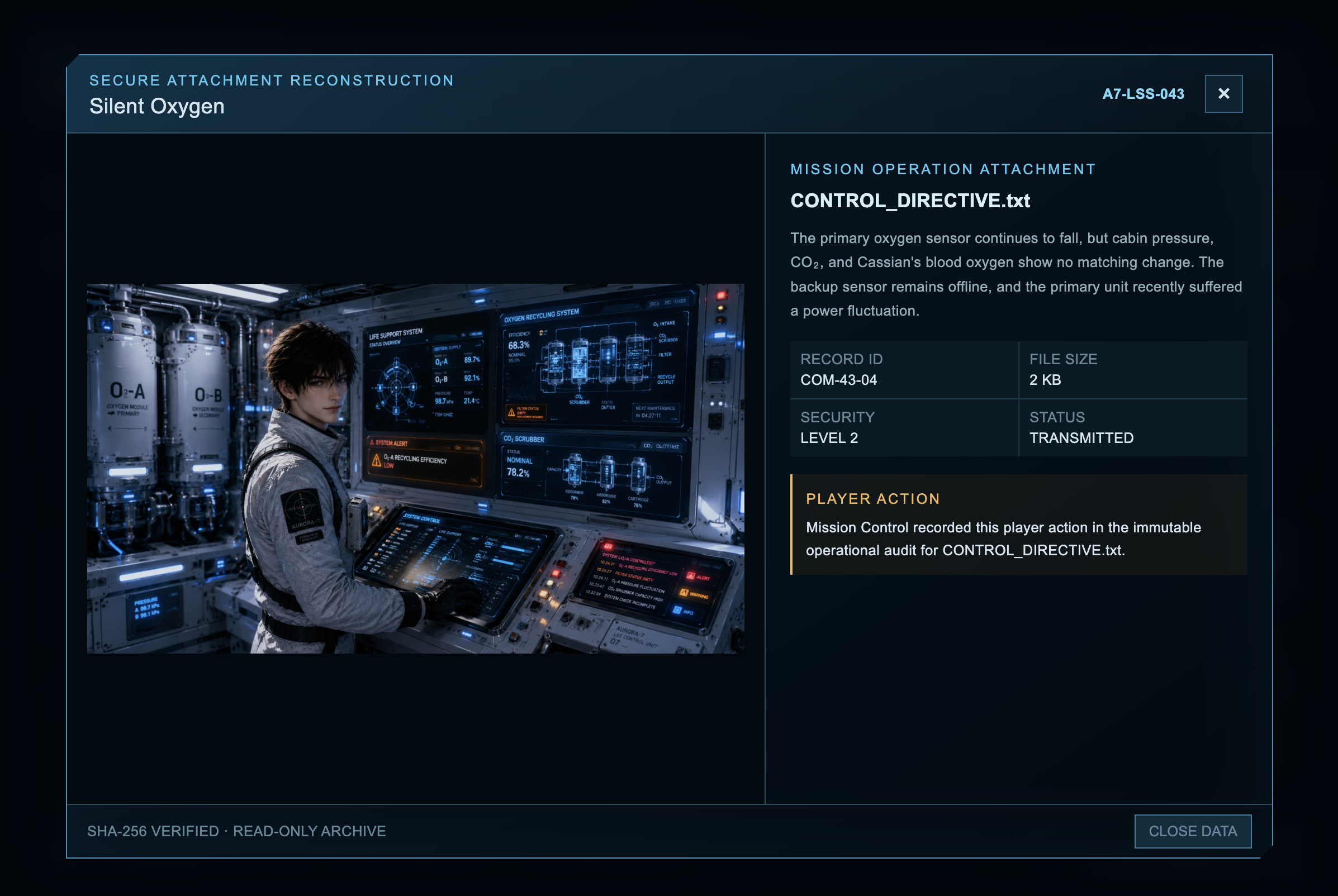
Attachment Viewer
-
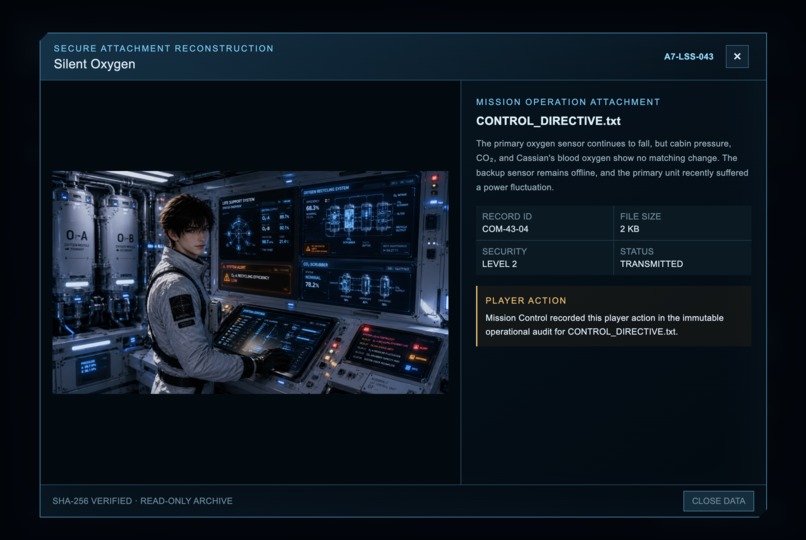
Attachment Viewer – Continued
-
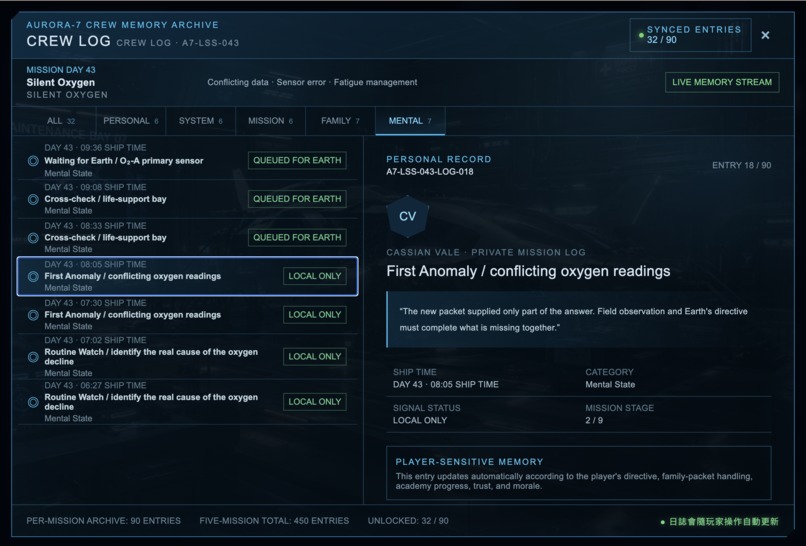
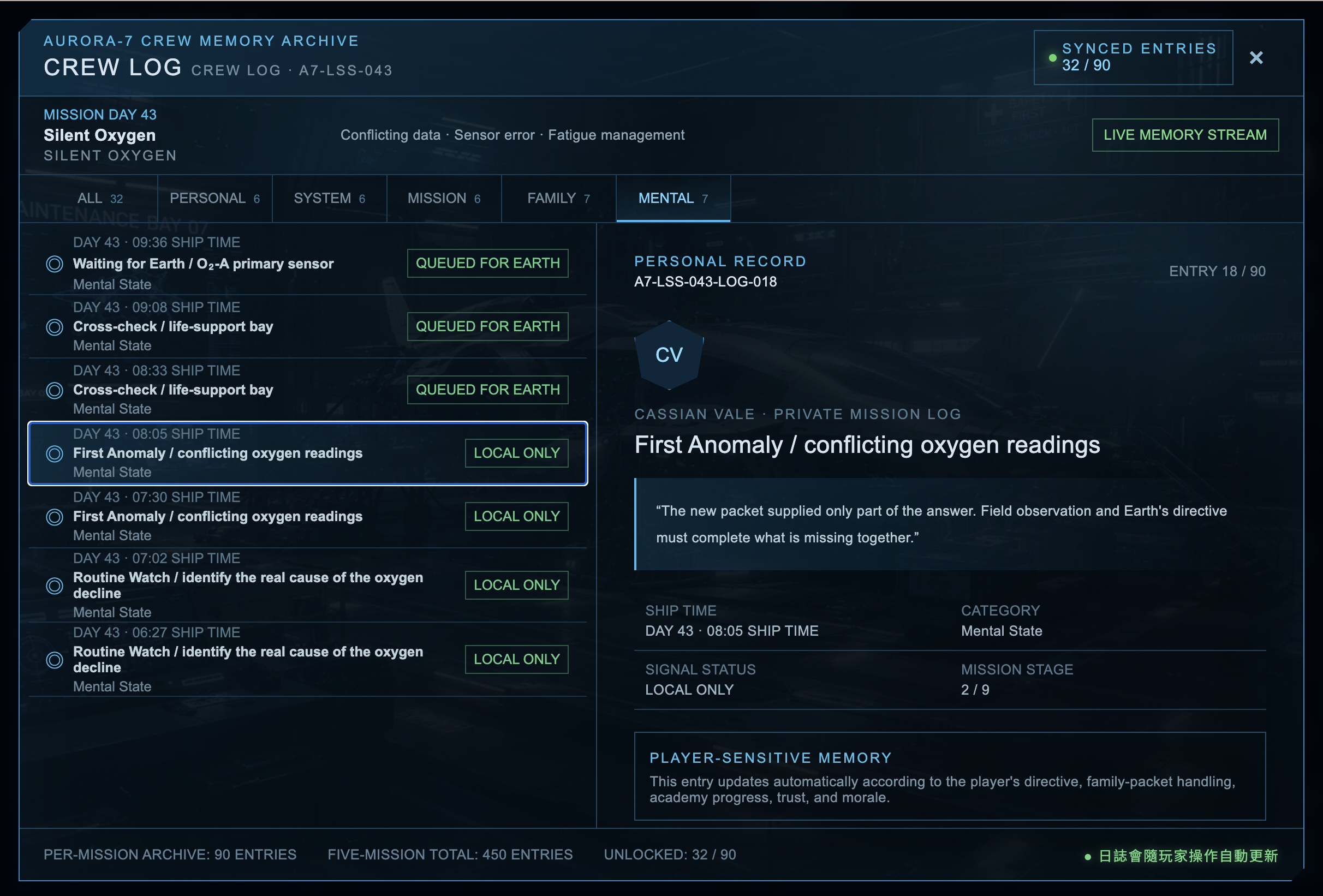
Operations Log
Light-Year Relay 光年回信
Every message belongs to the past. Every reply changes the future.
Inspiration
Light-Year Relay began with a simple question:
What if the greatest challenge of deep-space exploration wasn't distance—but communication?
Real deep-space missions are constrained by the speed of light. As spacecraft travel farther from Earth, every message arrives minutes—or even hours—late. Mission Control never sees the present; it only sees the past.
That scientific limitation fascinated me.
Most space games ask players to become the astronaut.
Light-Year Relay asks players to become the people waiting for the astronaut.
Instead of piloting a spacecraft, players become Mission Control, interpreting delayed transmissions, making critical decisions with incomplete information, and living with the consequences of every command they send.
As the project evolved, another idea became equally important.
Behind every mission is a family waiting on Earth.
I wanted communication—not combat—to become the emotional core of the experience, connecting science, family, and hope across light-years.
This universe actually began before the hackathon as an AI-powered interactive character and narrative experience. Over time, I continued expanding its world, characters, and emotional themes, always hoping that one day I could transform it into a real game.
When I discovered OpenAI Build Week with only four days remaining before the submission deadline, I realized it was the perfect opportunity to finally bring that long-running idea to life as a playable experience.
What it does
Light-Year Relay is a narrative sci-fi decision game where players serve as Mission Control for the deep-space vessel Aurora-7.
Players receive delayed transmissions from the spacecraft and analyze engineering reports, crew health, scientific discoveries, and personal messages before sending one irreversible command back to the crew.
Because communication is delayed by the speed of light, every decision arrives in the future. Players never know the spacecraft's current situation when making choices.
Every decision influences future mission events, crew survival, scientific progress, and the relationship between astronaut Cassian and his daughter Sophie.
The game also includes optional educational content inspired by real astronomy and human spaceflight.
Within the story, these lessons are presented as learning materials prepared for Cassian's daughter Sophie. Mission Control can review the same educational content and complete optional practice questions alongside her.
Successfully completing these activities rewards Sophie with additional Family Relay conversations, allowing more meaningful communication between father and daughter while naturally encouraging curiosity about astronomy and future space exploration.
How I built it
Although the world and characters already existed before the hackathon, the game itself was built specifically for OpenAI Build Week.
I discovered the event with only four days remaining before the submission deadline.
Rather than seeing that as too little time, I challenged myself to finally transform this narrative universe into a playable prototype.
Over the next three days, I developed the first playable version as a solo creator by combining my own game design with multiple AI tools throughout the entire production pipeline.
GPT-5.6 became my primary creative collaborator. It helped me brainstorm gameplay systems, generate mission scenarios, expand worldbuilding, refine narrative structure, improve UI copy, and localize the project into English.
One of the biggest advantages was rapidly generating mission reports, crew logs, dialogue variations, event descriptions, and multilingual content. Instead of manually writing every possible variation, I could quickly iterate while keeping the overall narrative consistent.
Codex accelerated software development by assisting with project architecture, gameplay logic, responsive UI implementation, debugging, refactoring, and solving technical challenges throughout development.
Beyond programming, I also incorporated multiple AI creative tools throughout production.
AI image generation helped create concept art, character illustrations, UI assets, promotional artwork, and other visual resources.
AI music and sound generation accelerated the production of background music, interface sounds, notification effects, and ambient audio.
AI video generation helped create promotional videos and cinematic presentations.
Creating assets has traditionally been one of the most time-consuming parts of solo game development. With AI supporting the production process, I was able to prototype, iterate, and polish visual and audio assets dramatically faster than traditional workflows.
Without today's AI tools, building a prototype with this amount of gameplay, artwork, music, sound, localization, narrative content, and presentation in just a few days simply wouldn't have been realistic for me as a solo developer.
Although AI supported nearly every stage of development, every gameplay mechanic, narrative decision, visual direction, and final production choice was ultimately designed, refined, and curated by me.
Challenges I ran into
The biggest challenge was transforming a real scientific limitation into engaging gameplay.
Actual deep-space communication is slow, technical, and often uneventful. Preserving scientific authenticity while making every transmission emotionally meaningful required many iterations.
Another challenge was helping players immediately understand their role.
Most space games place players inside the spacecraft.
Light-Year Relay does the opposite.
Players never become the astronaut.
Instead, they become Mission Control, making important decisions without ever knowing the spacecraft's current situation.
As a solo developer, I also had to balance programming, narrative design, UI/UX, localization, artwork, sound design, video production, and project management within an extremely limited timeframe.
AI dramatically accelerated these workflows, allowing me to spend more time refining gameplay instead of repeatedly producing supporting assets.
Accomplishments that I'm proud of
I'm especially proud of transforming a real scientific constraint into the game's central gameplay mechanic instead of simply using it as background lore.
I'm also proud of creating a Mission Control experience that feels fundamentally different from traditional space games.
Rather than flying the spacecraft, players experience the emotional weight of delayed communication and difficult decision-making from Earth.
Another accomplishment is integrating educational content naturally into the narrative.
Instead of presenting science as a separate quiz mode, astronomy and astronautics become part of Sophie's learning journey, allowing players to explore the same educational content while strengthening the emotional connection between father and daughter.
Finally, I'm proud of turning a long-running story universe into its first playable game prototype, combining programming, storytelling, artwork, music, sound design, video production, and AI-assisted creative workflows into one cohesive experience.
What I learned
Working with GPT-5.6, Codex, and other AI creative tools fundamentally changed the way I approach game development.
Rather than thinking of AI as simply a coding assistant, I found it most valuable as a creative collaborator across the entire production pipeline—from gameplay design and mission generation to localization, artwork, music, sound, video production, and rapid prototyping.
Generating large amounts of mission data, dialogue variations, multilingual content, and production assets became dramatically faster, allowing me to spend far more time refining gameplay instead of repeatedly producing supporting content.
The biggest lesson I learned is that AI doesn't replace creativity.
Instead, it dramatically lowers the barrier between imagination and execution.
For independent developers, the biggest limitation has often been production capacity rather than ideas. AI allowed me to spend less time creating thousands of supporting assets and more time designing the player experience I wanted to build.
For years, this universe existed only as an interactive narrative and an idea I hoped to turn into a game someday.
OpenAI Build Week gave me both the opportunity and the motivation to finally build the first playable version.
Instead of using AI to build the game for me, I used AI to help me build more of the game, allowing me to focus on the creative decisions that shape the player's experience.
What's next for Light-Year Relay
This Build Week submission represents the first playable prototype of a much larger vision.
Next, I plan to expand the game with:
- More branching missions and long-term consequences.
- Additional communication systems between Mission Control, the spacecraft, and the astronaut's family.
- Richer relationships between Cassian, Sophie, and the people supporting the mission on Earth.
- More educational content inspired by astronomy, astronautics, and future space exploration.
- Additional mission scenarios and dynamic events.
- Higher-quality artwork, music, sound design, voice acting, and cinematic storytelling.
I also plan to continue exploring how AI can assist future game development—not by replacing creativity, but by enabling solo developers to build richer, more immersive experiences.
My goal is to continue refining Light-Year Relay into a complete narrative sci-fi experience that combines science, education, emotional storytelling, and meaningful player decisions.
Built With
- cloudflare
- humanaicollaboration
- indiegame
- narrativegame
- node.js
- openaicodex
- scifigame
- spaceexploration
- typescript
- vinext
- webaudio
- webgame

Log in or sign up for Devpost to join the conversation.