-
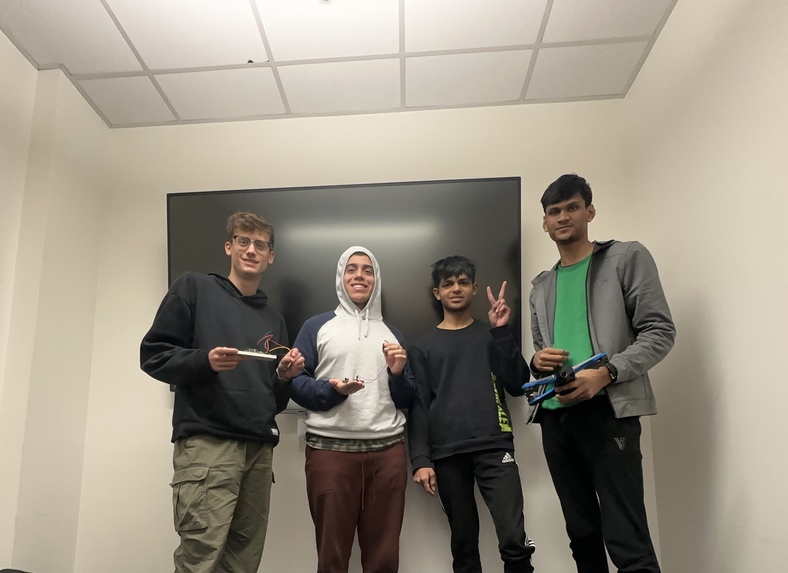
Team FLY
-

Logo


Inspiration
After the introduction ceremony, we wandered around the TreeHacks areas until we stumbled across the drone room. After being shown a demo and seeing how person recognition and obstacle detection were able to function, we were hooked, and decided to fully commit to something related to drones. After tossing around a few ideas, talking with SkyDio and looking at their SDK and API, we decided it would be most reasonable to attempt to create a game using drones and additional hardware. This has shown us the greater implications and potential of machine learning within drones.
What it does
We combined drones and laser sensors to create two different features. The first feature challenges players to hit the drone with the laser sensor as many times as possible within a set time limit. The first feature spins in a sporadic pattern that makes it difficult for the user to laser the drone. After the time limit, the program notifies the user how many times it got hit. The second feature requires players to hit a rapidly moving drone with the laser sensor in order to deactivate it. Once the drone is hit, our program would stop the flight path and have it land. The different patterns in each game provide variety and added challenge for users.
How we built it
We used SkyDio’s built in methods for “skill” creation. Essentially, a skill is a program that will operate and cause actions on the drone after being selected by the user in the drone’s interface. We had to use Python to create movement patterns and a score count, and we used an Arduino board, IR receiver, and IR emitter to detect when the drone is hit but the player.
Challenges we ran into
Initially, we could not access SkyDio’s SDK or API, but after meeting with their representatives, we were able to get permission a few hours later. Then, while creating the program software, all but one of our testing simulators stopped working. While testing in the drone room, there was not enough space to allow for the drone to act the way we were asking it to.
Accomplishments that we're proud of
The three major accomplishments that we’re proud of are as follows: Used Arduino to take real-time data from the laser strikes and created a program in Python to tell the drone to land and if it got “hit,” ultimately hoping to use data to land the drone in real time. Created a skill with a working UI on both simulation and real world drones by using SkyDio’s software development console Tested the integration of new hardware with existing drone hardware and software in order to create new functionality for drones.
What we learned
We learned how the current groundbreaking drone technology functions, specifically how they are able to detect and avoid obstacles, detect and follow subjects, and how to access stored data about flights. As well, we gained a better understanding about how an Arduino can be used to send real-time sensor information into programs to test the current state of a program. Ultimately, we learned that, in real life, things are going to break, and being able to reform ideas and action plans is crucial to staying on track and actually achieving solutions.
What's next for Light Strike
We believe the future of drone technology is one where drones, paired with advanced sensors, can have a transformative impact in high-risk environments where time is of the essence. In particular, we see great potential for drones to aid in search and rescue operations, where traditional search methods can be slow, dangerous, and potentially life-threatening. Drones equipped with sensors such as thermal imaging cameras, and LiDAR can capture real-time data from the disaster site, providing emergency responders with a more comprehensive understanding of the situation. Machine learning algorithms can analyze this data and provide insights that may not be immediately apparent to human analysts. The intersection of sensors on drones and machine learning has the potential to revolutionize a wide range of industries and applications beyond emergency response. As both technologies continue to evolve and become more sophisticated, we can expect to see even more innovative applications in the future.


Log in or sign up for Devpost to join the conversation.