Inspiration
Two of our team members have loved ones that suffer from dementia and who have actually experienced getting lost. We wanted to see how we could include location tracking and haptics to help the user navigate back to safety.
What it does
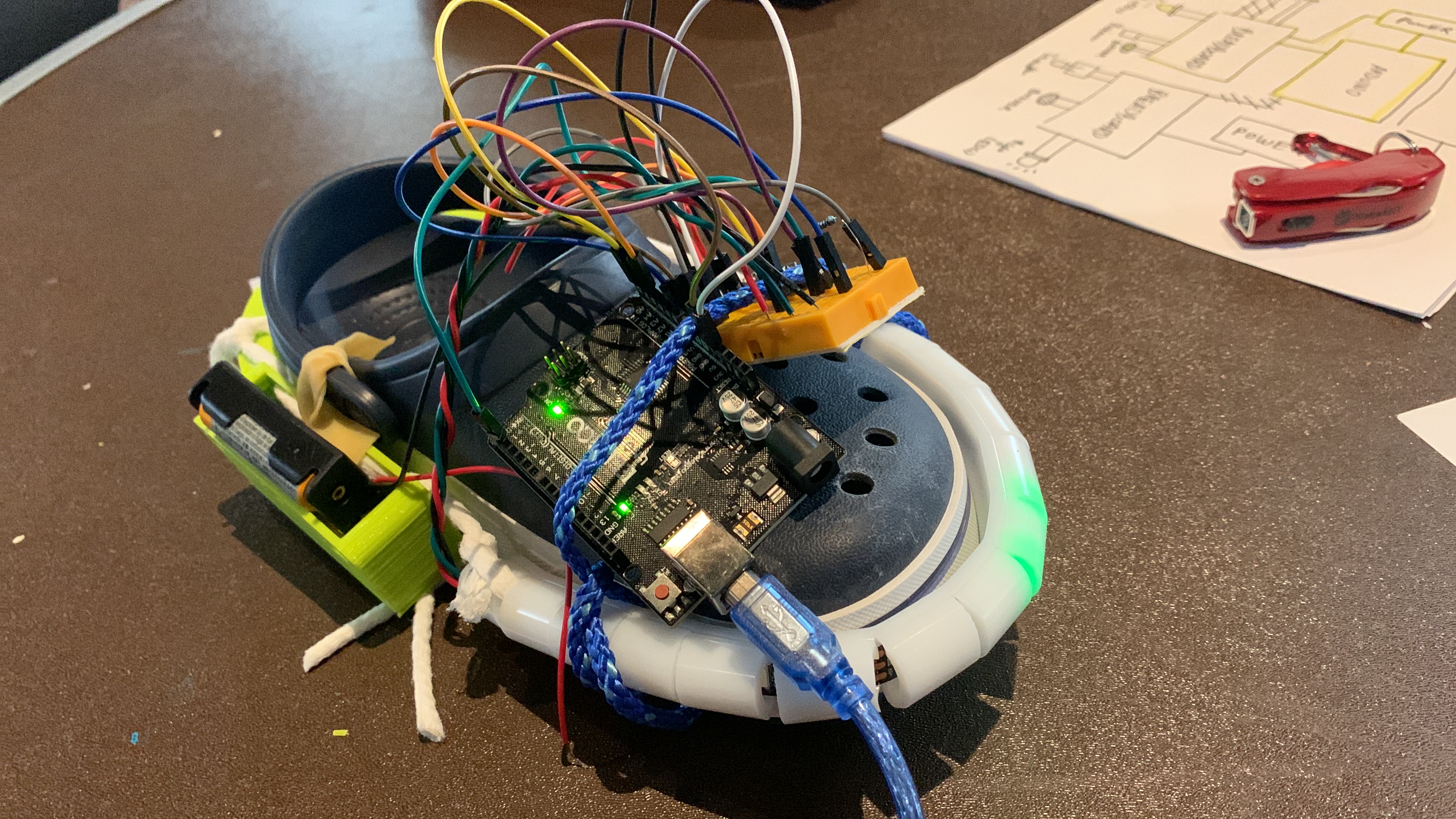
Our current prototype lights up different sections of the shoe based on keyboard input, simulating the direction that the user would need to go in based on geolocation and orientation. Ideally, we'd take into account our current location, destination, and orientation, and find a best-suited path to follow, which would be translated to lights.
How we built it
We used an Arduino, breadboard, led-strip, 3D-printed battery holder and a silicon-diffuser.
Challenges we ran into
We couldn't get hold of a GPS Neo6M for our location tracking capabilities, so we spent some time trying to see how we could get our current location from a web browser. It didn't end up working out, but we were able to learn more about website capabilities. Additionally, we used an accelerometer and gyroscope with the hopes of figuring out our orientation, but realized later on that these wouldn't be the right sensors. A magnetosensor or an eCompass would have been the right sensors to use for figuring out orientation.
Accomplishments that we're proud of
Learning more about Geoposition in html, LED projects and Arduinos. And being able to crank out a product in 24hrs!
What we learned
The importance of starting small and building our way up, experimentation to learn more about our different sensors, and pivoting when necessary.
What's next for Light My Way
Make our device more compact, connect to GPS and include a compass, include directional vibrations as an additional haptic.


Log in or sign up for Devpost to join the conversation.