-
-
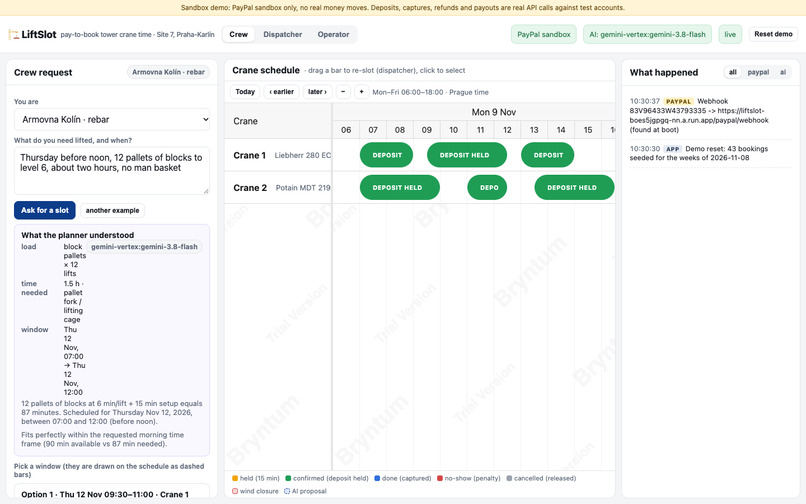
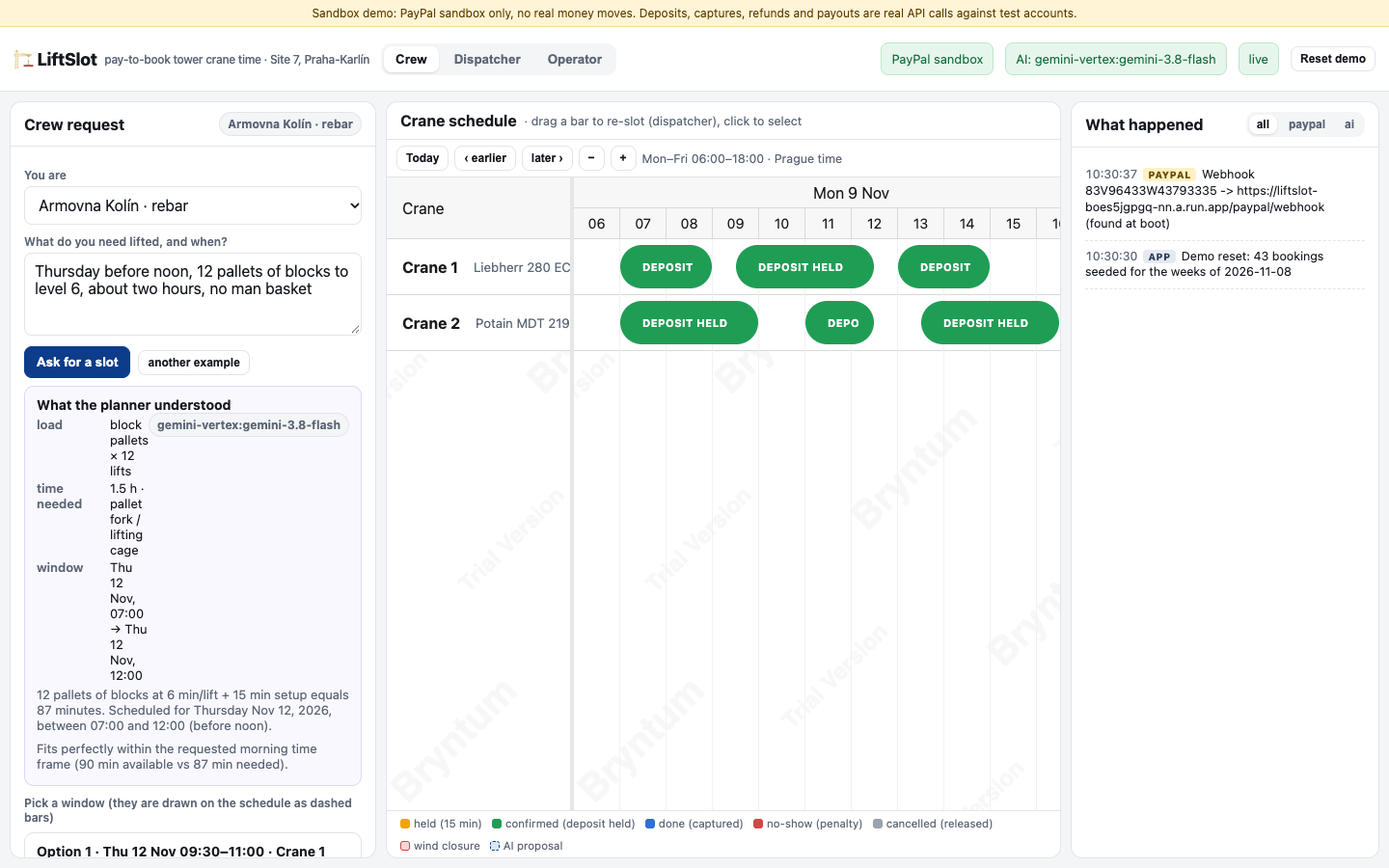
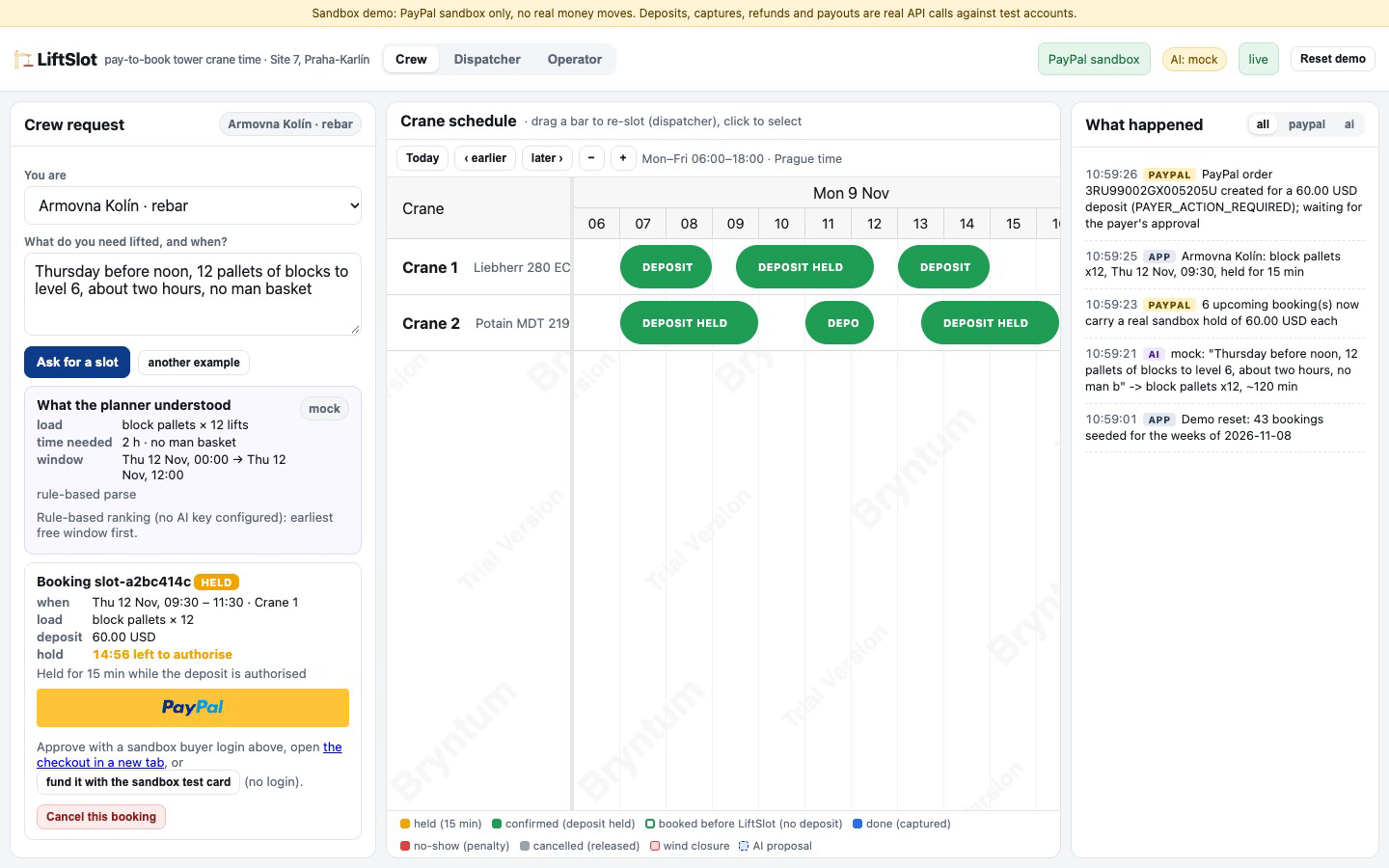
Crew: the foreman's sentence becomes ranked slot options, drawn as dashed ghost bars on the schedule
-
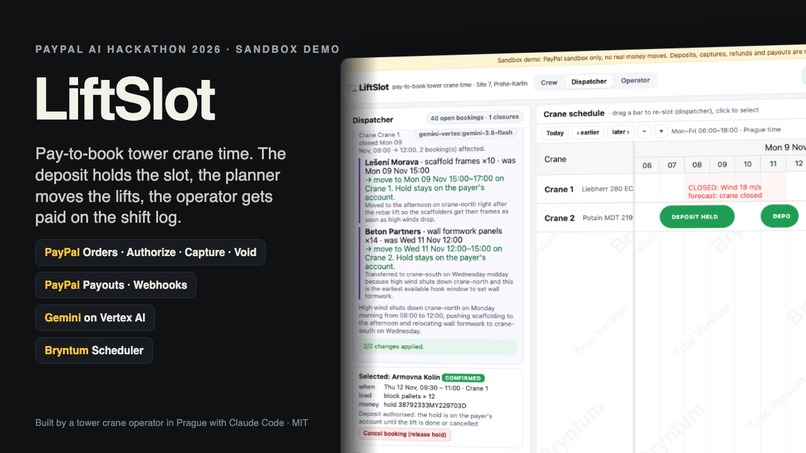
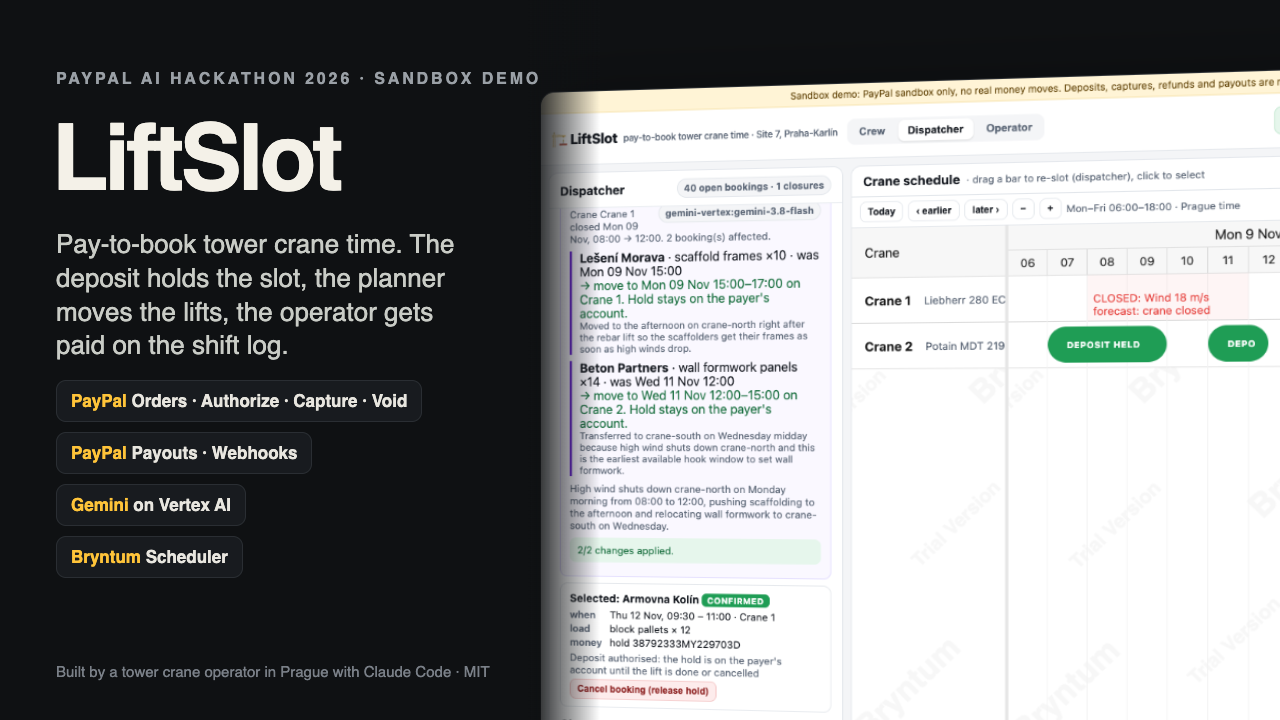
LiftSlot: pay-to-book tower crane time, running on the PayPal sandbox
-
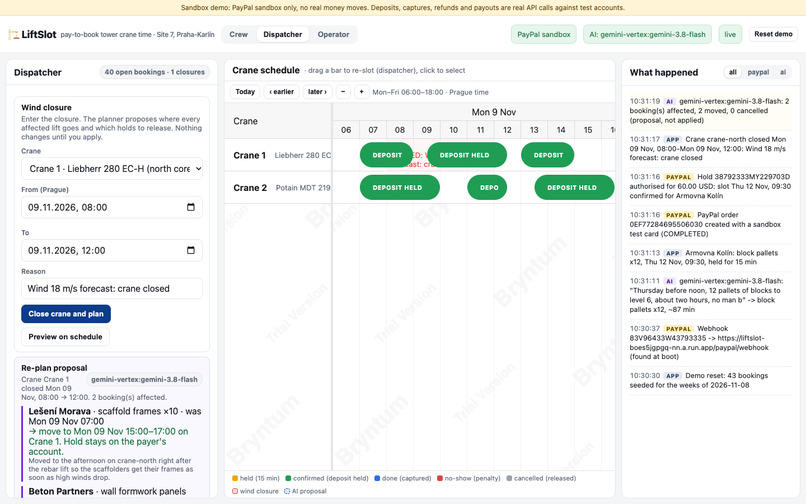
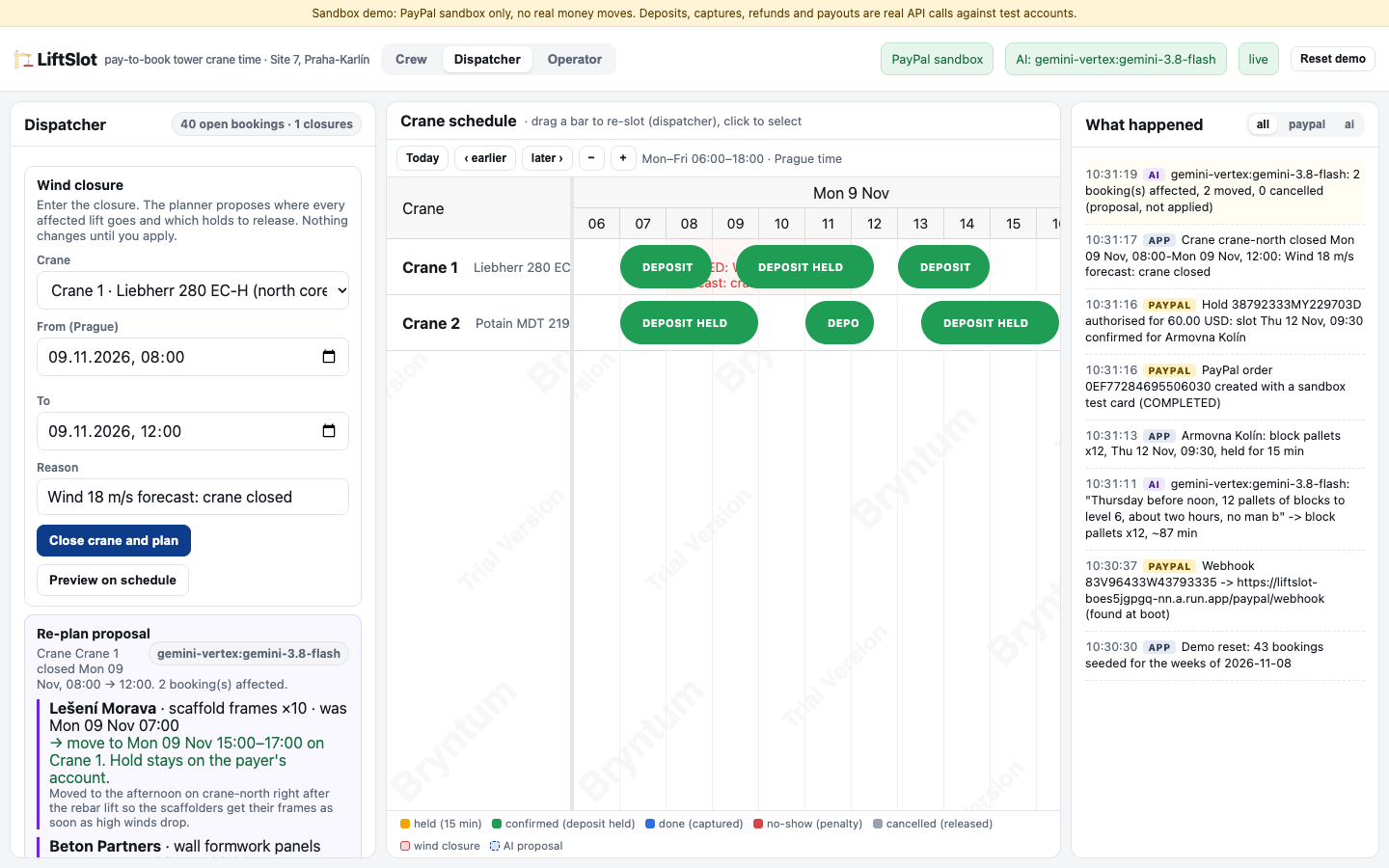
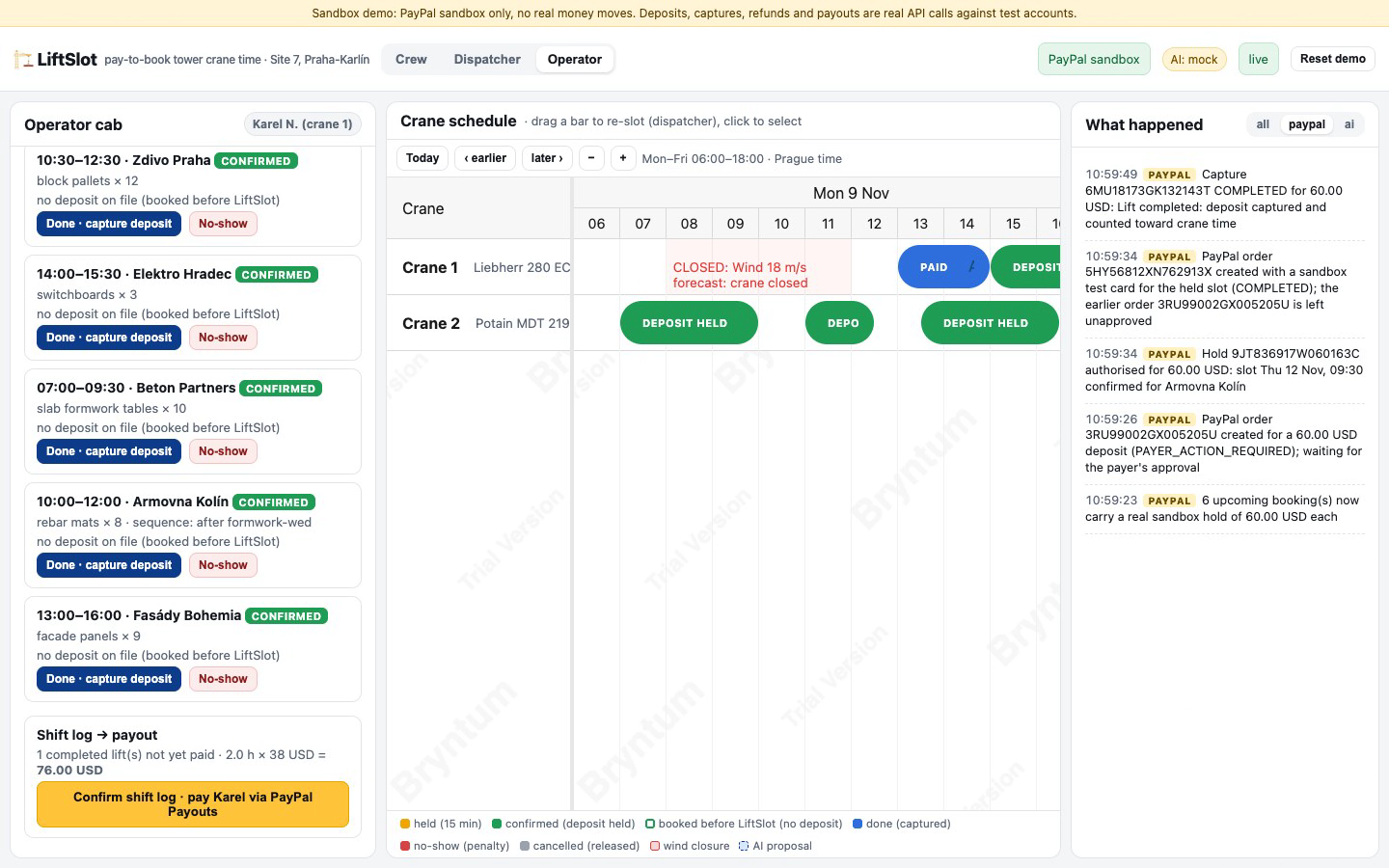
Dispatcher: a wind closure, the planner's diff with reasons, and the red closure band on the crane row
-
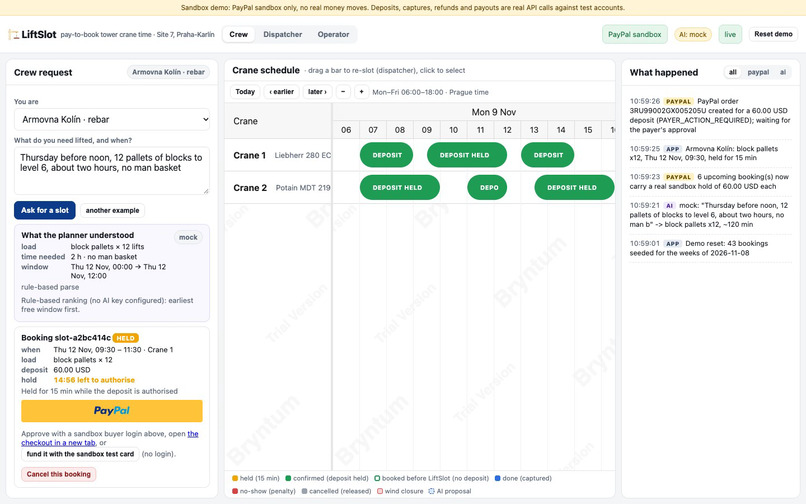
Deposit: the real PayPal button (sandbox) or a server-side test card authorizes 60 USD and the bar turns green
-
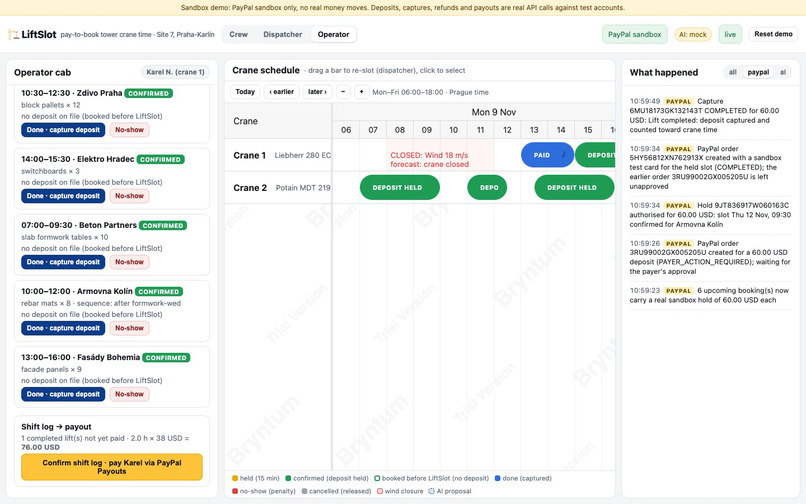
Operator: Done captures the deposit; the capture and its verified webhook land in the What happened panel
Inspiration
I drive a tower crane in Prague. One crane, and every crew on the site needs it: formwork, rebar, masonry, facade, scaffolders, electricians. Nobody books it. They come to the cab at 06:45 and shout, and whoever shouts loudest gets the hook first. The rest wait with their pallets on the ground.
Then the wind comes. The anemometer goes over the limit, I shut the crane down, and the day's plan is gone. Somebody in the office starts calling crews one by one. Some crews don't show up for the window they asked for, and the crane stands idle while another crew would have taken it. And at the end of the month my own hours get checked twice and paid late.
I kept thinking it should work like a hotel room. You say what you need lifted and when, you put down a deposit, the slot is yours. Lift done, the deposit is taken. If wind closes the crane you get it back, and if you don't show up you lose it. And the operator gets paid when the shift log is signed, not weeks after.
That's LiftSlot. I built it for this hackathon with Claude Code writing the code, because I know the problem and I don't write code myself.
What it does
LiftSlot is one responsive web app with three roles, switched in the top bar. Everything runs on the PayPal sandbox, no real money moves.
Crew (phone). The foreman types what he needs in plain language: "Thursday before noon, 12 pallets of blocks to level 6, about two hours, no man basket." Gemini turns that into a structured request (load, lifts, duration from a cycle-time table, window, rigging) and asks one question when it can tell neither what is being lifted nor how much. The code computes the free windows, the model ranks them and writes one plain reason for each. The crew picks one, the slot is held for 15 minutes, and a 60 USD deposit is authorized through PayPal: the real PayPal button with a sandbox login, or a server-side sandbox test card with no login. The bar turns green.
Dispatcher (site office). Enters a wind closure. It is recorded at once and the planner returns a diff: which lifts move where on which crane, which get canceled with their hold released, and a reason for each. One the model wrote on the live app: "Moved to the afternoon on crane-north right after the rebar lift so the scaffolders get their frames as soon as high winds drop." No booking moves or loses its hold until Apply, and moved bookings keep their authorization. Dragging a bar to another time or crane also works, server-validated.
Operator (crane cab). Taps Done or No-show on each lift. Done captures the deposit. No-show after a 30-minute grace captures it as a penalty. "Confirm shift log" creates a PayPal Payouts batch for the operator's hours.
Every money rule lives in one policy table in code, and the AI never calls a money operation. PayPal webhooks drive the screen; a live "What happened" panel shows PayPal, app and AI events as they land.
Try it (for judges)
- Open https://liftslot-418348230685.northamerica-northeast1.run.app (Cloud Run; the first load after a quiet spell can take a moment). State lives in memory on purpose: a cold start reseeds the week, same as Reset demo, which also puts fresh sandbox holds on the next six bookings. The top bar switches roles: Crew, Dispatcher, Operator.
- Crew: press "Ask for a slot" with the example text, click an option (the dashed bars on the schedule), then "Use sandbox test card". No PayPal login needed: the 60 USD deposit is authorized with a published sandbox test card and the bar turns green. "Pay deposit with PayPal" shows the real PayPal button instead (sandbox buyer login, optional).
- Dispatcher: "Close crane and plan" with the prefilled wind closure (it defaults to tomorrow 08:00 to 12:00; on a Friday or Saturday set From and To to the next weekday morning first). Read the diff; the red closure band is already on the crane row. Press "Apply re-plan" and watch the bars move.
- Operator: pick one of the green DEPOSIT HELD lifts (the six funded after reset), tap "Done · capture deposit", and watch the capture and its webhook land in the "What happened" panel on the right. Then "Confirm shift log" creates the Payouts batch for the operator's hours; press refresh after a few seconds and it reads SUCCESS.
How we built it
TypeScript end to end. Node 22 with Fastify, SQLite through node:sqlite in memory (reseeded on every boot), server-sent events. Vite and React 19 on the front, Bryntum Scheduler 7.3.8 for the timeline. GitLab CI tests and typechecks every push; on main it builds the image with kaniko, copies it with skopeo and deploys to Cloud Run through Workload Identity Federation, so no service account key exists anywhere.
PayPal. Orders v2 with intent AUTHORIZE. custom_id is the slot id, invoice_id the booking reference, and every call that creates or moves money (order, authorize, capture, void, payout) carries a PayPal-Request-Id. Two approval paths: the PayPal JS SDK button (the order is created server-side) and a server-side sandbox test card, so the demo runs with nobody logged in. Then /authorize, and later capture (final_capture, note_to_payer carrying the policy reason) or void. Payouts v1 with sender_batch_id set to the shift log id, so a retry cannot pay twice. The server registers its own webhook at boot, verifies every delivery with verify-webhook-signature on the raw body and deduplicates by event id. The fallback is reading PayPal back on demand: onApprove authorizes straight away and a refresh button re-reads the payout batch, so a late webhook never blocks the demo.
AI. Gemini 3.8 Flash on Vertex AI, authenticated through the Cloud Run service account, no API key. Three jobs: parse the request, rank the windows the code already computed, write the reasons in a wind re-plan. Every answer is JSON that the code validates and clamps. An Anthropic or Gemini API key also works; with no key at all a rule-based fallback keeps every flow working.
Testing. 14 unit tests run the policy table and the booking service against a fake PayPal. tools/smoke.mjs drives the built app in headless Chrome; tools/live-check.mjs runs the real sandbox cycle (deposit, void, deposit, capture, payout).
Challenges we ran into
The button and the webhook race. onApprove and CHECKOUT.ORDER.APPROVED can both try to authorize the same order; PayPal answers ORDER_ALREADY_AUTHORIZED to the loser, so the code reads the order back instead of failing.
Dates. The model sometimes writes the right day with a stale year. The parser now gets the current time in UTC and Prague time, and a date more than a day in the past is pushed forward year by year until it lands in the future.
Models on Vertex. The Gemini 2.5 family was retired in October and the 3.x models don't answer on every regional endpoint, so the provider probes a short list at boot and keeps the first model that answers. Gemini 3 also counts its thinking against the output budget, so the budget is generous and thinking is set low.
Sandbox funding. Seeded bookings carry no hold, so after every boot or reset the next six upcoming ones get real sandbox holds. Not every published test card was accepted for every slot, so three cards PayPal does accept rotate through the six and any refusal is logged with PayPal's debug id.
Payouts. The default sandbox business account came from a Czech developer account, so it had no USD: the first payout batches went UNCLAIMED to a placeholder receiver, reserved the balance and then failed with insufficient funds, and the cancel-unclaimed call answered an internal error. The fix was a US sandbox business account (USD 5,000 by default), a new REST app bound to it, and a second sandbox account as the operator's receiver. Now the batch goes PENDING, PROCESSING, SUCCESS in about 20 seconds.
Accomplishments that we're proud of
Hold, capture, void and payout run end to end on the sandbox, with the verified webhooks landing in the panel on screen, and the shift log ends with a Payouts batch that reads SUCCESS. Not one money call is made by the AI. Every one goes through a policy table with tests.
The schedule is the product. Payment state is the color of the bar, the AI's options are dashed ghost bars you can click, a closure is a red band on the crane row, and dragging a bar moves a booking that keeps its PayPal authorization.
The whole thing deploys from a git push with no cloud key anywhere: the CI job signs into Google Cloud with its own OIDC token, the runtime service account can only call Vertex AI, and the PayPal sandbox credentials live only as masked CI variables.
And I did it with A2 English and no code of my own: a hosted, MIT-licensed product with a CI pipeline, built by telling a coding agent exactly how a crane day works.
What we learned
A webhook can beat the button to /authorize. When it does, PayPal answers ORDER_ALREADY_AUTHORIZED to the loser, and the right move was to read the order back instead of treating that as an error. So the webhook is the truth, reading PayPal back on demand is the safety net, and the demo waits on neither.
Keep the AI out of the money. When the model can only read and plan, and the code decides capture or void, the system gets easy to test and easy to explain. A fake PayPal and 14 tests cover every money rule, and the model can be swapped or switched off without touching them.
Free windows, conflicts, closures and the formwork-before-rebar order are plain code. What the model is good at is reading a foreman's sentence and writing the one line a foreman reads. Asking it to also find the free windows would have made it slower and wrong more often.
One thing I only learned from the docs: as far as I can see, sandbox authorizations don't expire, while a live one holds 29 days with a 3-day honor period. Long-dated bookings would need reauthorize (it's in the client, unused in the demo). Saying this in the README felt better than hiding it.
What's next for LiftSlot
For a real site: operators link their own PayPal account for payouts instead of a seeded receiver, a persistent database instead of the in-memory seed, reauthorization of holds for bookings more than three days out, a licensed Bryntum package, and a Czech-language UI, since the crews here speak Czech and the foremen type on phones. Operator breaks and crane maintenance as time ranges the planner respects, the same way it respects wind closures today. A month-end statement per crew built from the captured deposits.
Bigger picture: on every site I've worked, the crane was booked by shouting. A crane-hire company could run LiftSlot per site. Crews pay the deposit from the phone, and the operator in the cab is paid for the hours he lifted, on the day he lifted them.
Sponsor prize note: Best Use of Bryntum
The Bryntum Scheduler is the main screen in all three roles, and payment state is the color of each bar: amber while the slot is held for 15 minutes, green once PayPal authorizes the deposit, blue when the lift is done and captured, red for a no-show penalty, gray with a strike-through for a released hold (shown while that booking is selected). The label says it too: HELD, DEPOSIT HELD, PAID, NO-SHOW, RELEASED. Bookings made before LiftSlot carry no deposit and are white with a green outline, labeled BOOKED, so the six funded green bars stand out.
Cranes are resources, bookings are events. The AI's proposed windows are dashed ghost events on the crane rows; the crew clicks one to pick it. Wind closures are red resource time ranges, with an orange preview range once the dispatcher leaves the From or To field.
The dispatcher drags a held or confirmed bar to another hour or the other crane (drag constrained to the timeline; read-only for the other roles). The drop posts a move the server checks against bookings and closures, authorization untouched. Tooltips show crew, load, the deposit with its authorization id and the policy reason behind the state. The time axis is cut to site hours (Monday to Friday, 06:00 to 18:00 Prague), the current-time line is on, and the board shows two site weeks from Monday, opening on today (on a weekend, the coming Monday). Updates arrive over server-sent events, so a webhook recolors the bar on every open screen. Trial package 7.3.8 via @bryntum/scheduler-react, watermark expected.
