LifeRescue — AI-Powered Emergency Response
What Inspired Us
An emergency is a situation where people often have very little time to understand what is happening and decide what to do next. Even a few minutes of confusion can make things more difficult.
We started thinking about how AI could help in these situations. Modern AI models can understand complex information and generate useful recommendations, while search tools can bring in additional information from external sources. But there is an important question: how do we make sure an AI-generated recommendation is not blindly trusted when safety is involved?
We didn't want to build just another chatbot that answers emergency-related questions. We wanted to explore an approach where AI helps interpret a situation, external research provides additional context, and a separate safety mechanism controls the decisions.
That idea became LifeRescue.
What We Built
LifeRescue is an AI-powered emergency preparedness and response coordination prototype.
Its core principle is:
Nemotron interprets. Tavily researches. The deterministic safety policy decides.
We integrated NVIDIA Nemotron 3 Super 120B A12B through Nebius Token Factory to analyze emergency scenarios and generate structured triage information.
We also integrated Tavily Search API to retrieve relevant external emergency-response references. These references are displayed in the application, with clear labeling to indicate that they are untrusted external information.
The most important part is our deterministic Safety Policy Engine. It independently evaluates risk, enforces mandatory escalation rules, and validates which response actions are permitted. Neither the AI model nor the external research results can override these rules.
How We Built It
We built the application using Python, FastAPI, SQLite, HTML, CSS, and Vanilla JavaScript.
The backend is organized around an AI provider abstraction, a deterministic Safety Policy Engine, and a Response Orchestrator.
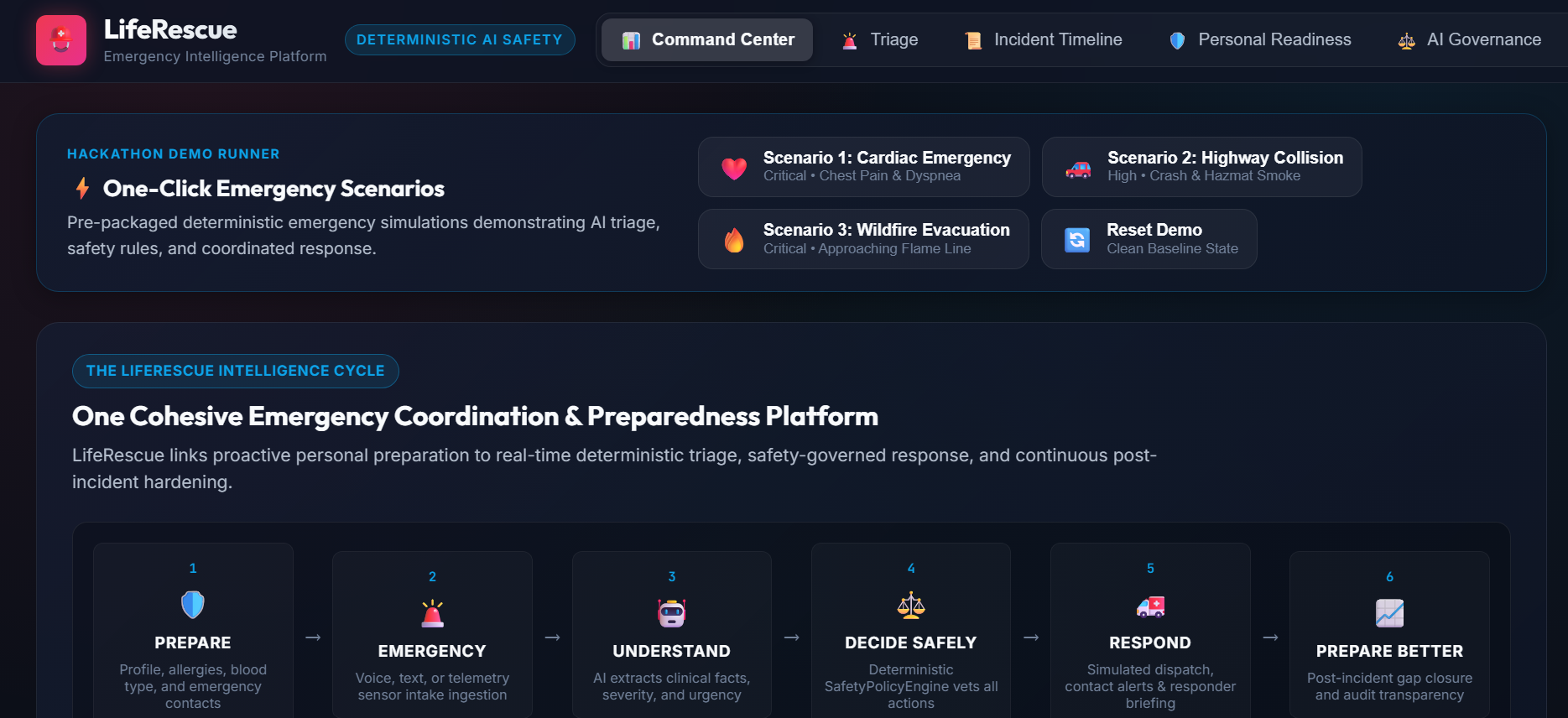
The application follows seven stages:
- Emergency Intake: The user enters an emergency scenario.
- AI Analysis: NVIDIA Nemotron analyzes the scenario and generates structured information, including category, severity, urgency, confidence, and relevant facts.
- Risk Evaluation: The Safety Policy Engine independently evaluates the risk and applies mandatory escalation rules.
- External Research: Tavily retrieves relevant emergency-response references. The results are displayed as untrusted evidence and remain isolated from safety decisions.
- Response Planning: The Response Orchestrator prepares a structured response using the validated analysis and safety decisions.
- Governed Actions: Proposed actions are checked against approved action types and safety restrictions. Dispatch and notifications are simulated.
- Incident Timeline: The application records the workflow stages, research evidence, safety decisions, and simulated actions for review.
We also implemented structured response validation, controlled mock fallback behavior, action allowlists, prompt-injection protections, rate limiting, and audit logging.
Challenges We Faced
One of our biggest challenges was making the AI integration reliable without giving the model unrestricted control.
AI responses can sometimes be incomplete, malformed, or different from the expected structure. We addressed this through structured validation, provider abstraction, and fallback handling.
Integrating external research introduced another challenge. Search results can provide useful information, but they can also contain irrelevant or misleading content. We designed Tavily as a separate research step so that its results are never passed into the AI prompts or deterministic safety decisions.
Getting everything working in production was another important part of the journey. We worked through deployment configuration, demo authentication, API connectivity, and runtime fallback issues before successfully validating both live integrations.
The final production demonstration successfully executed an emergency scenario using live NVIDIA Nemotron inference through Nebius Token Factory and a live Tavily search request. The resulting evidence appeared in the incident workflow, while the deterministic safety engine independently enforced the required emergency escalation.
What We Learned
The biggest lesson was that building an AI application for a sensitive use case involves much more than connecting an API to a frontend.
We learned the importance of separating AI-generated suggestions from application-level decisions, validating every structured response, treating external information as untrusted, and making fallback behavior transparent.
We also learned that a system should make its decisions and limitations visible. That is why we included an incident timeline showing the different stages instead of presenting everything as one final AI-generated answer.
Most importantly, we came away with a stronger appreciation for deterministic controls and system-level safety when working with powerful AI models.
What Could Come Next?
LifeRescue is currently a hackathon prototype, and we see several opportunities to develop it further:
- Work with verified emergency-response organizations.
- Have emergency guidance reviewed by qualified professionals.
- Support more emergency scenarios and preparedness assessments.
- Explore integrations with authorized responder networks.
- Expand safety testing, monitoring, and audit capabilities.
These improvements would require additional validation, expert involvement, and appropriate partnerships before any real-world deployment.
Important Limitations
LifeRescue is a hackathon prototype, not a certified medical device or production emergency dispatch system.
All emergency dispatches, SMS notifications, and response actions demonstrated in the application are simulated. The application does not contact real emergency responders or send real emergency messages.
It does not replace emergency services, qualified medical professionals, or professional advice. In a real emergency, contact your local emergency services immediately.
Built With
- ai-agents
- ai-safety
- api-integration
- artificial-intelligence
- automation
- emergency-response
- fastapi
- generative-ai
- html
- javascript
- machine-learning
- nebius-token-factory
- nvidia
- nvidia-nemotron
- python
- responsible-ai
- safety-engineering
- sqlite
- tavily


Log in or sign up for Devpost to join the conversation.