LIFEQUEST — Practice Life Before Life Tests You
Inspiration
LIFEQUEST started from a simple observation: people are frequently evaluated on what they can remember, list on a resume, or prove through certificates, while many important real-world capabilities are revealed only when a person has to make a decision.
A student can complete a course and still feel unprepared for a workplace conversation. A job seeker can know interview theory but struggle with an unfamiliar situation. An employer can see a resume but still have limited visibility into how a candidate prioritizes, communicates, reasons, or responds to consequences.
We wanted to build something that lets people practice life before life tests them.
LIFEQUEST therefore treats capability as something that can be practiced through realistic situations, observed through decisions, reflected on through consequences, and represented with transparent evidence.
The central loop is:
Situation → Decision → Consequence → Feedback → Evidence → Replay
The product is designed as one extensible capability platform connecting career readiness, practical decision-making, assessment, skill evidence, practical problem-solving, safety awareness, and social-impact directions.
What It Does
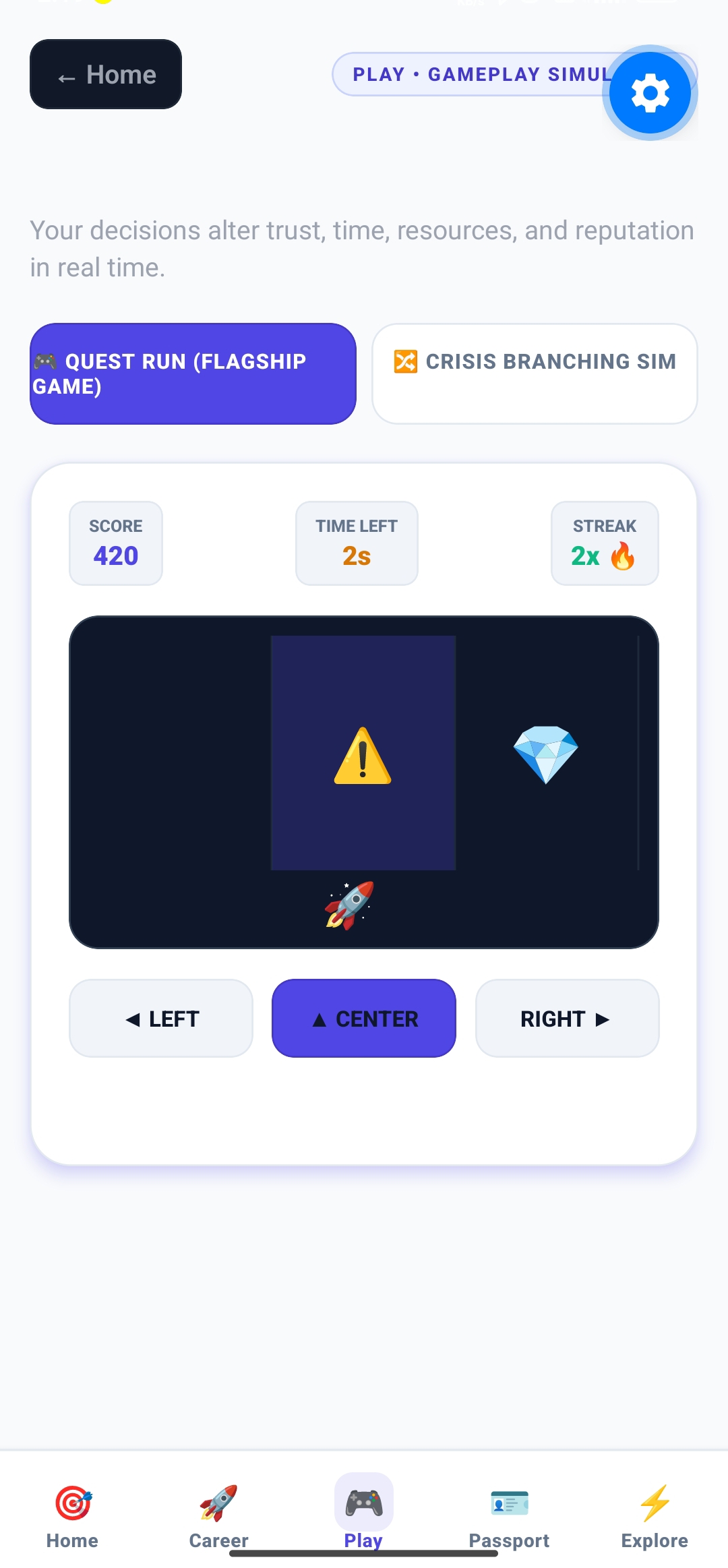
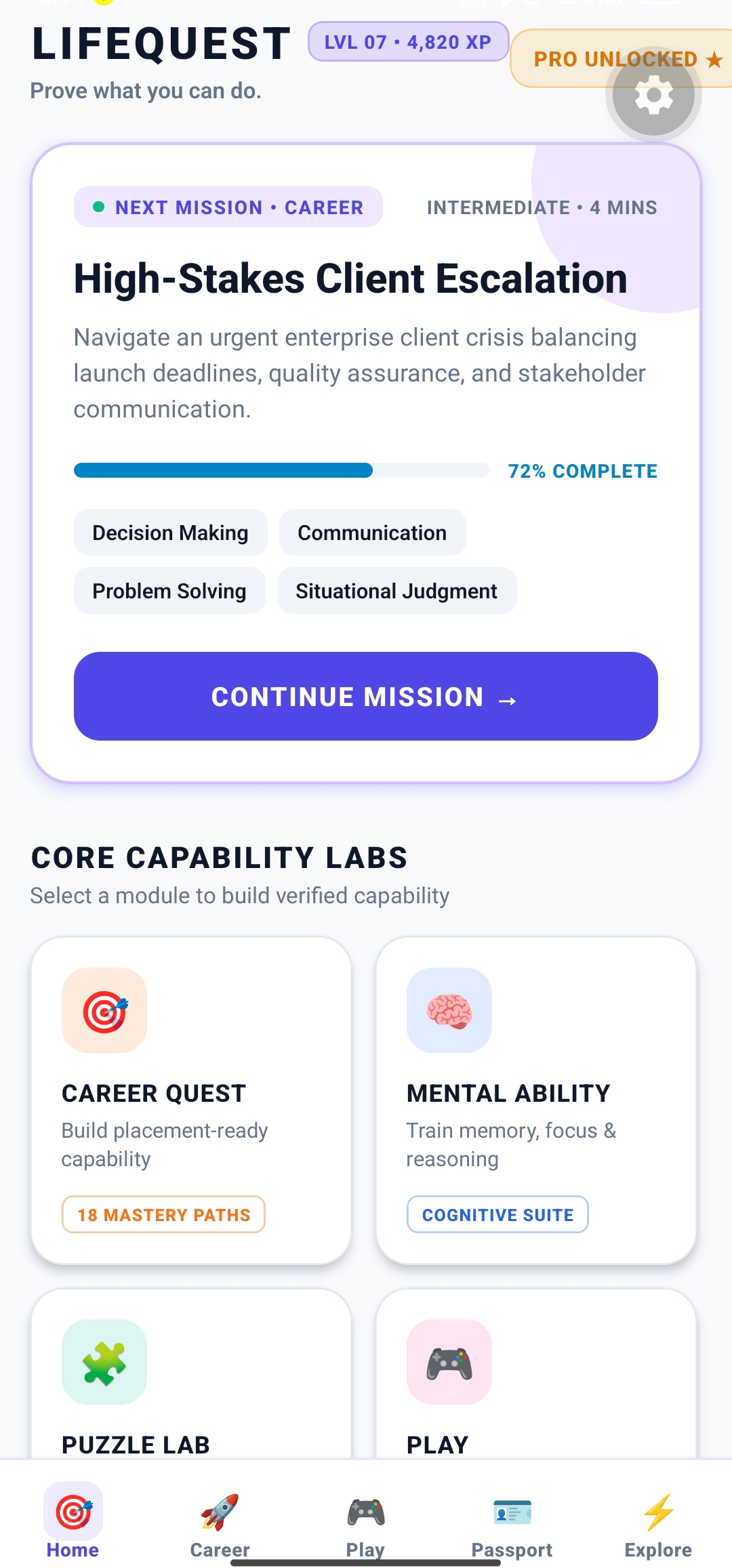
LIFEQUEST is an interactive capability-practice platform built around Missions.
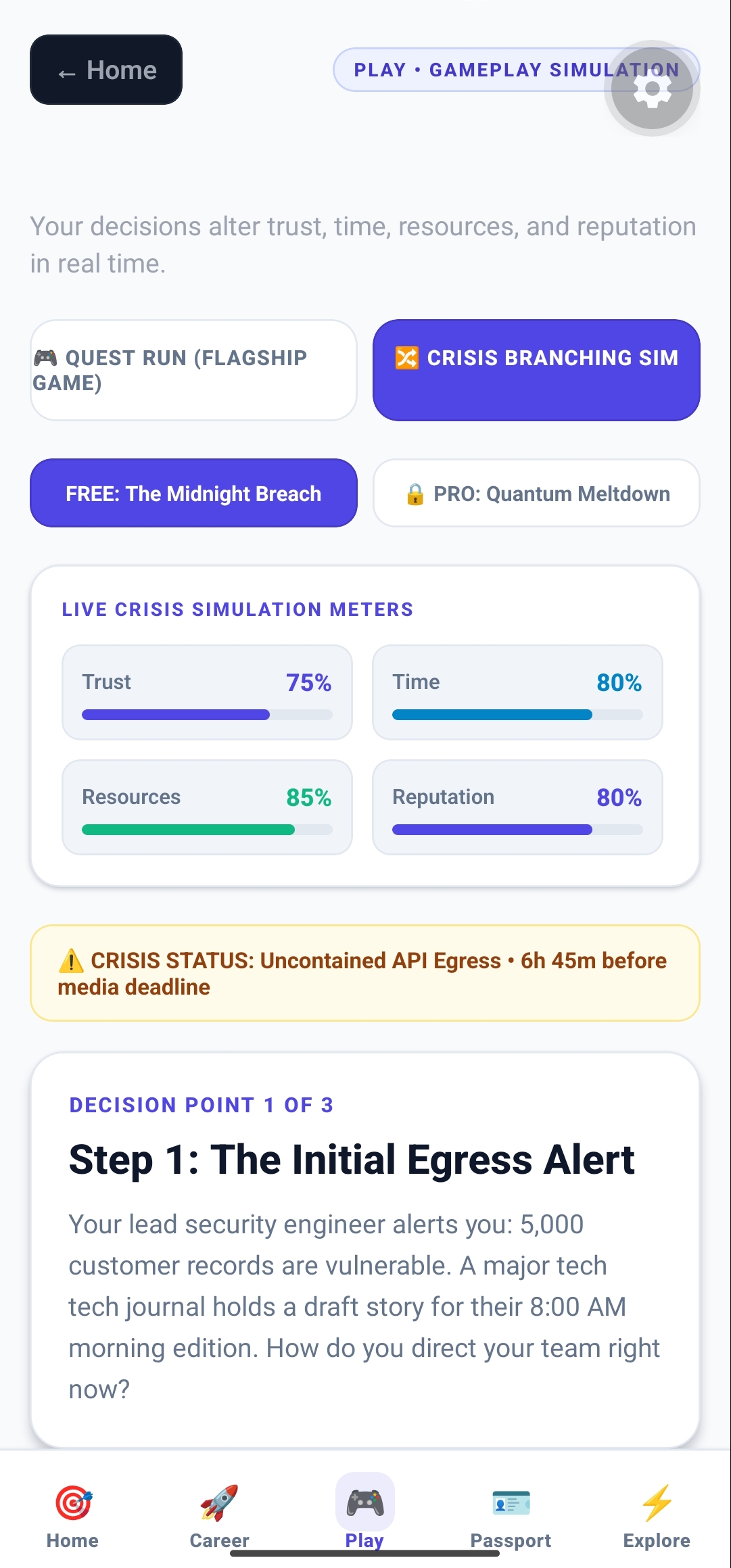
Instead of presenting every experience as a conventional quiz, a Mission can place the user inside a situation, ask them to choose an action, evaluate the decision, show consequences, and provide structured feedback.
The platform includes directions for:
- Career readiness
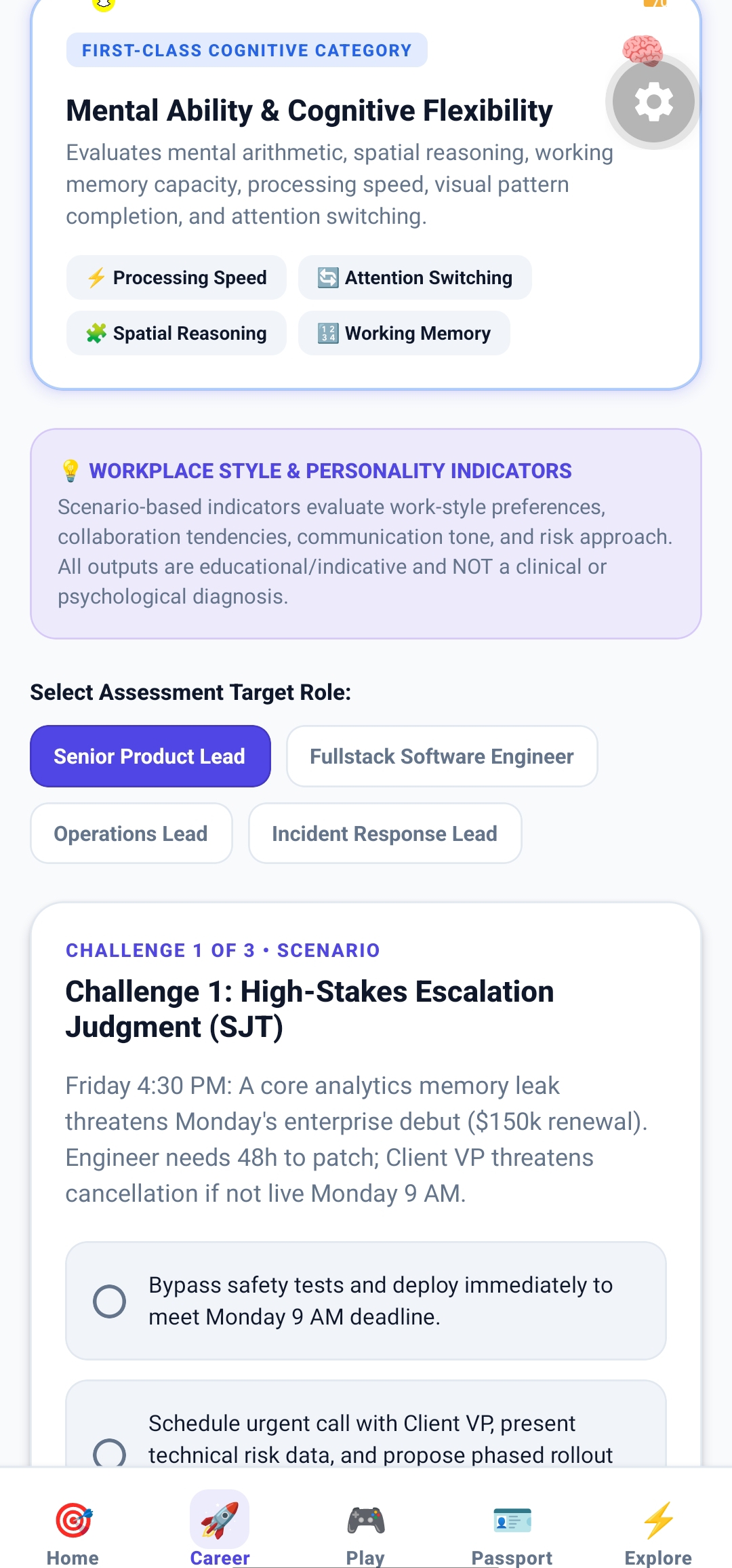
- Mental ability and reasoning
- Aptitude and quantitative practice
- Puzzle-based practice
- Situational judgment
- Workplace decision making
- Communication practice
- Interview preparation
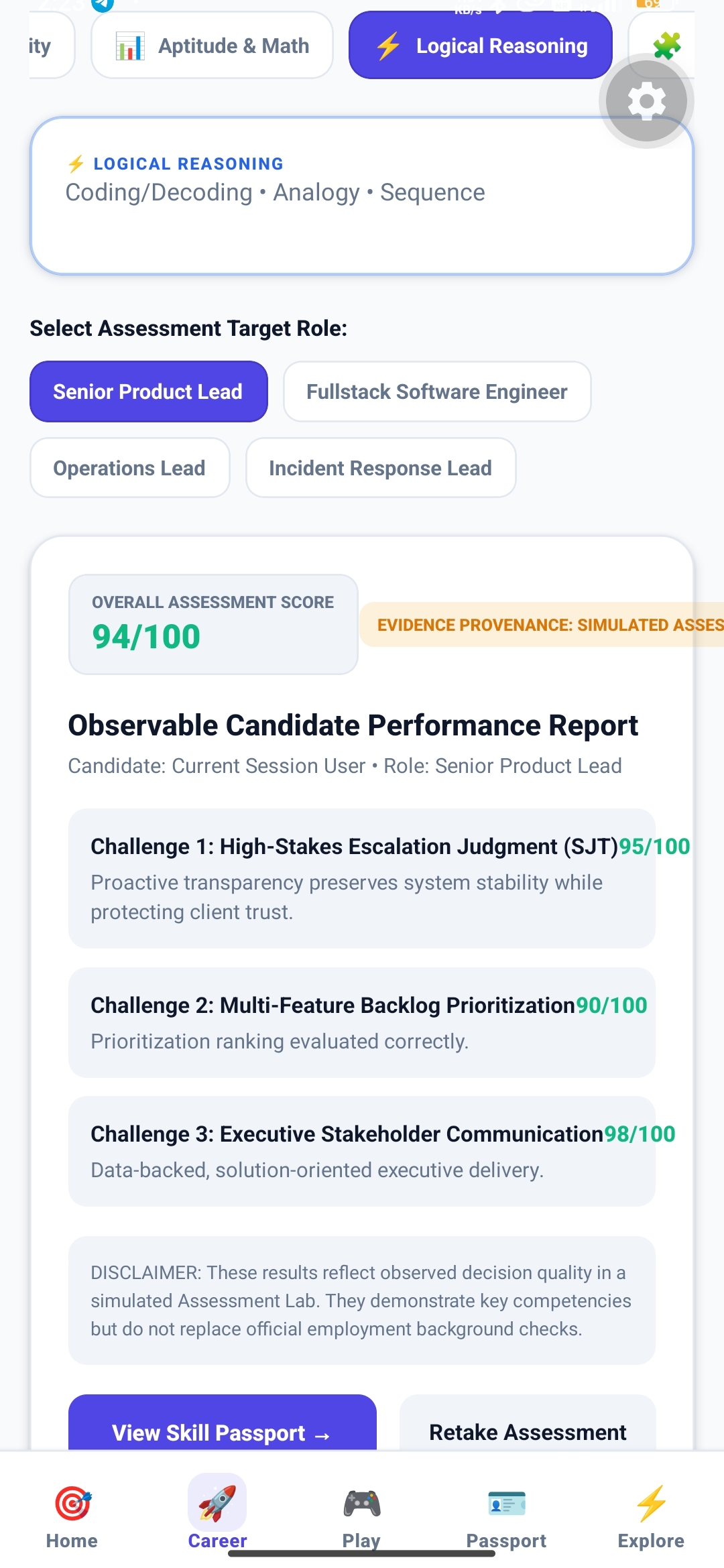
- Employer assessment
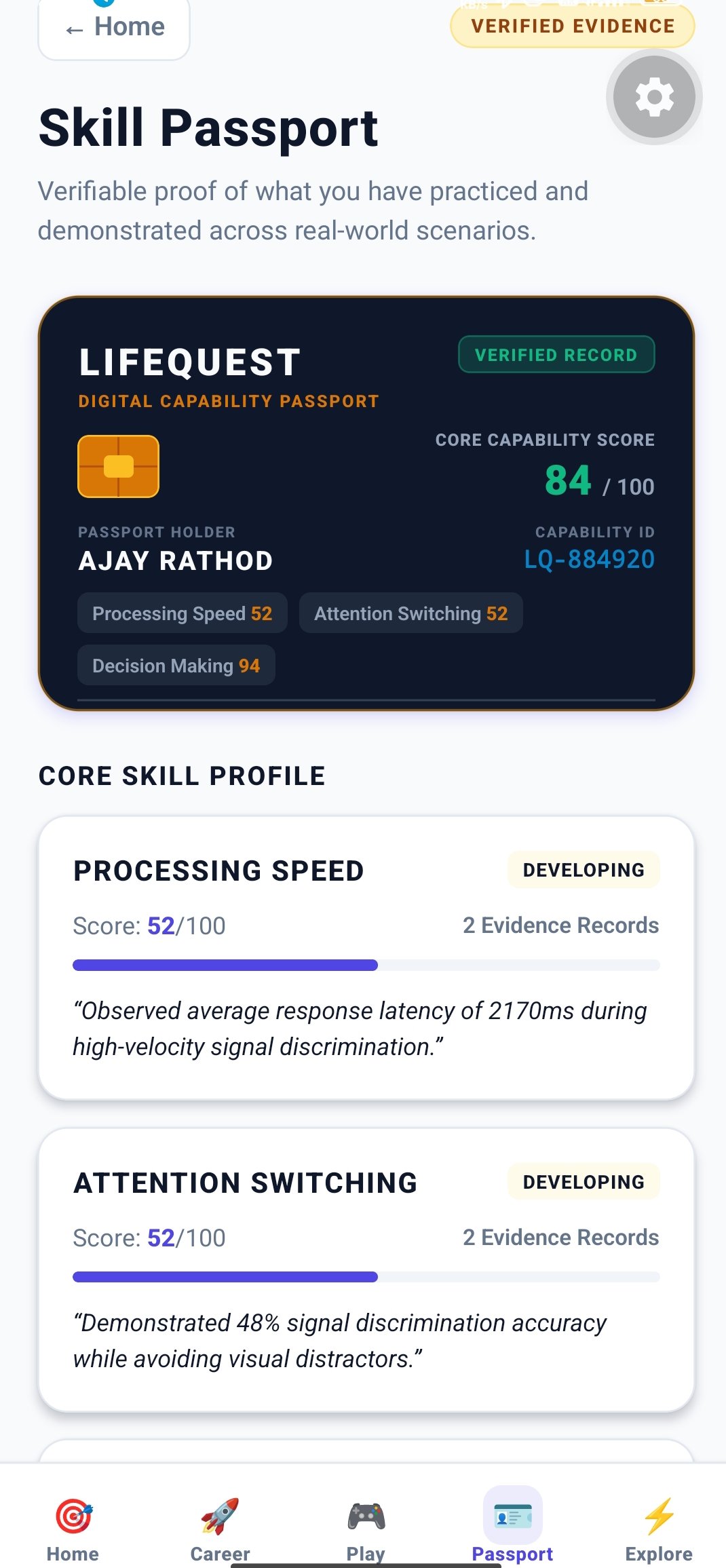
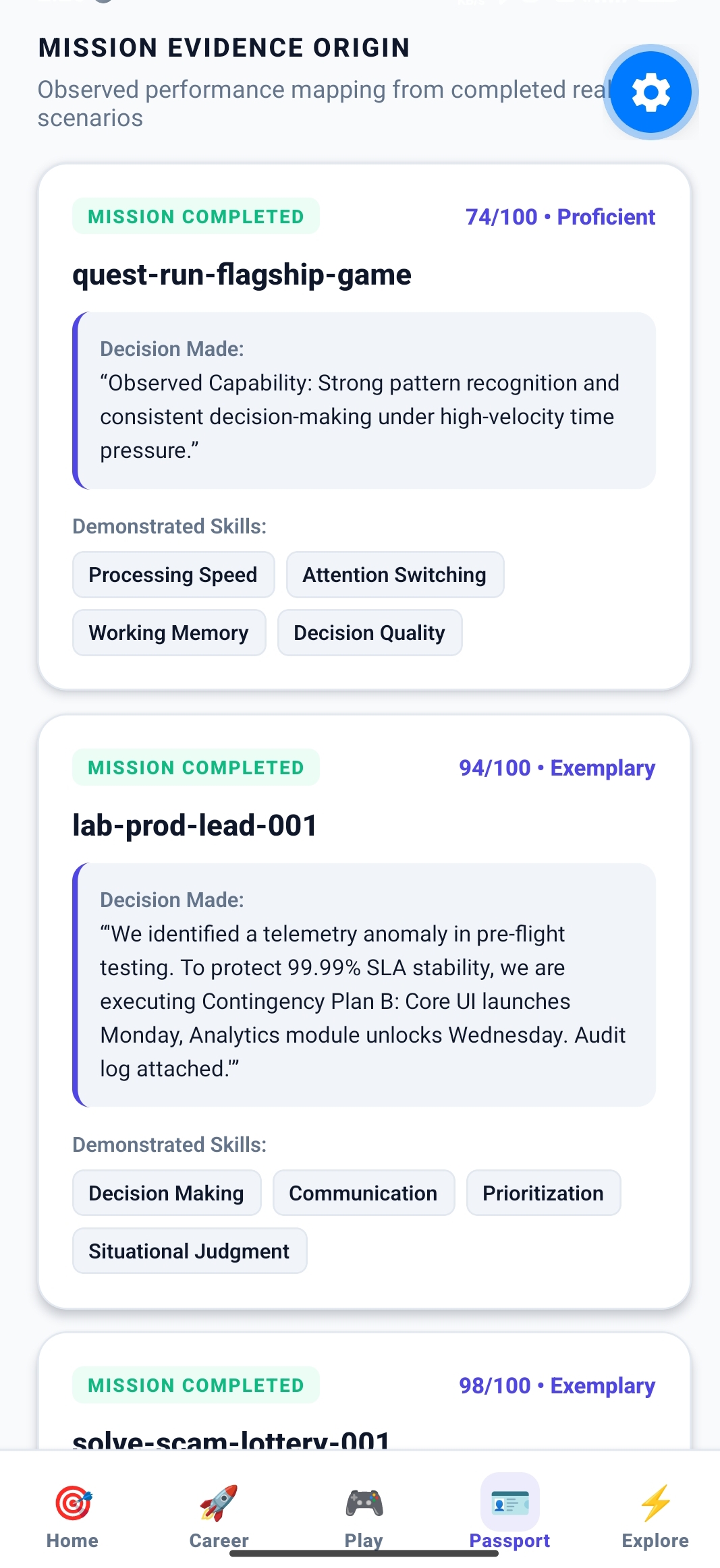
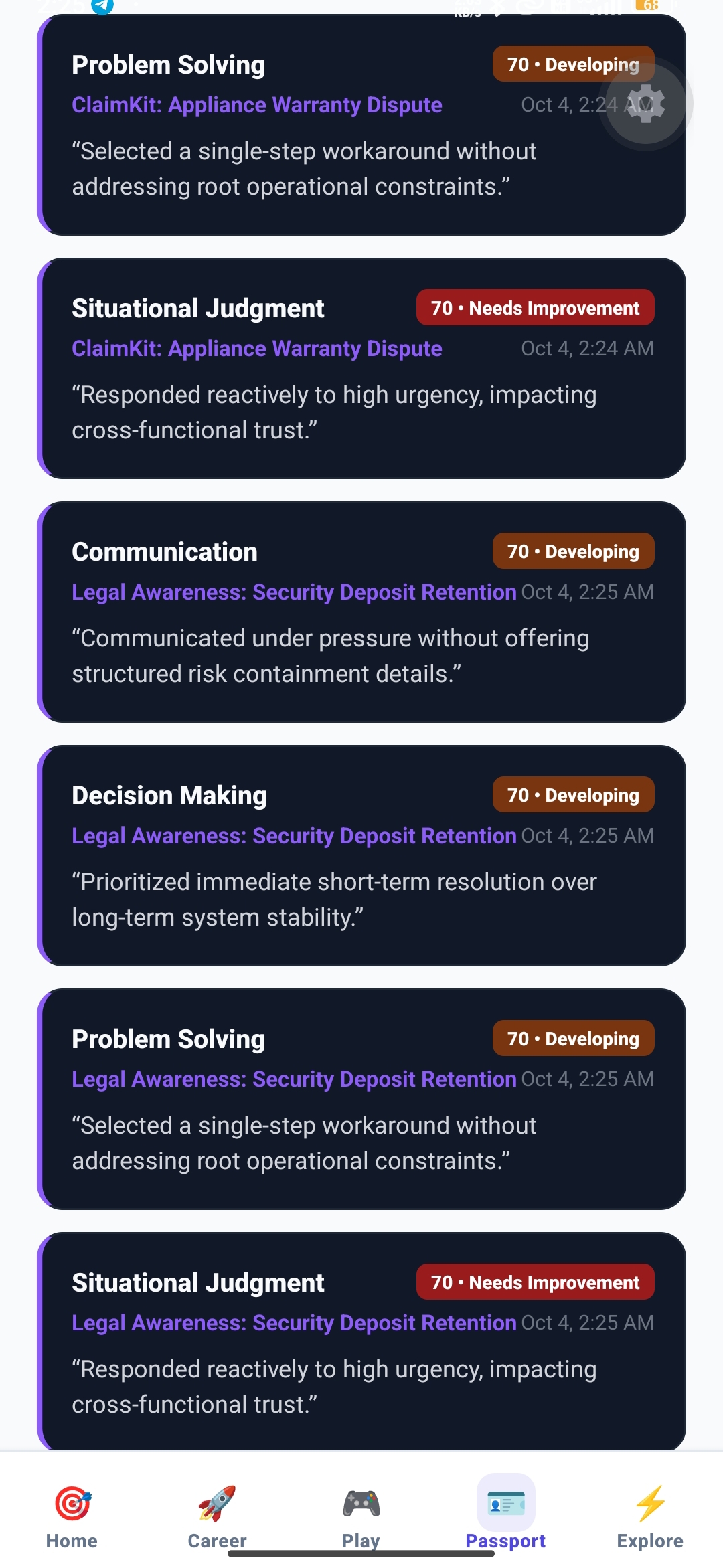
- Skill Passport
- Impact Passport
- Practical problem-solving
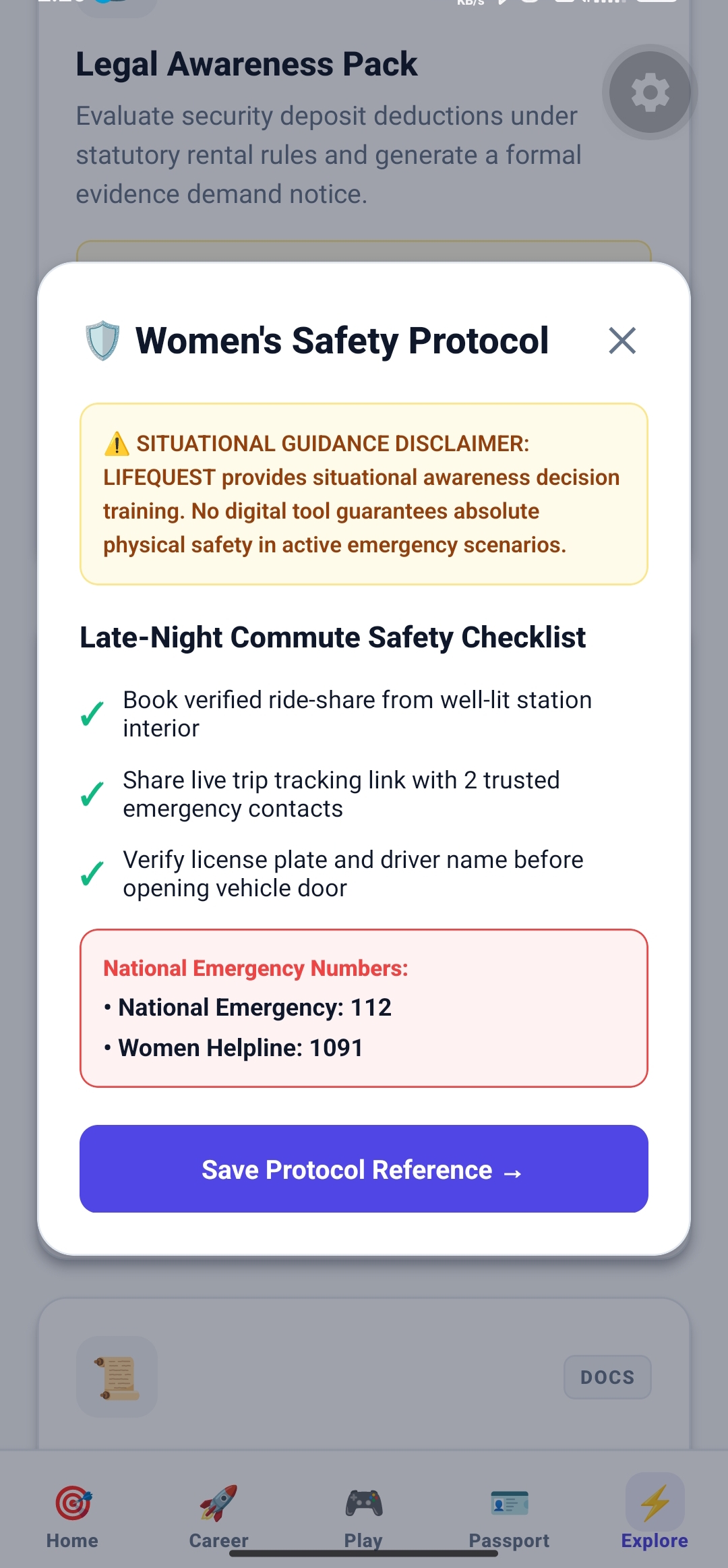
- Women's-safety decision practice direction
- Broader social-impact and community-action direction
The important distinction is that LIFEQUEST does not automatically turn simulated performance into professional credentials.
A completed simulation means the user practiced a situation. It does not, by itself, prove real-world experience.
One platform, multiple real-life capability domains
LIFEQUEST is intentionally broader than a single career-preparation app. Its common Mission and evidence architecture can support different moments where people need to think, decide, communicate, verify, or act.
The product experience is organized around:
CAREER
  → Aptitude • Reasoning • Puzzles • Workplace • Interview

ASSESS
  → Employer Tests • Skills • Questions • Preview • Organization

PROVE
  → Skill Passport • Evidence • Provenance

IMPACT
  → Impact Passport • Action • Outcome • Timeline

SOLVE
  → Claims • Documents • Scam Awareness • Legal Awareness • Practical Action

SAFETY
  → Situational Awareness • Risk Recognition • Communication • Appropriate Response
The important architectural idea is that these are not intended to be isolated mini-apps. They share the same capability philosophy: practice or perform an action, capture what happened, communicate the limits of the evidence, and use the result for improvement.
The Core Experience
A conventional quiz often looks like:
Question → Answer → Score
LIFEQUEST is designed around a richer loop:
Realistic Situation
        ↓
Understand Context
        ↓
Make a Decision
        ↓
Observe Consequence
        ↓
Receive Feedback
        ↓
Generate Transparent Evidence
        ↓
Replay
        ↓
Improve
This allows the user to learn not only whether an answer was accepted, but why a decision produced a particular outcome.
The architecture is intentionally reusable: different scenarios can use the same Mission Engine while representing different skills and domains.
Career Readiness
LIFEQUEST's career ecosystem is designed to practice capabilities that are difficult to capture through certificates alone.
Aptitude & Math
Practice directions include:
- Percentage
- Ratio
- Profit and Loss
- Number Series
- Quantitative problem solving
Logical Reasoning
Practice directions include:
- Coding / Decoding
- Analogy
- Sequence
- Pattern recognition
- Structured reasoning
Puzzle Lab
Practice directions include:
- Matrix
- Pattern
- Logic puzzle
- Spatial reasoning
- Adaptive reasoning concepts
Situational Judgment
Users practice workplace situations involving:
- Judgment
- Risk awareness
- Prioritization
- Stakeholder handling
- Professional decision making
Workplace
Practice directions include:
- Prioritization
- Decision making
- Collaboration
- Managing competing demands
- Professional response
Communication
Practice directions include:
- Professional communication
- Workplace responses
- Stakeholder interaction
- Clear communication
- Appropriate professional tone
Interview Prep
Practice directions include:
- HR
- Technical
- Situational questions
- STAR-style behavioral responses
The objective is not to make users memorize a "correct" interview script. It is to help them practice thinking and communicating under realistic constraints.
Employer Assessment
LIFEQUEST also includes an employer-oriented assessment direction.
The intended workflow is:
Employer
   ↓
Add Test
   ↓
Select Assessment Type
   ↓
Select Skills
   ↓
Add / Reorder Questions
   ↓
Preview
   ↓
Organize Test
This provides a foundation for assessments organized around explicit capabilities instead of only resume keywords.
The assessment architecture includes employer assessment and reporting components.
The long-term direction is to help employers observe structured evidence of capabilities such as:
- Reasoning
- Decision making
- Communication
- Prioritization
- Collaboration
- Technical capability
without claiming that a simulation alone is equivalent to professional experience.
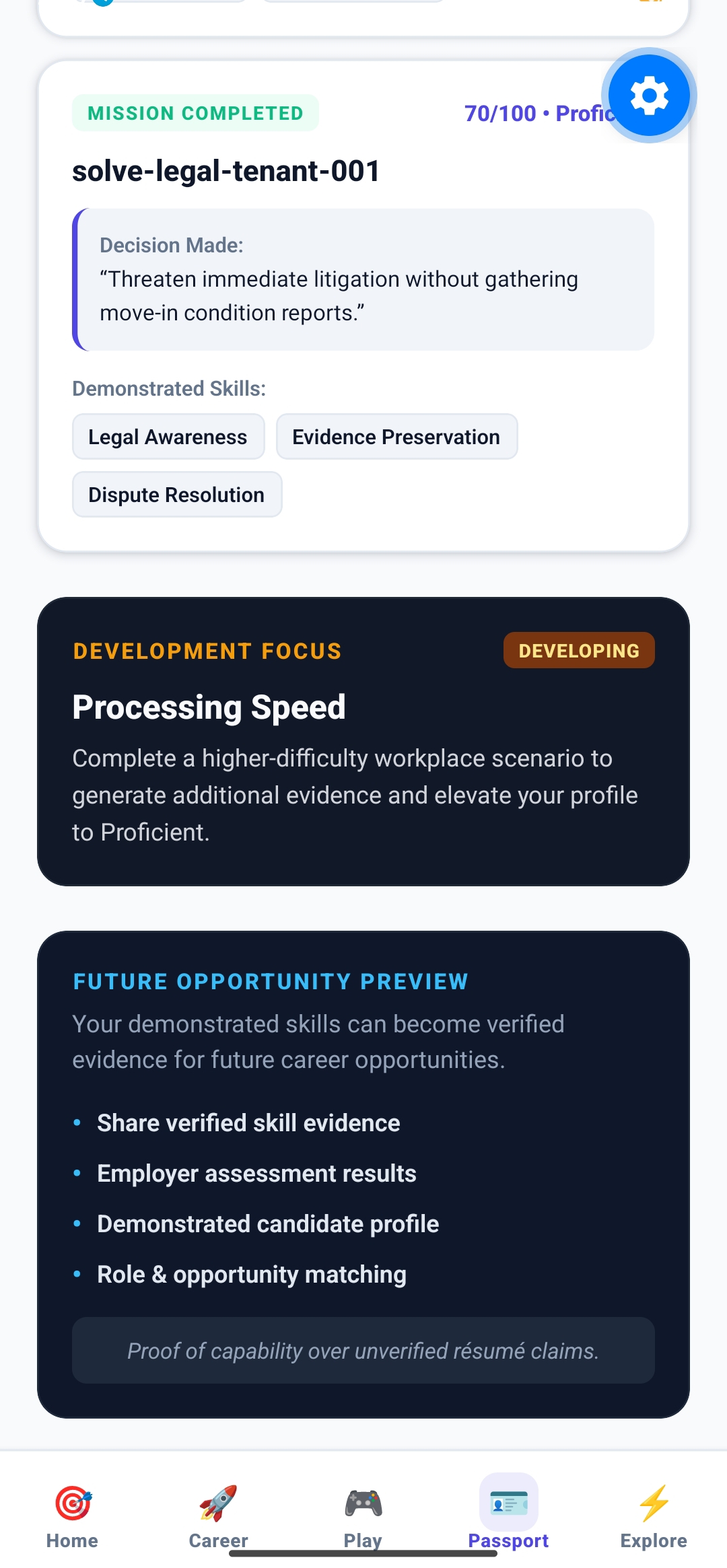
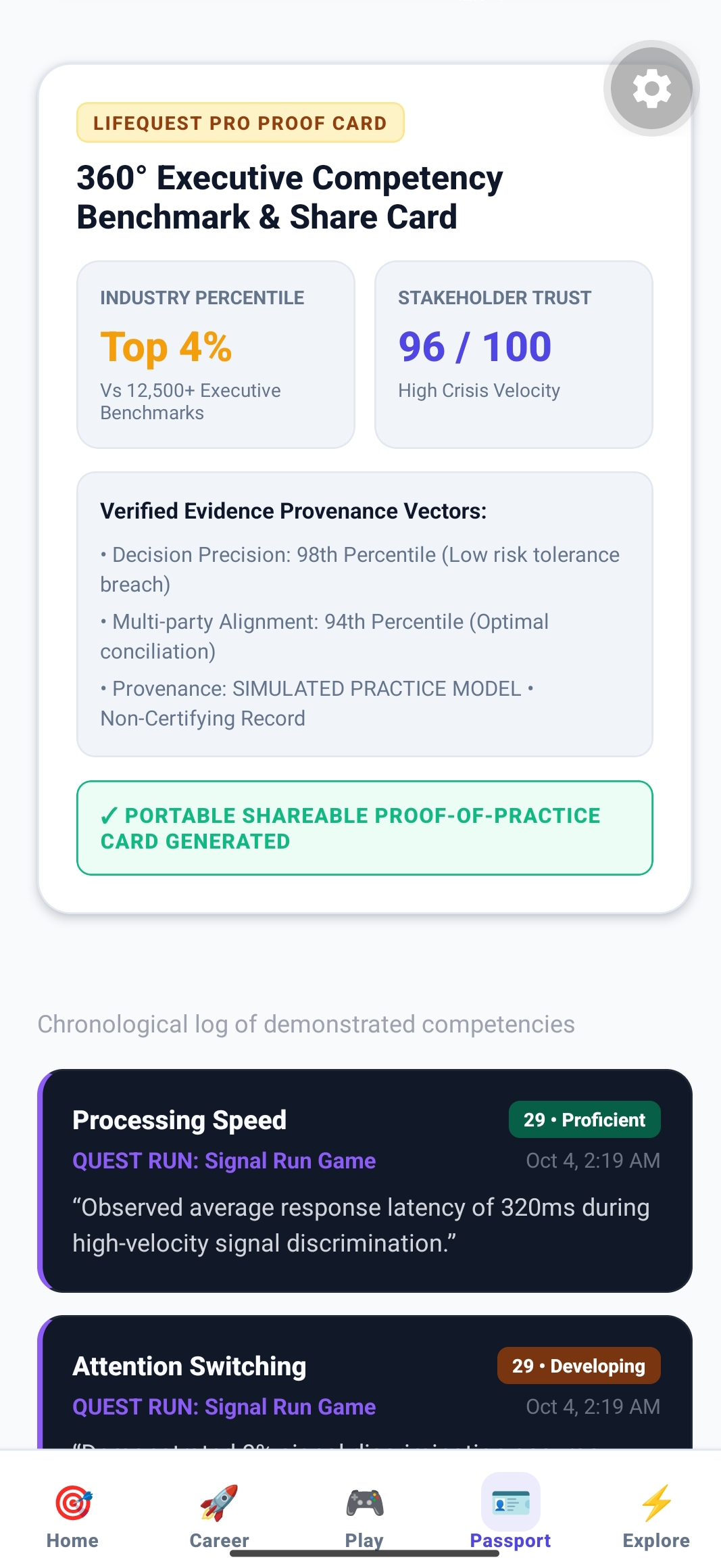
Skill Passport
The Skill Passport organizes evidence around capabilities rather than simply collecting generic certificates.
Examples of capability areas include:
- Problem solving
- Decision making
- Communication
- Collaboration
- Reasoning
- Workplace judgment
- Technical capability
- Practical action
The Skill Passport is designed to answer a more useful question than "How many certificates do you have?"
It asks:
What did you practice, what did you demonstrate, and what evidence actually exists?
Evidence Integrity
Evidence integrity is a core design principle of LIFEQUEST.
Skill platforms can easily create a misleading impression if every completed simulation is presented as a real credential.
We deliberately avoid that.
LIFEQUEST uses provenance states such as:
- Simulated
- Simulated Model
- Demonstrated
- Projected
- Field Verified
These states communicate what a piece of evidence actually represents.
For example:
A completed workplace simulation can be Simulated.
A modeled expected result can be Projected.
An appropriate practical activity can produce Demonstrated evidence.
Evidence genuinely validated in a real-world context can eventually become Field Verified.
The principle is simple:
Practice is not automatically proof of experience.
This distinction is important for both learners and employers because it prevents the platform from overclaiming what its results mean.
Impact Passport
LIFEQUEST extends beyond employability through an Impact Passport direction.
The idea is to make meaningful action visible without pretending that simulated activity is real-world impact.
A potential impact flow is:
Identify a Problem
        ↓
Choose an Action
        ↓
Take Action
        ↓
Record Evidence
        ↓
Describe Outcome
        ↓
Build Impact Timeline
This can support directions such as:
- Community contribution
- Social impact
- Responsible action
- Inclusion
- Peace-oriented contribution
- Women's safety
- Community problem solving
The same provenance principle applies:
A simulated impact scenario is practice. Real-world impact requires real-world action and appropriate evidence.
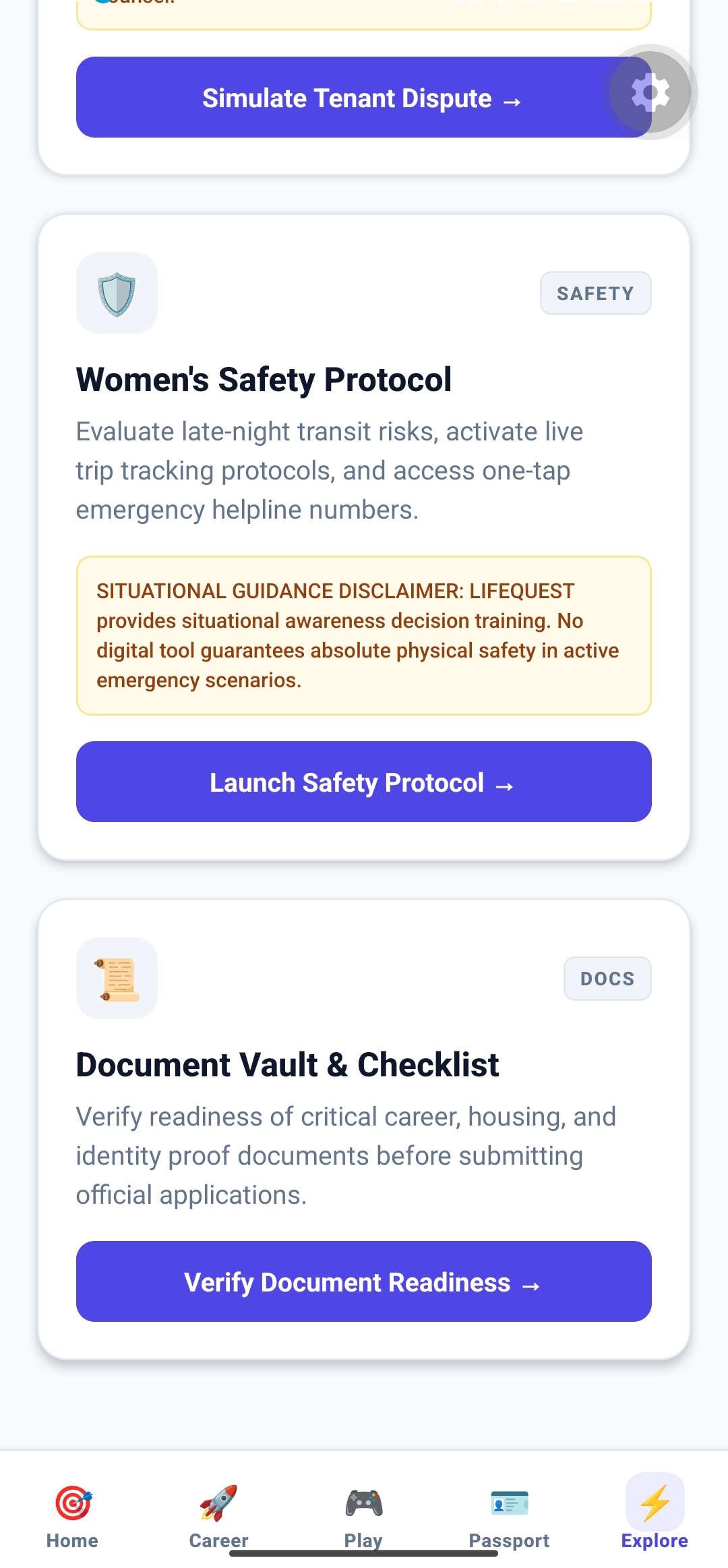
Women's Safety Direction
One important social-impact direction of LIFEQUEST is women's safety.
The same decision-practice engine can be used to create educational scenarios involving:
- Situational awareness
- Risk recognition
- Emergency decision making
- Communication under pressure
- Seeking appropriate assistance
- Supporting others in difficult situations
The goal is not to replace emergency services, trained professionals, law enforcement, medical services, or established safety systems.
The goal is to provide structured practice for recognizing situations and thinking through appropriate responses.
A safety-oriented practice flow can be represented as:
Recognize Situation
        ↓
Assess Risk
        ↓
Consider Options
        ↓
Choose an Appropriate Response
        ↓
Understand Consequence
        ↓
Review / Replay
This makes the same capability framework useful beyond employment.
Social Impact and Peace-Oriented Direction
LIFEQUEST also has a broader social-impact direction.
The underlying idea is:
A person's capability should not only improve their employability; it can also increase their ability to contribute positively to their community.
The platform can therefore extend toward:
- Peace
- Community contribution
- Social awareness
- Inclusion
- Responsible decision making
- Women's safety
- Practical problem solving
- Positive community action
These are directions supported by the product architecture rather than claims that every area is already fully implemented.
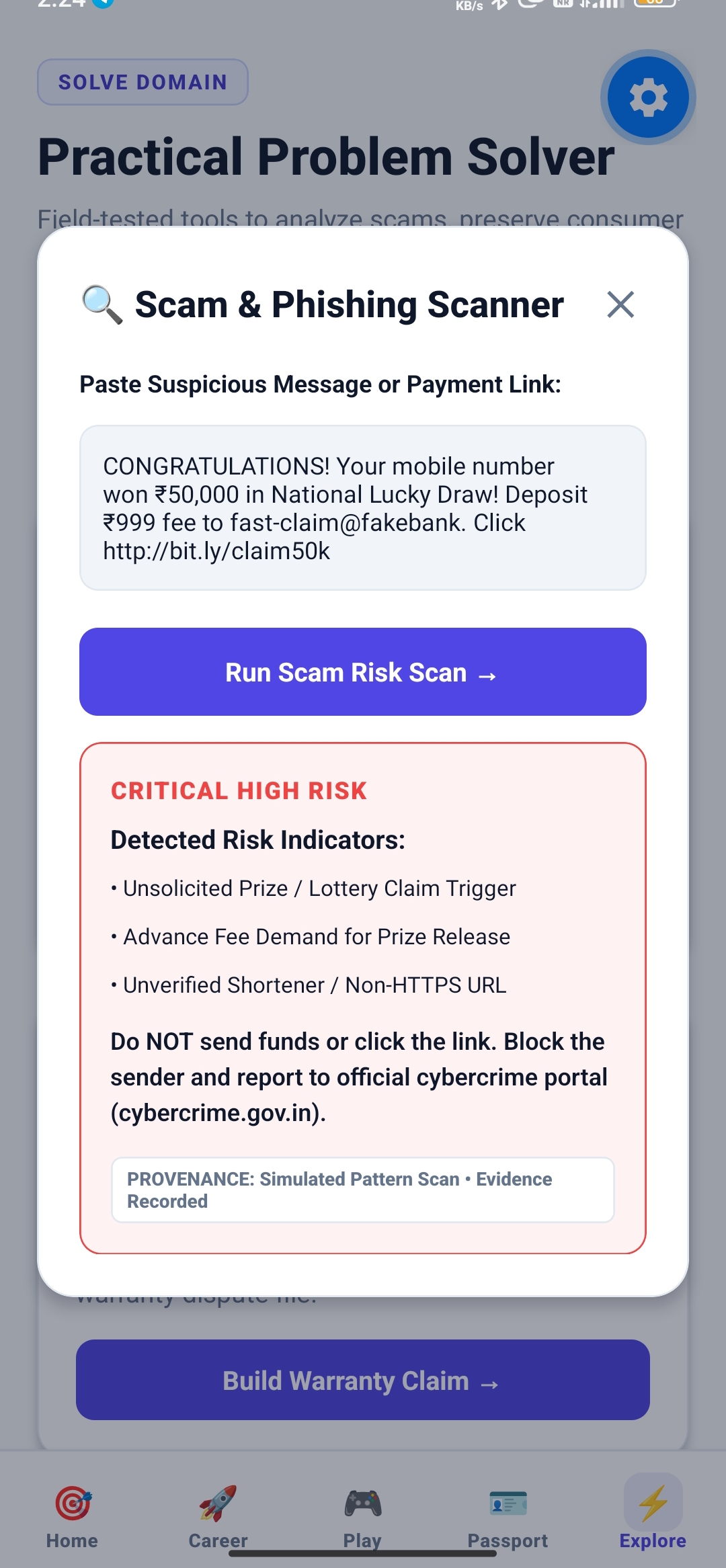
Solve
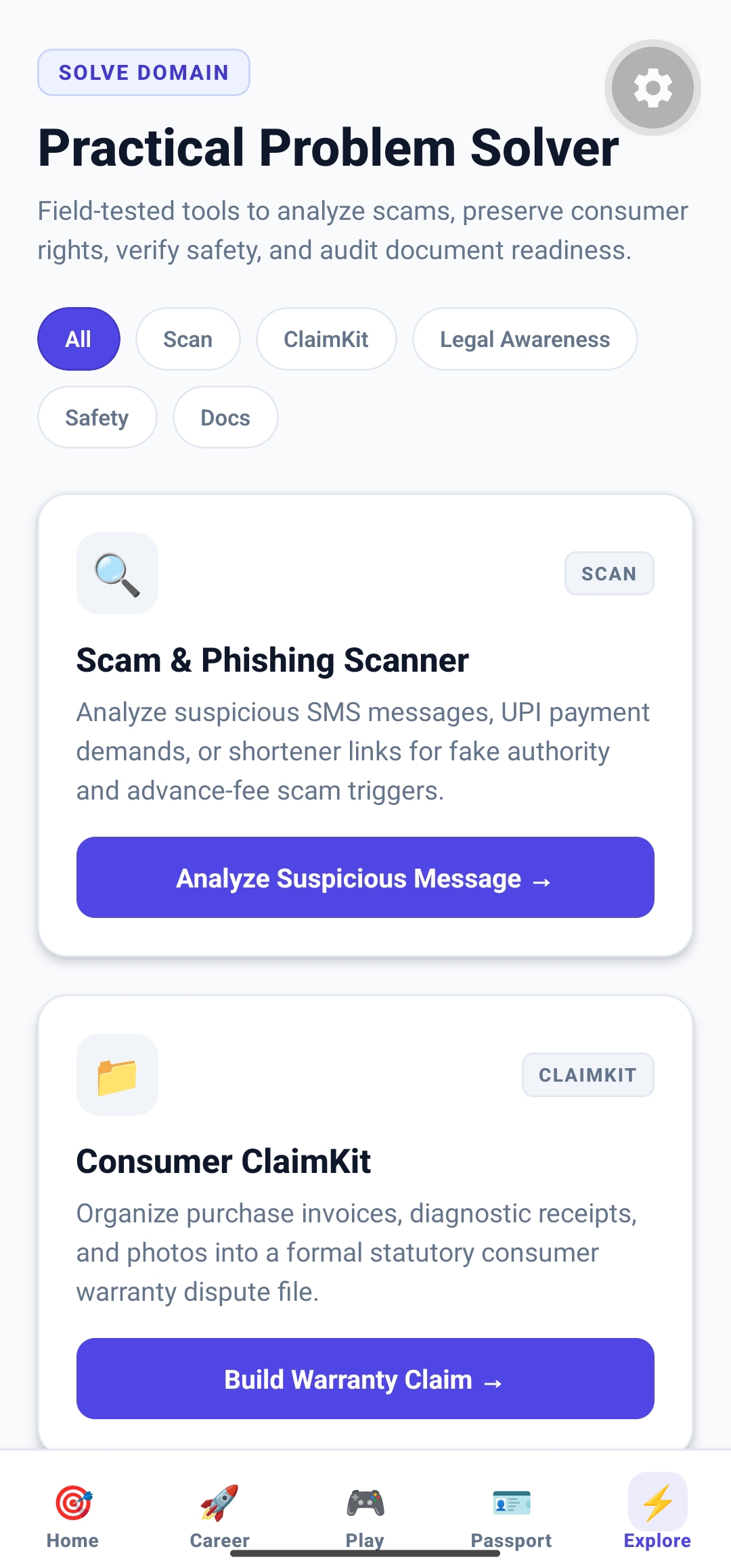
The Solve area extends LIFEQUEST beyond tests and preparation into practical action.
Its purpose is to move the user from:
Identify → Understand → Decide → Act → Document
The broader product direction includes practical workflows such as:
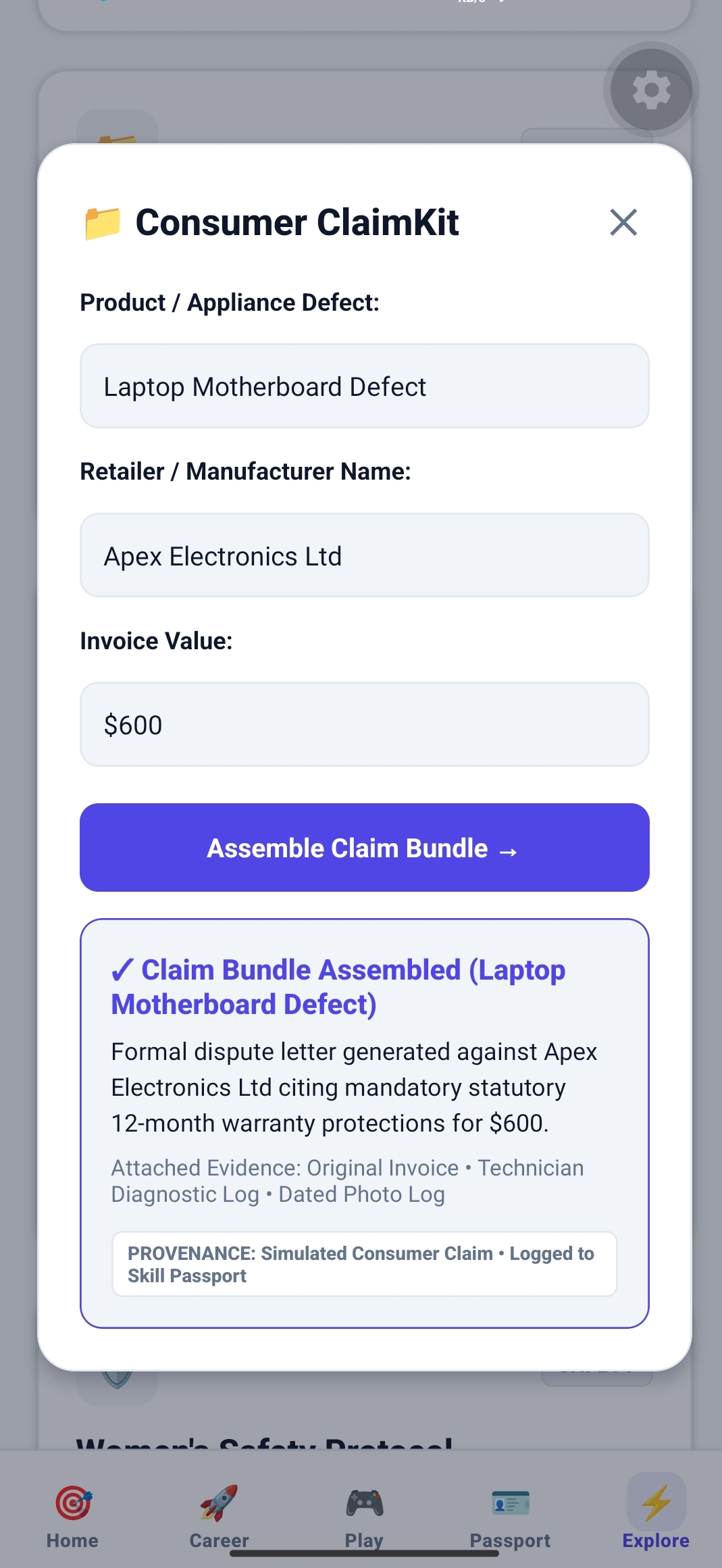
- ClaimKit-style claim/document support
- Structured document and evidence workflows
- Scam-awareness and investigation-oriented guidance
- Legal-awareness and responsible decision-support
- Practical problem solving
- Safety-oriented decision practice
- Evidence organization
These tools are designed to help users understand a problem and organize useful evidence or next steps. They are not presented as a replacement for qualified legal, emergency, financial, or professional advice.
The same product philosophy applies across Solve:
Understand the situation → make a better decision → document what matters → learn from the outcome.
How We Built It
LIFEQUEST is built as a mobile-first React Native application using Expo and TypeScript.
Core stack
- React Native
- Expo
- TypeScript
- Expo Router
- React Hooks
- Structured mission datasets
- Branching simulation logic
- Evidence provenance tracking
- Assessment Lab models
- Skill Passport evidence components
- Employer assessment components
- Employer reporting components
- RevenueCat
RevenueCat is integrated for subscription, paywall, and entitlement management.
We deliberately avoided unnecessary dependencies. The final product upgrade added zero new npm packages and preserved the existing native configuration.
Architecture
The application is organized around reusable product concepts rather than treating every feature as an isolated screen.
                         LIFEQUEST
                             |
              +--------------+--------------+
              |                             |
         UI / Screens                 Shared Components
              |                             |
              +--------------+--------------+
                             |
                       Mission Engine
                             |
             +---------------+---------------+
             |               |               |
         Missions        Evaluation       Progress
             |               |               |
             +---------------+---------------+
                             |
                      Evidence Model
                             |
                       Skill Passport
                             |
             +---------------+---------------+
             |                               |
        Learner Flow                  Employer Flow
             |                               |
        Practice                     Assessment Builder
             |                               |
        Feedback                       Reporting
             |
       Impact / Action
This structure allows multiple product experiences to share the same underlying practice and evidence concepts.
Mission Engine
The Mission Engine is the central product mechanism.
A Mission can represent:
- A scenario
- A decision
- Multiple choices
- Feedback
- Consequences
- Progress
- Replay state
- Skill association
- Evidence state
The architecture allows new Missions to be introduced without redesigning the entire application.
This is important because the product can expand across career readiness, workplace judgment, social impact, and other domains while retaining one consistent interaction model.
Branching Simulation Logic
Instead of reducing every activity to a binary correct/wrong result, LIFEQUEST can represent decision consequences.
Conceptually:
Situation
   |
   +---- Choice A ----> Consequence A ----> Feedback
   |
   +---- Choice B ----> Consequence B ----> Feedback
   |
   +---- Choice C ----> Consequence C ----> Feedback
This makes the experience closer to decision practice.
It also provides a foundation for replay:
What happens if I choose differently?
Observable Skills
LIFEQUEST is designed around observable behavior.
Rather than simply claiming:
"You are a strong leader."
the platform can associate an activity with observable actions such as:
- Prioritized competing tasks
- Considered stakeholder impact
- Identified risk
- Communicated appropriately
- Selected an action
- Responded to feedback
- Replayed a scenario
This creates a more transparent relationship between practice and capability.
Technical Design Decisions
We intentionally kept the architecture lightweight.
Instead of introducing a large backend or additional frameworks solely for the hackathon, we extended the existing Expo/React Native architecture.
This allowed us to focus engineering effort on:
- Product coherence
- Simulation logic
- Evidence integrity
- Reusable components
- Assessment workflows
- Demonstrable functionality
rather than infrastructure that was not necessary to demonstrate the core idea.
RevenueCat
RevenueCat is used for subscription/paywall and entitlement management.
This keeps monetization concerns separated from the Mission Engine.
The architecture can therefore distinguish between:
- Free experiences
- Pro experiences
- Entitlements
- Paywall presentation
- Judge/demo access where applicable
Document and Evidence Workflow
For document-related functionality, the current implementation uses a structured text/photo fallback rather than depending entirely on native camera OCR.
This was a deliberate stability trade-off.
It keeps the workflow usable across web and development environments while avoiding unnecessary native complexity for the core product.
Challenges We Faced
1. Building one coherent product
The biggest challenge was expanding LIFEQUEST without turning it into a collection of disconnected screens.
The solution was to keep the Mission Engine as the central experience and connect different modes through the same:
Practice → Consequence → Evidence
model.
2. Separating practice from proof
A major product-design challenge was preventing simulated performance from being mistaken for real professional experience.
We addressed this through explicit evidence provenance states.
3. Maintaining stability during rapid development
The project needed to evolve quickly without introducing unnecessary native configuration changes.
We therefore reused the existing Expo/React Native architecture and avoided unnecessary dependencies.
4. Supporting different environments
The product needed to remain practical across mobile development and web environments.
For document-related workflows, a structured text/photo fallback helped avoid making native OCR infrastructure mandatory for the core experience.
5. Designing for extensibility
Career preparation, employer assessment, skill evidence, and social impact could easily become separate applications.
The challenge was finding a shared model.
The Mission Engine and evidence model became that shared foundation.
Accomplishments That We Are Proud Of
We are proud that LIFEQUEST evolved beyond a conventional quiz or interview-preparation application.
The product now brings together:
- Interactive Missions
- Decision practice
- Consequence-based feedback
- Skill evidence
- Evidence provenance
- Career readiness
- Employer assessment
- Interview preparation
- Workplace simulations
- Impact-oriented experiences
- Women's-safety decision-practice direction
Most importantly, these areas are connected by a common product philosophy rather than being completely independent features.
What We Learned
We learned that a useful practice product is not just a collection of questions.
The important part is the complete loop:
Situation → Decision → Consequence → Feedback → Evidence → Replay
That loop makes the experience closer to practicing a decision than simply consuming information.
We also learned that transparency matters when building systems around skills and evidence.
A simulation can demonstrate how someone approached a scenario, but it should not pretend to be proof of something that has not actually happened.
We learned that product architecture matters as much as feature count.
A reusable Mission Engine allowed us to extend the platform into different capability areas without creating a separate architecture for every feature.
We also learned that social impact needs the same evidence discipline as employability. A user should be able to practice a safety or community scenario without the system incorrectly presenting that simulation as real-world impact.
What's Next
The next stage of LIFEQUEST can expand the same foundation into:
- More adaptive Missions
- Larger reasoning and aptitude libraries
- More workplace simulations
- Deeper interview practice
- More employer assessment templates
- Richer Skill Passport evidence
- Real-world evidence verification workflows
- More Impact Passport experiences
- Women's-safety scenarios
- Community problem-solving Missions
- More structured communication practice
- More technical interview simulations
- Improved assessment analytics
The goal is not simply to add more screens.
The goal is to increase the quality and usefulness of the:
Practice → Evidence → Improvement → Action
loop.
Why LIFEQUEST
LIFEQUEST is built around a simple idea:
Don't just tell people what they should know. Let them practice what they need to do.
A certificate can show that someone completed something.
A score can show how someone performed on a particular test.
But realistic practice can reveal how someone thinks through a situation.
LIFEQUEST combines that practice with transparent evidence so users can understand what they actually demonstrated.
The long-term vision is a capability layer connecting:
Learning → Practice → Decision → Evidence → Employability → Real-world Contribution
Responsible Product Positioning
LIFEQUEST does not claim that:
- A simulation equals professional experience.
- A score predicts a person's future with certainty.
- A practice result is a clinical or psychological diagnosis.
- A safety simulation replaces emergency services or professionals.
- A simulated social-impact action equals real-world impact.
Instead, the product focuses on:
- Practice
- Reflection
- Observable behavior
- Feedback
- Evidence provenance
- Repeatability
- Responsible communication of results
Built With
- React Native
- Expo
- TypeScript
- Expo Router
- React Hooks
- RevenueCat
- Structured Mission Engine
- Branching Simulation Logic
- Assessment Lab
- Skill Passport
- Evidence Provenance Model
Final Product Principle
LIFEQUEST is based on one simple principle:
Practice life before life tests you.
The product brings decision practice, career preparation, structured assessment, transparent evidence, and social-impact directions into one extensible platform.
The central loop remains:
Situation
   ↓
Decision
   ↓
Consequence
   ↓
Feedback
   ↓
Evidence
   ↓
Replay
   ↓
Improvement
That loop is the foundation of LIFEQUEST.
Hashtags
LIFEQUEST #EdTech #CareerReadiness #SkillDevelopment #SocialImpact #WomenSafety #DigitalSafety #LegalAwareness #AI #ReactNative #Expo #TypeScript
Built With
- android
- assessment
- career
- decision
- development
- education
- expo.io
- gamification
- javascript
- making
- mobile
- native
- productivity
- react
- revenuecat
- router
- simulation
- skill
- typescript

Log in or sign up for Devpost to join the conversation.