-
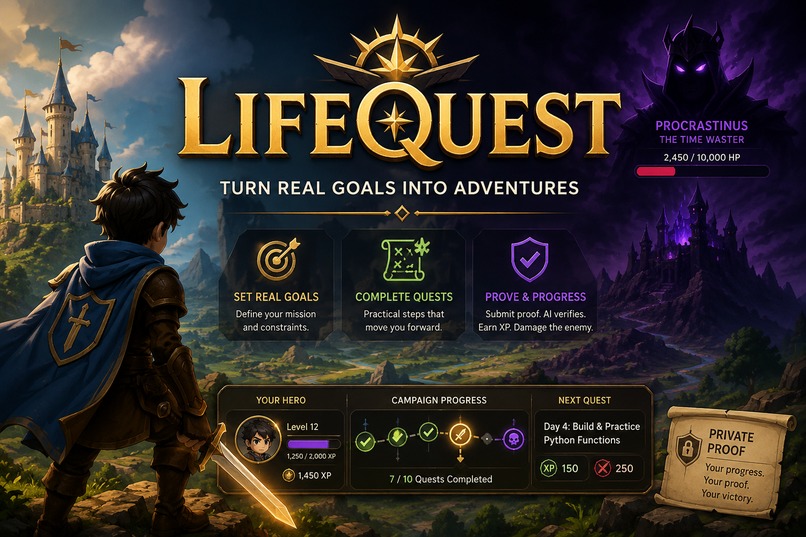
Promotional Thumbnail
-

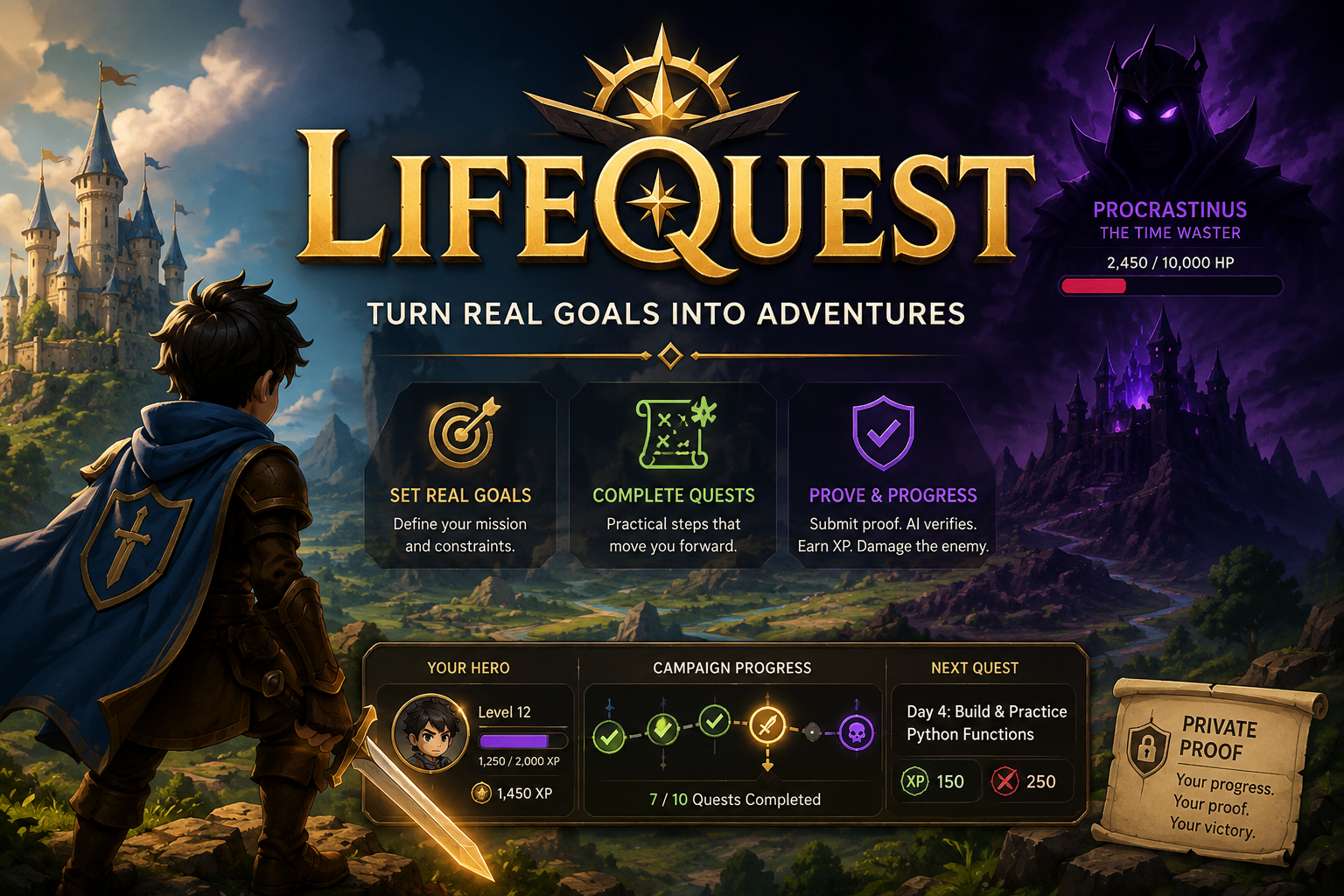
Landing Page

Inspiration
Large goals often fail for a simple reason: the next action is unclear, progress feels invisible, and motivation disappears before meaningful results appear.
Most productivity applications present users with another list of tasks. I wanted to explore a different approach: what if completing a real goal felt like progressing through an adventure?
LifeQuest transforms practical goals into focused role-playing campaigns. The fantasy layer is not a distraction from the work—it gives the work context, momentum, visible stakes, and a sense of progression.
What it does
LifeQuest allows a user to describe:
- A real-world goal
- The time they can commit each day
- Their biggest obstacle
- Their preferred difficulty
GPT-5.6 converts these constraints into a structured campaign containing:
- A hero identity
- A themed realm
- A nemesis representing the user's obstacle
- A practical sequence of quests
- Visible success requirements
- XP rewards and enemy damage
Users open a quest, complete the real-world task, and submit private image or screenshot proof.
On the live path, proof is processed on the server. The image is validated and moderated before GPT-5.6 assesses it against every success requirement. The result includes a clear requirement-by-requirement explanation rather than only a vague accepted or rejected verdict.
When proof is accepted, the user earns XP, damages the campaign enemy, unlocks progression, and moves closer to completing the campaign.
The browser never decides its own reward. XP and enemy damage are applied through a server-authoritative, idempotent PostgreSQL function so repeated requests cannot award progress twice.
How we built it
LifeQuest is built as a single Next.js App Router application using:
- Next.js and React
- Strict TypeScript
- Tailwind CSS
- Supabase Authentication
- Supabase PostgreSQL
- Row Level Security
- Private Supabase Storage
- OpenAI Responses API
- GPT-5.6 Structured Outputs
- OpenAI image understanding and moderation
- OpenAI Realtime for narration
- Zod validation
- Vitest and Testing Library
- Playwright browser testing
- Vercel for deployment
Campaign generation uses a schema-validated GPT-5.6 response. Generated quests are checked for ordering, practical duration, reward limits, difficulty, and complete success requirements before they are saved.
Campaign and quest creation is atomic, preventing partially created campaigns.
Proof files remain private and are stored in user-scoped paths. File size, MIME type, binary signature, ownership, and quest status are checked before verification.
Supabase Row Level Security restricts users to their own profiles, campaigns, quests, and submissions.
How Codex helped
Codex was used throughout the core development workflow rather than only for isolated code suggestions.
It helped inspect and recover the initial incomplete project, complete the Next.js route structure, diagnose strict TypeScript failures, implement reusable interface states, strengthen Supabase security, and build automated tests around the most sensitive application boundaries.
Codex also helped with:
- App Router pages and route handlers
- Zod schemas and AI response contracts
- Atomic and idempotent database functions
- Private proof-validation logic
- Authentication and authorization boundaries
- Responsive layouts down to 320px
- Keyboard and reduced-motion accessibility
- Unit and browser testing
- Production-hardening checks
- Deployment and handoff documentation
I remained responsible for the key product and engineering decisions: limiting the MVP to one focused progression loop, keeping proof private, preventing the browser from awarding rewards, using an honest deterministic presentation fallback, and avoiding unrelated social, marketplace, and payment features.
How GPT-5.6 is used
GPT-5.6 has two meaningful runtime responsibilities.
First, it transforms a user's practical goal and constraints into a bounded, structured RPG campaign. The output is validated before it can enter the database.
Second, it assesses private proof against every visible quest requirement. It returns a structured verdict with a separate assessment for each requirement.
The model is treated as an untrusted external boundary. Its outputs are schema-validated, low-confidence or incomplete assessments are rejected, and progression is applied only after server-side verification succeeds.
Challenges we faced
Making AI progression trustworthy
The most important challenge was preventing a user or browser request from directly claiming success, XP, or enemy damage.
We solved this by moving progression into a service-role-only PostgreSQL function with row locking and idempotency protection.
Protecting private proof
Proof images may contain private information, so files must not be publicly accessible.
LifeQuest uses a private storage bucket, user-scoped paths, server-side ownership validation, file-signature checks, moderation, and privacy-safe verification receipts.
Keeping generated quests practical
A creative campaign is not useful if its quests are vague or impossible.
The application validates generated quest order, daily-time constraints, reward ranges, success requirements, and difficulty before persistence.
Building a reliable presentation
Live AI and external services can fail during a short demonstration. LifeQuest therefore includes an explicitly labelled seeded demo with deterministic accepted and rejected proof examples.
The seeded mode is never presented as live AI. It exists so judges can reliably experience the complete interaction and progression loop, while the repository contains the separate live OpenAI and Supabase path.
Accomplishments that we're proud of
- A complete goal-to-campaign-to-proof progression loop
- Structured GPT-5.6 campaign generation
- Explainable proof assessment
- Private proof storage
- Server-authoritative rewards
- Duplicate-safe XP and enemy damage
- Supabase Row Level Security
- A responsive fantasy interface
- Keyboard and reduced-motion accessibility
- Automated unit, security-contract, and browser tests
- A reliable and honestly labelled seeded demonstration
- Clear separation between simulated presentation behavior and live AI behavior
What we learned
AI applications need more than a prompt and a model call.
Reliable AI products require validation, authorization, failure handling, privacy controls, idempotency, testing, and honest communication about which results are live and which are simulated.
Structured Outputs made it possible to treat GPT-5.6 as a controlled application component rather than an unrestricted text generator.
Codex was most useful when it worked across the whole repository: understanding architecture, tracing failures across boundaries, implementing focused changes, running tests, and documenting remaining limitations.
What's next for LifeQuest
The next stage is broader live evaluation across different goal categories and proof types.
Future work includes:
- Evaluating more real proof samples
- Improving adaptive quest quality
- Supporting more campaign themes
- Expanding goal-category coverage
- Adding deeper long-term campaign analytics
- Testing progression with a wider user group
The immediate priority remains the same: make the next real-world action concrete, keep the evidence private, and make progress difficult to fake.
Built With
- api
- codex
- css
- form
- framer
- github
- gpt-5.6
- hook
- level
- motion
- next.js
- openai
- playwright
- postgresql
- react
- realtime
- responses
- row
- security
- supabase
- tailwind
- typescript
- vercel
- vitest
- zod


Log in or sign up for Devpost to join the conversation.