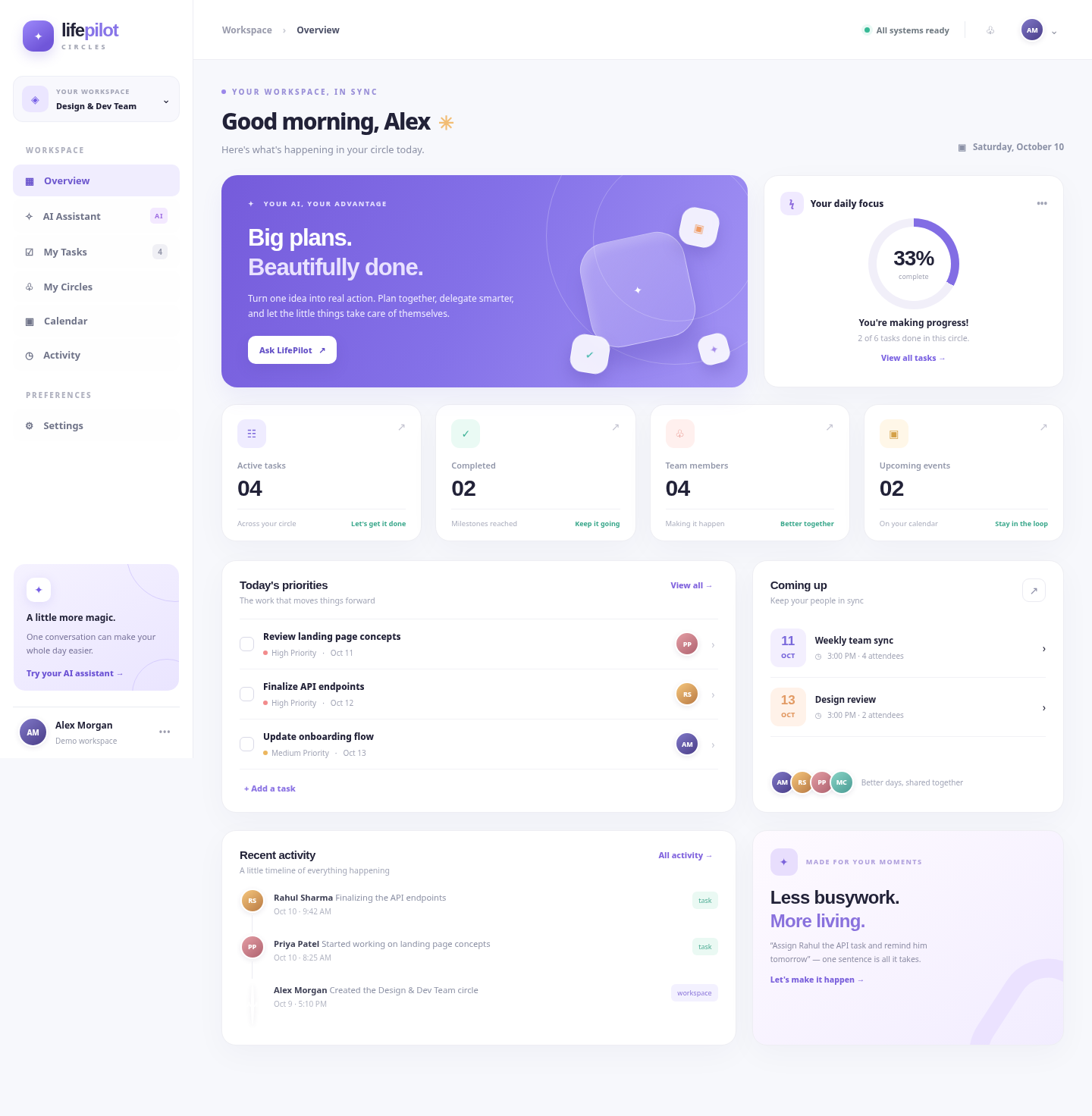
LifePilot AI — Your Intelligent Personal Action Assistant
Inspiration
Every day, people switch between multiple applications to manage tasks, organize schedules, track goals, and find information. AI assistants can answer questions, but many cannot take meaningful actions across the tools people already use.
We want to explore how an intelligent assistant can move beyond conversation and become an action-oriented personal productivity companion.
That inspired LifePilot AI, an AI-powered assistant designed to understand natural-language requests, plan tasks, connect with external services, and execute authorized actions using the Model Context Protocol (MCP).
What it does
LifePilot AI aims to make everyday productivity easier through a single conversational interface.
Planned capabilities include:
- Natural-language interaction: Understand requests through text and potentially voice.
- AI-powered task planning: Convert complex goals into manageable steps.
- Smart scheduling: Organize tasks, priorities, and study plans.
- MCP integrations: Connect the assistant to external services through reusable tools.
- Agentic workflows: Coordinate multiple steps instead of generating only text responses.
- Human-in-the-loop approval: Request permission before making sensitive changes.
- Task tracking: Display actions, progress, and execution results.
- Persistent context: Maintain task history and relevant user preferences.
Example
A user asks:
"Help me learn AWS Bedrock in seven days and organize my study schedule."
LifePilot AI is designed to break the goal into daily objectives, prepare actionable tasks, request confirmation, create approved tasks, and track progress.
How we're building it
Our proposed architecture combines a modern web application with a Python-based AI agent and MCP server.
Frontend
- Next.js and TypeScript
- Tailwind CSS
- Conversational dashboard
Backend
- Python and FastAPI
- MCP server using Streamable HTTP
- PostgreSQL for application data
AI and orchestration
- LangGraph or AWS Strands Agents
- Amazon Bedrock for model inference, subject to availability and cost
- Tool calling and structured outputs
- Stateful workflows with approval checkpoints
Deployment
- Cloud-hosted MCP endpoint
- HTTPS and secure authentication
- Logging, testing, and monitoring
Challenges we want to solve
Our biggest engineering challenge is building an AI agent that can safely execute real actions rather than simply respond with generated text.
We plan to investigate:
- How agents discover and invoke MCP tools.
- How to maintain context across multiple tool calls.
- How to prevent unauthorized or unintended actions.
- How to manage failures, retries, and partial execution.
- How to expose a reliable MCP interface for an Alexa+-oriented experience.
What we hope to learn
We joined this hackathon primarily to gain hands-on engineering experience.
Our learning goals are to understand MCP architecture, agent orchestration, tool integration, cloud AI services, authentication, and production-ready backend design.
We also want to improve our teamwork, testing, documentation, and technical demonstration skills.
What's next
Our first milestone is a functioning MCP server connected to an AI agent that can manage tasks safely.
Once the core integration works, we plan to expand LifePilot AI with scheduling, additional integrations, voice interaction, and smarter personalized workflows.
Our vision: Turn AI from something that only answers questions into something that helps people get things done.
Built With
- amazon-alexa
- amazon-bedrock
- amazon-web-services
- docker
- fastapi
- github
- langgraph
- mcp
- next.js
- oauth-2.0
- postgresql
- python
- react
- tailwind-css
- typescript
