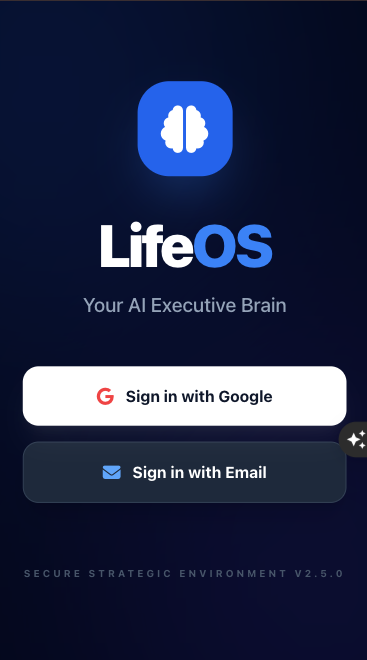
🧠 LifeOS — Building an AI Executive Brain for Human Potential
🚀 The Inspiration
LifeOS was born from a simple but powerful realization:
We use AI to optimize businesses, logistics, and code — but not our own lives.
Most people set goals in isolation, forget lessons from past experiences, and make decisions without long-term simulation. I wanted to build something different — an AI executive brain that helps individuals think strategically about their own lives.
LifeOS is designed to function like a personal board of directors: tracking goals, remembering context, identifying risks, simulating the future, and helping users make high-leverage decisions.
🎯 What Problem Does LifeOS Solve?
People struggle with:
- Scattered goals across apps
- No strategic long-term thinking
- Forgetting important life lessons
- Lack of structured decision support
- Burnout from poor life balance
LifeOS solves this by combining:
- Goal optimization
- Memory intelligence
- Future simulation
- AI-powered life analysis
It transforms raw personal data into strategic life clarity.
🏗️ How I Built It
LifeOS is built as a full-stack AI-native application using:
- Frontend: React 19 + TypeScript + Vite
- Backend: Node.js + Express on Firebase Functions
- Database: Firestore
- Vector Search: Pinecone
- AI: OpenAI GPT-4o
- Hosting: Firebase Hosting
🧠 AI Architecture
The core innovation is memory-augmented reasoning:
- User memories are embedded using
text-embedding-3-small - Stored in Pinecone vector database
- Retrieved via semantic similarity
- Injected into GPT-4o context for personalized responses
This creates an adaptive AI system that improves as users add more data.
In simplified terms:
$$ Decision\ Quality \propto Context\ Depth $$
The more structured context the AI has, the better its strategic recommendations.
🔥 Key Innovations
1️⃣ Executive Chat with Memory Context
Not just a chatbot — it retrieves relevant past experiences and uses them to give structured executive-level responses:
- Situation summary
- Action plan
- Priority tasks
2️⃣ AI Goal Optimization Engine
Each goal is analyzed for:
- Success probability (0–100%)
- Risk factors
- Missing milestones
- Health score
This turns vague ambitions into executable strategy.
3️⃣ Future Simulation Engine
Users can simulate 1–20 year trajectories in:
- Safe Mode
- Moderate Mode
- Ambitious Mode
The AI generates:
- Financial projections
- Career evolution
- Health trajectories
- Risk analysis
This forces long-term thinking before decisions are made.
4️⃣ Life Graph Dependency Analysis
Interactive node graph visualizing:
- Goals
- Habits
- Risks
- Relationships
- Projects
AI identifies:
- Bottlenecks
- Leverage points
- Single points of failure
🧩 Challenges I Faced
⚙️ 1. Designing AI That Feels Strategic, Not Generic
Prompt engineering was critical. Early versions produced surface-level advice. I refined structured prompts and response templates to ensure outputs included:
- Concrete actions
- Risk awareness
- Strategic framing
🔎 2. Memory Context Without Overloading Tokens
Retrieving too much memory degraded performance. I implemented:
- Importance scoring
- Vector similarity ranking
- Controlled context injection
This kept responses relevant and efficient.
🔐 3. Secure Multi-Tenant Architecture
Each user’s:
- Firestore data
- Pinecone vectors
- AI interactions
Had to be completely isolated. I designed strict Firebase security rules and per-user vector namespaces.
📊 4. Balancing Intelligence with UX
A powerful AI system is useless if overwhelming. I focused on:
- Clean dark-mode UI
- Glass morphism design
- Clear dashboards
- Guided onboarding
📚 What I Learned
- AI becomes exponentially more powerful when given structured personal data.
- Vector databases are essential for long-term contextual memory.
- Strategic framing matters more than raw intelligence.
- Building AI products requires equal focus on UX and prompt design.
🌍 Why LifeOS Matters
We are entering a world where AI will be everyone’s assistant.
LifeOS pushes that idea further:
Not just assistance — but strategic augmentation.
It helps users:
- Think in decades, not days
- Identify leverage points in life
- Avoid predictable failure paths
- Make data-informed personal decisions
🔮 The Vision
LifeOS is Version 1 of a larger mission:
To build the world’s first AI-powered operating system for human potential.
Future plans include:
- Mobile apps
- Habit tracking
- Calendar integrations
- Voice interface
- AI coaching system
🏁 Final Thought
LifeOS is more than a productivity tool.
It is an experiment in answering a bigger question:
What happens when you give every individual their own AI executive brain?
And this is just the beginning.
Built With
- cloud
- firebase
- firebase-authentication
- firebase-cloud-functions-(node.js-20)
- firebase-hosting
- firestore
- openai-gpt-4o-api
- openai-text-embedding-3-small
- pinecone-vector-database
- react-19
- recharts
- storage.
- typescript
- vite

Log in or sign up for Devpost to join the conversation.