LifeOS: Personal Operating System
Inspiration
Seven apps. One life. Zero coordination.
A calendar that didn't know about my deadlines. A habit tracker I kept forgetting to open. A job tracker living inside a spreadsheet. A notes app full of things I never acted on. None of them knew me — what I was working toward, how I was feeling, what was quietly slipping away.
I was tired of managing the tools instead of living the life.
Then my sister, a doctor, saw the early version and said: "I need something like this too. But for patient calls, medical records, my own health."
That sentence changed everything. The problem wasn't mine alone. Every person alive is managing a life work, health, goals, relationships, growth and most of them are doing it scattered across systems that were never designed to work together.
I rebuilt it. For everyone.
What it does
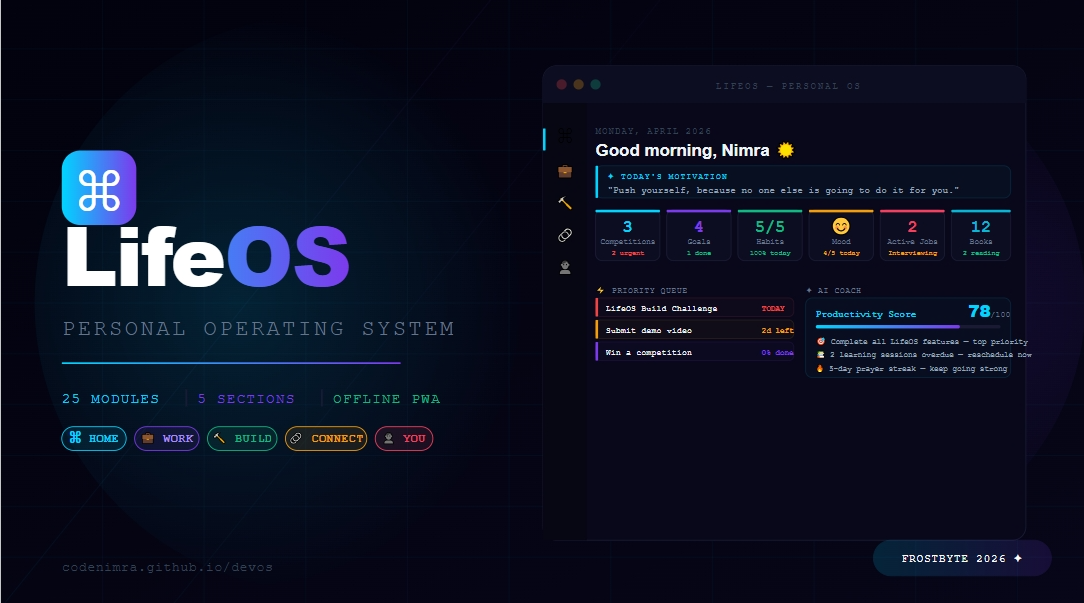
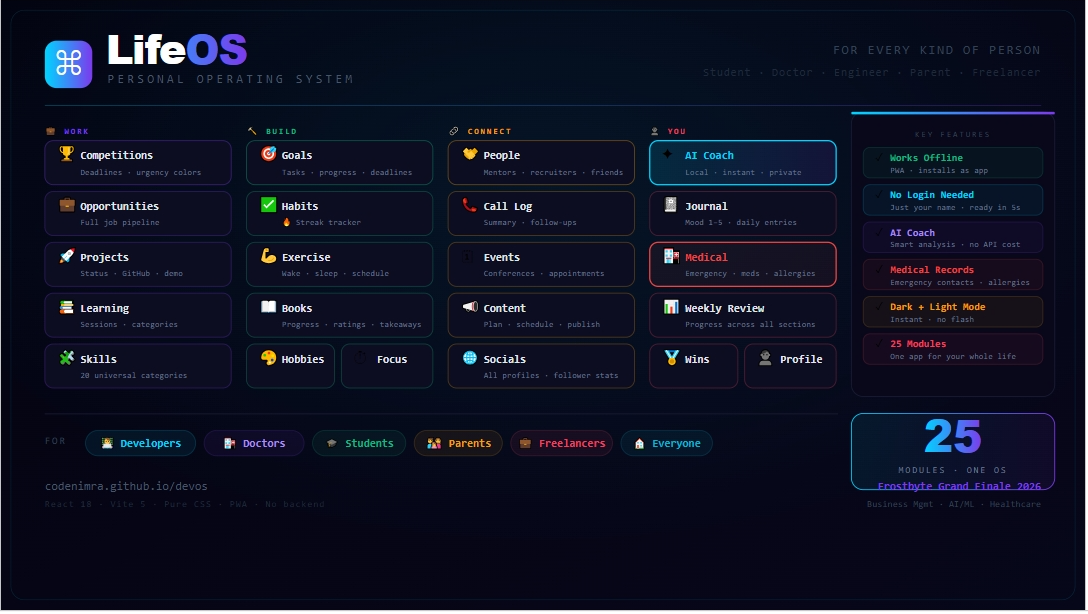
LifeOS is a personal operating system 25 modules covering every dimension of daily life, organized into five sections.
Work — Competitions and deadlines with color-coded urgency. A full job opportunity pipeline. Active projects. Learning sessions. A skills map that works for any field: software, medicine, design, business, or anything else.
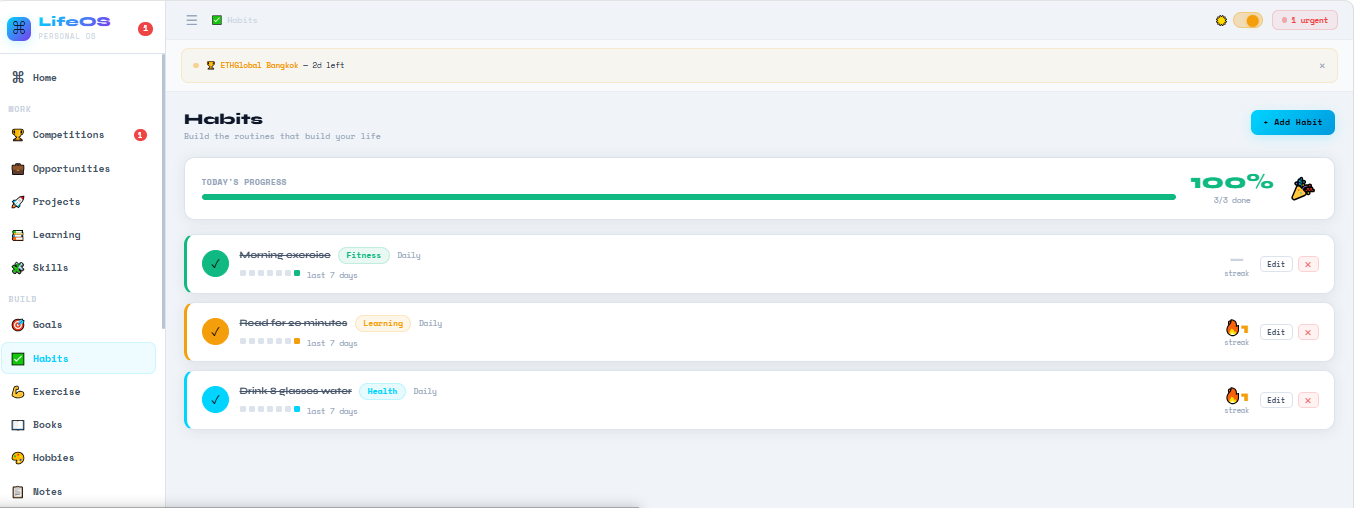
Build — Goals with sub-task breakdowns and progress bars. Daily habits with 7-day streak tracking. Exercise logging with a customizable daily schedule. A reading list with progress, ratings, and key takeaways. Hobby time management with weekly hour goals. A built-in Pomodoro focus timer.
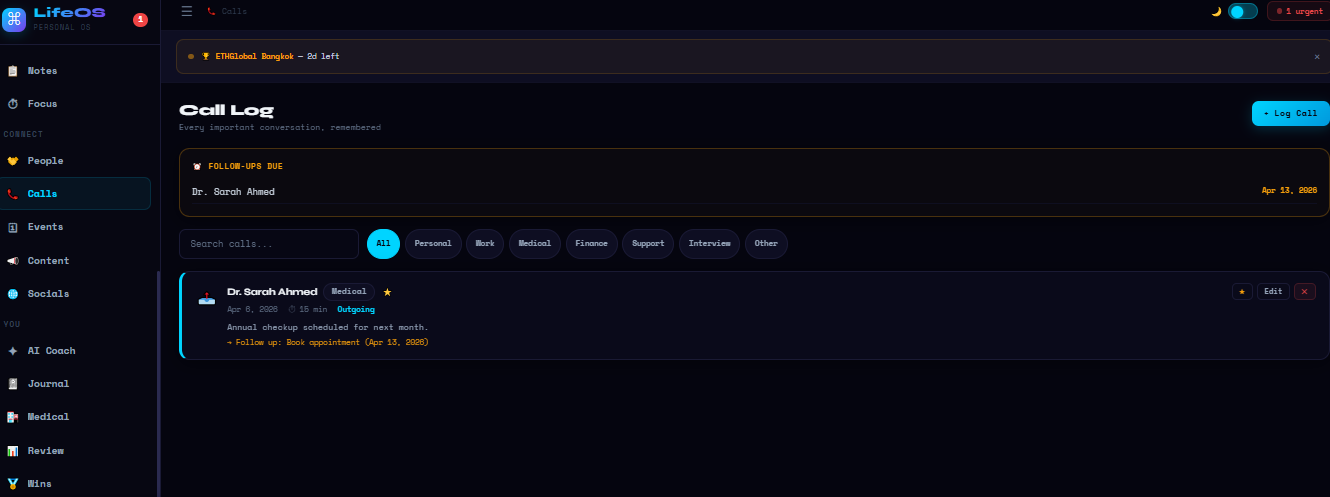
Connect — A people network for mentors, colleagues, doctors, and friends. A call log with summaries and follow-up reminders. Events, content calendar, and all social profiles in one place.
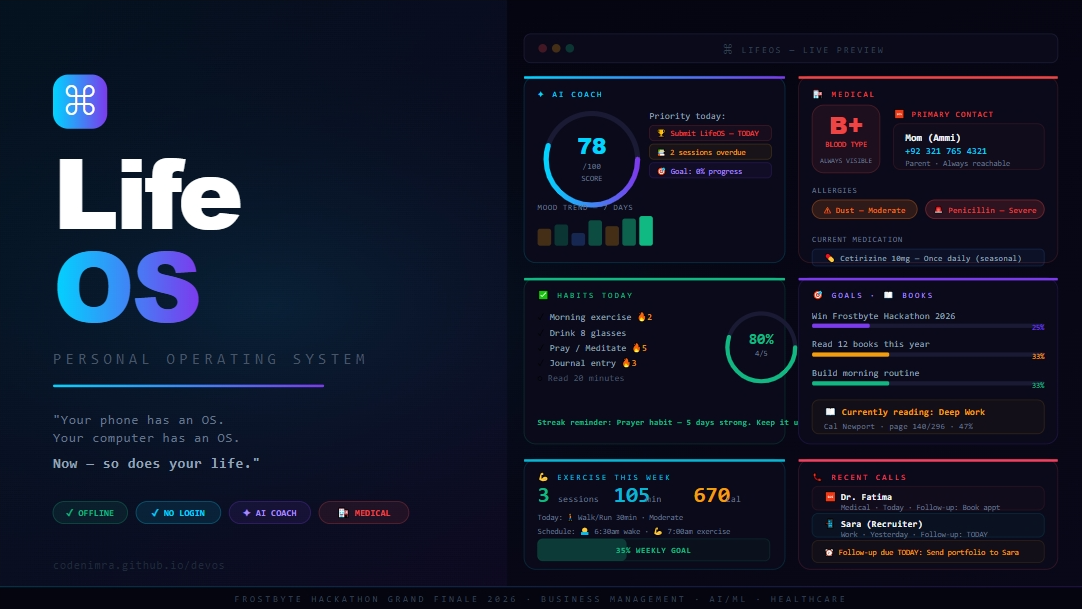
You — Daily journal with 1–5 mood tracking. A complete medical profile: emergency contacts, blood type, medications, and allergies with severity levels. Weekly progress review. Achievement tracking. An AI Coach that reads your actual life.
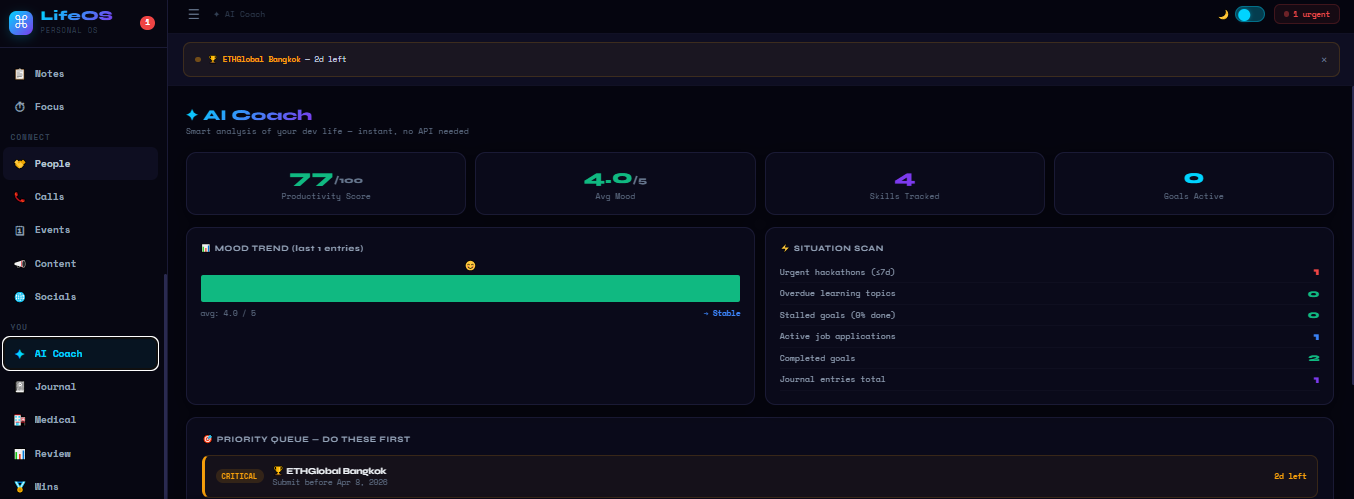
AI Coach — The intelligence layer. It evaluates your deadlines, mood patterns, habit streaks, stalled goals, and skill gaps then returns a priority queue, a productivity score, smart suggestions, and a full progress breakdown. Instantly. No API key. No internet. No cost. Complete privacy.
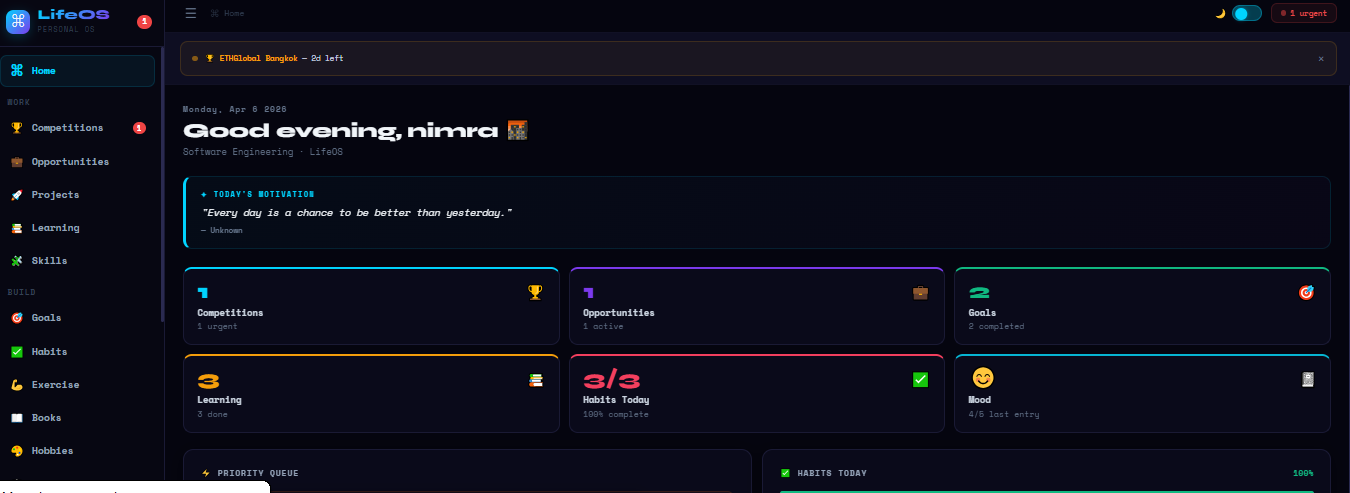
Every section opens with real sample data. No setup. No confusion. Open it and understand it in under ten seconds.
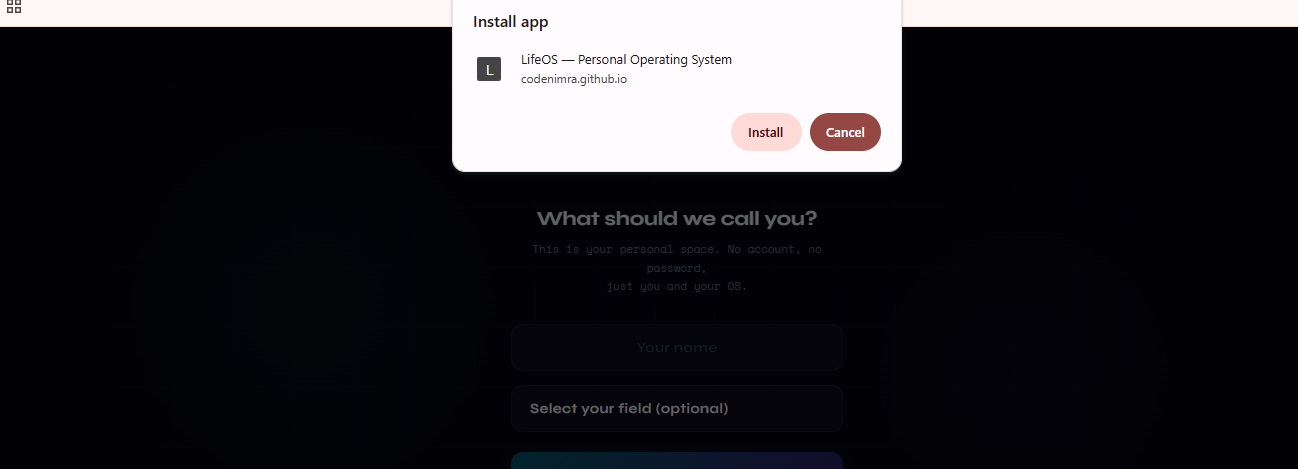
It works fully offline. Installs as an app. Requires no account and no password just your name, and your OS is ready.
How I built it
React 18 and Vite 5 fast, lean, native-feeling in the browser.
Styling is pure CSS with CSS variables. No frameworks, no libraries. Dark and light themes switch on a single HTML attribute. Every color, spacing token, and animation is defined once and consistent across all 25 modules.
The AI Coach runs entirely in the browser. It evaluates real user data against carefully designed signals deadline urgency, mood trajectory, habit consistency, goal stall patterns, skill gaps and returns insight that feels personal because it is reading your data. No external calls. Zero latency. Full privacy.
Full PWA support: service worker, web manifest, and offline caching. LifeOS works without an internet connection and installs directly to a home screen on any device.
The Medical section required the most deliberate design. Emergency contacts with primary flagging, blood type display, medications, allergies with severity levels, and health conditions structured so the most critical information surfaces first, instantly, when it matters most.
Live at codenimra.github.io/devos. Open to anyone with a browser.
Challenges I ran into
Architecture at scale. Building 25 fully functional modules each with its own data model, forms, filtering, and UX while keeping the product coherent required real discipline. I started with a single file that grew past 1,700 lines, then refactored into a proper multi-file structure: 25 page components, 3 layout components, custom hooks, utility modules, and a constants layer. One wrong import path brought down the entire build. Several times, it did.
Deployment. Netlify auto-detected the project as a Remix app. Vercel failed because Vite was in devDependencies. GitHub Pages needed a custom base path in the Vite config. Each platform failed for a different reason. I resolved all of them.
Designing intelligence without an API. Building an AI Coach that feels genuinely insightful without any external calls meant thinking carefully about what signals actually matter in a real person's life. Not just what is overdue, but what patterns are forming. Not just what is urgent, but what is being avoided. That thinking made the product better.
Scope. Twenty-five modules, full architecture, PWA support, deployment, documentation, architecture diagrams, demo video, and this story all inside a hackathon window, alone.
Accomplishments I'm proud of
LifeOS is a complete, working product not a prototype. Every module functions. Every section opens with real data already present so any visitor understands the value without filling in a single form.
The Medical section is the feature I am most personally proud of. No mainstream productivity tool has it. Blood type, emergency contact, critical allergies, medications organized, accessible, and potentially life-saving. That is not a feature that belongs only in a hospital system. It belongs in the pocket of every person.
The AI Coach delivering real, personalized insight from local data with zero latency, zero API cost, and complete privacy is something I am proud of both technically and philosophically. Intelligence should not require sending your personal life to a server.
Building this alone 25 modules, full stack, deployed and live inside a hackathon window is the accomplishment I will carry longest.
What I learned
Design for a real person, not a user type. Every feature in LifeOS exists because a specific person a student, a parent, a doctor, a freelancer has a genuine need for it. That specificity produces better products than any amount of abstract persona work.
Constraints produce creativity. No external API forced me to think harder about what insight actually means. No UI framework forced me to understand CSS deeply enough to build a polished, themeable interface from scratch. Both constraints made the product stronger.
Architecture decisions made early compound across the entire build. A flat file structure is fast to start and painful to finish. A modular structure costs time upfront and saves everything afterward.
The most useful products are not the most complex ones. LifeOS works because it removes friction one place, one system, zero barriers. That simplicity was the hardest design decision to hold. It was worth every moment.
Built With
- ai
- claude
- css3
- github
- html
- javascript
- react
- vite


Log in or sign up for Devpost to join the conversation.