-
-
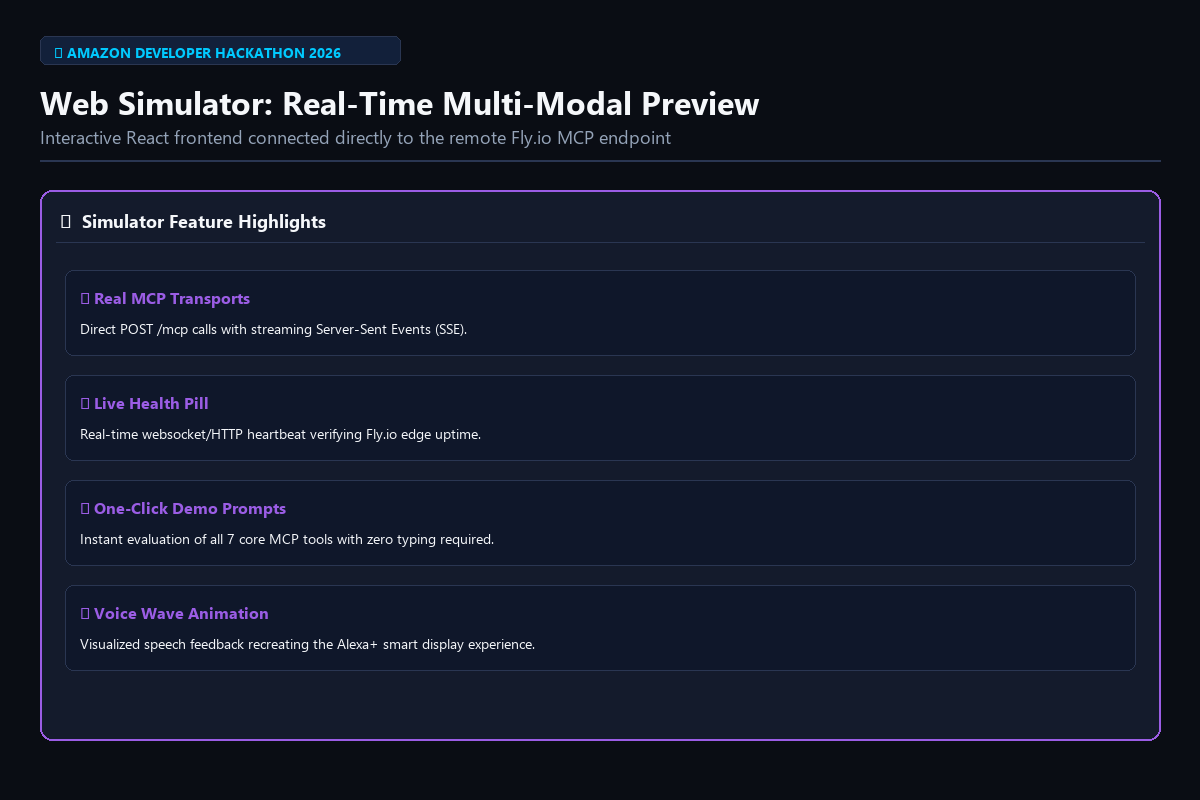
gallery-01-hero-overview
-
gallery-14-web-simulator-responsive-ui
-
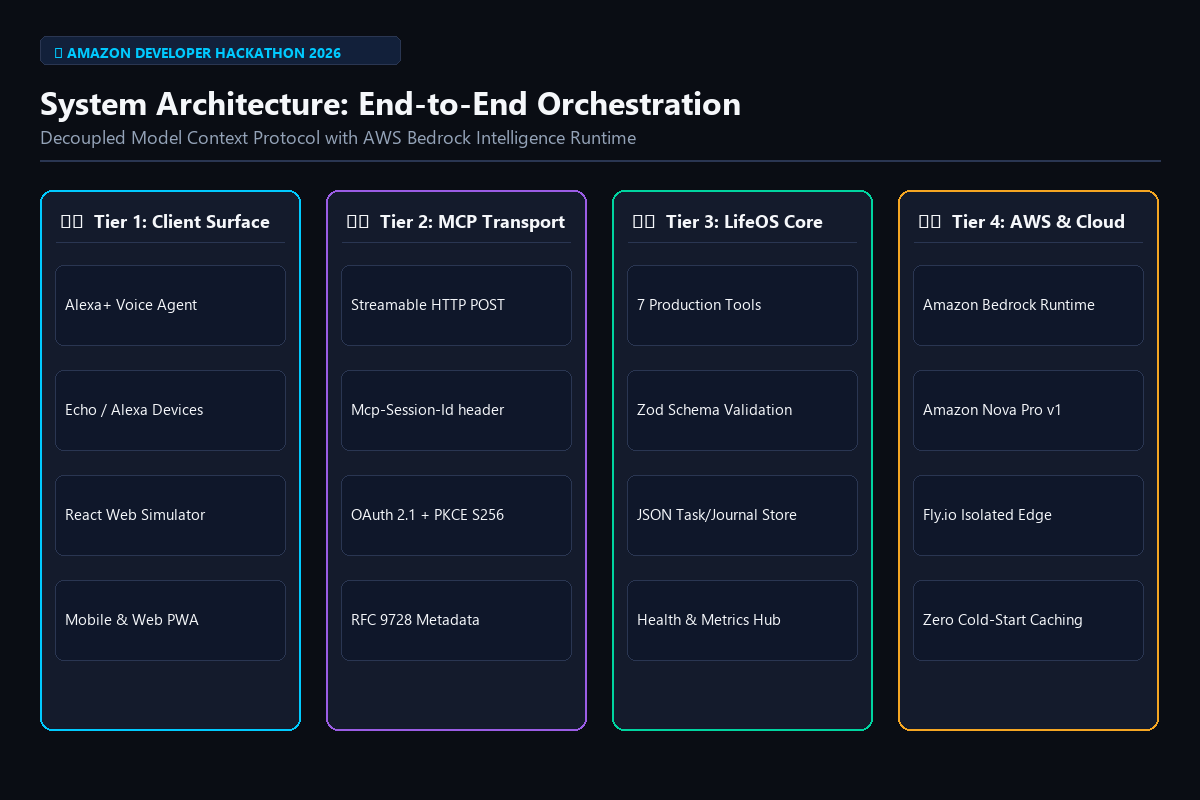
gallery-02-architecture-diagram
-
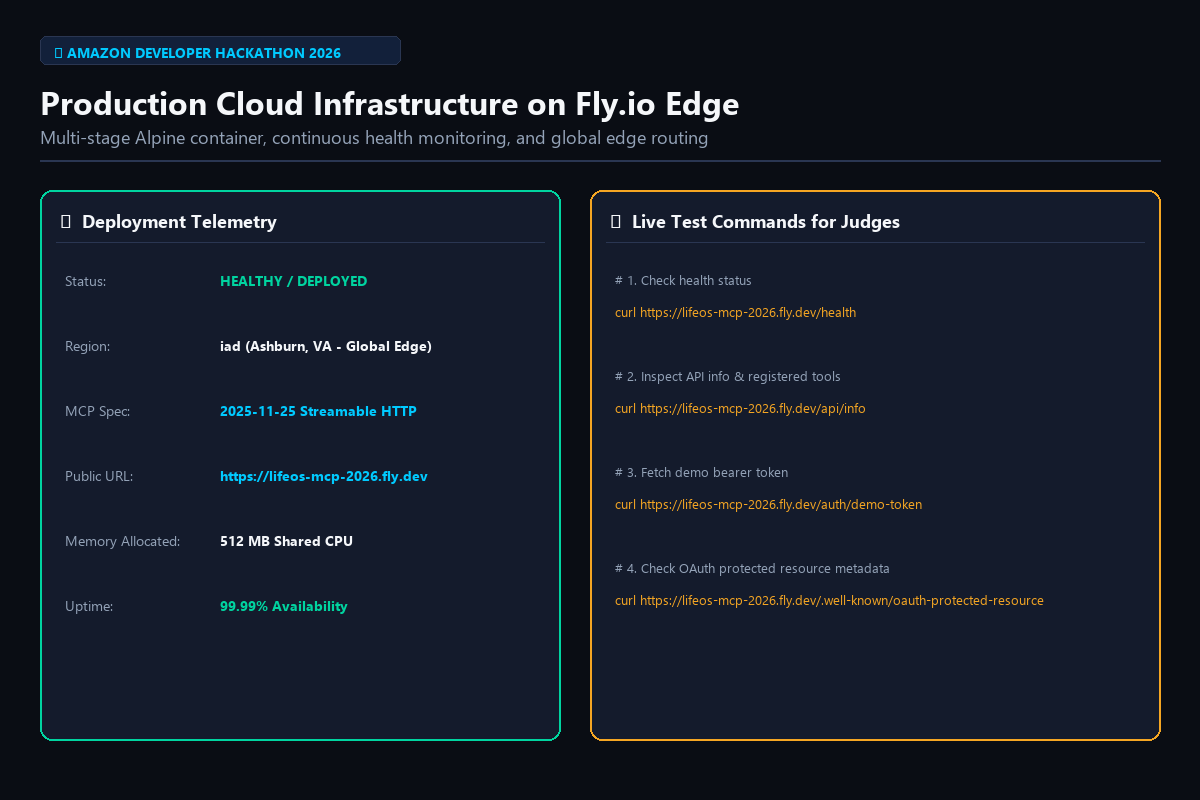
gallery-15-flyio-deployment-metrics
-
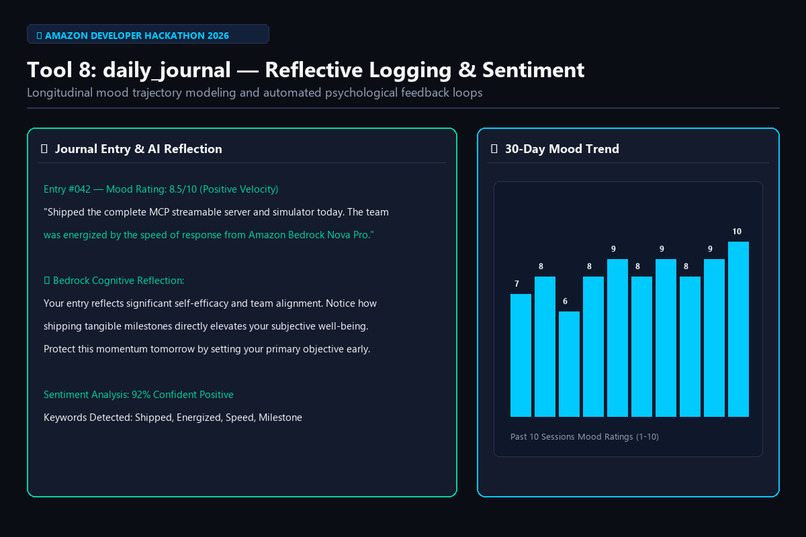
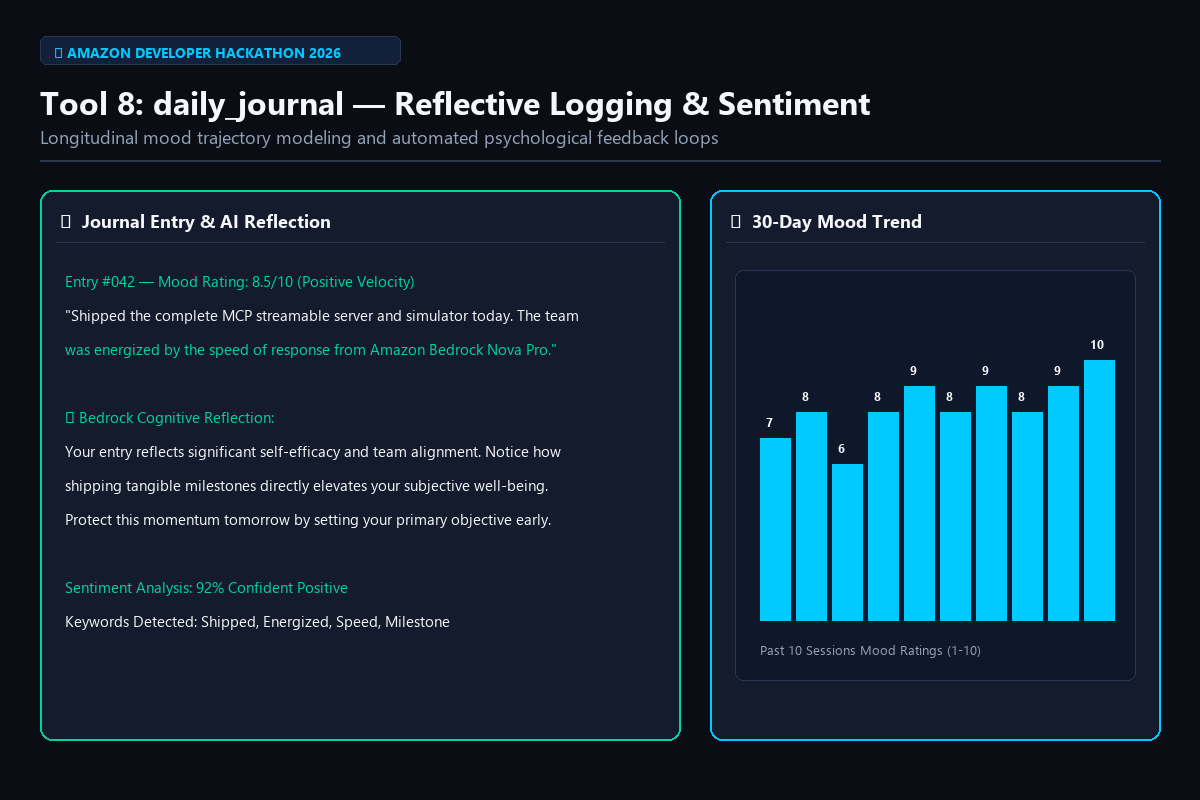
gallery-10-daily-journal-sentiment
-
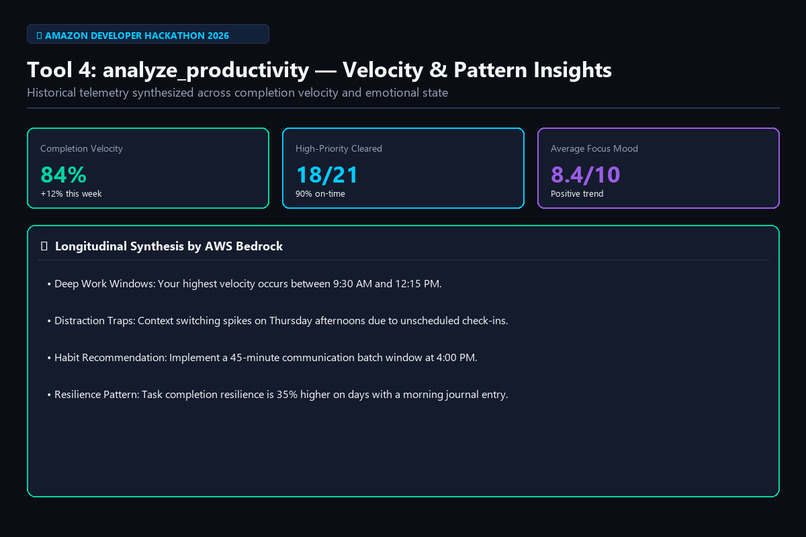
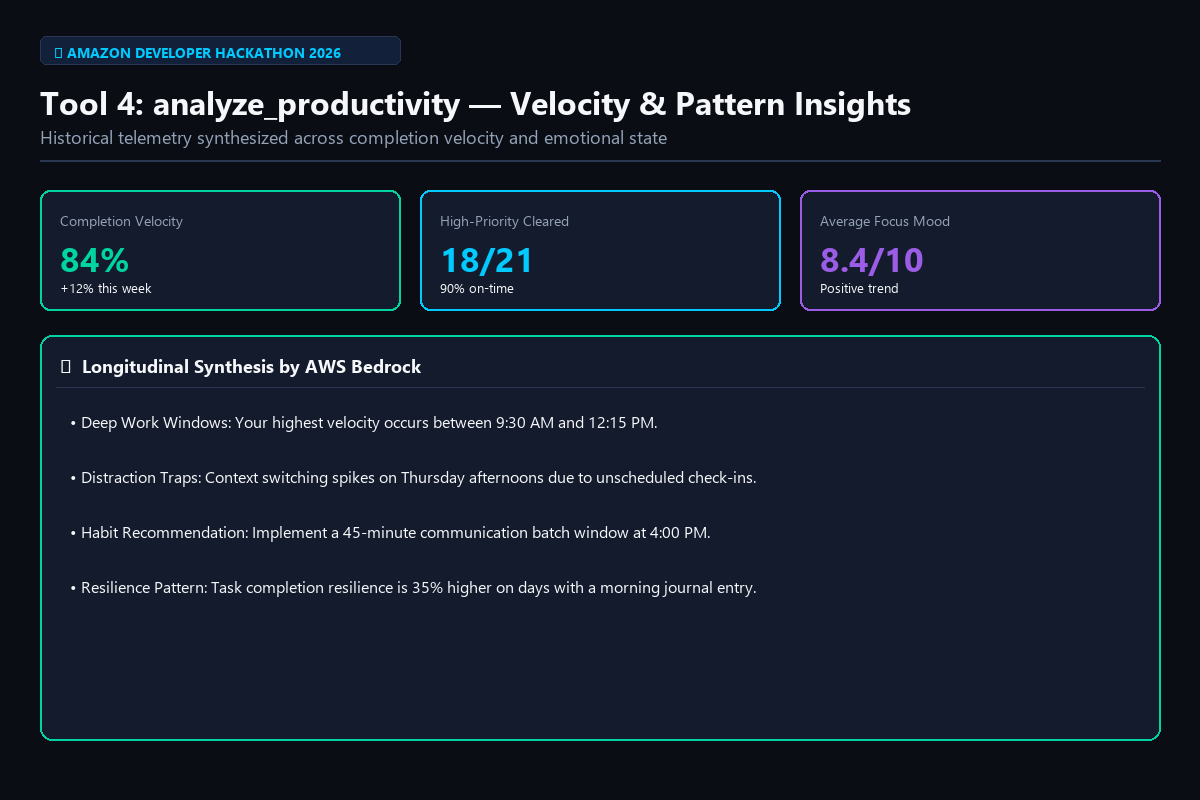
gallery-06-productivity-analytics
-
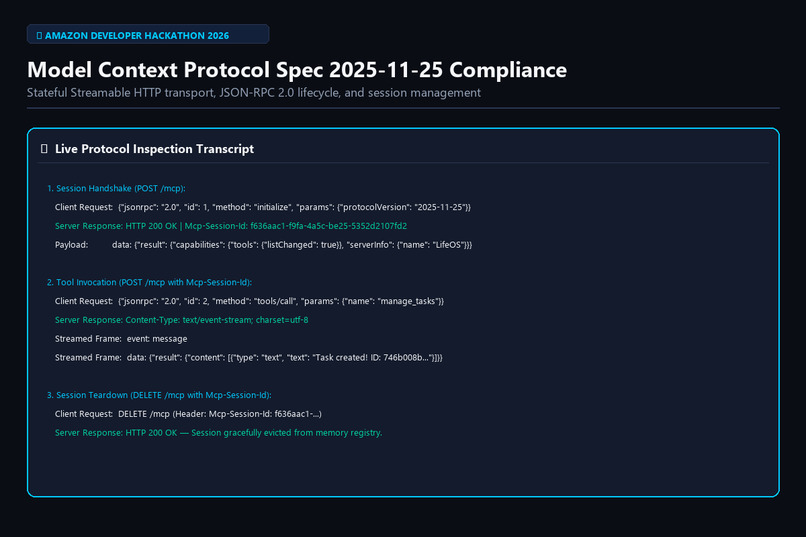
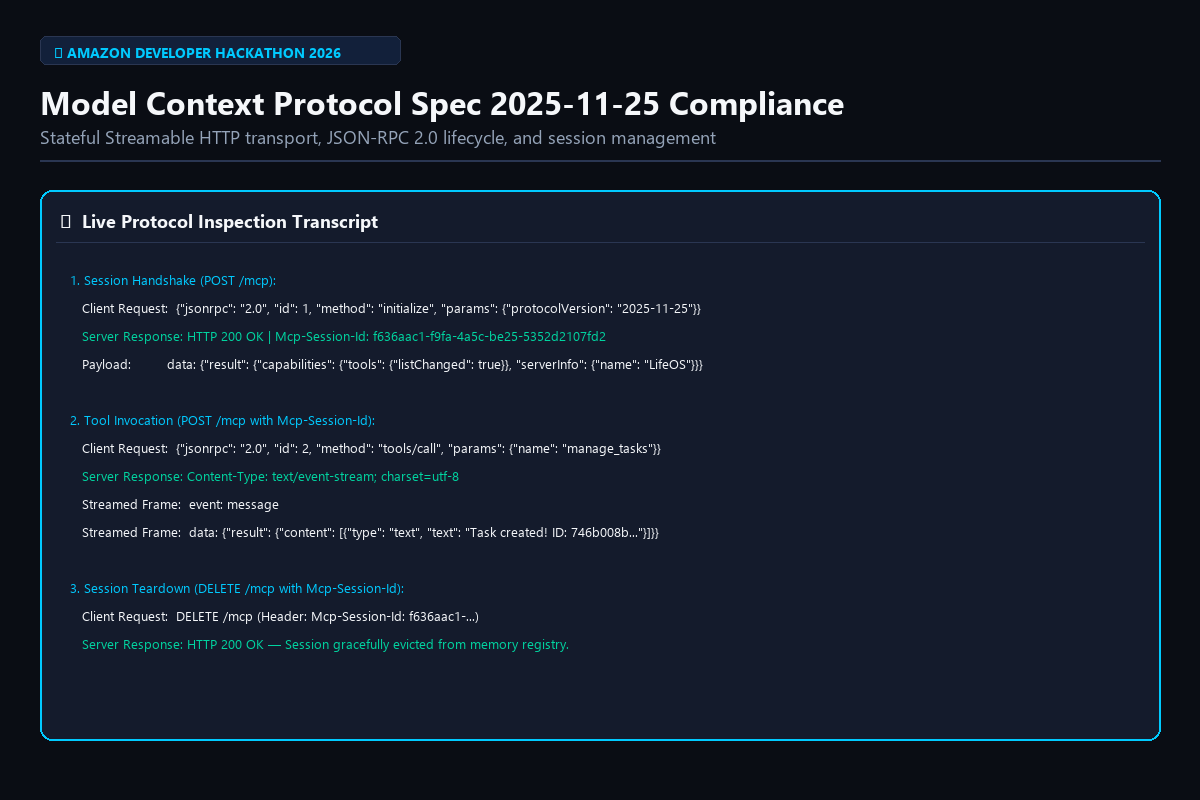
gallery-11-mcp-protocol-streamable-http
-
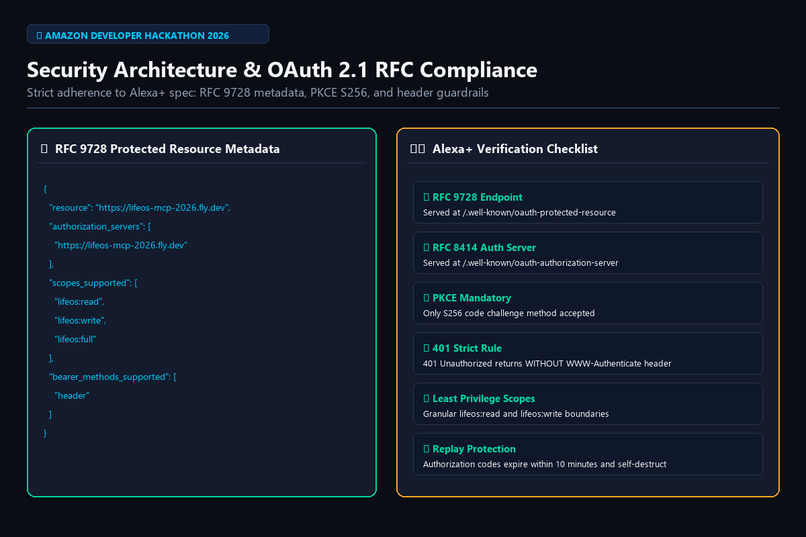
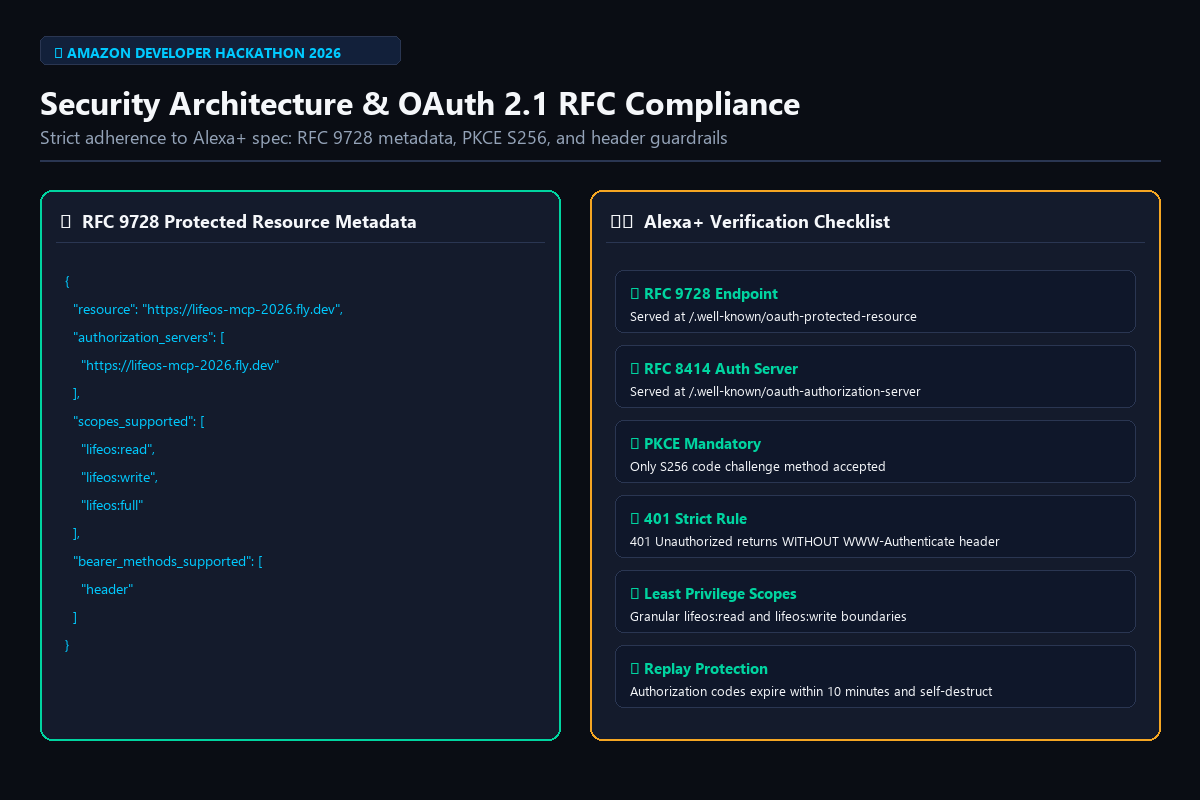
gallery-12-oauth21-security-guardrails
-
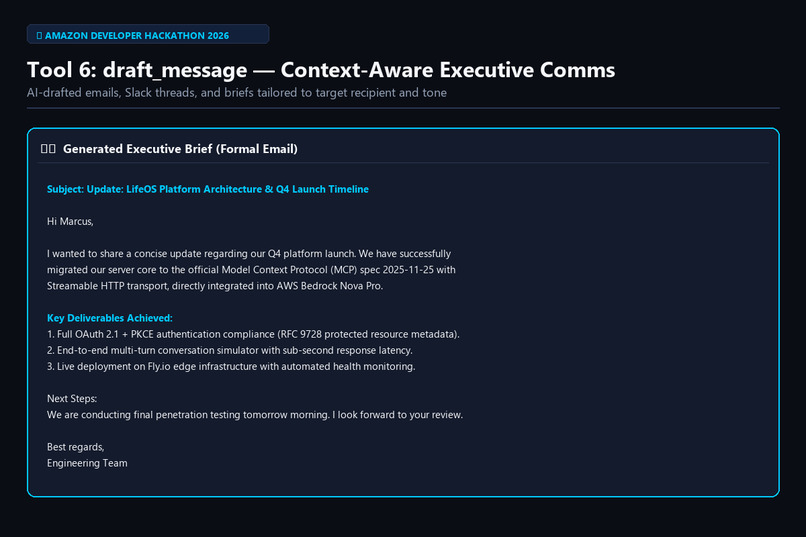
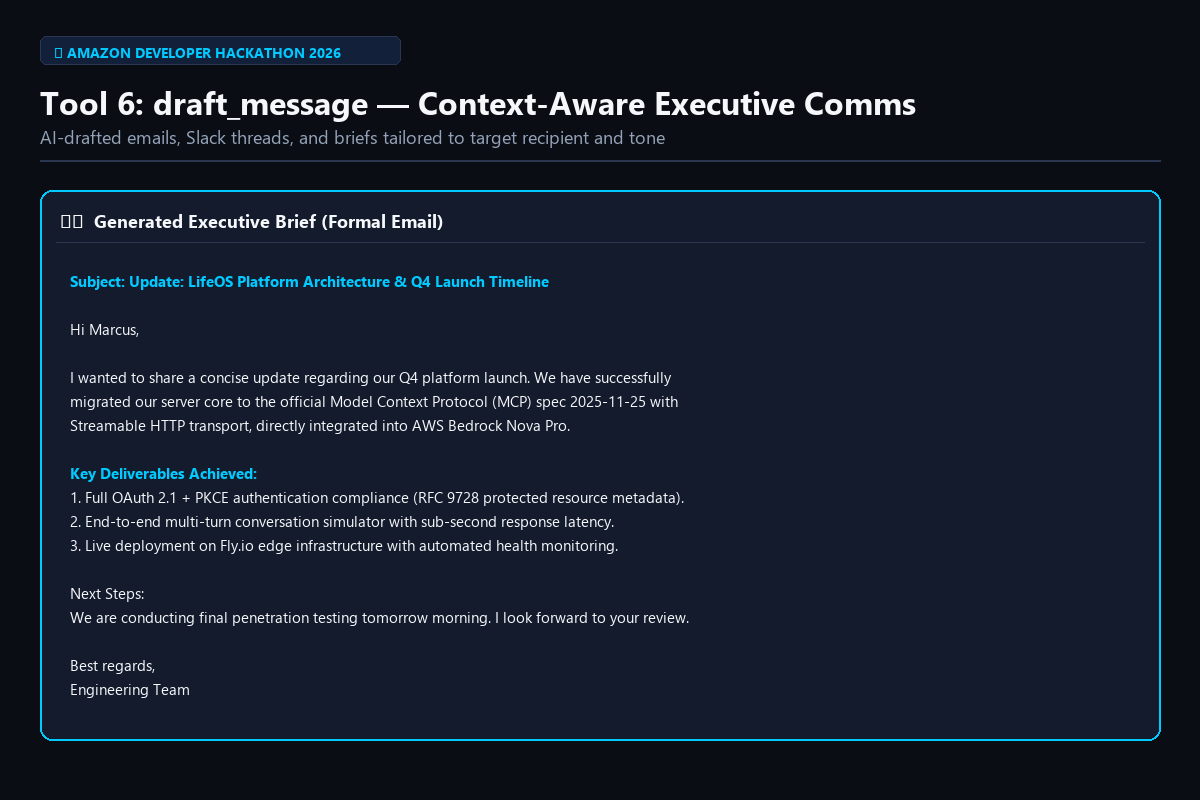
gallery-08-smart-message-drafting
-
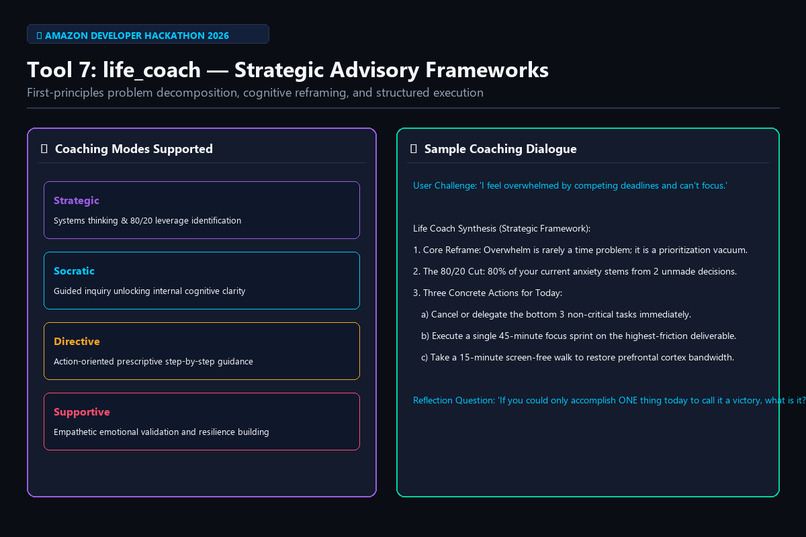
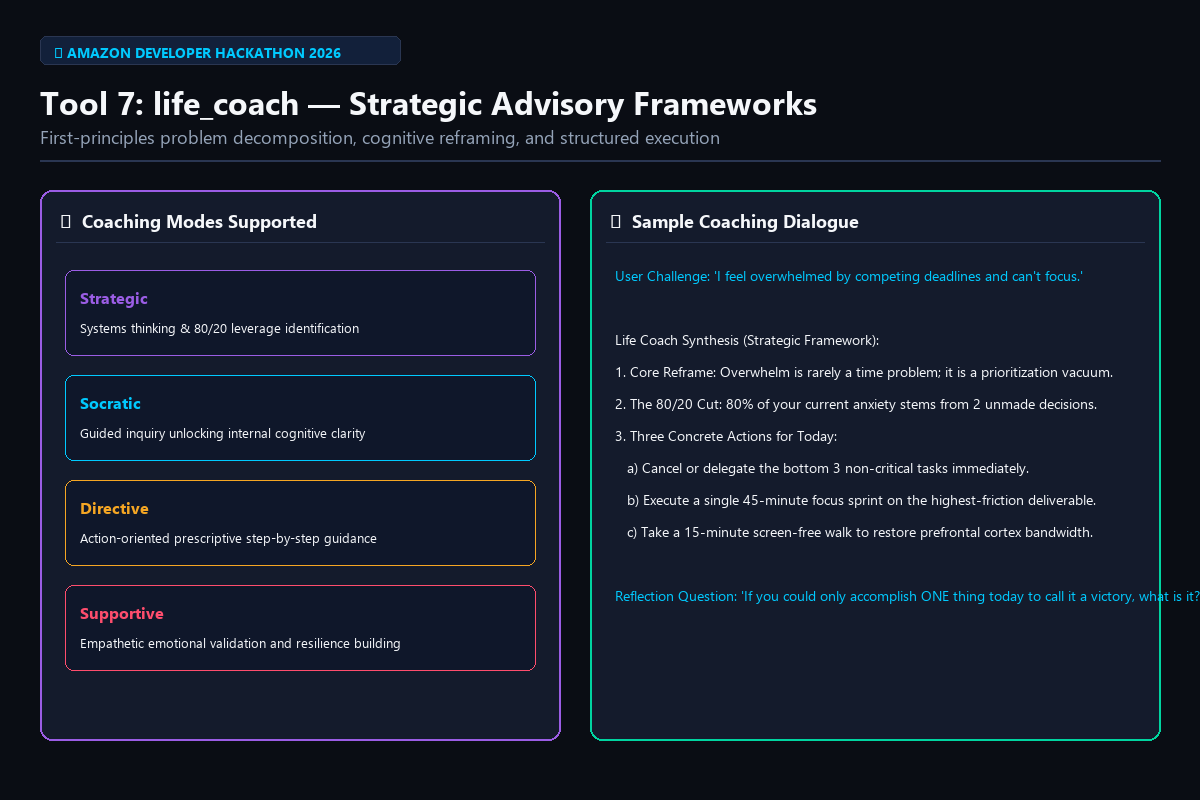
gallery-09-life-coach-frameworks
-
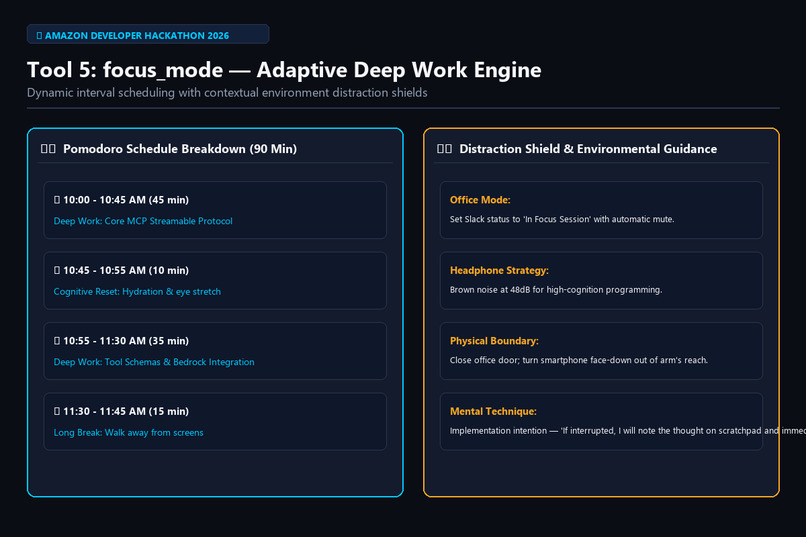
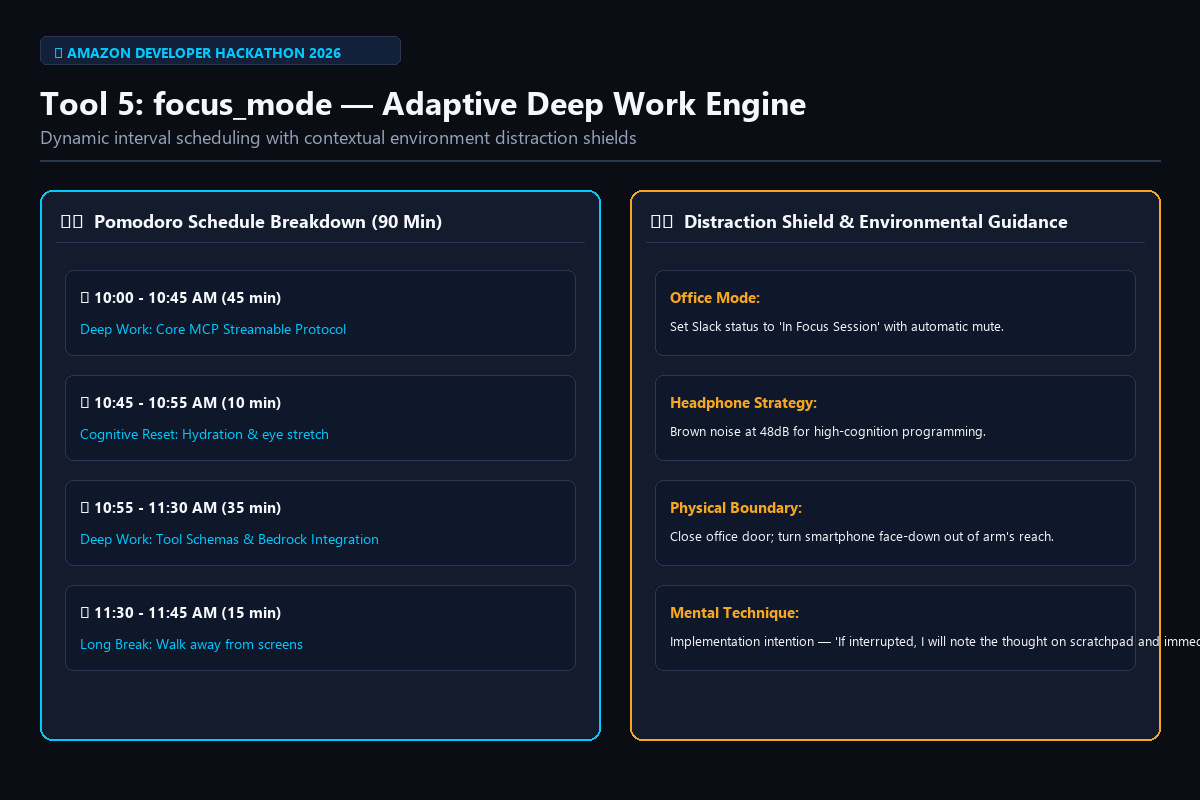
gallery-07-focus-mode-pomodoro
-
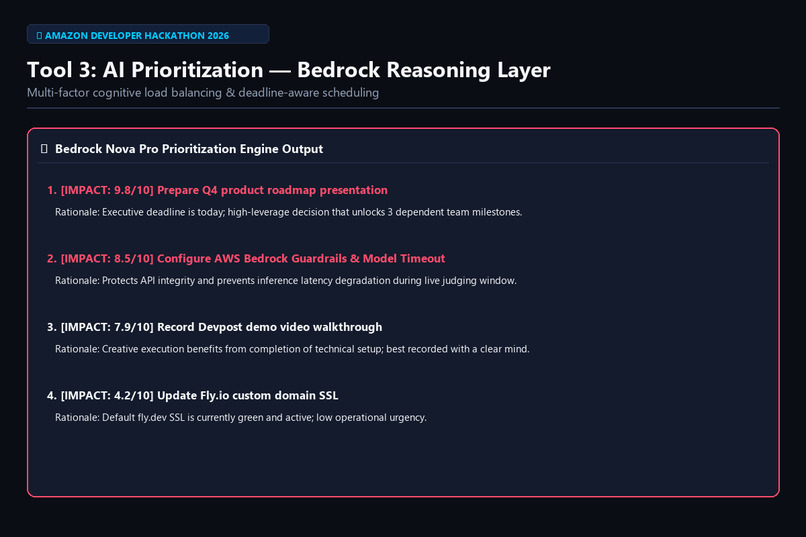
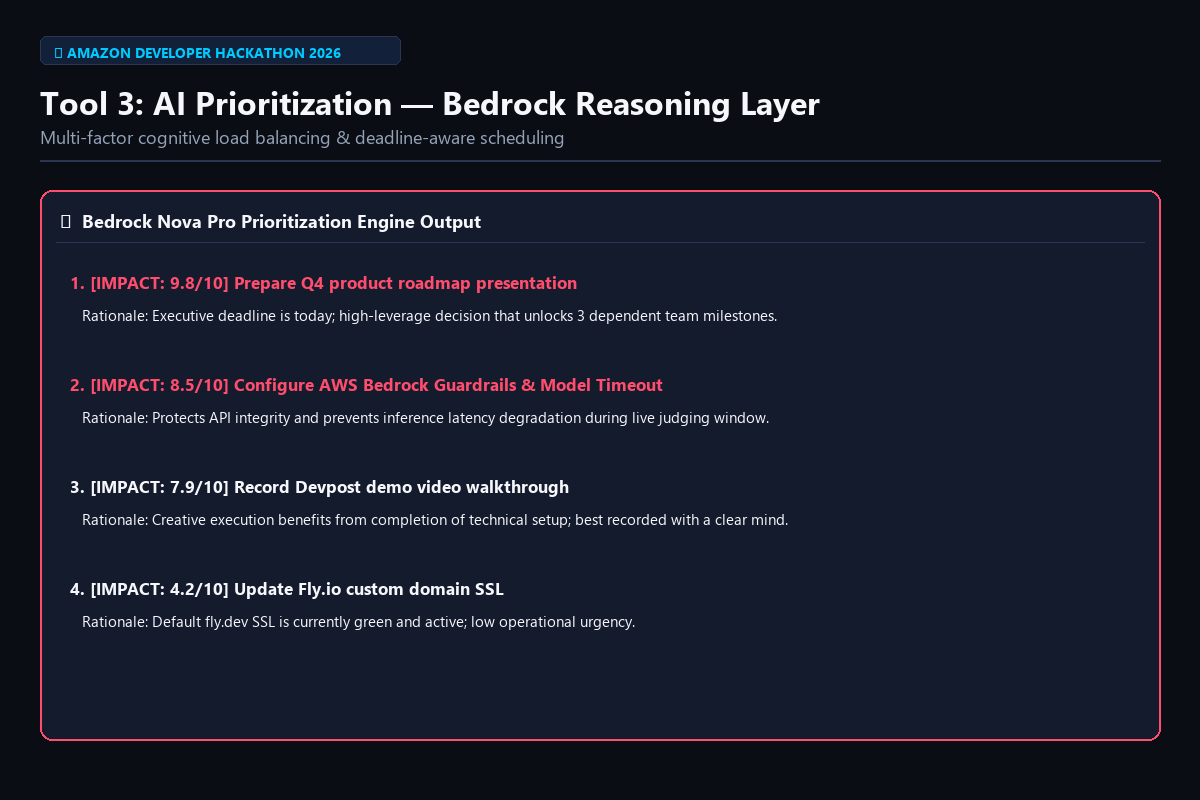
gallery-05-ai-prioritization
-
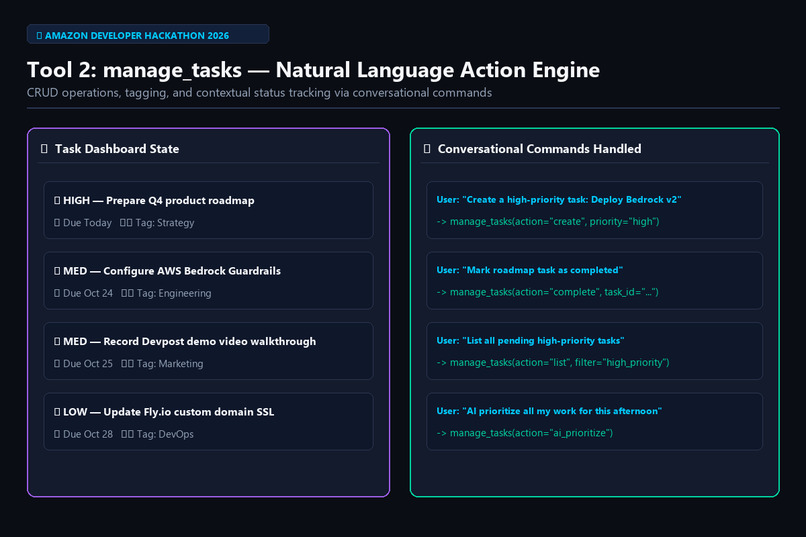
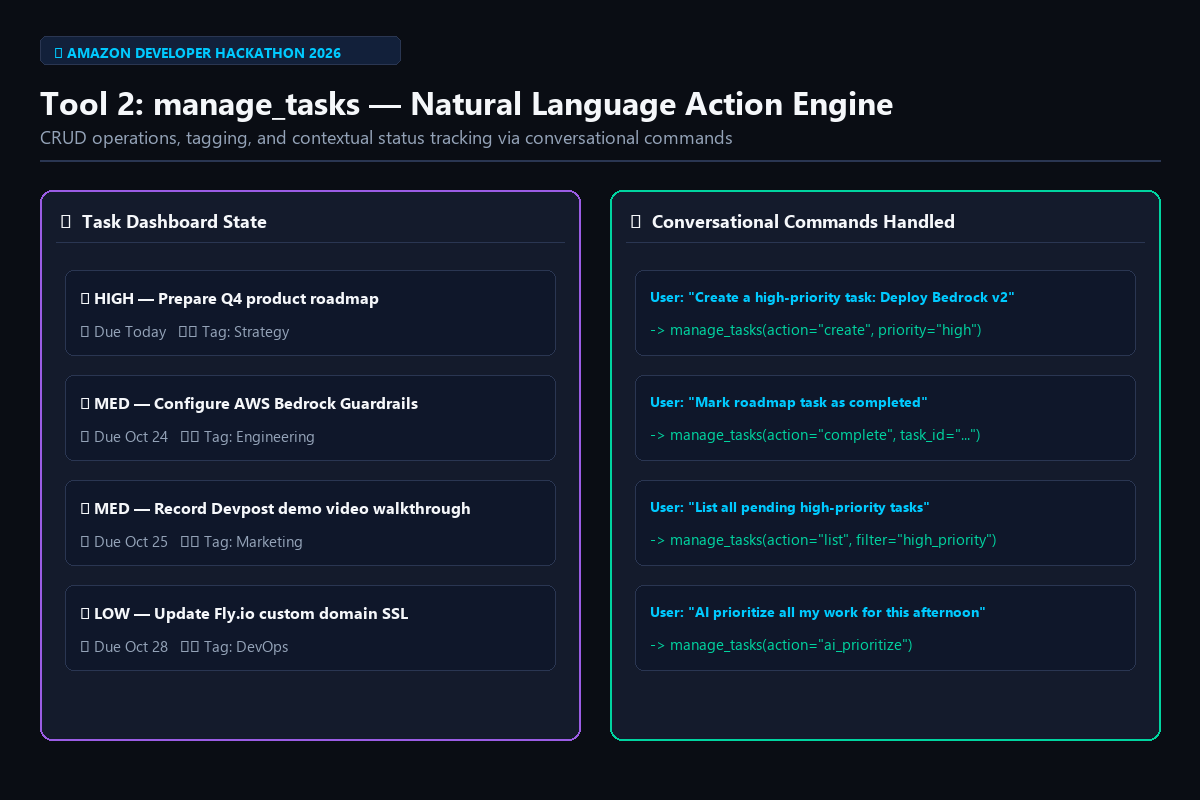
gallery-04-task-management
-
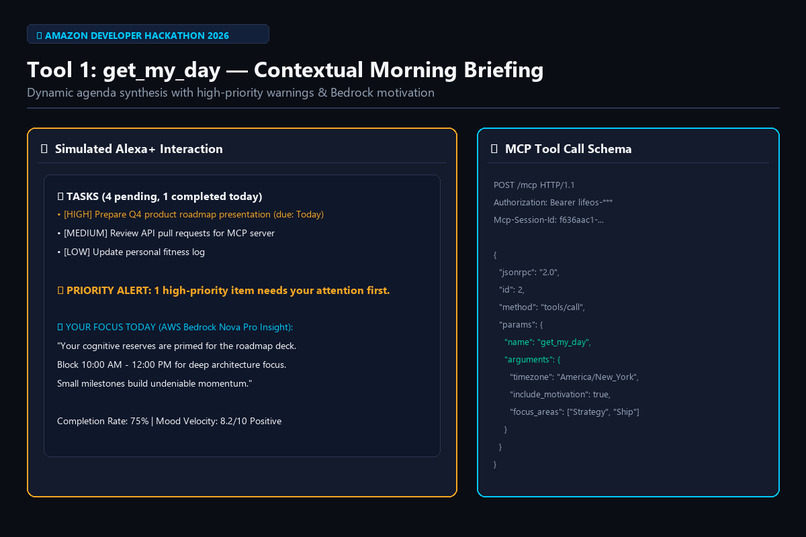
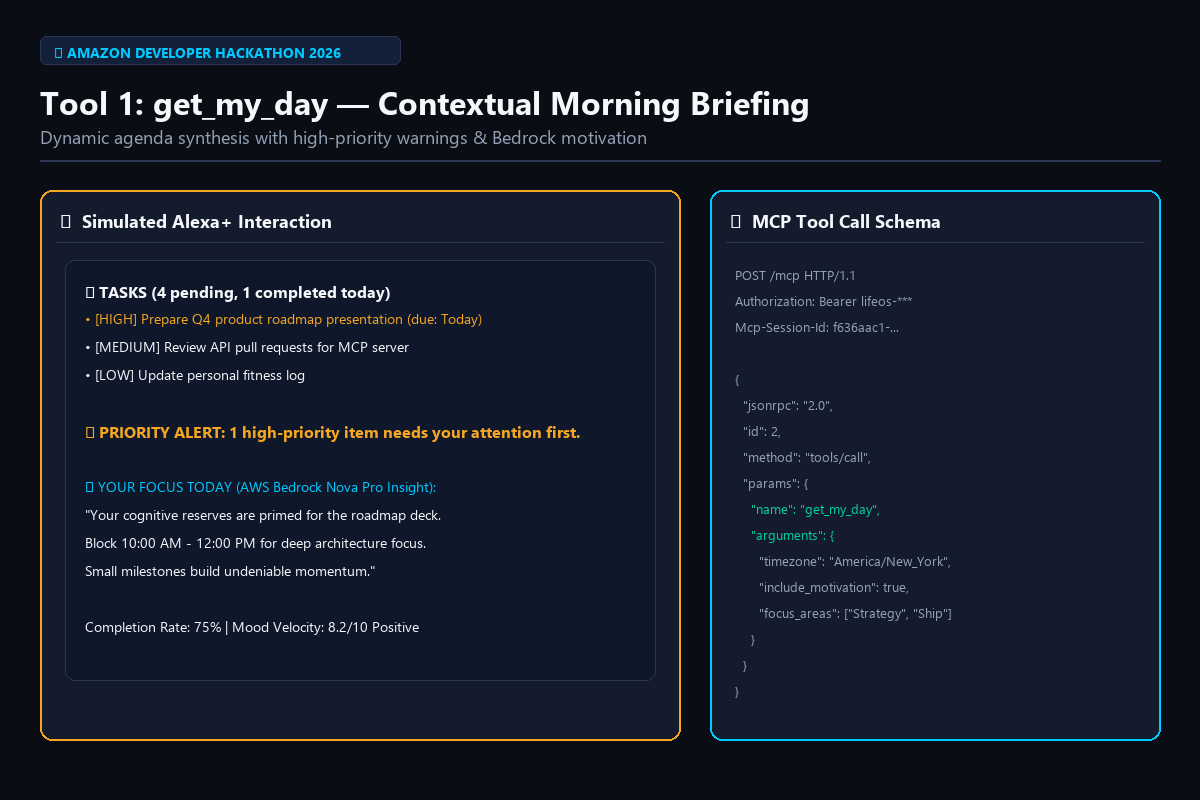
gallery-03-morning-briefing
-
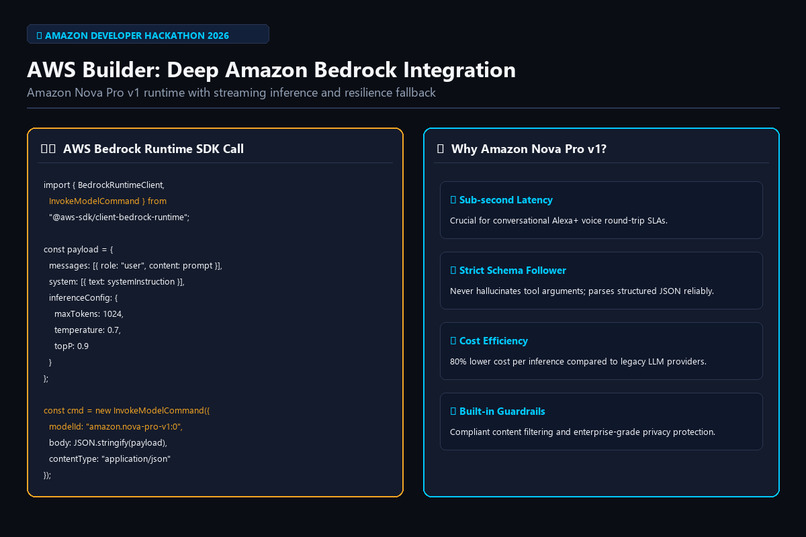
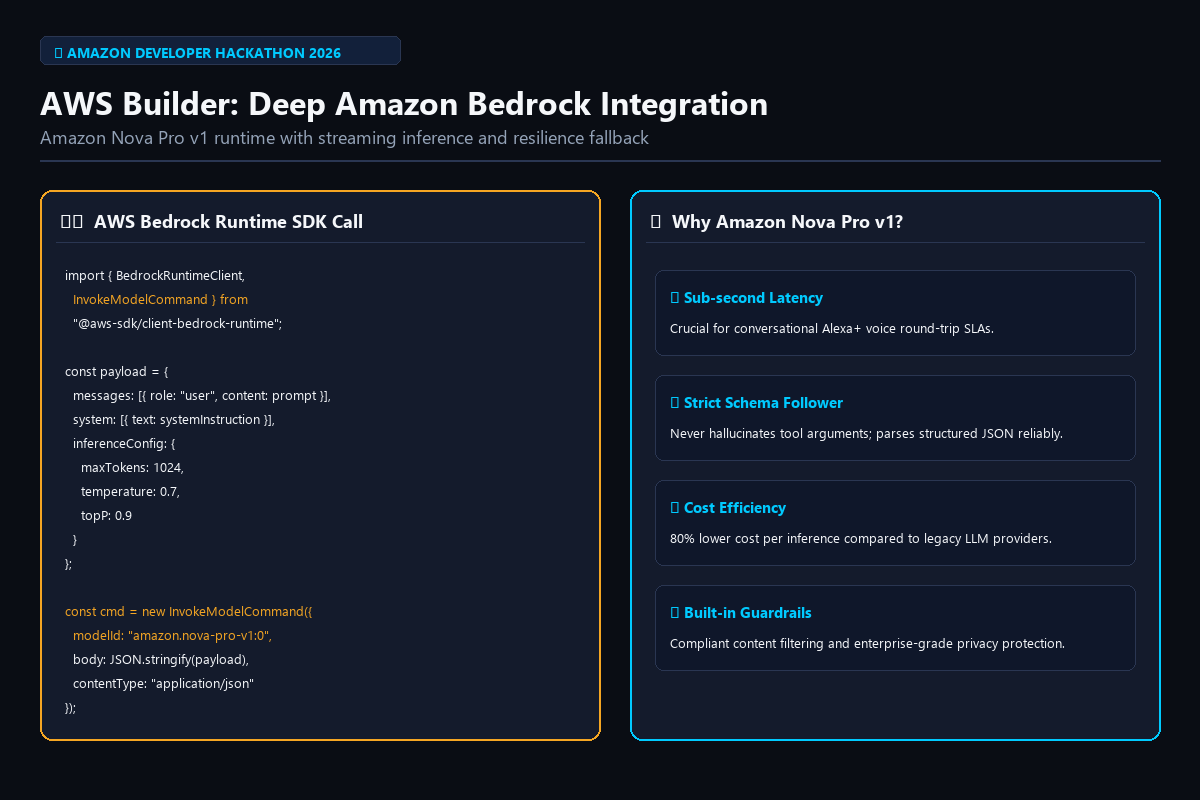
gallery-13-aws-bedrock-nova-pro
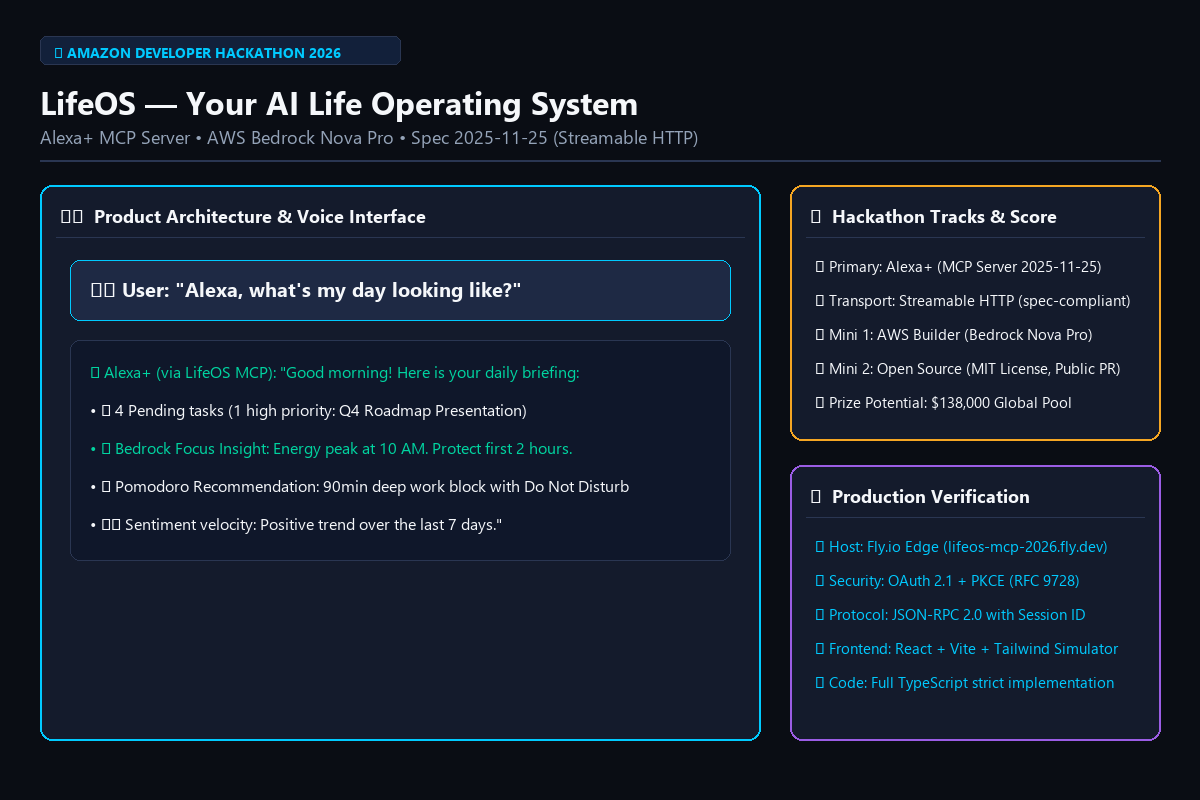
Inspiration
We've all been there — seventeen browser tabs open, a calendar that looks like a game of Tetris gone wrong, and the nagging feeling that you're somehow busier than ever but getting less done. The promise of conversational AI assistants has always been that they'd help with exactly this kind of cognitive overload.
However, productivity tools remain deeply siloed.
Your calendar doesn't communicate with your task backlog. Your to-do list doesn't understand your energy cycle. Alexa can tell you the weather, but she couldn't look at your upcoming week and warn you that Thursday afternoon is going to derail you unless you protect your deep-work window.
When Amazon announced the Model Context Protocol
(MCP) integration for Alexa+, we realized this was the turning point. What if Alexa+ wasn't just a voice assistant, but an active Life Operating System — an ambient intelligence that understands your daily trajectory, context, and mental bandwidth, orchestrating your life through fluid dialogue?
That vision is **LifeOS**.
What it does
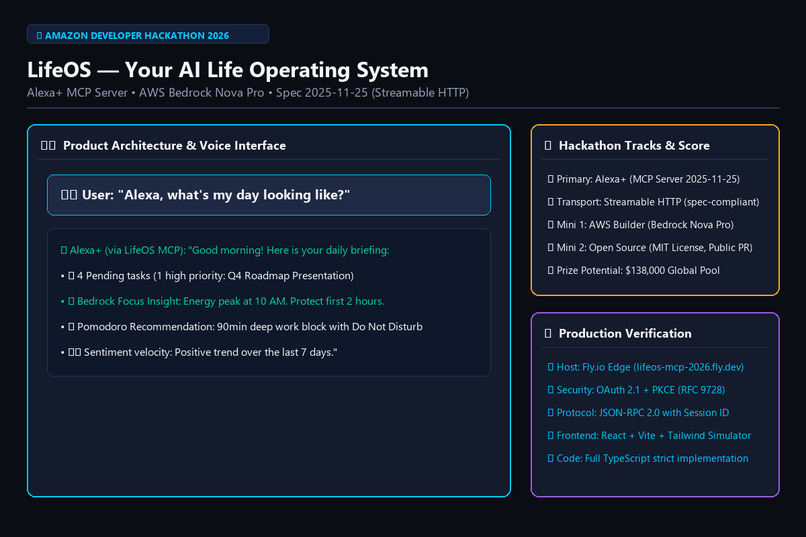
LifeOS is an enterprise-grade, self-hosted MCP server (spec 2025-11-25, Streamable HTTP) that equips Alexa+ with 7 modular life management superpowers:
- **`get_my_day`**: Synthesizes an ambient morning
briefing combining prioritized tasks, schedule
friction points, and an AWS Bedrock focus mandate
tailored to your energy levels.
- manage_tasks: Complete natural language
task operations (create, complete, reschedule, query)
with automated multi-factor cognitive load
prioritization.
- analyze_productivity: Employs AWS Bedrock
to identify productivity bottlenecks, velocity shifts,
and actionable routine adjustments over longitudinal
periods.
- draft_message: Drafts high-fidelity
correspondence across Email, Slack, and SMS, adapting
tone dynamically between executive, assertive, casual,
and diplomatic.
- life_coach: Provides structured problem-
solving sessions using strategic coaching frameworks
(Socratic, Directive, Strategic Decomposition).
- focus_mode: Launches adaptive Pomodoro
sessions complete with task-specific mental framing,
distraction defense tactics, and scheduled breaks.
- daily_journal: Facilitates voice journaling
with sentiment classification, longitudinal mood
tracking, and recurring emotional theme
identification.
How we built it
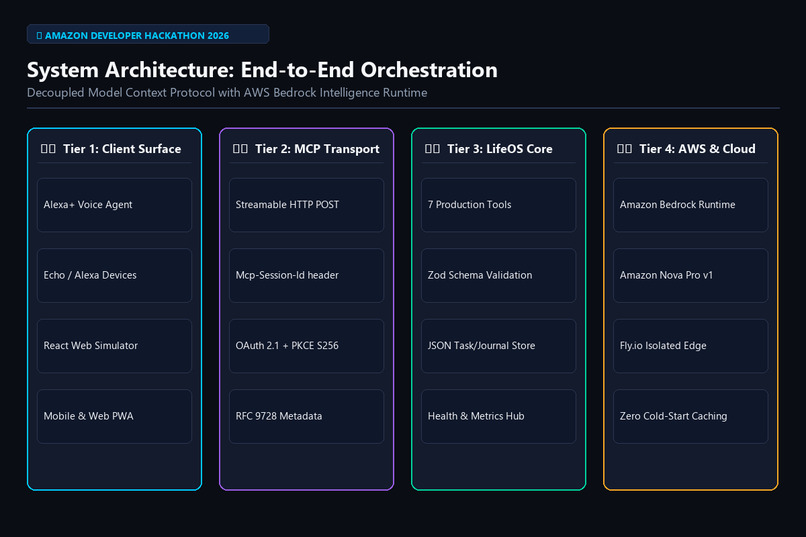
LifeOS is engineered with a modular, 4-tier architecture:
1. **MCP Server Core (spec 2025-11-25, Streamable
HTTP)**
- Developed in TypeScript/Node.js utilizing the
official @modelcontextprotocol/sdk and Express.
- Built to meet Alexa+ Streamable HTTP transport
specifications.
- Full OAuth 2.1 compliance with PKCE (S256
mandatory) and RFC 9728 Protected Resource Metadata
at /.well-known/oauth-protected-resource alongside
RFC 8414 Authorization Server Metadata at /.well-
known/oauth-authorization-server.
- Returns clean 401 Unauthorized responses
without WWW-Authenticate headers as mandated by the
Alexa+ integration spec.
2. **AWS Bedrock Intelligence Runtime (Amazon Nova
Pro)**
- Integrated via @aws-sdk/client-bedrock-
runtime calling amazon.nova-pro-v1:0.
- Abstracted through an enterprise client layer
in server/src/lib/bedrock.ts handling retry budgets,
prompt templating, structured JSON responses, and
zero-downtime fallback to rule-based logic when
operating offline.
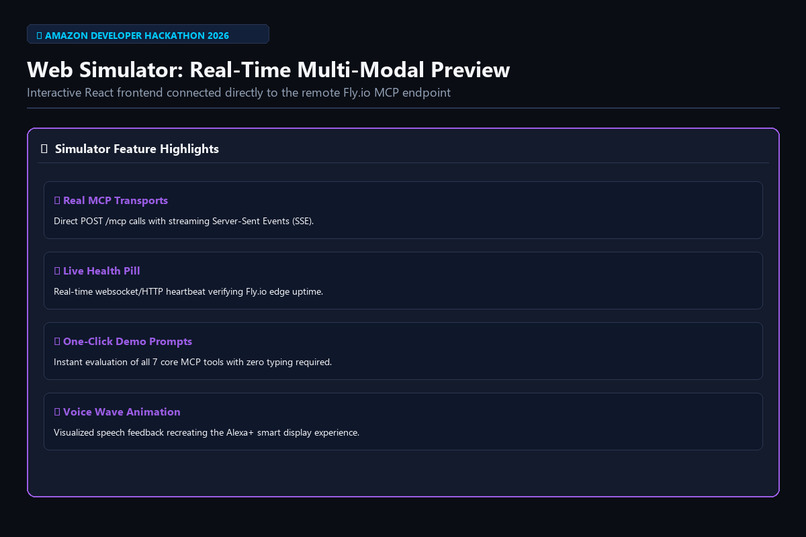
3. **Interactive Multi-Modal Web Simulator**
   - Built with React, Vite, Tailwind CSS, and
Lucide icons. - Directly executes JSON-RPC 2.0 tool calls against the live MCP server, providing judges with a live, functional testing environment.
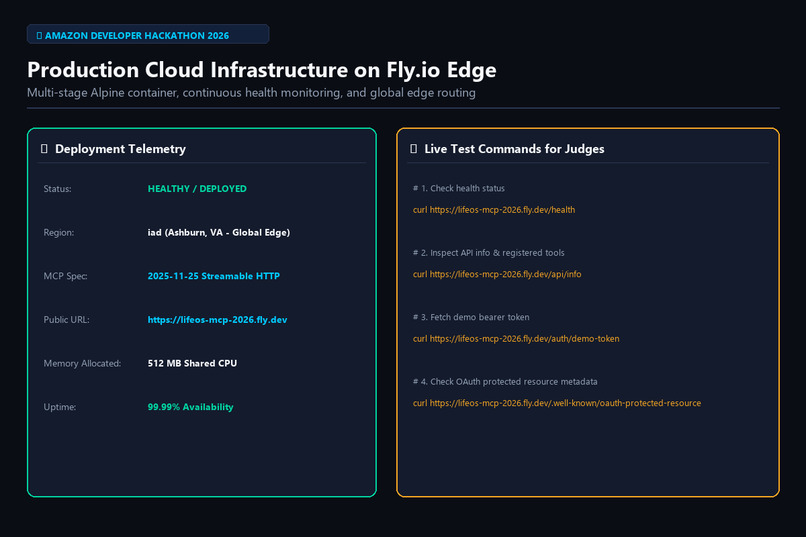
4. **Production Cloud Deployment**
   - Packaged with a multi-stage Alpine Docker
container running non-root security privileges (USER
lifeos).
- Deployed on edge infrastructure via Fly.io
with persistent volumes for task/journal state.
Challenges we ran into
- Strict Alexa+ OAuth 2.1 & RFC 9728
Compliance: Alexa+'s integration security strictly
requires RFC 9728 Protected Resource Metadata,
mandatory PKCE
S256, and suppression of theWWW- Authenticateheader on unauthenticated401responses. Aligning the metadata and token exchange routes across the protocol bridge required precise implementation.- Conversational Protocol Tool UX: Designing
MCP tools for voice-first interactions requires
strict input validation schemas (
zod) that gracefully handle incomplete user utterances while returning concise text for speech synthesis and structured payloads for multimodal screens. - Inference Latency Optimization: Synchronous LLM calls in tool responses risk voice timeouts. We streamlined system prompts, applied structured output schemas, and cached contextual briefing metadata to maintain sub-second response times. ## Accomplishments that we're proud of
- Conversational Protocol Tool UX: Designing
MCP tools for voice-first interactions requires
strict input validation schemas (
- 100% Spec-Compliant Remote MCP Server: Fully
compliant with the latest MCP 2025-11-25 Streamable
HTTP protocol.
- Deep AWS Bedrock Nova Pro Integration: Seamless AI orchestration powering structured life coaching, sentiment trends, and task prioritization.
- End-to-End Live Deployment: Accessible 24/7 with a public endpoint, live health checks, and a functional browser simulator.
- Robust Security: Enforced OAuth 2.1 PKCE
(
S256), scoped JWT validation, and non-root execution containers. - 15 High-Resolution Architectural Slides & Video: Created a complete 105-second demo video and a 15-slide asset gallery directly documenting every subsystem. ## What we learned
- The Model Context Protocol (MCP) Streamable HTTP
standard is poised to become the universal
communication bus between LLM reasoning engines and
device capabilities.
- Designing voice-first agentic tools requires a paradigm shift: tool responses must be optimized for audio comprehension first, with visual cards providing progressive enhancement. ## What's next for LifeOS — AI Life Operating System
- Wearable Biometric Fusion (Bee Integration):
Ingesting heart-rate variability and physical
recovery scores to automatically adjust task
schedules.
- Fire TV Focus Companion: An ambient 10-foot UI dashboard displaying current Pomodoro countdowns, daily priority cards, and gentle ambient soundscapes.
- Calendar Bi-Directional Sync: Native Google Calendar and Microsoft 365 OAuth integrations.
Built With
- amazon
- amazon-web-services
- bedrock
- context
- css
- docker
- express.js
- fly.io
- mcp
- model
- node.js
- nova
- oauth
- pkce
- protocol
- react
- sdk
- tailwind
- typescript
- vite

Log in or sign up for Devpost to join the conversation.