Inspiration
People manage different parts of their daily lives using different apps, reminders, notes, and calendars. A student has academic schedules and assignments, an employee has work tasks and deadlines, and a senior citizen may need important reminders and appointments.
We wanted to build one intelligent platform that understands the user's role and provides relevant support instead of giving everyone the same experience.
This led us to LifeOS AI, a role-aware personal assistant designed to organize everyday activities through AI and automation.
What it does
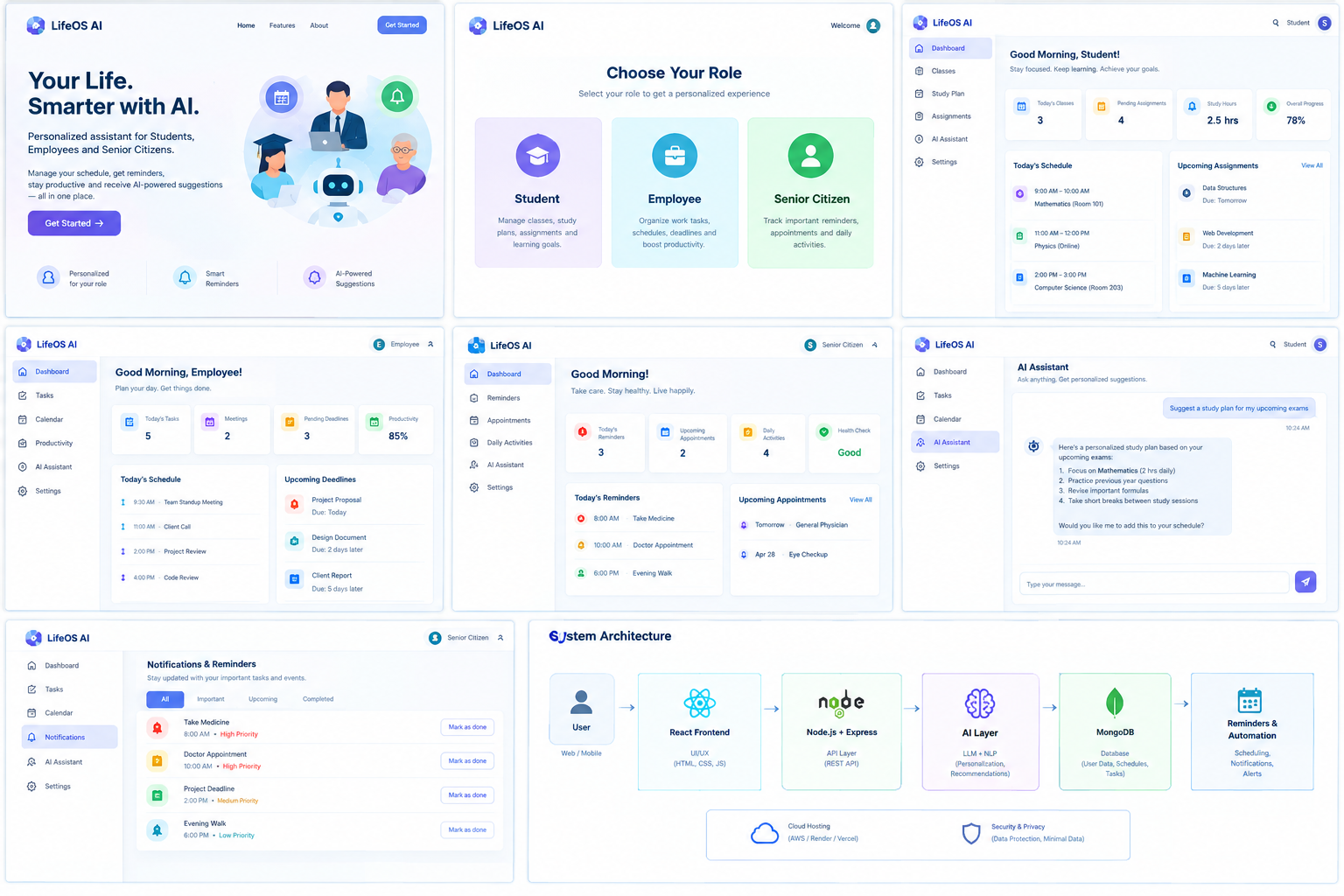
LifeOS AI provides personalized assistance based on the user's selected role:
- Students can manage classes, study schedules, assignments, and learning tasks.
- Employees can organize work tasks, schedules, deadlines, and productivity activities.
- Senior citizens can manage important reminders, appointments, and daily activities.
- AI analyzes the user's context and helps generate personalized schedules and suggestions.
- A reminder system helps users keep track of important tasks and events.
- Notifications can be organized based on their importance.
- The platform is designed to bring multiple daily-life assistance features into one place.
How we built it
We designed LifeOS AI as a modular web-based platform with an AI layer.
The main components include:
- Frontend: React.js, HTML, CSS, JavaScript
- Backend: Node.js and Express.js
- Database: MongoDB
- AI Layer: LLM-based personalization and recommendation
- Automation: Task scheduling, reminders, and notification management
- API Layer: Connects the frontend, backend, database, and AI services
The system first identifies the user's role and preferences. It then uses that context to generate relevant tasks, schedules, reminders, and suggestions.
Challenges we ran into
One of the main challenges was designing a system that could support different types of users without creating completely separate applications.
We also had to think about:
- Creating role-specific workflows
- Making AI recommendations relevant instead of generic
- Connecting AI functionality with normal application logic
- Managing schedules and reminders reliably
- Designing a simple interface for users with different levels of technical familiarity
- Handling user information responsibly and minimizing unnecessary data collection
Accomplishments that we're proud of
We are proud of creating a single platform that brings together AI, automation, personalization, and everyday task management.
Our key achievements include:
- Building a role-aware assistant architecture
- Supporting Student, Employee, and Senior Citizen workflows
- Connecting AI recommendations with real application data
- Creating automated reminders and task management
- Designing the system as a scalable modular platform
- Turning a broad real-world problem into a working technology prototype
What we learned
During development, we learned that building an AI application is not only about integrating an AI model.
We learned how important it is to:
- Define the real user problem before choosing technology
- Combine AI with traditional software logic
- Design clear user-specific workflows
- Structure APIs and database models properly
- Consider privacy when handling personal information
- Test AI-generated outputs instead of blindly trusting them
- Design applications that can scale beyond a single use case
What's next for LifeOS AI
Our next goal is to expand LifeOS AI into a more complete personal productivity and assistance platform.
Future improvements could include:
- Voice-based interaction
- Multilingual support, including regional Indian languages
- Calendar and email integration
- Smarter notification prioritization
- More personalized learning and work recommendations
- Additional user roles and domains
- Mobile application support
- Improved privacy and user-control features
- Cloud deployment and scalable AI infrastructure
Our long-term vision is to make LifeOS AI a context-aware personal assistant that adapts to different stages and situations of everyday life.
Built With
- artificial-intelligence
- automation
- cloud-computing
- express.js
- generative-ai
- javascript
- machine-learning
- mongodb
- natural-language-processing
- node.js
- personalization
- react
- rest-api
- web-app


Log in or sign up for Devpost to join the conversation.