-
-
-
Architecture Overview
Inspiration
Every health app we've ever used had the same fatal flaw...it would show us data and leave us to figure out what to do with it. We'd wake up after 4 hours of sleep, see a red recovery score on Whoop, and still drag ourselves to a HIIT class because nothing actually cancelled it. That is not INTENTIONAL LIVING. The insight was simple: the problem isn't the data, it's that nothing acts on it. We wanted to build the thing that closes that loop. Not a dashboard, not a recommendation, but an agent that rewrites your day before you even open your eyes.
What it does
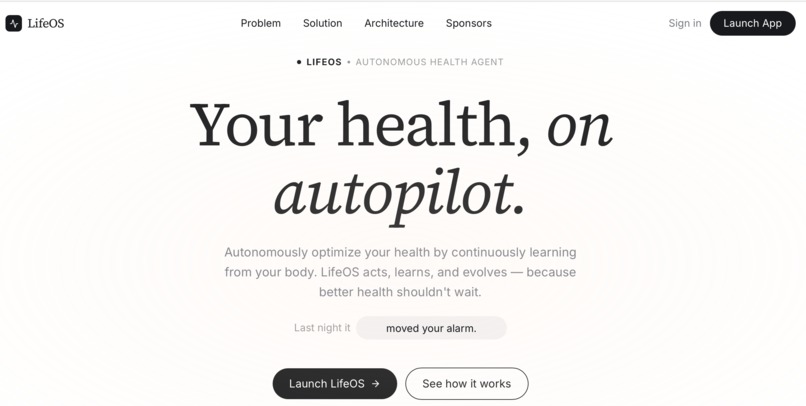
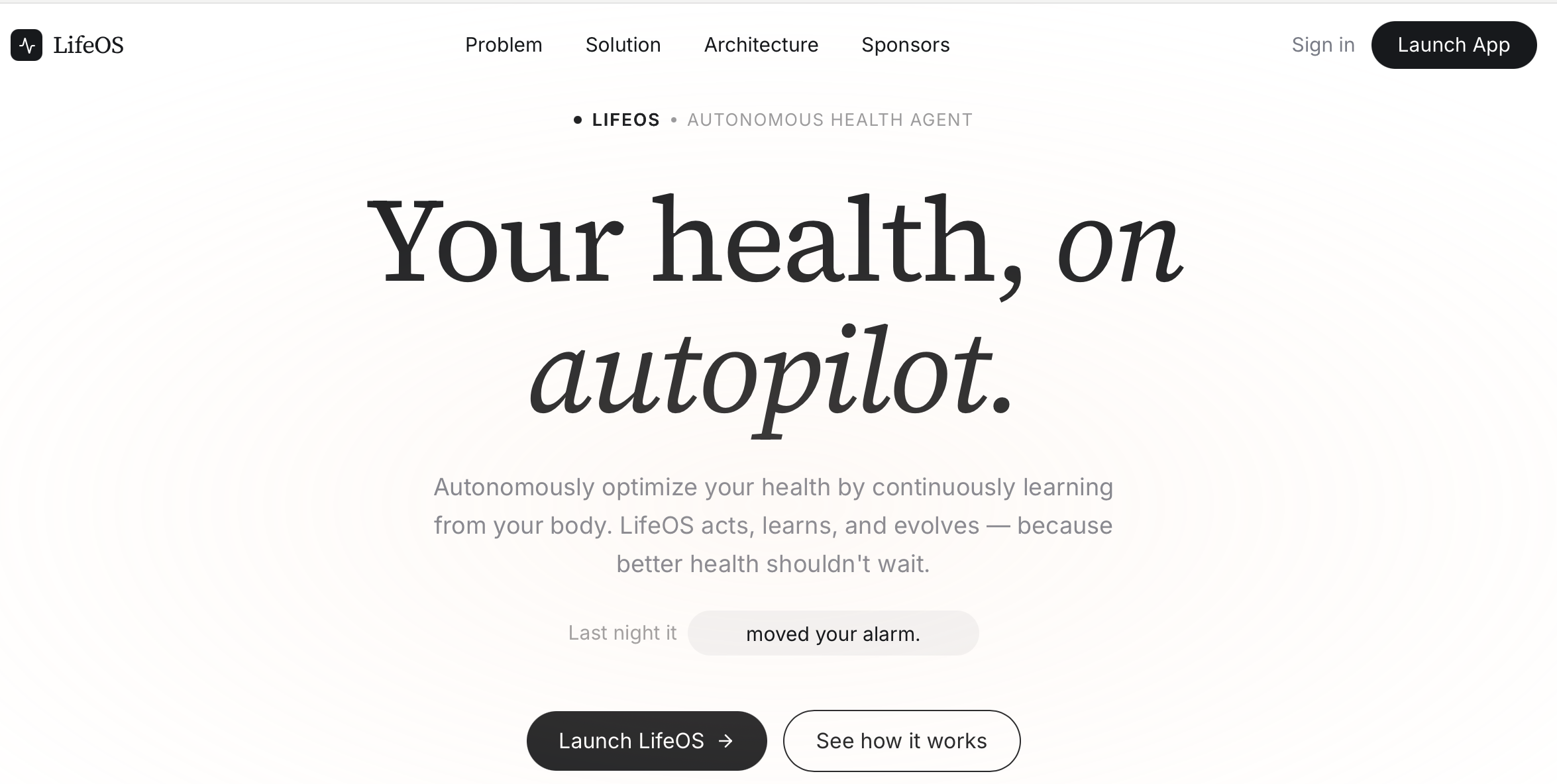
LifeOS is an autonomous health agent that runs a continuous optimization loop while you sleep. It ingests your biometric data from Oura, Apple Health, and Fitbit through Nexla, reasons over it using a committee of specialized AI sub-agents through Zero.xyz, and takes real actions — cancelling workouts, moving alarms, blocking screens, adjusting nutrition targets — all authorized through Pomerium's policy layer. Every morning you wake up to a schedule already rebuilt around what your body actually did last night. Critically, it learns: it tracks which interventions moved your sleep score, rejects the ones that didn't work, and rewrites its own strategy over time. It's not a recommendation engine. It's an operating system for your health.
How we built it
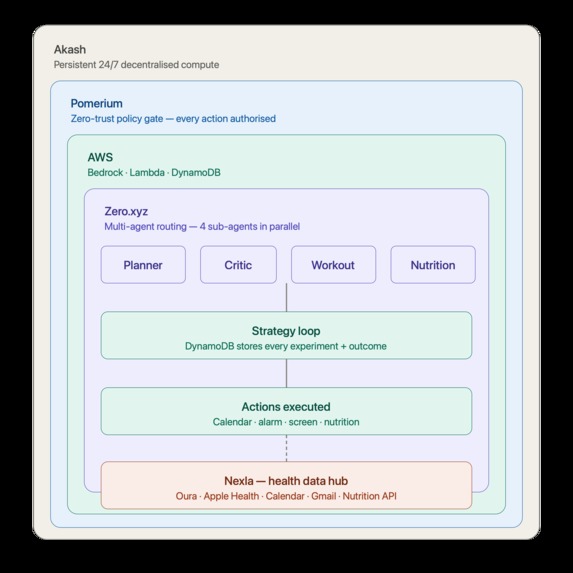
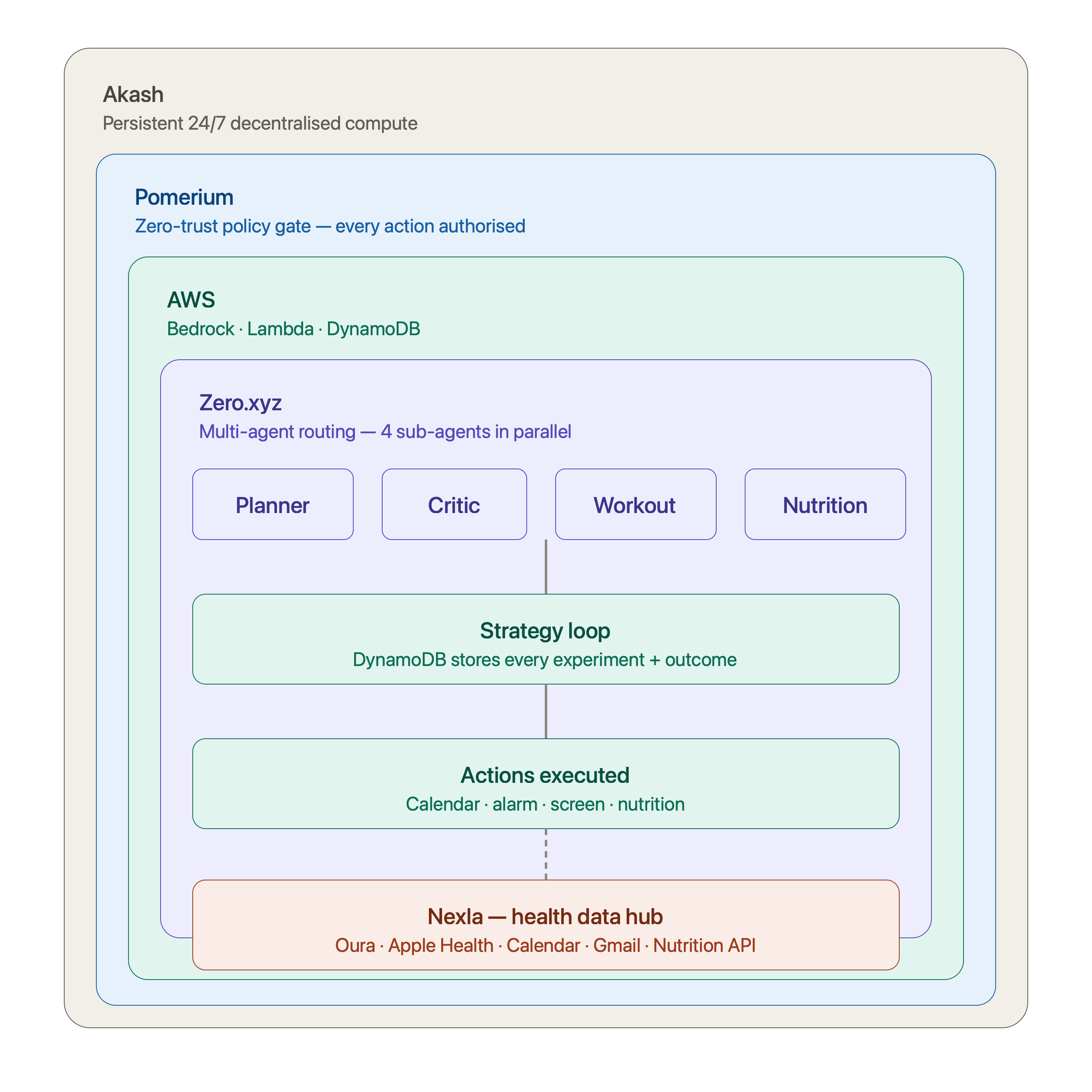
We built LifeOS as a five-layer stack where each sponsor owns a structural role. Nexla serves as the health data hub, unifying streams from wearables, Google Calendar, Gmail, and nutrition APIs into a single clean JSON context object the agent can reason over each morning. Zero.xyz routes four specialized sub-agents in parallel — a Planner, a Critic, a Workout Expert, and a Nutrition Expert — using different model endpoints without rate limit bottlenecks; the Planner proposes actions and the Critic blocks unsafe ones until they reach consensus. AWS Bedrock runs the underlying model inference, Lambda triggers the nightly loop, and DynamoDB stores the full strategy history — every experiment the agent has tried and whether it worked. Pomerium acts as the authorization layer between the agent and your personal accounts, enforcing policies like "can create calendar events, never delete them" so a bug can't accidentally wipe your week. Akash runs the entire loop on decentralized compute 24/7, meaning your biometric data never touches a company's central server. The frontend is built in Next.js using a custom design system — phosphor green on black, terminal aesthetic, live agent loop visualization in the dashboard.
Challenges we ran into
The hardest problem was designing a feedback signal that was both objective and meaningful. Early versions just tracked whether the user "felt better," which turned out to be useless — too noisy, too slow, too subjective. We shifted to hard biometric signals: HRV the morning after an intervention, sleep score delta, resting heart rate trend. That gave the agent something it could actually evaluate against. The second challenge was the Planner/Critic dynamic — getting two agents to genuinely disagree and reach consensus rather than one just rubber-stamping the other required careful prompt architecture and explicit instructions for the Critic to be adversarial. The third was scope: an agent that touches your calendar, Gmail, and device settings is one bug away from being a disaster, and designing the Pomerium policy layer to make that safe without making it useless took more iteration than expected.
Accomplishments that we're proud of
The self-correction loop actually works. We ran it on real data over 23 simulated days and watched it try bedtime nudges, observe they were being ignored, switch to screen blocking, and see sleep scores jump 31%. The agent changed its own playbook based on evidence, which is exactly what we set out to build. We're also proud of how naturally the sponsors integrated — Nexla, Zero.xyz, AWS, Pomerium, and Akash each own a distinct architectural layer with no redundancy and no bolted-on feel. And the live dashboard demo, where you can watch the agent reasoning in real time — Planner proposing, Critic blocking, actions executing through Pomerium — is something we think communicates the idea better than any slide deck could.
What we learned
The difference between an agent that recommends and an agent that acts is entirely about feedback signal design. If you can't measure whether an intervention worked, the loop has nothing to learn from. We also learned that multi-agent debate — having a Critic whose explicit job is to block the Planner — produces dramatically better decisions than a single generalist agent, especially for health decisions where the cost of a wrong action is real. And practically: Pomerium's zero-trust model is genuinely the right architecture for any agent that touches personal accounts. We initially saw it as a sponsor integration requirement and ended up viewing it as a non-negotiable design constraint.
What's next for LifeOS
The immediate next step is connecting to real wearable APIs rather than simulated data — Oura has a developer sandbox we can be live with in a week. After that, we want to expand the action surface beyond calendar and device: grocery list updates based on the week's nutrition gaps, Spotify playlist selection based on recovery state, thermostat adjustment for sleep temperature optimization. Longer term, the vision is a marketplace of health strategies that the agent can pull from — peer-reviewed protocols, community-validated experiments — so it's not just learning from your own data but from everyone's. The startup case is clear: Whoop is worth $3.6B selling hardware plus dashboards. LifeOS is the software-only agent layer that makes any wearable actually change your behavior, at $20/month with no hardware required.
Built With
- akash
- amazon-web-services
- cursor
- nexla
- pomerium
- zero.xyz

Log in or sign up for Devpost to join the conversation.