-
-
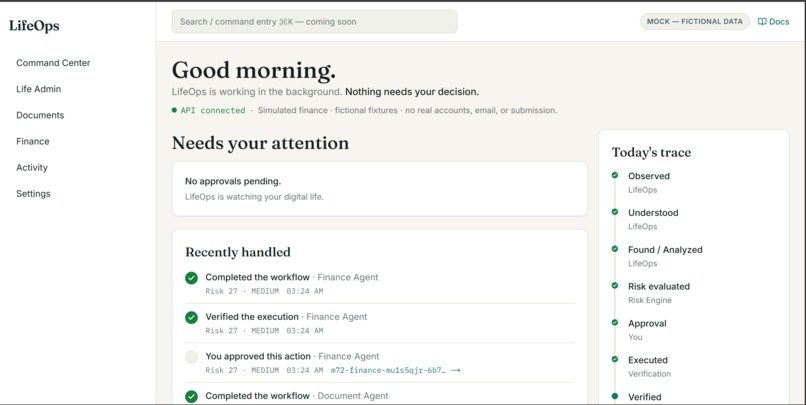
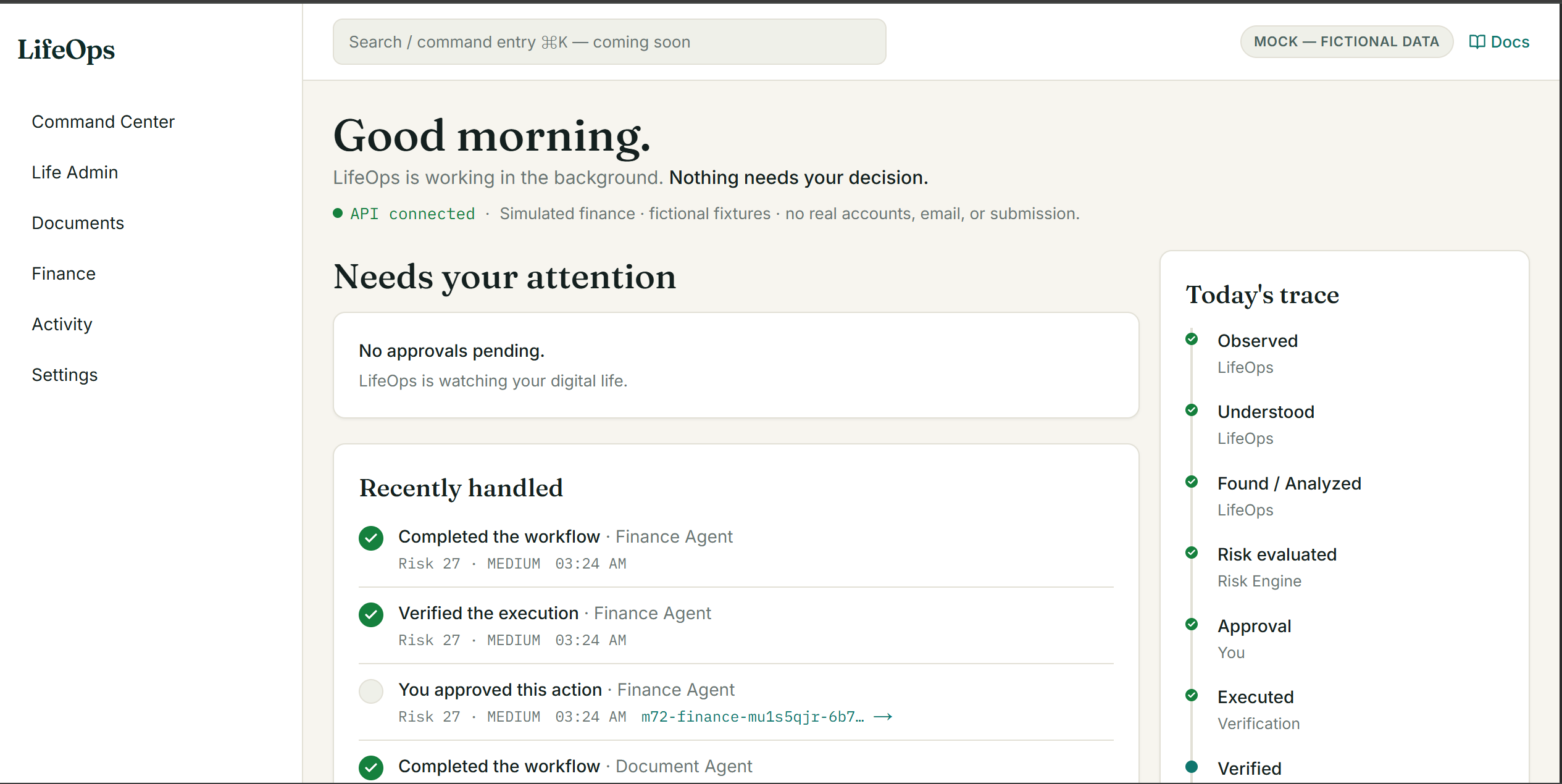
Command Center
-
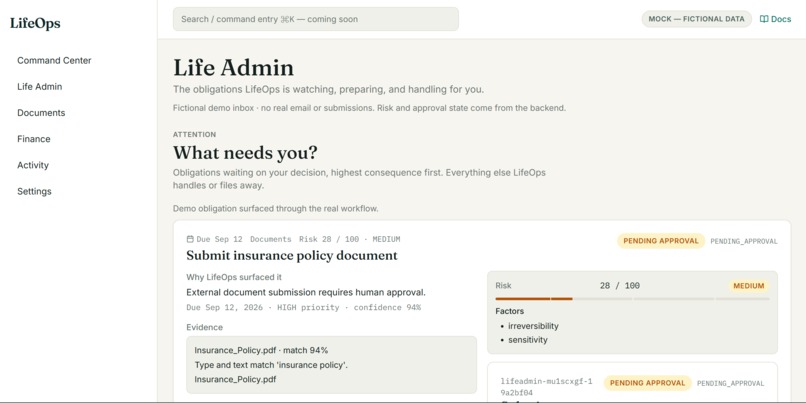
Life Admin Approval
-
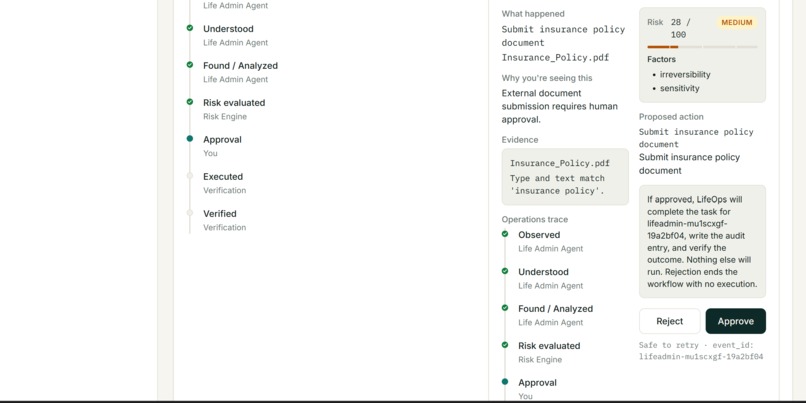
Operations Trace
-
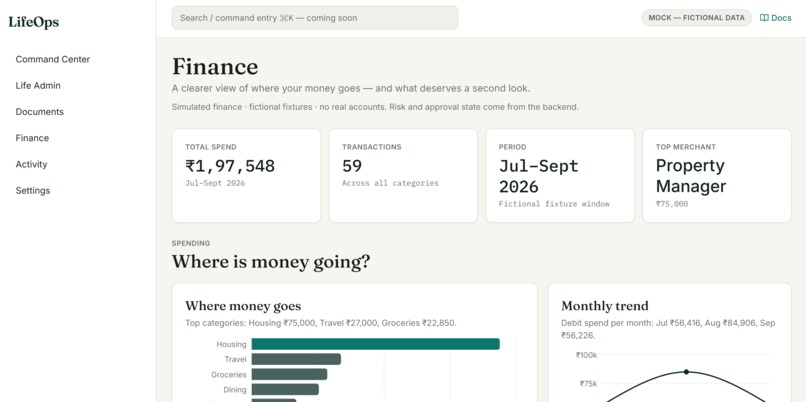
Finance Page
-
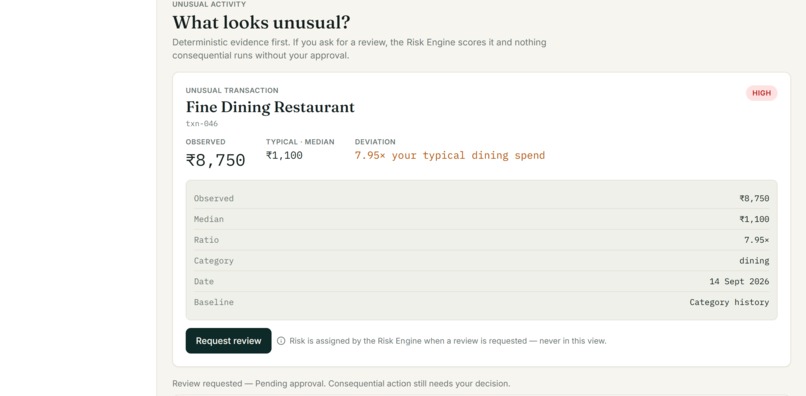
Finance anomaly
-
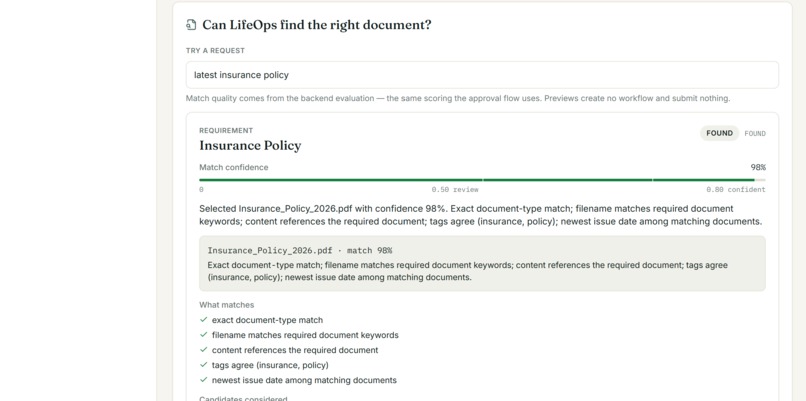
Documents
-
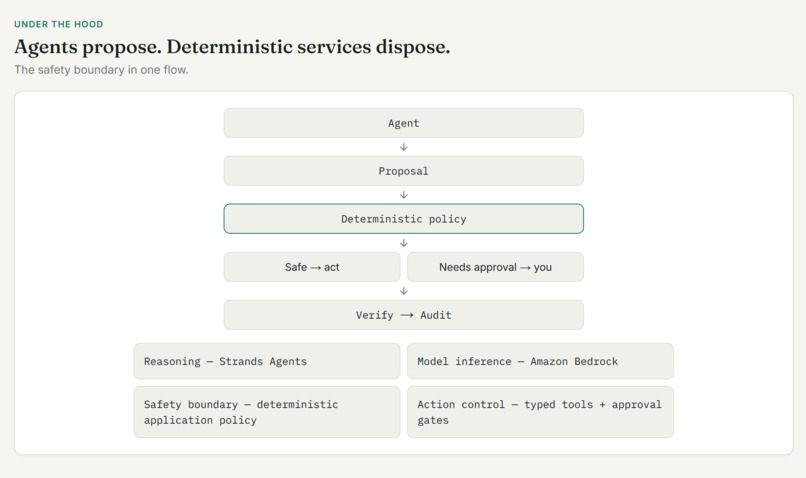
Architecture
Inspiration
Modern life has become a collection of small operational tasks scattered across email, documents, calendars, bills, subscriptions, and financial activity.
The problem isn't that these tasks are individually difficult. The problem is that someone has to continuously notice them, understand what is required, find the right information, decide what is safe, and follow through.
We wanted to explore a different idea:
What if an AI agent could operate your life like a good operations assistant — handling routine work autonomously and interrupting you only when your judgment actually matters?
That became LifeOps — Your Personal Operations Agent.
Our core principle is simple:
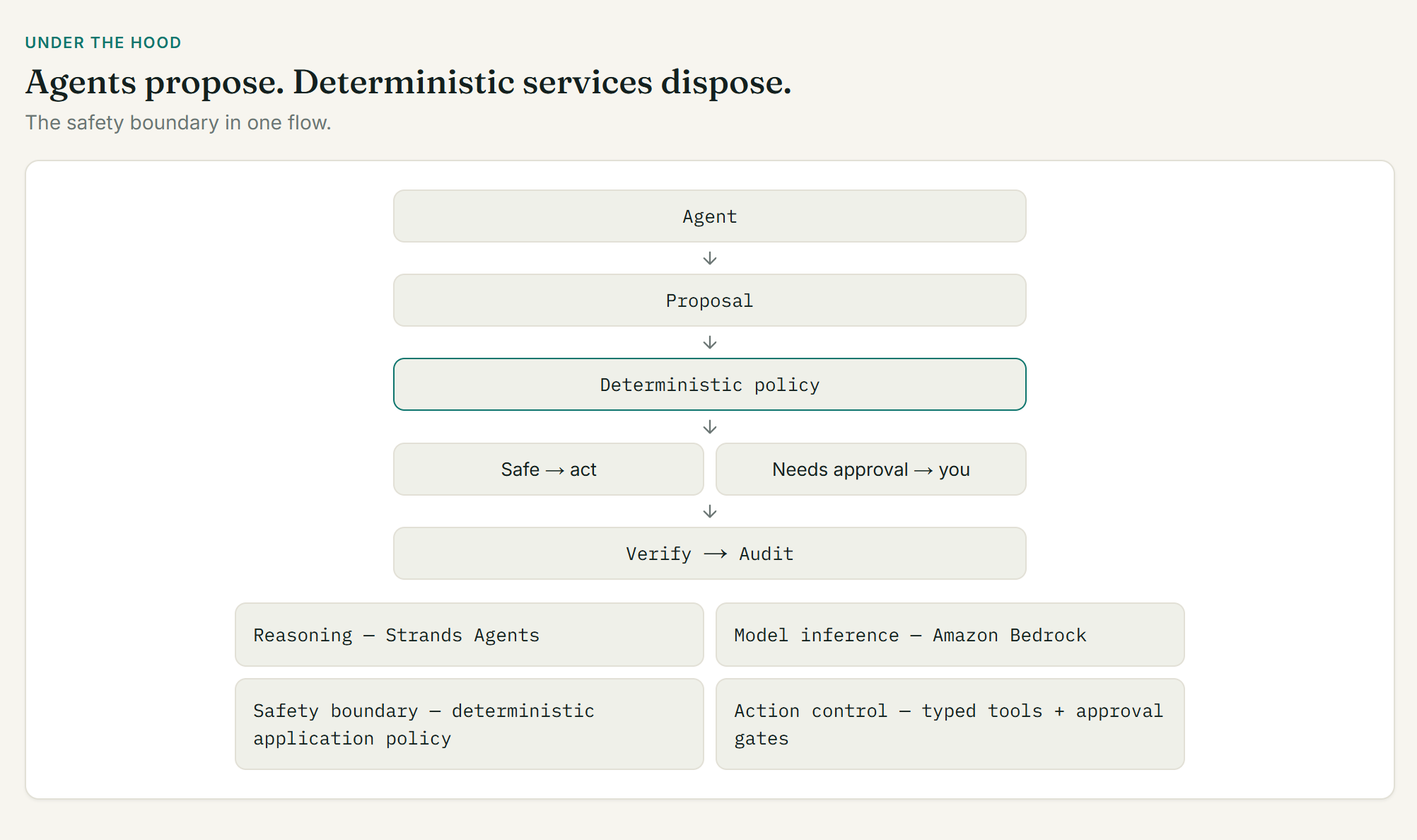
The model proposes. LifeOps decides.
Instead of giving an LLM unrestricted access to a user's digital life, we built a governed agentic system where AI reasoning is surrounded by deterministic safety controls and human approval.
What it does
LifeOps watches fictional digital-life events and turns them into operational workflows.
It currently demonstrates three major areas:
Life Admin
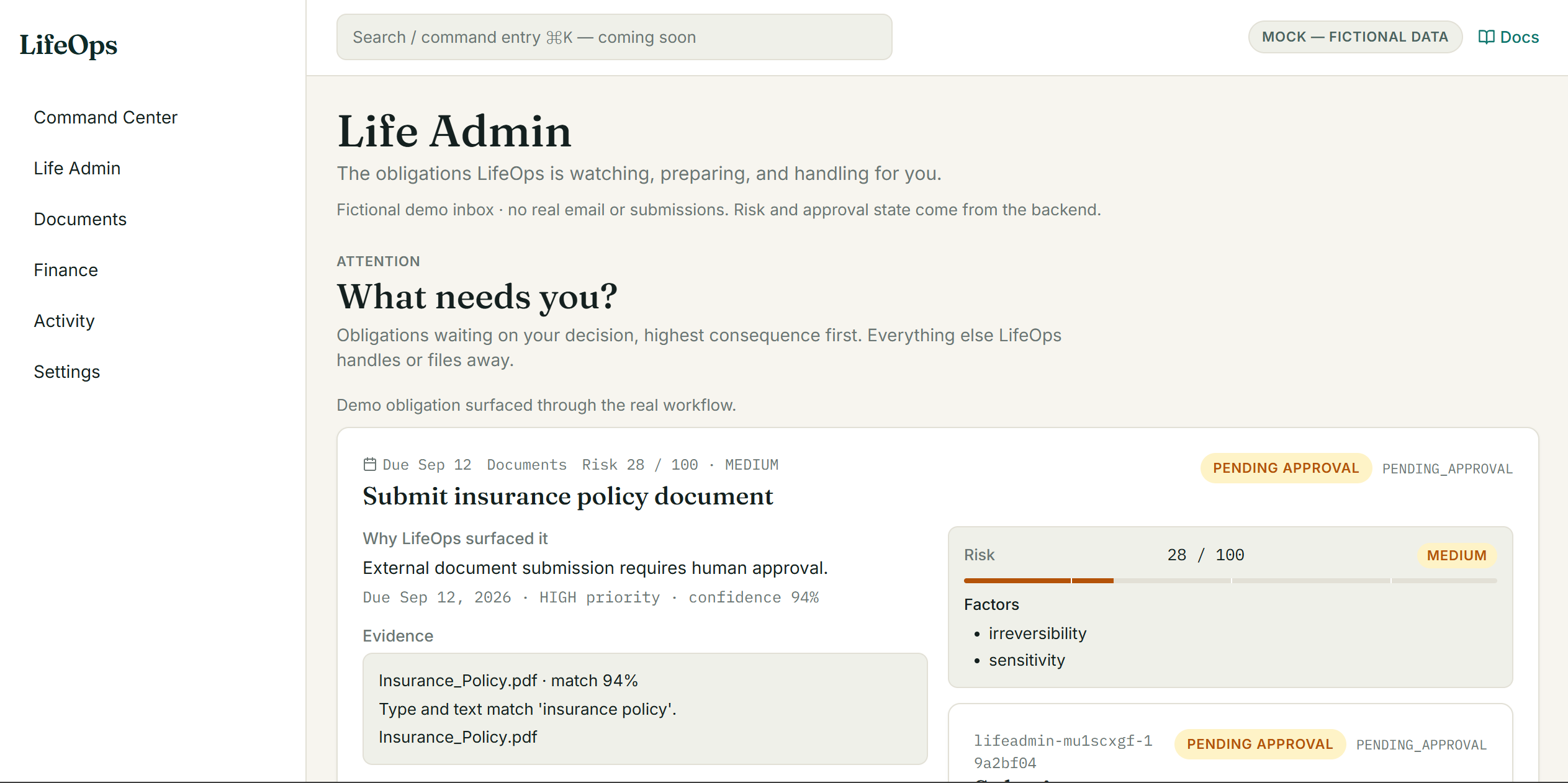
LifeOps can identify obligations from incoming requests, find supporting documents, assess the associated risk, and prepare the appropriate action.
For example:
Insurance request
      ↓
Obligation detected
      ↓
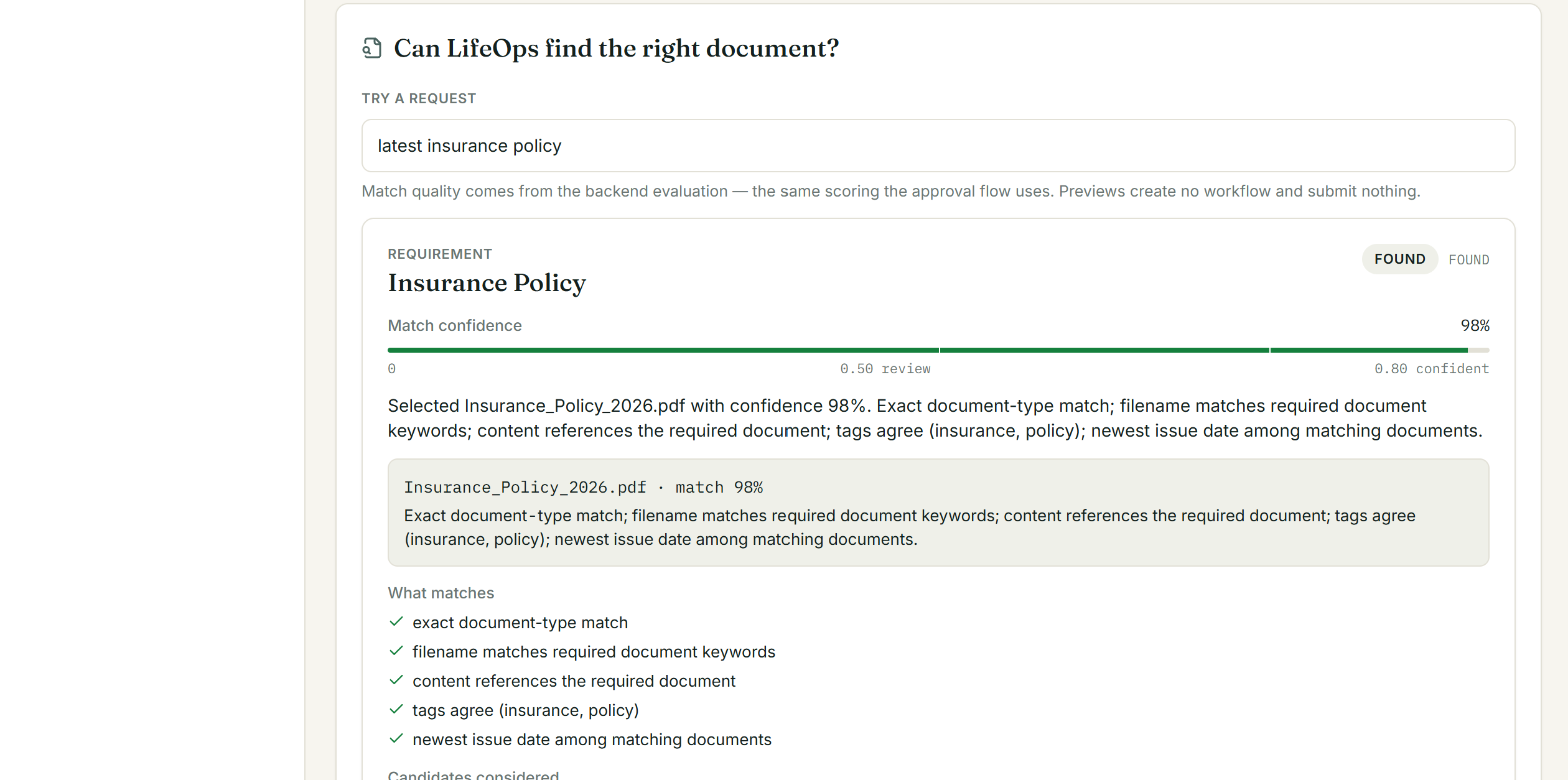
2026 policy found — 98% match
      ↓
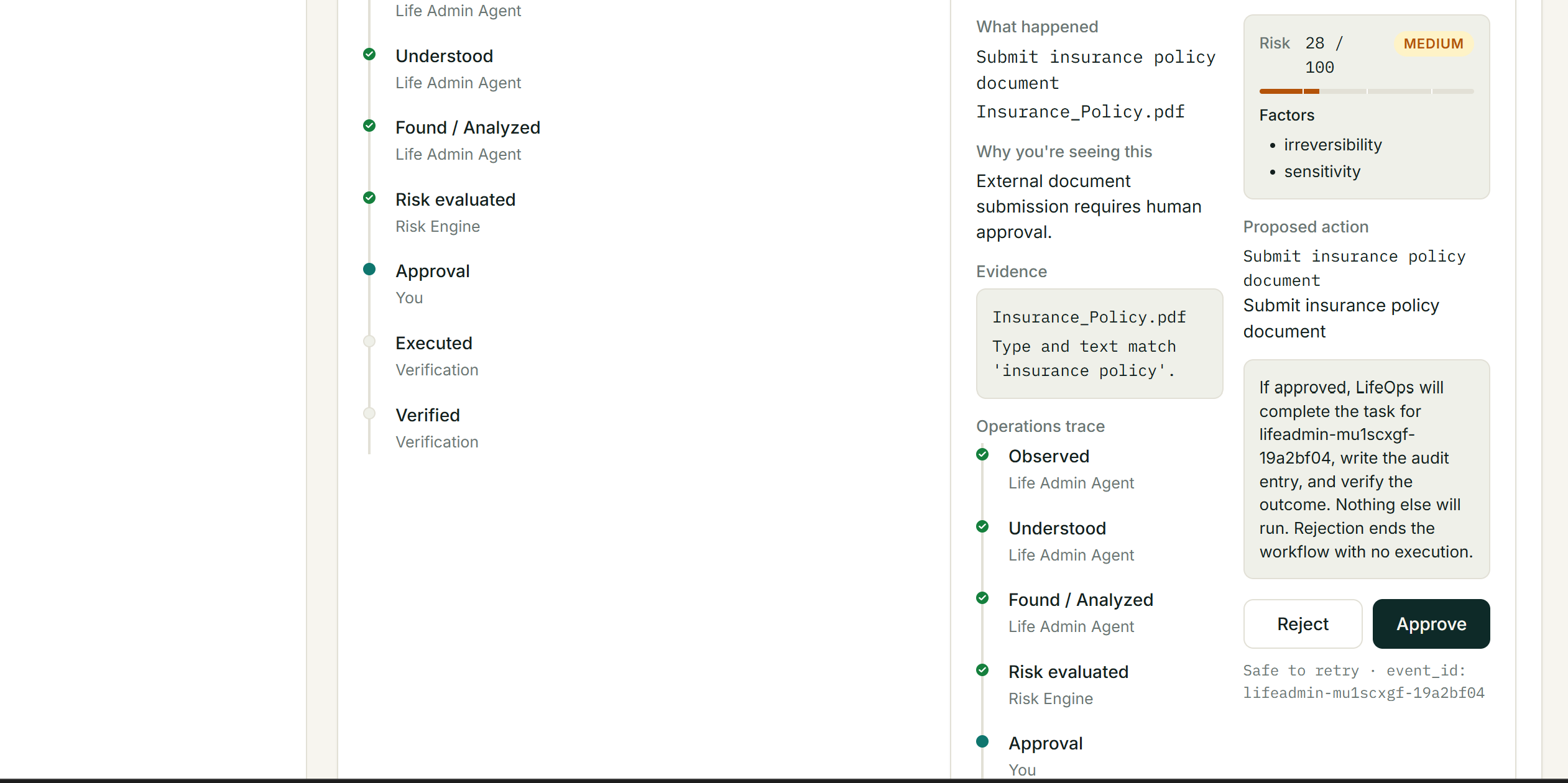
Risk assessed — 28 / 100 (MEDIUM)
      ↓
Human approval required
      ↓
Approved
      ↓
Action executed
      ↓
Receipt verified
      ↓
Audit recorded
Documents
The Document Agent searches a fictional document vault and distinguishes between:
- confident matches
- ambiguous matches
- missing documents
- expired documents
A high-confidence 2026 policy can proceed to approval, while an ambiguous certificate or missing visa is surfaced for review rather than treated as a confident match.
Finance
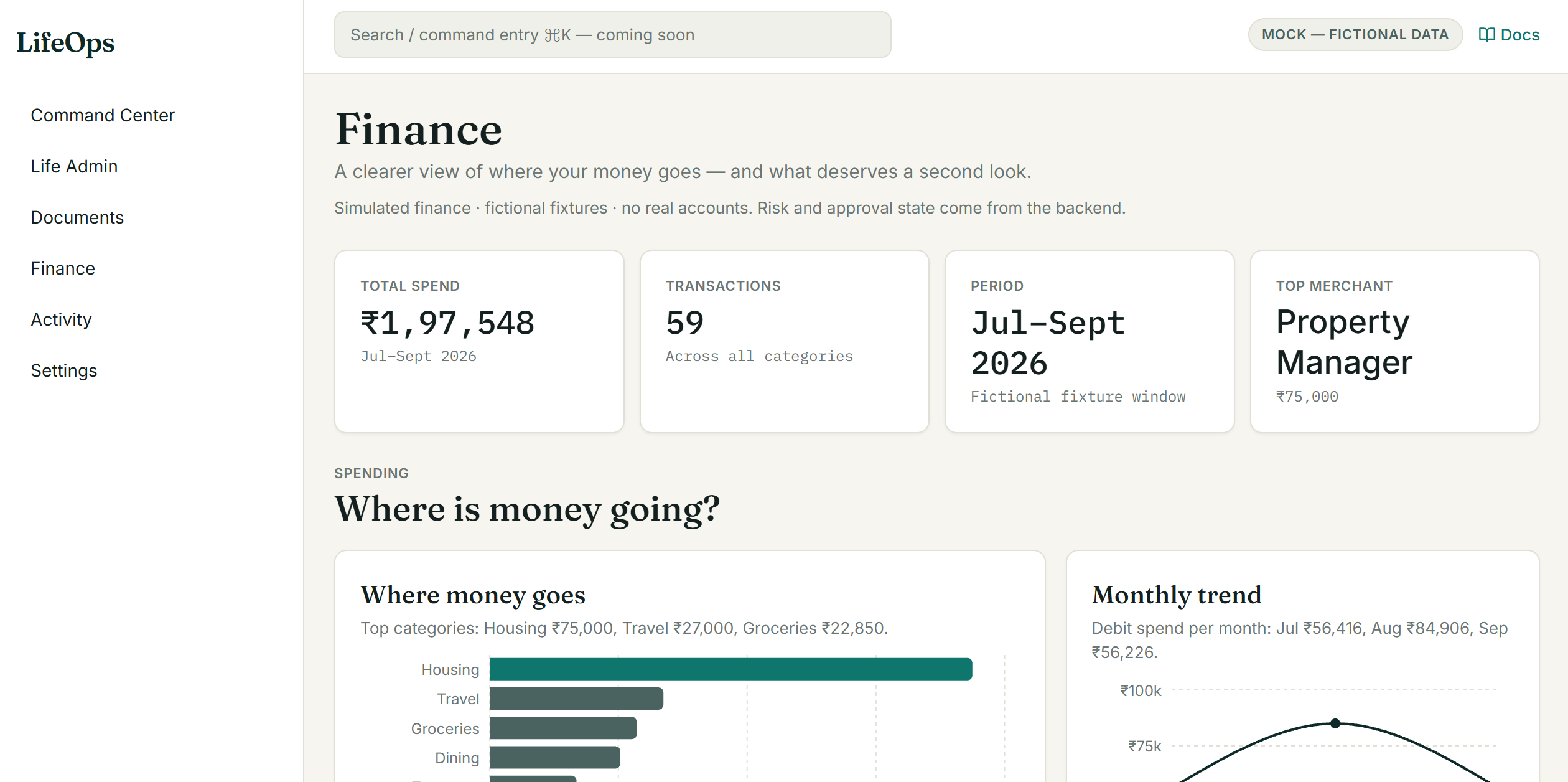
The Finance Agent analyzes fictional transactions and identifies unusual activity.
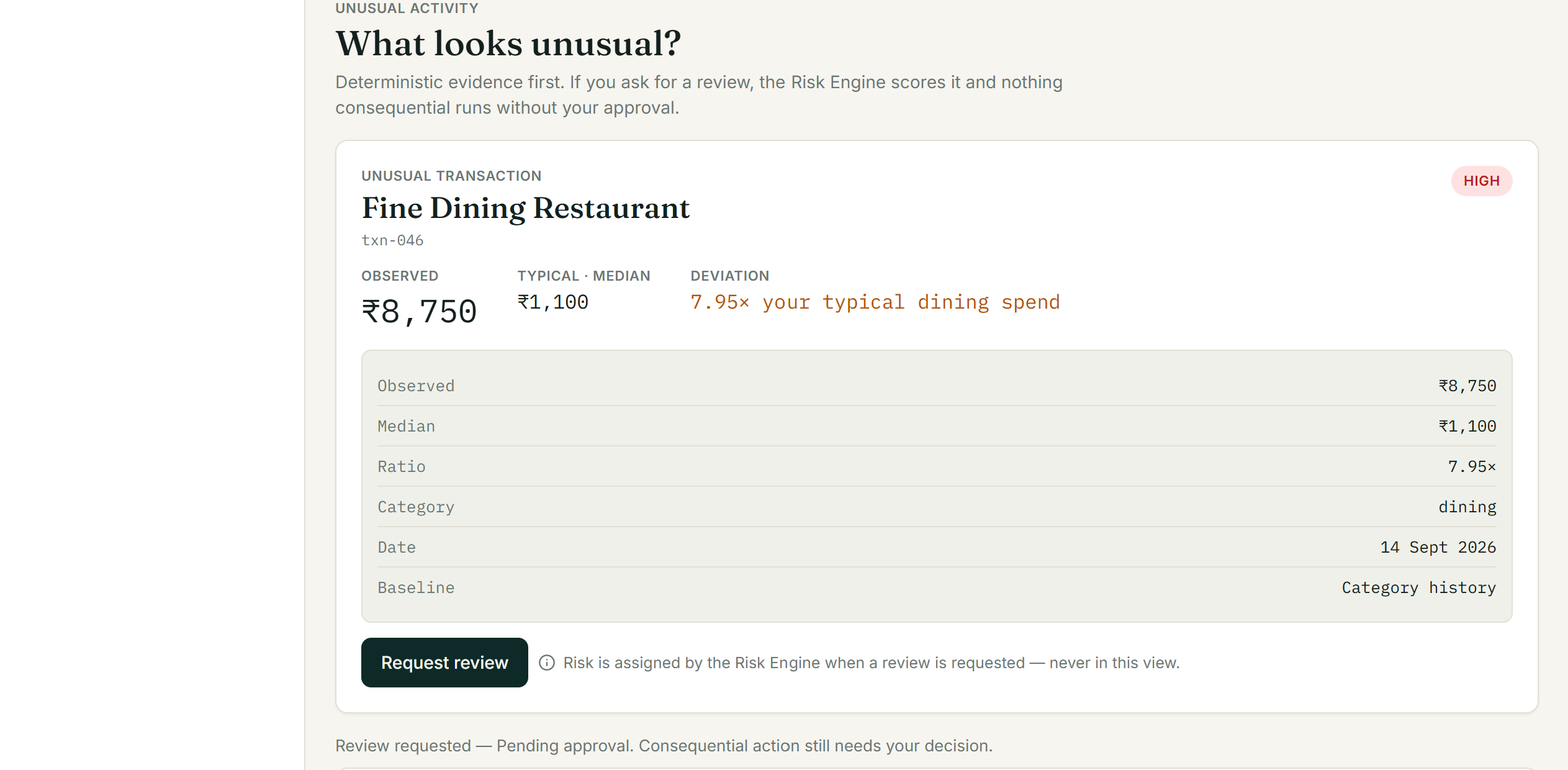
For example, LifeOps surfaces a ₹8,750 dining transaction against a ₹1,100 median, making it approximately 7.95× the normal amount.
The important part is not simply detecting an anomaly. LifeOps surfaces it as something requiring human attention instead of silently taking consequential action.
How we built it
LifeOps is built around an agentic workflow:
OBSERVE
   ↓
UNDERSTAND
   ↓
PLAN
   ↓
ACT
   ↓
VERIFY
   ↓
LEARN
The implementation uses Strands Agents as the agent framework.
Our model layer is provider-agnostic:
                 ┌── OpenAI
                 │
Strands Agent ───┼── Amazon Bedrock
                 │
                 └── Mock
The submitted implementation uses OpenAI through Strands' official OpenAIModel, which we validated end-to-end with structured Pydantic output. Amazon Bedrock support is also implemented through the same provider abstraction.
The important architectural boundary is:
Event
  ↓
Strands Agent
  ↓
Typed Proposal
  ↓
Deterministic Risk Engine
  ↓
Approval Gate
  ↓
Execution
  ↓
Verification
  ↓
Audit Ledger
The LLM is responsible for reasoning, using permitted read-only tools, identifying findings, and producing a typed proposal.
It does not control:
- authoritative risk scores
- risk bands
- approval decisions
- execution
- verification
- audit records
- idempotency
Risk is calculated deterministically from explicit factors. Consequential actions enter a server-side approval gate. Execution and verification are deterministic mock operations, and every completed workflow produces an append-only audit trail.
We built the backend with Python and FastAPI, using Pydantic domain models and a thin API layer over the existing workflows.
The frontend is built with Next.js, React, TypeScript, Tailwind CSS, and a data-driven product UI designed around a calm operations-console experience.
All demonstration data is fictional and sandboxed. No real email accounts, bank accounts, financial transactions, documents, or personal credentials are accessed.
Challenges we ran into
1. Bedrock account authorization
During development, our newly created AWS account consistently returned:
ValidationException: Operation not allowed
Bedrock reported the models as regionally available but returned:
authorizationStatus: NOT_AUTHORIZED
We opened an AWS Support case and preserved Bedrock as a provider in our architecture.
Rather than making the project dependent on resolving an external account-level issue immediately before the deadline, we used Strands' provider abstraction and validated the same agent architecture with OpenAI.
This turned an infrastructure blocker into an architectural advantage: the agent layer remained independent from the model provider.
2. Keeping the LLM inside a safe boundary
It was tempting to let the agent decide whether an action was safe or execute an action directly.
We deliberately did not.
We separated probabilistic reasoning from deterministic governance. This required careful boundaries between agent proposals, risk evaluation, approval, execution, verification, and audit.
3. Making autonomy understandable
"AI agents" can easily become an opaque chat interface.
We wanted users to understand what LifeOps noticed, why it surfaced something, what evidence it found, what risk was detected, and exactly where human judgment was required.
That led us to build the Operations Trace, evidence-first approval experience, risk presentation, and audit activity around the actual workflow state rather than around a chatbot conversation.
Accomplishments that we're proud of
We're proud that LifeOps is more than a collection of AI demos.
A real agentic architecture
Multiple specialized agents operate through Strands while sharing a common governed workflow.
Live model validation
The OpenAI provider has been validated end-to-end through Strands with structured Pydantic proposals.
Deterministic safety
The model cannot assign itself a risk score, approve its own action, execute an action, mark an action verified, or write to the audit ledger.
Human control
LifeOps doesn't ask for approval for everything. It is designed to automate routine work while stopping when risk, uncertainty, or consequence makes human judgment important.
Verification and auditability
Actions don't become complete simply because the model says they succeeded. Execution produces a receipt, verification checks that receipt, and the workflow records the result in an append-only audit ledger.
Idempotency
Repeated events are keyed by event_id, preventing duplicate workflows and executions.
Engineering discipline
The project currently has 133 passing backend tests, with frontend typechecking, linting, and production builds passing as well.
Most importantly, we built the product around a principle we believe should become increasingly important as agents gain more autonomy:
Autonomy should be earned through evidence, bounded by policy, and interrupted by humans when the consequences matter.
What we learned
We learned that building an agent is only part of building a useful agentic product.
The difficult question isn't:
"Can the LLM figure this out?"
It is:
"What happens when the LLM is wrong?"
That changed how we designed LifeOps.
We learned to separate:
- reasoning from authority
- proposals from decisions
- confidence from risk
- execution from verification
- automation from autonomy
- AI capability from user trust
We also learned the value of designing around provider abstraction. When Bedrock access became unavailable because of an AWS account restriction, our Strands-based architecture allowed us to validate the same agent system with another model provider without rewriting the application.
Finally, we learned that a good personal agent should not constantly demand attention. The best experience is often invisible: the agent handles something correctly, records what happened, and only interrupts when the human genuinely needs to decide.
What's next for LifeOps - Your Personal Operations Agent
The current version uses fictional sandbox data and deterministic simulated execution. The next stage would connect LifeOps to real user-authorized systems while preserving the same safety architecture.
Potential integrations include:
- email and calendar
- cloud document storage
- subscriptions and recurring payments
- financial data
- reminders and household tasks
- real document submission workflows
We would also move the current in-memory state to durable storage and eventually deploy the agent workflows using AWS infrastructure such as EventBridge, Lambda, and AgentCore where appropriate.
The long-term vision is not an AI that takes over someone's life.
It is an operations layer between people and the growing complexity of their digital lives.
LifeOps should make routine work disappear while keeping important decisions visible.
Your life has enough notifications. Your operations agent should know when to act — and when to ask.
Built With
- agents
- ai
- amazon-web-services
- automation
- fastapi
- next.js
- openai
- pydantic
- python
- react
- typescript

Log in or sign up for Devpost to join the conversation.