-
-
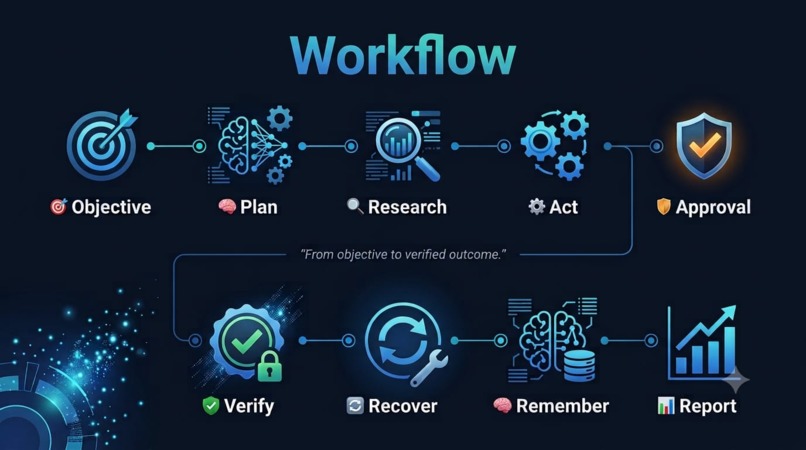
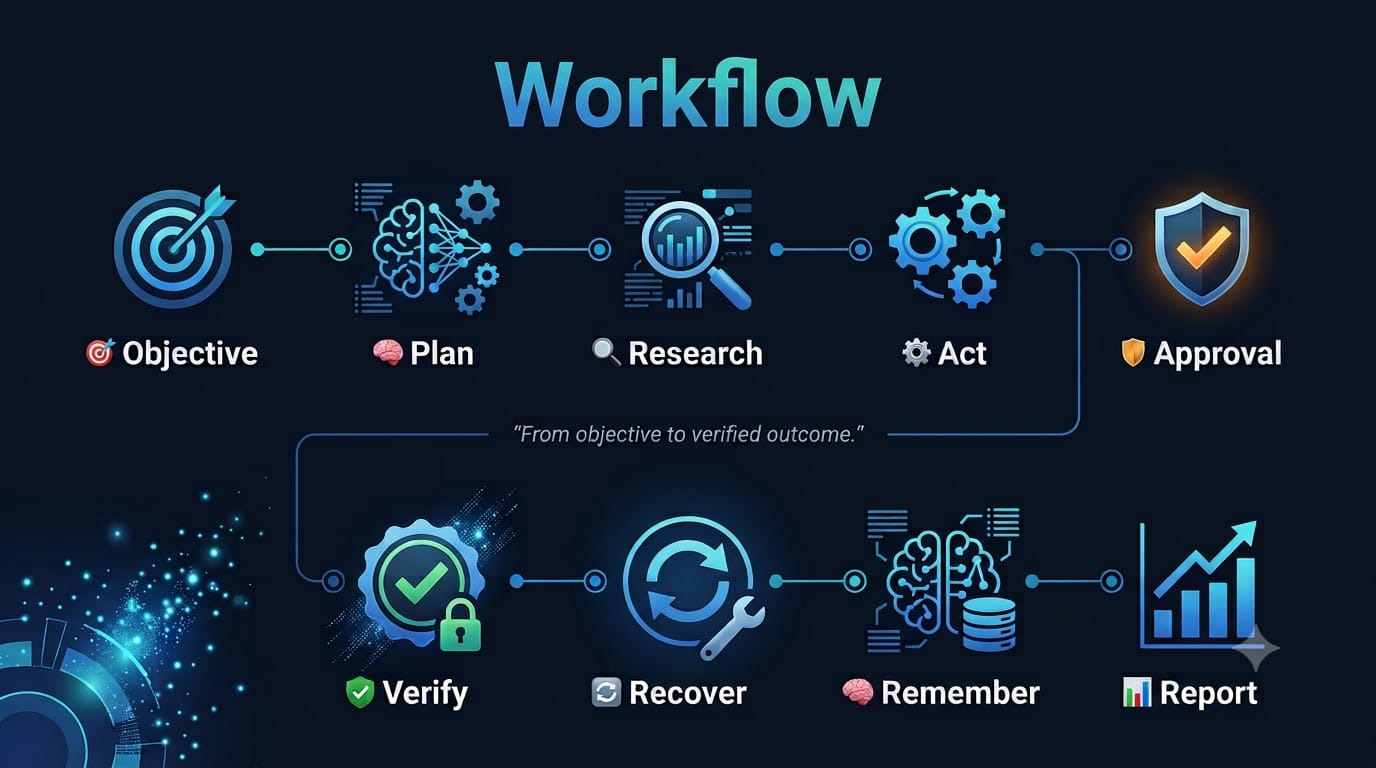
WorkFlow
-
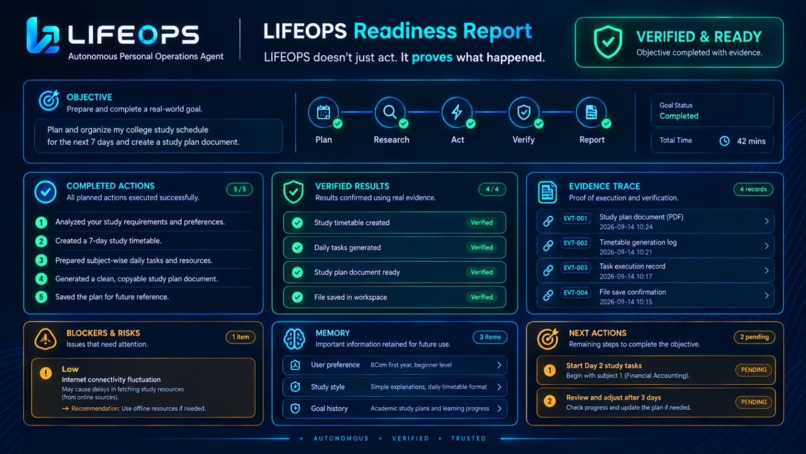
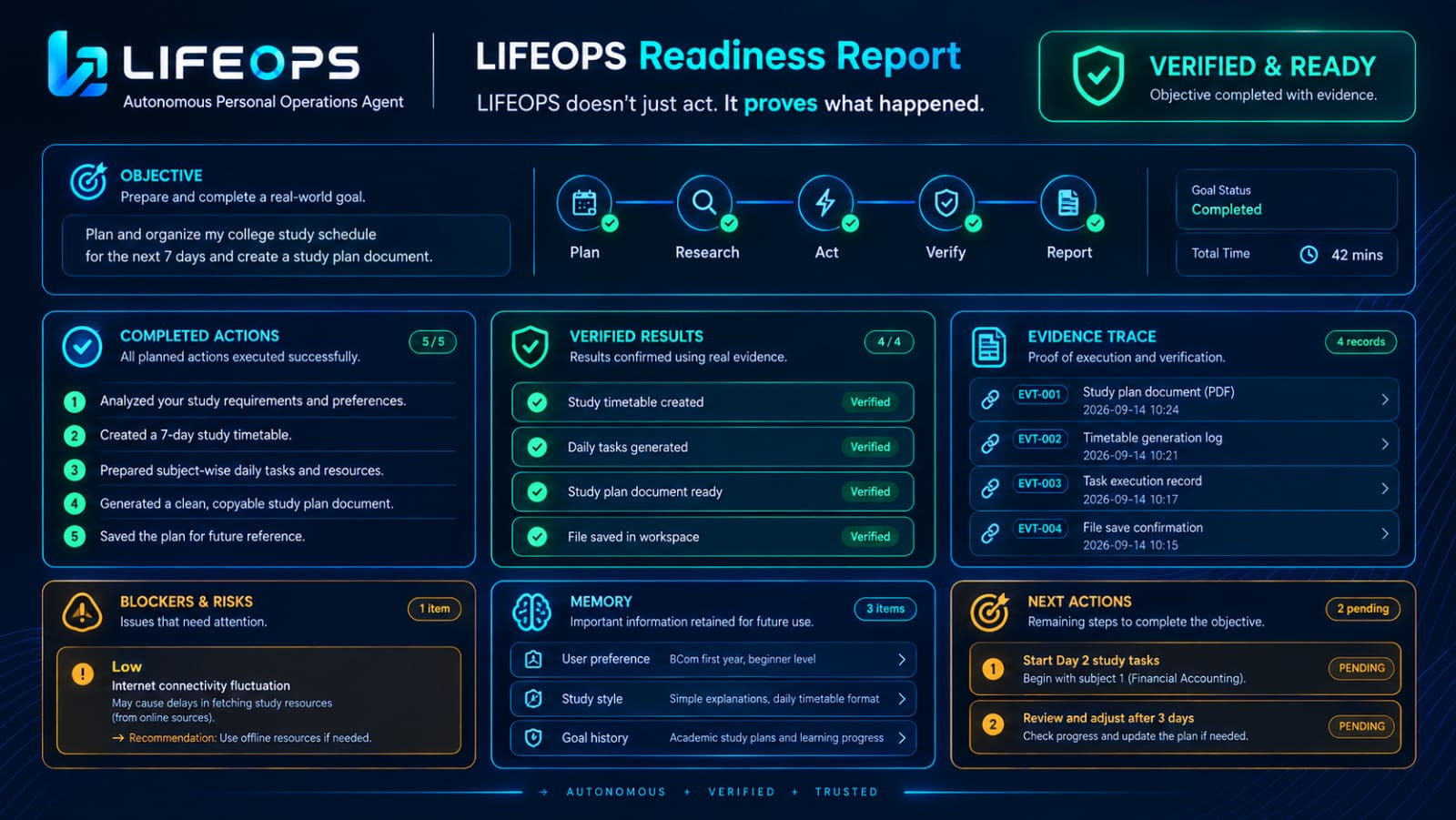
Readiness report
-
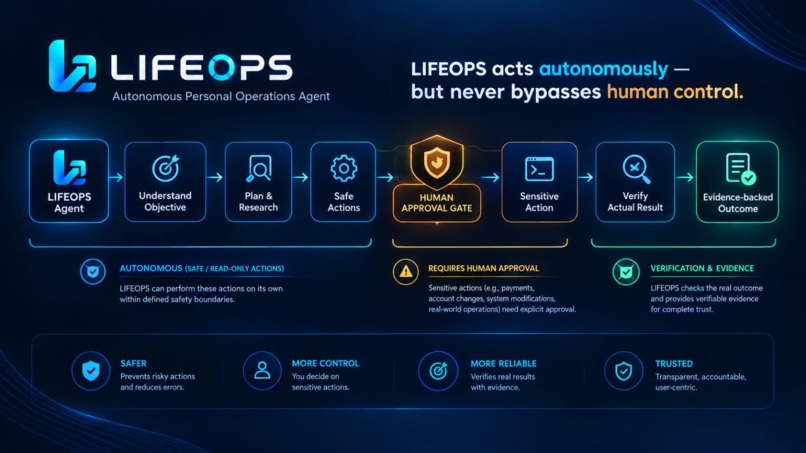
Saftey
-
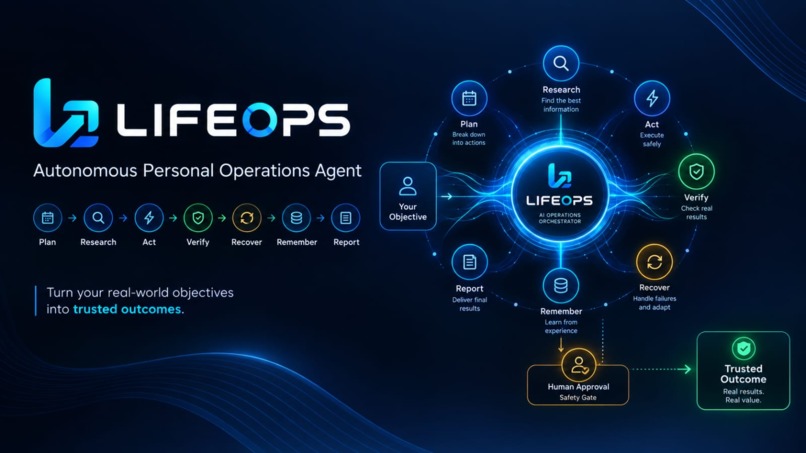
Hero banner
-
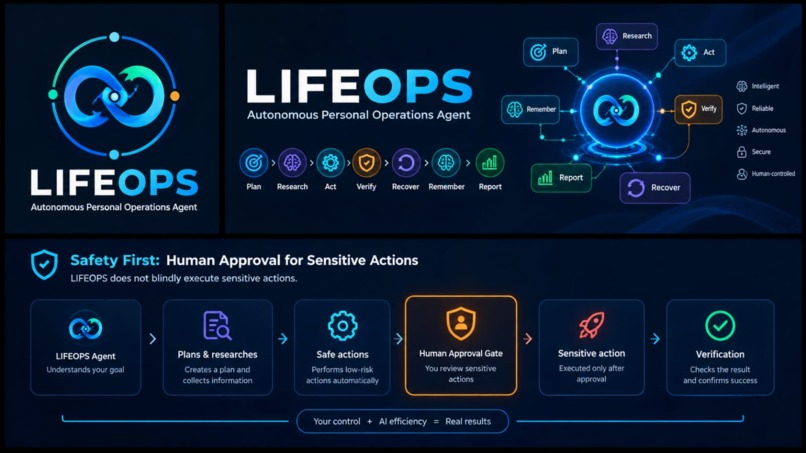
Logo
-
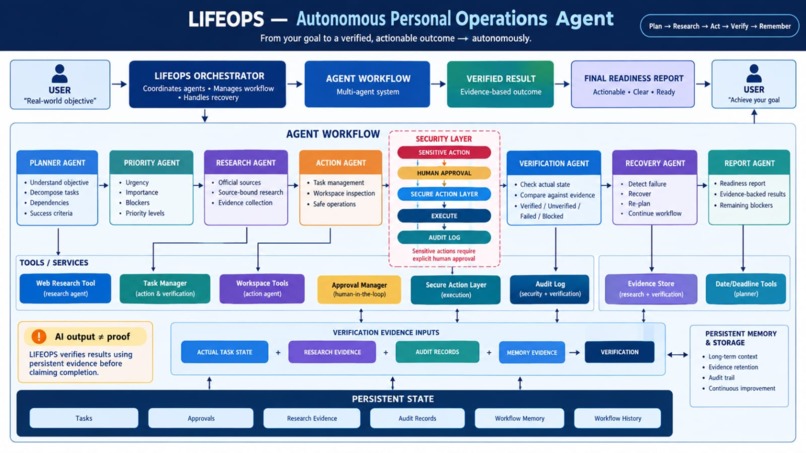
Architecture
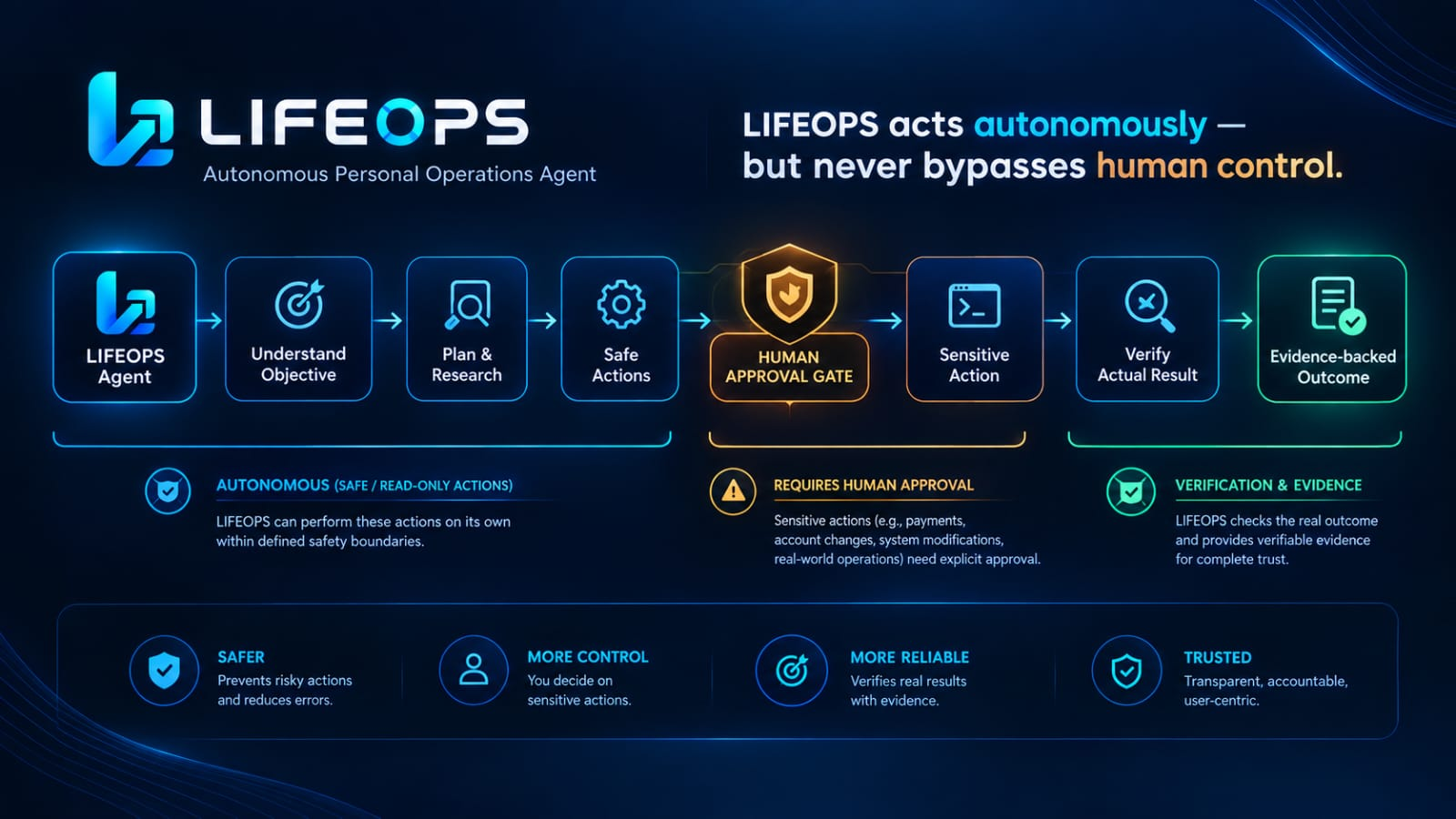
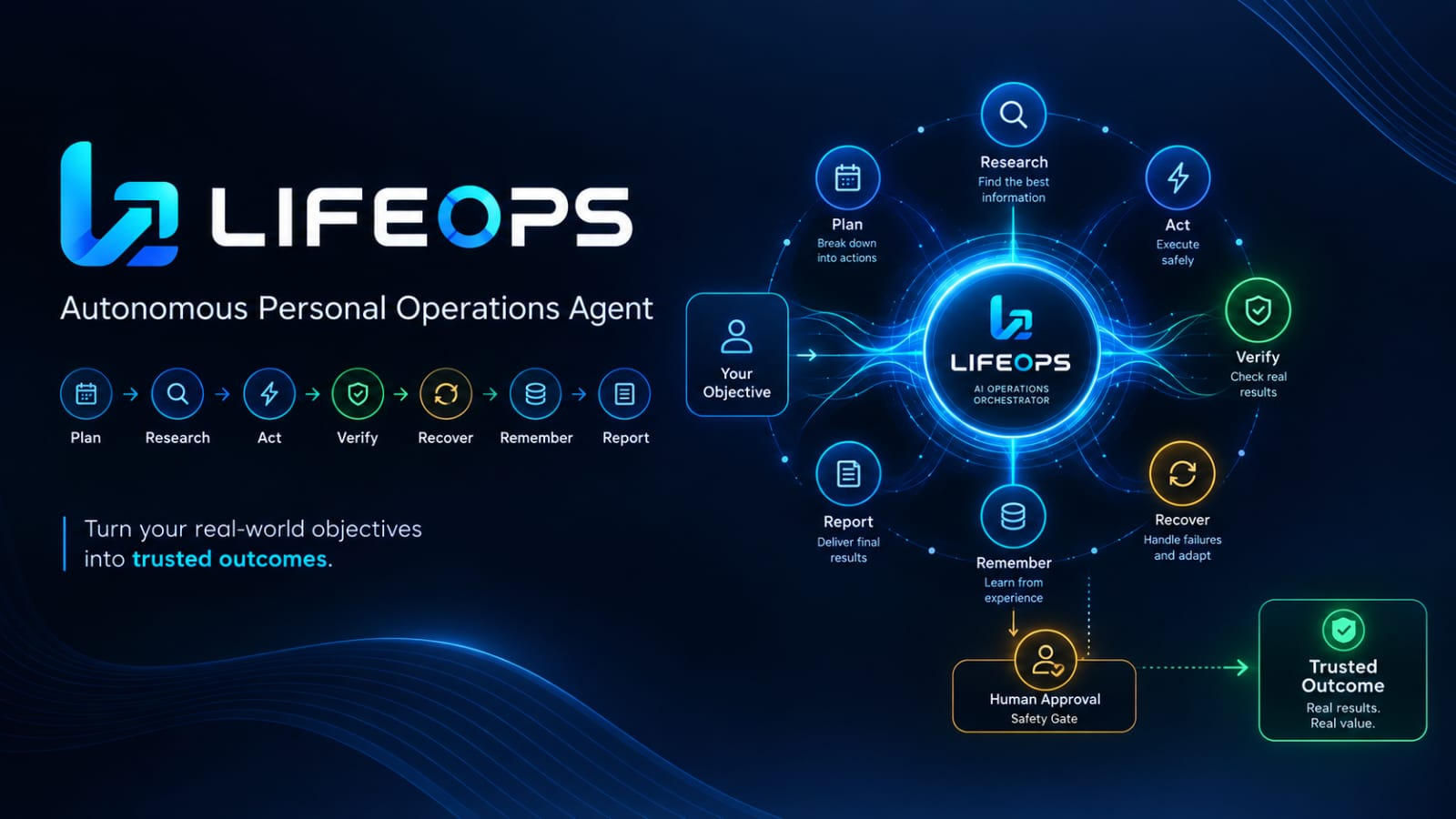
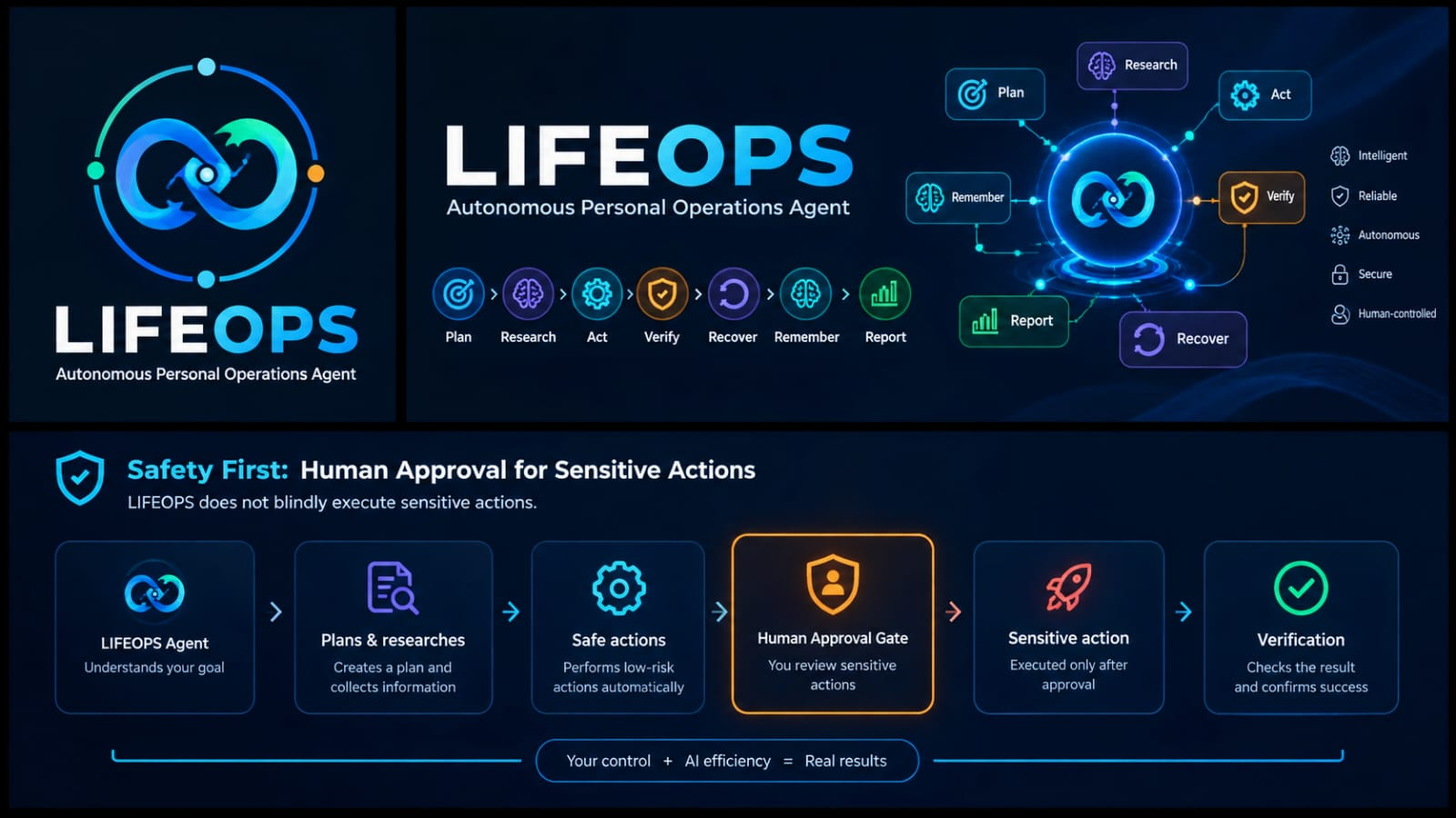
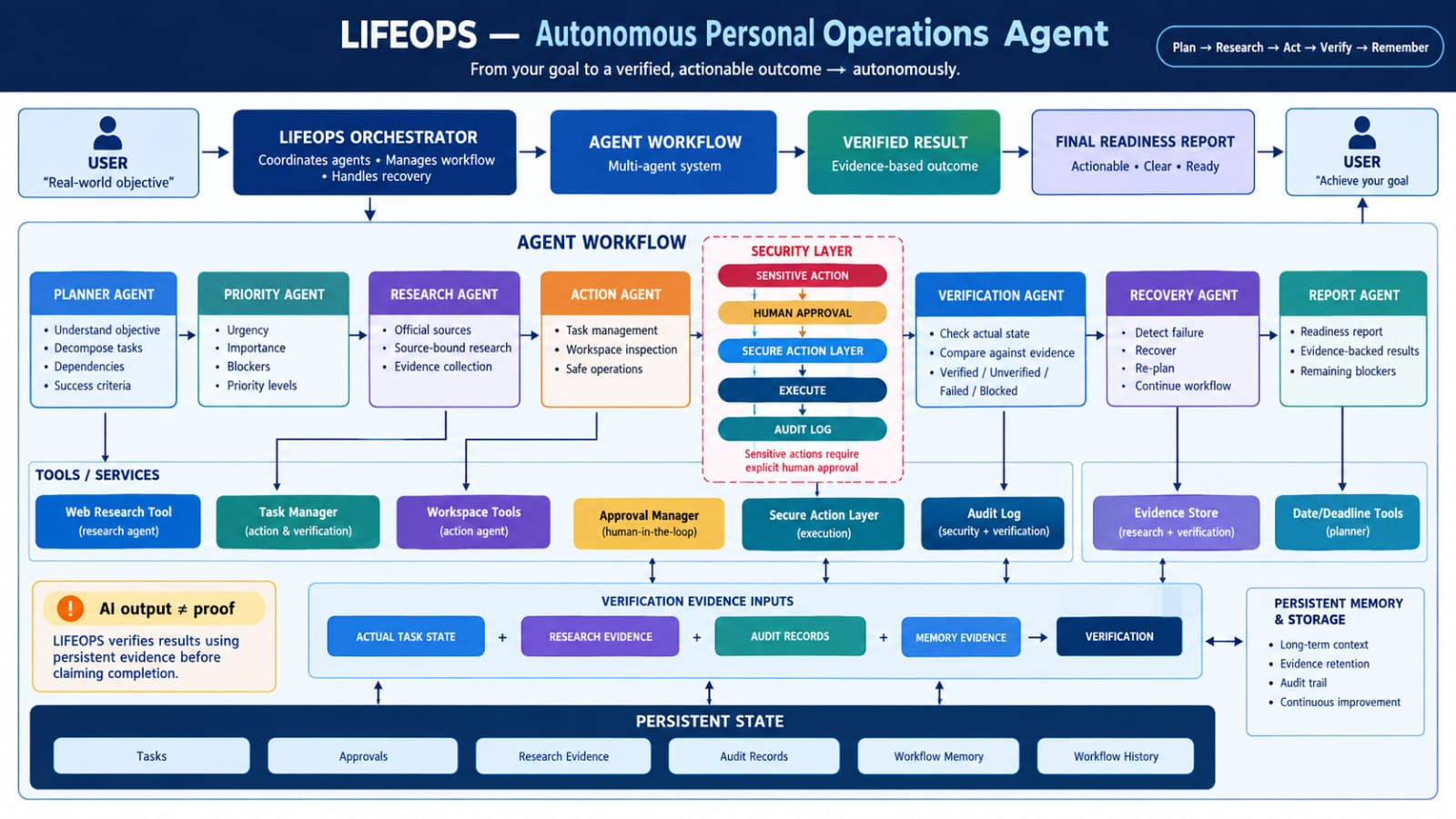
Inspiration
AI assistants are becoming increasingly capable, but there is still a gap between generating an answer and actually managing an objective from start to finish.
For a real-world task, a person often has to break the objective into smaller tasks, decide priorities, research information, take actions, check whether those actions succeeded, handle failures, and remember what happened.
This inspired me to build LIFEOPS — Autonomous Personal Operations Agent: a system designed to turn a high-level objective into a structured, evidence-based and verifiable workflow.
The goal was not to create an AI that simply says what should be done, but an agent system that can plan, research, act, verify, recover, and remember while keeping humans in control of sensitive actions.
What it does
LIFEOPS accepts a high-level objective and coordinates a multi-stage agent workflow around it.
The system can:
- Break objectives into actionable tasks.
- Prioritize tasks and identify important next steps.
- Research information using evidence from external sources.
- Execute permitted actions through controlled tools.
- Require explicit human approval for sensitive operations.
- Verify outcomes using persistent evidence instead of relying only on AI-generated claims.
- Distinguish between VERIFIED, UNVERIFIED, FAILED, and BLOCKED outcomes.
- Recover from failures and identify the next verification step.
- Preserve workflow history, evidence, approvals, and audit information.
- Generate a final traceable workflow report.
The central workflow is:
Objective -> Plan -> Prioritize -> Research -> Action -> Verify -> Recover -> Report -> Remember
LIFEOPS is designed around the principle that autonomy should increase usefulness without removing human control.
How we built it
LIFEOPS is built in Python using the Strands Agents SDK and AWS Bedrock with Qwen for agent intelligence.
The system is organized into specialized components rather than relying on a single agent to perform every task.
Agent layer
- Planner Agent — converts an objective into structured tasks, dependencies, deadlines, missing information, and success criteria.
- Priority Agent — determines priorities and the most important next actions.
- Research Agent — gathers evidence from external sources and preserves source information and evidence identifiers.
- Action Agent — performs only permitted operations through controlled tools.
- Verification Agent — evaluates outcomes against available persistent evidence.
- Recovery — handles failures, blocked operations, and follow-up verification.
- Workflow Memory — preserves previous workflow history and evidence.
Safety layer
Sensitive actions are protected by an explicit approval system.
LIFEOPS uses:
- Exact approval matching.
- Persistent approval records.
- Human approval before sensitive actions.
- Approval consumption and replay protection.
- Restricted filesystem operations.
- Path traversal protection.
- Protection for sensitive files and directories.
- Persistent audit logging.
Evidence and memory
Research evidence, verification results, task information, approvals, and workflow history are persisted so that important decisions can be traced after execution.
Interface
A Streamlit dashboard provides a visual interface for running LIFEOPS and inspecting its workflow stages, readiness information, safety mechanisms, and results.
The project is organized into agents, tools, ui, data, tests, and docs, with the source code and setup instructions publicly available in the repository.
Challenges we ran into
One of the biggest challenges was designing autonomy without allowing the system to become uncontrolled.
It was important to make sure that an agent could perform useful operations while sensitive actions still required explicit human approval.
Another challenge was verification. An AI model can confidently claim that something happened even when there is no reliable evidence. LIFEOPS therefore separates execution from verification and requires persistent evidence before treating an outcome as verified.
We also had to design persistent state for approvals, tasks, evidence, audit logs, and workflow memory.
During development, managing the amount of accumulated workflow and research information passed between agent stages also became a practical engineering challenge. This highlighted the importance of controlling context size and keeping agent inputs focused.
Finally, building a usable Streamlit interface while maintaining a modular agent architecture required balancing simplicity for the user with separation of responsibilities internally.
Accomplishments that we're proud of
We are proud that LIFEOPS goes beyond a basic chatbot or single AI prompt and implements a complete operational workflow.
The most important accomplishments are:
- Built a working multi-stage agent workflow using the Strands Agents SDK.
- Implemented specialized planning, prioritization, research, action, and verification components.
- Added explicit human approval for sensitive operations.
- Implemented approval matching and replay protection.
- Added persistent audit logging.
- Built evidence-based verification with distinct outcome states.
- Added persistent workflow memory and traceability.
- Created a functional Streamlit dashboard.
- Added architecture and workflow documentation.
- Built a regression test suite for important safety, memory, verification, and persistence behavior.
- Made the project publicly available with setup instructions and source code.
Most importantly, we are proud of the design principle behind the system:
The agent can operate autonomously, but it does not get to decide that sensitive actions are automatically approved or that unverified outcomes are automatically successful.
What we learned
Building LIFEOPS taught us that creating an agent is not only about making a model capable of producing intelligent responses.
A useful autonomous system also needs:
State -> Tools -> Safety -> Evidence -> Verification -> Memory
We learned that specialization can make an agent system easier to reason about than giving one model responsibility for everything.
We also learned that verification needs to be treated as a separate responsibility from execution. An action being requested or attempted does not automatically mean that the desired outcome occurred.
Another important lesson was that safety has to be designed into the architecture rather than added as an afterthought.
Finally, working with persistent workflow information showed us that context management is an important engineering consideration for long-running agent systems.
What's next for LIFEOPS — Autonomous Personal Operations Agent
The next step for LIFEOPS is to move from a strong local prototype toward a more capable personal operations platform.
Future improvements include:
- More real-world integrations with productivity and communication tools.
- More robust long-running workflow execution.
- Richer recovery strategies for failed operations.
- More advanced evidence collection and verification.
- Improved memory retrieval across previous workflows.
- More granular permission and approval policies.
- Better monitoring and observability.
- Cloud deployment for secure remote access.
- Additional specialized agents and tools.
- More extensive automated testing and evaluation.
The long-term vision is to make LIFEOPS a trustworthy personal operations layer where users can delegate complex objectives to AI while retaining visibility, evidence, control, and the ability to intervene whenever it matters.
Built With
- agentic
- agents
- ai
- amazon-web-services
- artificial
- automation
- bedrock
- generative
- intelligence
- python
- qwen
- sdk
- strands
- streamlit


Log in or sign up for Devpost to join the conversation.