Inspiration
Modern life is fragmented across email, calendar, and financial notifications. Critical signals — overdue bills, spending spikes, scheduling conflicts — are buried inside unstructured data. We wanted to build a system that proactively detects these risks and takes safe, verified action before they become problems.
Instead of another reminder app, we built LifeOps — an AI Personal Operations Manager.
What it does
LifeOps continuously:
- Classifies incoming emails into structured events
- Detects financial and scheduling risks in real time
- Computes a measurable Chaos Score (0–100)
- Generates corrective action plans
- Verifies safety before automation
Logs all actions for auditability
Chaos Score Formula:
ChaosScore=(OverdueBills×20)+(SpendingSpikes×15)+(CalendarConflicts×10)+(OverdueTasks×5)ChaosScore = (OverdueBills \times 20) + (SpendingSpikes \times 15) + (CalendarConflicts \times 10) + (OverdueTasks \times 5)ChaosScore=(OverdueBills×20)+(SpendingSpikes×15)+(CalendarConflicts×10)+(OverdueTasks×5) This turns abstract stress into a measurable system metric.
How we built it
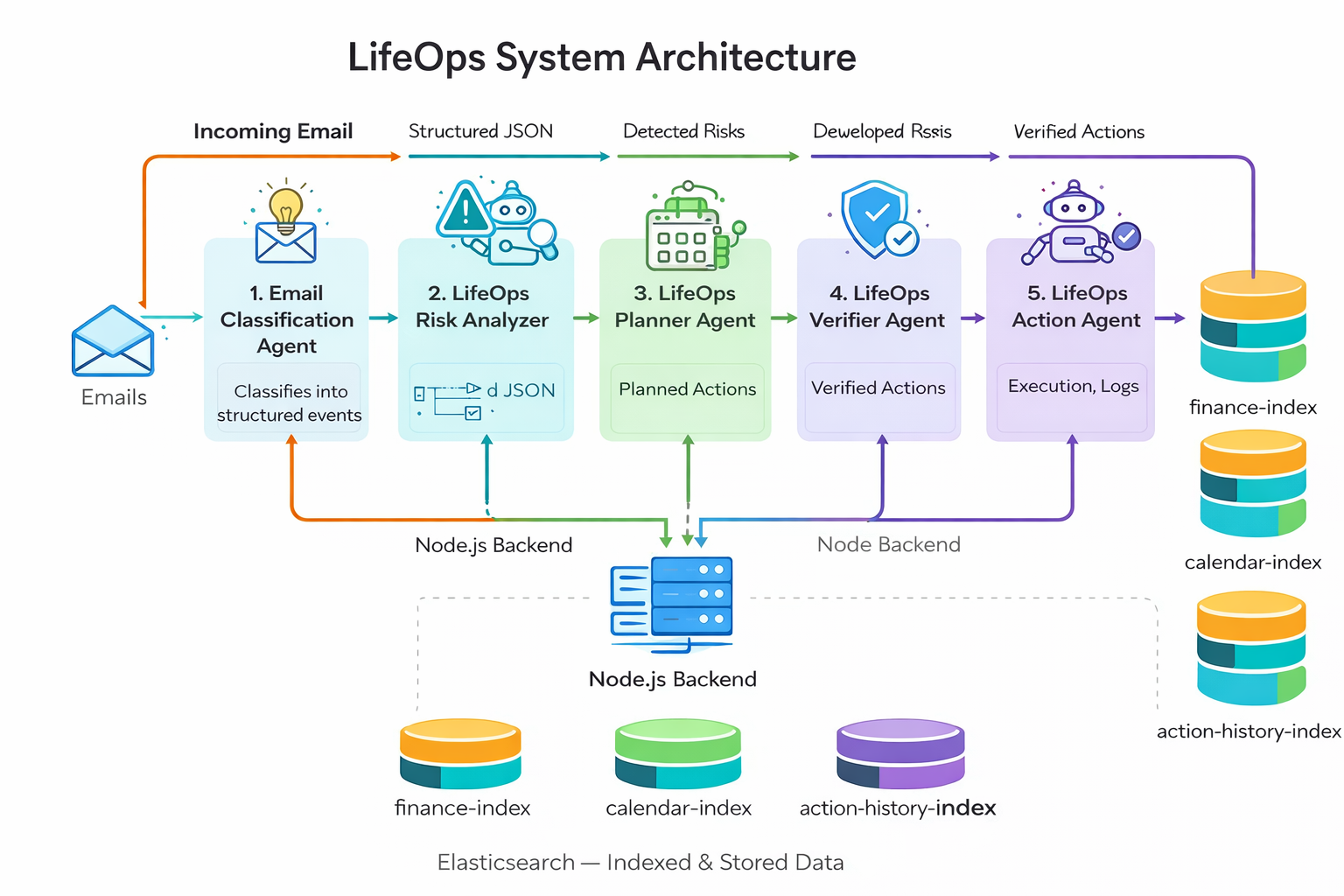
LifeOps is a 5-agent orchestration system powered by Elasticsearch:
- Classification Agent → Extracts structured data from raw text
- Risk Analyzer Agent → Uses cross-index Elasticsearch queries and time-series aggregations
- Planner Agent → Generates structured action plans
- Verifier Agent → Enforces confidence thresholds and duplicate checks
- Action Agent → Produces execution payloads
A Node.js backend orchestrates all agents and handles secure indexing into:
- events-index
- finance-index
- calendar-index
- action-history-index
We intentionally separated AI reasoning from execution to ensure reliability and production-grade safety.
Elasticsearch Impact
Elasticsearch enables:
- Cross-index correlation
- 7-day moving average spending detection
- Time-based bill risk analysis
- Real-time event storage
- Full audit trail logging
This allows LifeOps to move beyond prompt-based AI into data-driven decision automation.
Challenges we ran into
- Elastic AI agents had read-only permissions → solved using backend-controlled indexing
- Ensuring deterministic JSON between agents required strict schema design
- Coordinating multi-agent workflows required careful orchestration logic
Accomplishments that we're proud of
- Built a fully functional 5-agent system
- Implemented real-time risk detection using time-series analysis
- Designed measurable Chaos Score
- Added guardrails before automation
- Created full-stack system (AI + Backend + Dashboard + Elasticsearch)
What we learned
- Multi-agent systems are significantly more reliable than single-prompt automation
- Guardrails are essential for safe AI execution
- Elasticsearch dramatically enhances AI reasoning with structured time-series data
- AI systems need orchestration, not just prompts
What's next for LifeOps – AI Personal Operations Manager
- Live calendar and messaging integrations
- Predictive chaos forecasting
- Personalized behavior modeling
- Mobile dashboard
- Autonomous subscription management
Our long-term vision is to build an AI Operating System for daily life that proactively manages time, money, and commitments.
Built With
- axios
- elastic
- elasticsearch
- express.js
- node.js
- postman
- react
- render
- rest

Log in or sign up for Devpost to join the conversation.