-
-
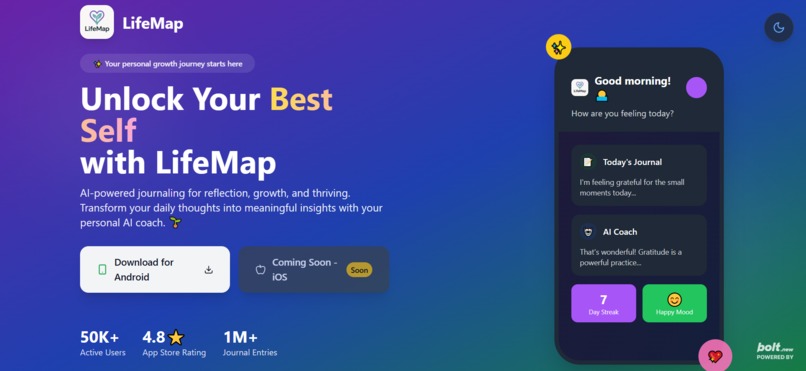
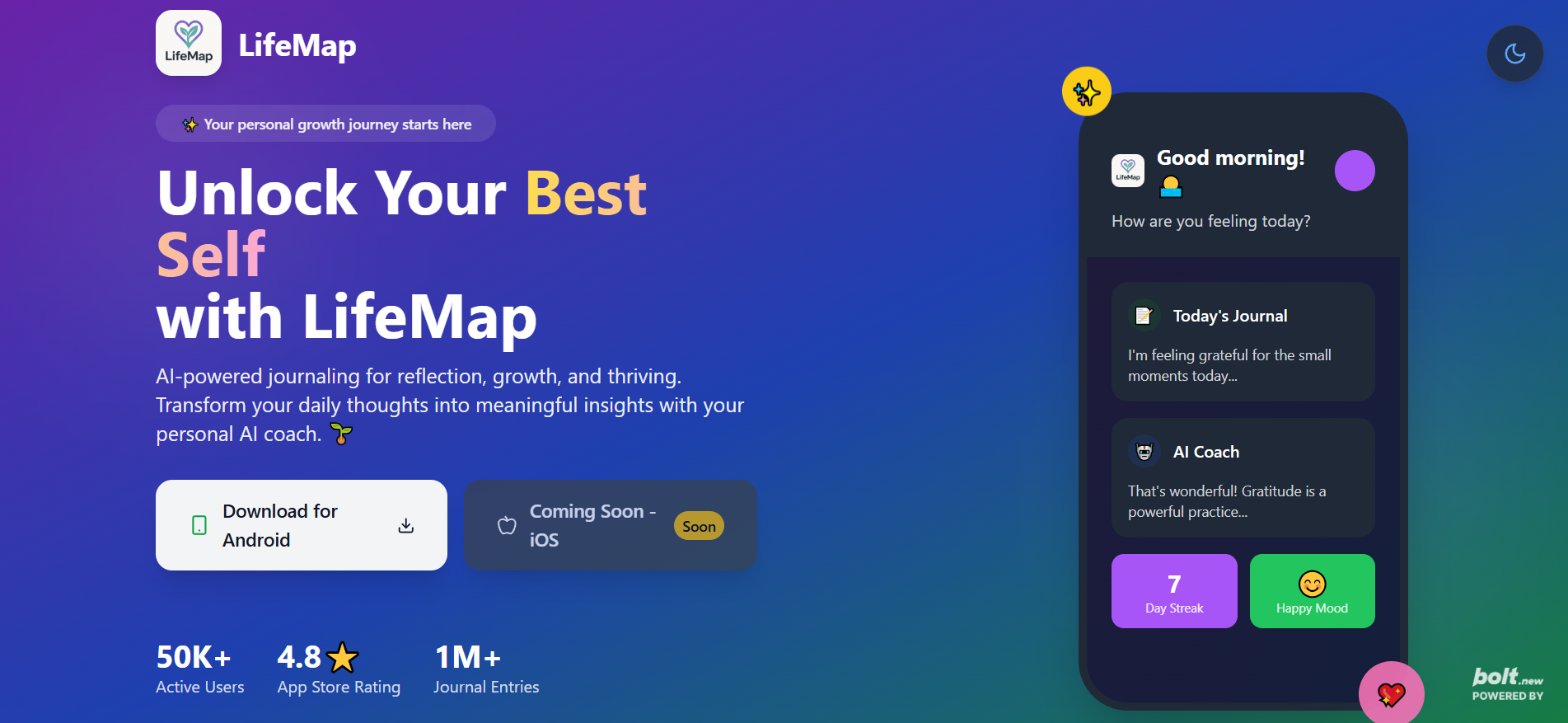
LifeMap
What Inspired Me
The journey to create LifeMap began with my own personal struggle to maintain consistent growth habits. Like countless others, I found myself in a cycle of starting new journals, setting ambitious goals, and tracking habits with enthusiasm, only to abandon them after a few weeks when the initial motivation faded. This pattern repeated itself across multiple apps and methods, leaving me frustrated and questioning why I couldn't stick to something as simple as daily reflection.
Through this struggle, I identified a fundamental gap in traditional journaling applications. While they provided the basic tools for writing and organizing thoughts, they lacked the intelligent guidance and insights needed to keep users engaged and motivated over the long term. Most apps were essentially digital notebooks with basic analytics, missing the crucial element of personalized feedback and actionable insights.
The breakthrough came when I began exploring how artificial intelligence could transform personal development. I envisioned a platform that could combine the therapeutic benefits of journaling with AI-powered insights that help users understand their patterns, receive personalized guidance, and stay motivated on their growth journey. The idea was to create not just a journaling app, but a true personal growth companion that learns from your entries and provides meaningful, actionable feedback.
What I Learned
Building LifeMap became an intensive learning journey that pushed me to explore and master multiple technology domains. The project served as a comprehensive education in modern mobile development, AI integration, and product design.
Technical Skills Across Multiple Domains:
- React Native & Expo: Delved deep into cross-platform mobile development, learning how to create smooth, native-like experiences that work seamlessly across iOS, Android, and Web platforms. Mastered the intricacies of platform-specific optimizations and performance tuning.
- AI Integration & Backend Development: Explored Flask backends, Dappier for API integrations, and the complex challenge of making AI responses feel personal and genuinely helpful rather than generic. Learned about prompt engineering, response filtering, and creating conversational AI that understands context.
- Real-time Data & Database Design: Supabase's real-time capabilities, designing efficient database schemas for user data, and implementing robust data synchronization that works across multiple devices and handles offline scenarios gracefully.
- Subscription Systems & Monetization: Implemented RevenueCat for Demo subscription management, learning about freemium business models, user psychology around pricing, and the technical challenges of managing subscription states across platforms.
User Experience Principles:
- Discovered the critical importance of micro-interactions, haptic feedback, and intuitive design in keeping users engaged. Learned how small details like smooth animations and responsive feedback can significantly impact user retention and satisfaction.
- Studied user onboarding flows and the psychology of habit formation, understanding how to design experiences that encourage daily use rather than occasional engagement.
Business Aspects:
- Gained insights into product-market fit, user acquisition strategies, and the balance between providing value and generating revenue.
- Learned about the challenges of building a sustainable business model in the competitive personal development app market.
How I Built It
The development of LifeMap followed a carefully planned iterative approach, with each phase building upon the previous one to create a robust and scalable application.
Phase 1: MVP Development Started with the core journaling functionality using React Native and Expo. This phase focused on creating a solid foundation with basic entry creation, mood tracking, and simple data persistence. The goal was to validate the core concept and ensure the basic user experience was intuitive and engaging.
Phase 2: AI Integration Added the Flask backend with Dappier API integration to bring intelligent insights to the platform. This phase involved significant experimentation with AI response generation, ensuring that the insights felt personal and actionable rather than generic. Implemented sophisticated prompt engineering and response filtering to create meaningful AI interactions.
Phase 3: Real-time Features Implemented Supabase for live data synchronization across devices. This phase focused on creating a seamless experience where users could access their data from any device, with real-time updates and robust offline handling. Designed efficient database schemas and implemented proper error handling for network issues.
Phase 4: Monetization Strategy Integrated RevenueCat for Demo subscription management, implementing a freemium model that provides value to free users while offering premium features for subscribers. This phase involved careful consideration of feature gating, pricing psychology, and creating compelling upgrade paths.
Phase 5: Polish & Optimization Added sophisticated animations, improved UI/UX design, and conducted extensive cross-platform testing. This phase focused on creating a premium feel and ensuring consistent performance across all supported platforms.
The tech stack was strategically chosen for scalability and developer experience. Expo provided rapid development capabilities and excellent cross-platform support, Supabase offered a powerful backend-as-a-service solution, and Flask allowed for custom AI logic and complex business rules.
Challenges I Faced
The development journey was filled with both technical and personal challenges that tested my problem-solving skills and resilience.
Technical Challenges:
- Cross-platform Compatibility: Ensuring consistent behavior across iOS, Android, and Web required extensive testing and platform-specific optimizations. Each platform has unique quirks and limitations that needed to be carefully navigated.
- AI Response Quality: Making AI insights feel personal and actionable rather than generic was one of the most significant challenges. This involved extensive prompt engineering, response filtering, and creating context-aware AI that could provide meaningful feedback based on user history.
- Real-time Synchronization: Implementing seamless data sync across devices while handling offline scenarios required sophisticated conflict resolution and data merging strategies. Ensuring data consistency across multiple devices was a complex technical challenge.
- Performance Optimization: Balancing rich features with smooth performance, especially with animations and real-time updates, required careful optimization and profiling. Mobile devices have limited resources, and maintaining 60fps animations while handling real-time data updates was challenging.
Product Challenges:
- User Engagement: Designing features that encourage daily use rather than occasional journaling required deep understanding of habit formation psychology and user motivation. Creating compelling reasons for users to return daily was crucial for long-term success.
- Privacy Concerns: Building trust around AI processing personal journal entries required transparent privacy policies, secure data handling, and clear communication about how user data is used and protected.
- Monetization Strategy: Finding the right balance between free features and premium value was a delicate balancing act. The goal was to provide enough value in the free tier to attract users while creating compelling reasons to upgrade.
- Onboarding Experience: Creating an intuitive first-time user experience that showcases the app's value and encourages continued use required extensive user testing and iteration.
Personal Growth Challenges:
- Scope Management: Learning to prioritize features and avoid feature creep was crucial for maintaining focus and delivering a quality product. It's easy to get excited about new features, but discipline is required to stay focused on core functionality.
- User Feedback Integration: Balancing user requests with technical feasibility and product vision required strong decision-making skills. Not every user request can or should be implemented, and learning to say no while maintaining user satisfaction was challenging.
- Continuous Learning: Staying updated with rapidly evolving mobile and AI technologies required ongoing education and adaptation. The technology landscape changes quickly, and maintaining relevance requires constant learning.
The biggest lesson from this journey was that building a personal growth app requires practicing what you preach. The project itself became a journey of continuous improvement, learning from failures, and staying committed to the vision despite setbacks and challenges. It reinforced the importance of persistence, adaptability, and maintaining focus on the core mission of helping users grow and improve their lives.
Built With
- android
- cross-env
- dappier-api
- expo-application-services-(eas)
- expo-cli
- expo-lint
- expo-router-5.1.0
- expo-sdk-53
- flask-2.3.3
- gunicorn
- ios
- jwt
- langchain
- lucide-react-native-0.475.0
- npm
- openweathermap-api
- postgresql
- react-native
- react-native-pie-chart-4.0.1
- react-native-reanimated-3.17.4
- render
- revenuecat
- row-level-security-(rls)
- supabase
- supabase-auth
- supabase-realtime
- supabase-rest-api
- typescript
- web


Log in or sign up for Devpost to join the conversation.