Inspiration
Cardiac emergencies are terrifying because the most important minutes happen before professional help arrives. LifeLink was inspired by a painful personal story: a loved one suffered a sudden cardiac emergency, and the people nearby did what most people would do — panic, call 911, and wait. But in those first few minutes, nobody knew where the nearest AED was, who nearby could help, or how to perform CPR confidently.
We built LifeLink to close that gap. It does not replace 911; it acts as the emergency response layer between “someone collapsed” and “help arrived.”
This problem matters because more than 350,000 out-of-hospital cardiac arrests happen in the U.S. each year, and immediate CPR can double or triple survival chances. Early defibrillation within 3–5 minutes can lead to survival rates as high as 50%–70%, but first responders often take 8–12 minutes to arrive.
What it does
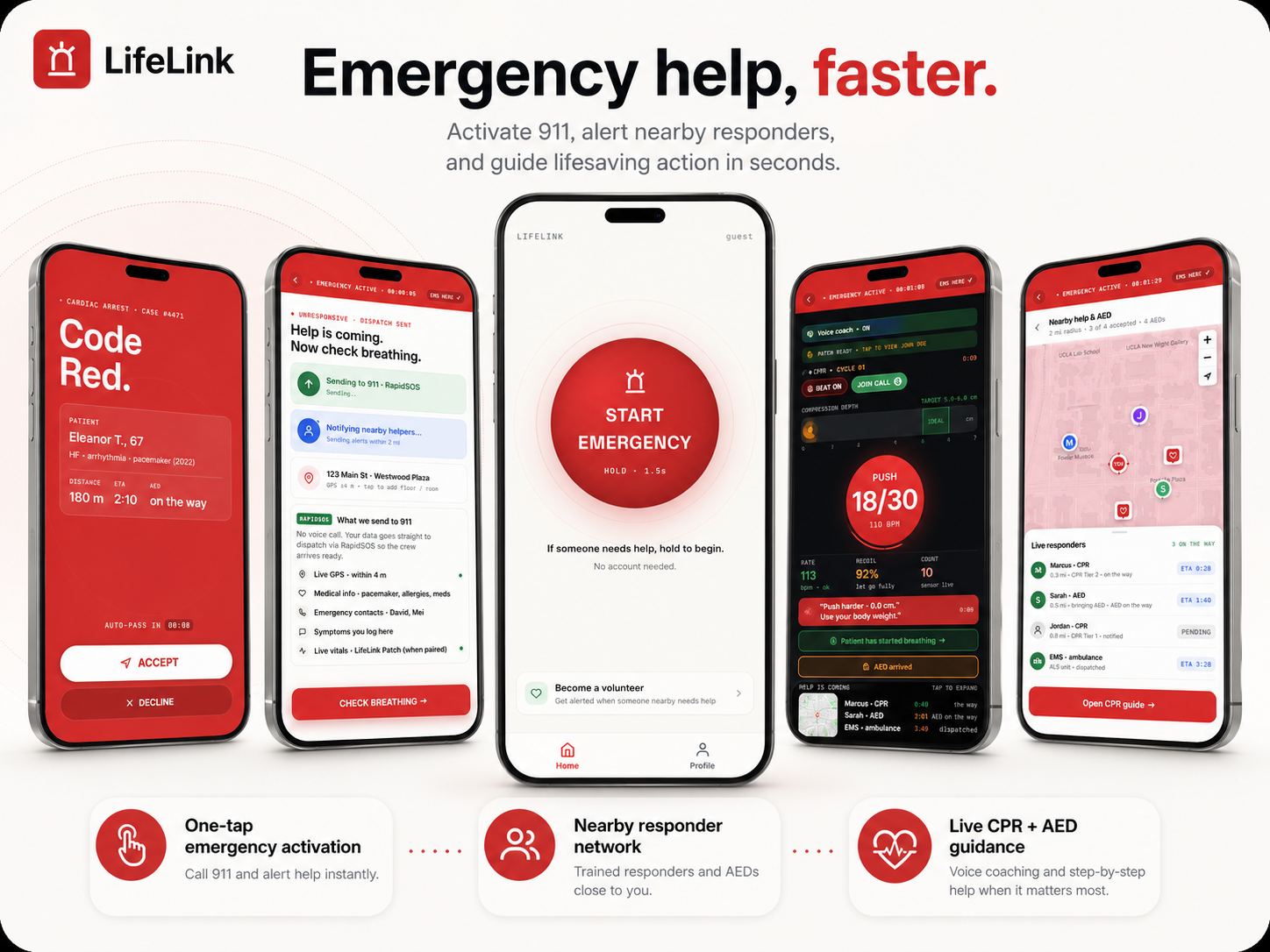
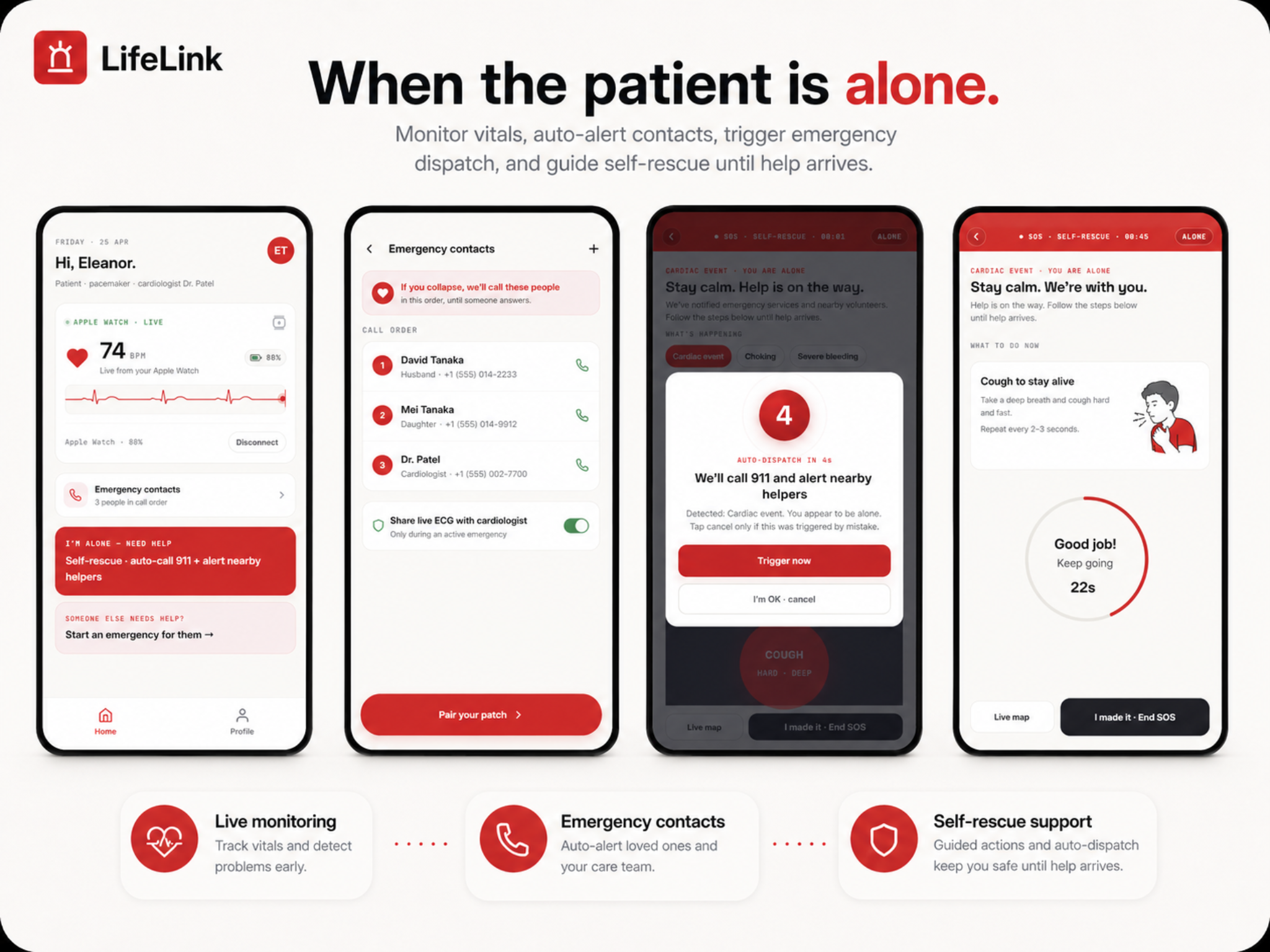
LifeLink is a mobile-first emergency response platform that helps patients access CPR guidance, nearby volunteers, AED retrieval, and medical handoff information during a cardiac emergency.
Core features:
- 🚨 One-tap SOS activation for patients
- 📍 AED map and routing for nearby helpers
- 👥 Volunteer coordination: one helper can go to the patient while another retrieves an AED
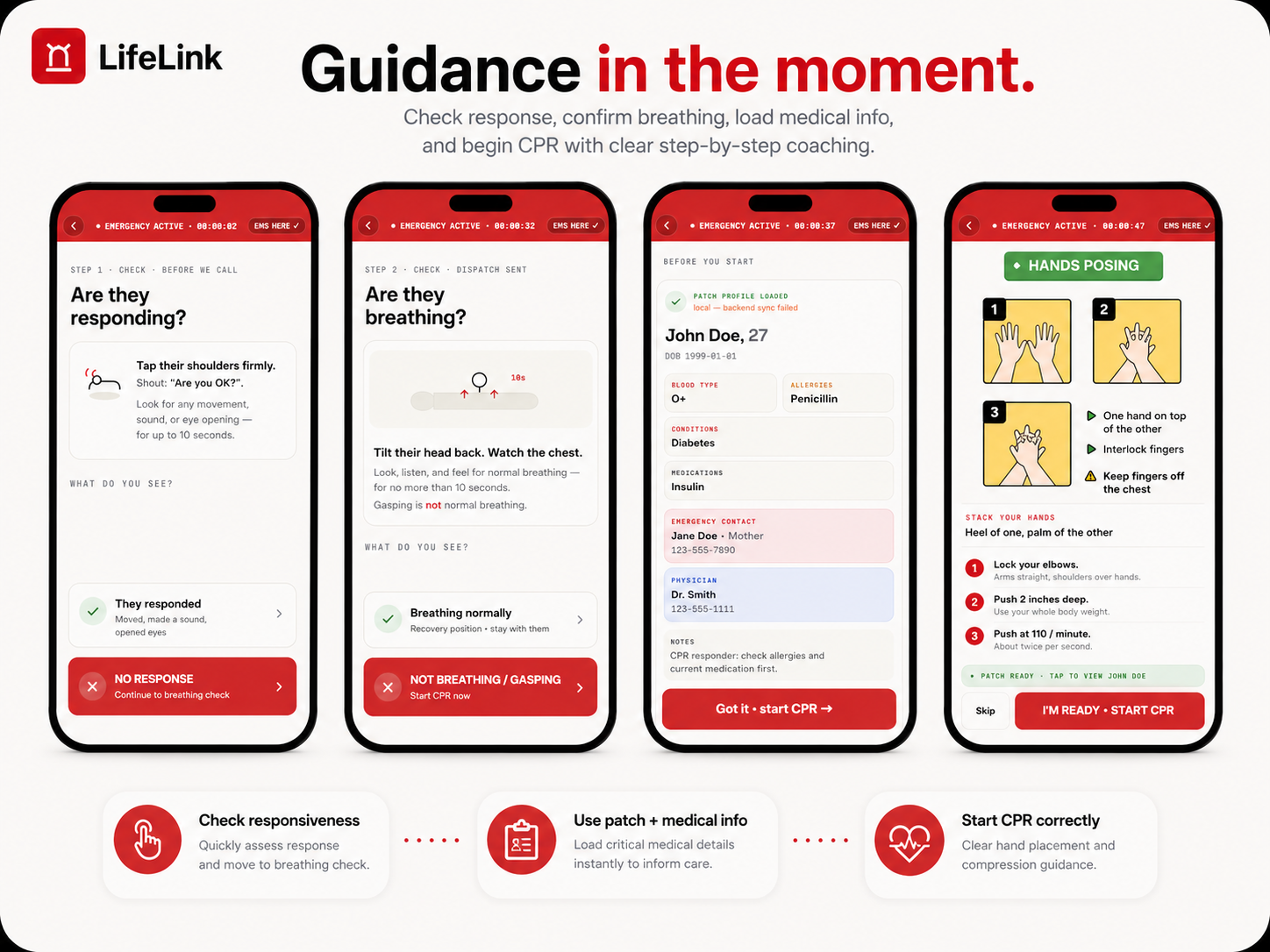
- 🫀 Real-time CPR guidance with voice support and rhythm feedback
- 🔌 Arduino CPR sensor prototype using an RP-S40-ST pressure sensor
- 🪪 Patient profile handoff with blood type, allergies, medications, emergency contacts, and notes
- 🌐 Bilingual interface for English and Chinese users
LifeLink focuses on the critical window where fast coordination can change outcomes.
How we built it
We built LifeLink as a full-stack emergency response prototype combining software, hardware, maps, and real-time coordination.
| Layer | Tech |
|---|---|
| Frontend | Next.js, React, TypeScript |
| UI | Tailwind CSS, custom components, shadcn/ui |
| Maps | Leaflet / Mapbox / Google Maps |
| Backend | FastAPI |
| Messaging | Twilio |
| Voice Guidance | ElevenLabs |
| Hardware | Arduino Nano Every + RP-S40-ST pressure sensor |
| Hardware Communication | Web Serial / Web Bluetooth |
| Data | AED registry, hospital data, volunteer mock data |
| Interop | FHIR-style handoff structure |
Our hardware prototype reads pressure data from the CPR sensor, converts it into voltage, detects valid compression events, and streams JSON data to the frontend through Web Serial.
Challenges we ran into
The hardest part was designing for a real emergency, not a normal app session. People under stress need clear instructions, large buttons, fewer choices, and immediate feedback.
We also had to coordinate multiple roles at once: patient, nearby helper, AED retriever, family contact, and future EMS handoff. On the hardware side, integrating Arduino sensor data through Web Serial required careful handling of serial connections, JSON streaming, thresholds, reset logic, and double-count prevention.
Another challenge was medical accuracy. A pressure sensor gives voltage, not direct chest depth, so we treated the hardware as a prototype and designed future calibration around CPR manikins.
Accomplishments that we're proud of
We are proud that LifeLink is more than a mockup. It is a working prototype that connects emergency UI, volunteer coordination, AED routing, CPR guidance, and hardware sensing.
We built:
- ✅ End-to-end SOS emergency flow
- ✅ Patient and volunteer role experiences
- ✅ AED discovery and helper routing
- ✅ CPR guidance with voice support
- ✅ Arduino-based compression detection
- ✅ Patient medical profile handoff
- ✅ Bilingual interface
- ✅ A believable architecture for pre-EMS emergency response
LifeLink’s biggest accomplishment is showing how nearby people, nearby AEDs, and simple hardware can become a coordinated rescue network.
What we learned
We learned that emergency technology is not about adding more features — it is about helping people take the right action faster.
Key lessons:
- Clarity matters as much as speed.
- Real-time systems are also human coordination systems.
- Hardware makes feedback more tangible, but calibration is essential.
- Medical products must avoid overclaiming and clearly separate prototype behavior from validated clinical measurements.
- The best emergency technology should reduce panic, not create more decisions.
What's next for LifeLink
Next, we want to make LifeLink more realistic, accurate, and deployable.
Planned improvements:
- Better CPR sensor calibration with a CPR manikin
- Stronger smartwatch and wearable integration
- Live verified AED registry integration
- Campus or city pilot deployment
- Richer responder handoff with CPR timeline, AED status, and patient profile
- More languages and accessibility support
- Future drone or smart-dispatch AED delivery exploration
Our long-term vision is to make LifeLink a community-powered emergency response network where patients, volunteers, AEDs, and responders work together before it is too late.
Built With
- agentverse
- anthropic
- arduino
- bluetooth
- elevenlabs
- fastapi
- fetch.ai
- fhir
- huggingface
- leaflet.js
- mapbox
- mongodb
- next.js
- postgresql
- python
- react
- redis
- tailwind
- twilio
- typescript


Log in or sign up for Devpost to join the conversation.