-
-
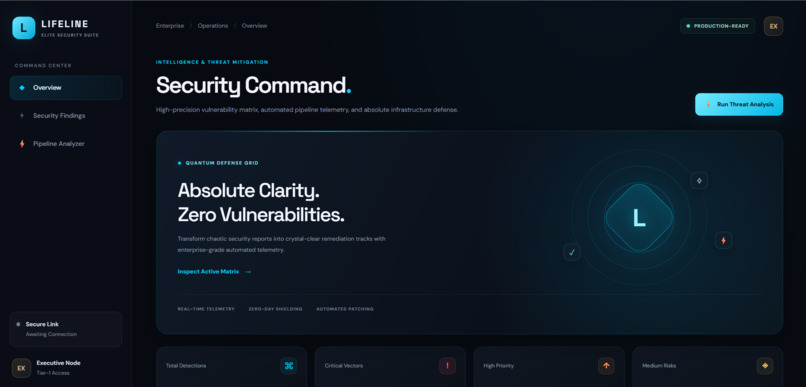
Overview
-
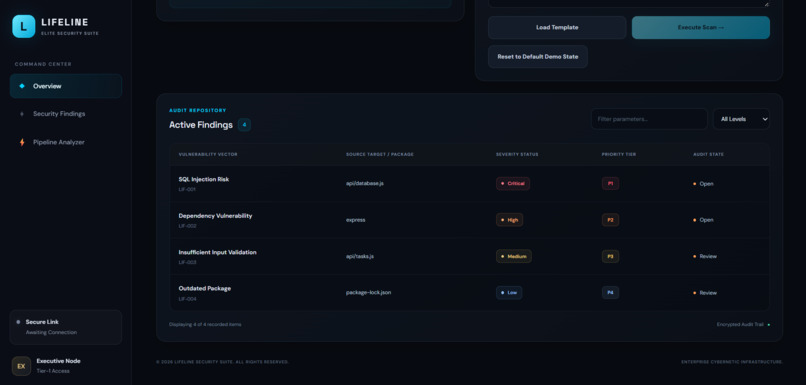
Security Findings
-
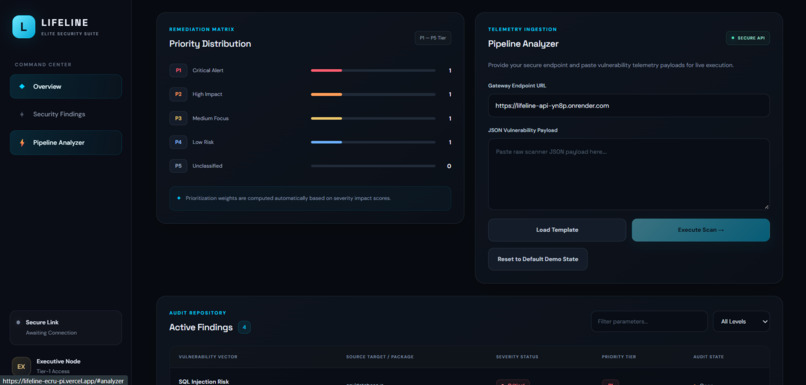
Pipeline Analyzer
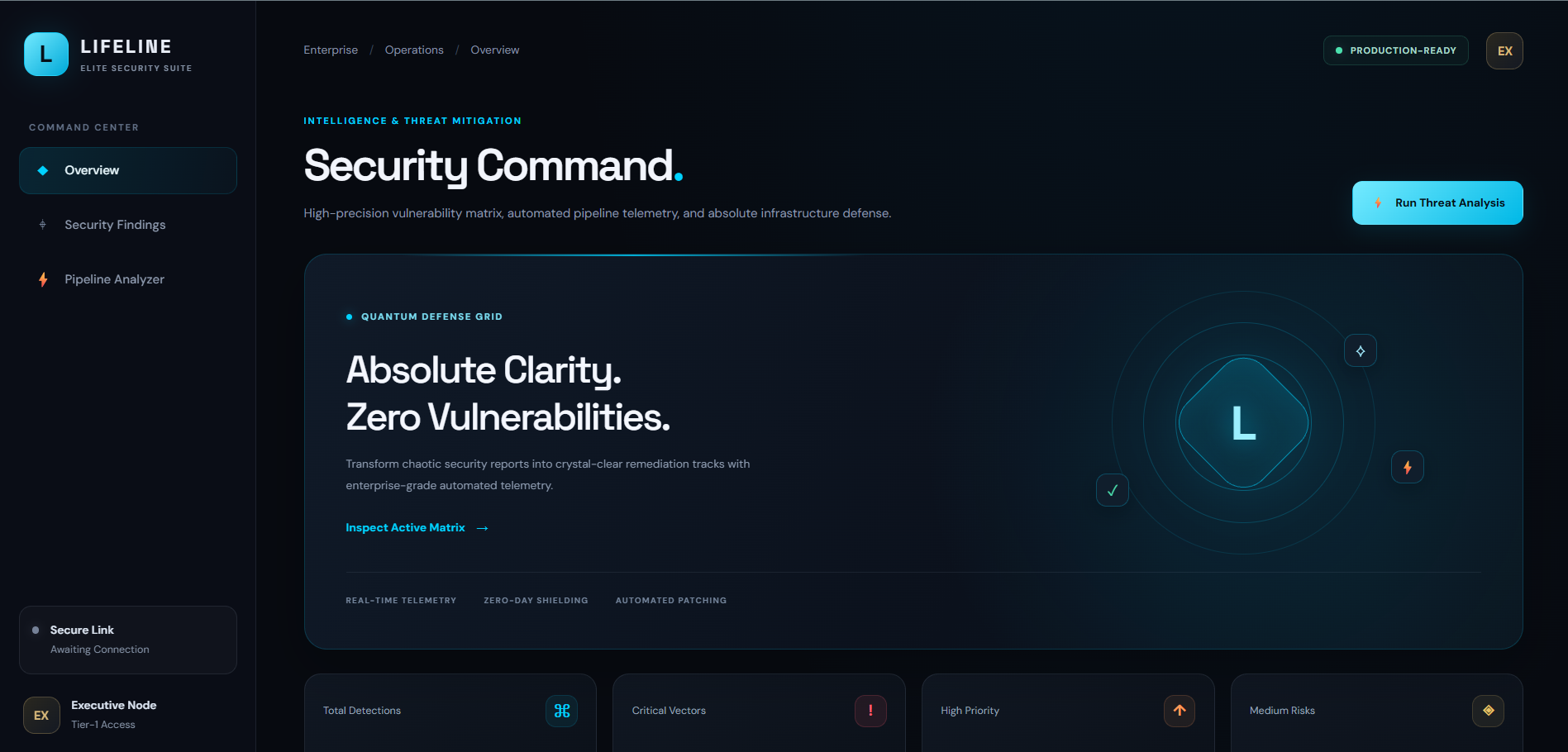
Inspiration
Modern software development is becoming faster with the help of AI, but shipping code quickly does not always mean shipping secure code. Security issues can go unnoticed, vulnerabilities can be difficult to prioritize, and development teams often need to switch between multiple tools to understand the risks in their applications.
We built LIFELINE to explore a better approach: an AI-powered security verification engine that helps developers identify potential risks, analyze security findings, and integrate verification into the software development lifecycle.
Our vision is to make security verification a more continuous, accessible, and actionable part of building software.
What it does
LIFELINE is an AI-powered security verification engine designed to support application security analysis and automated verification workflows.
Key capabilities include:
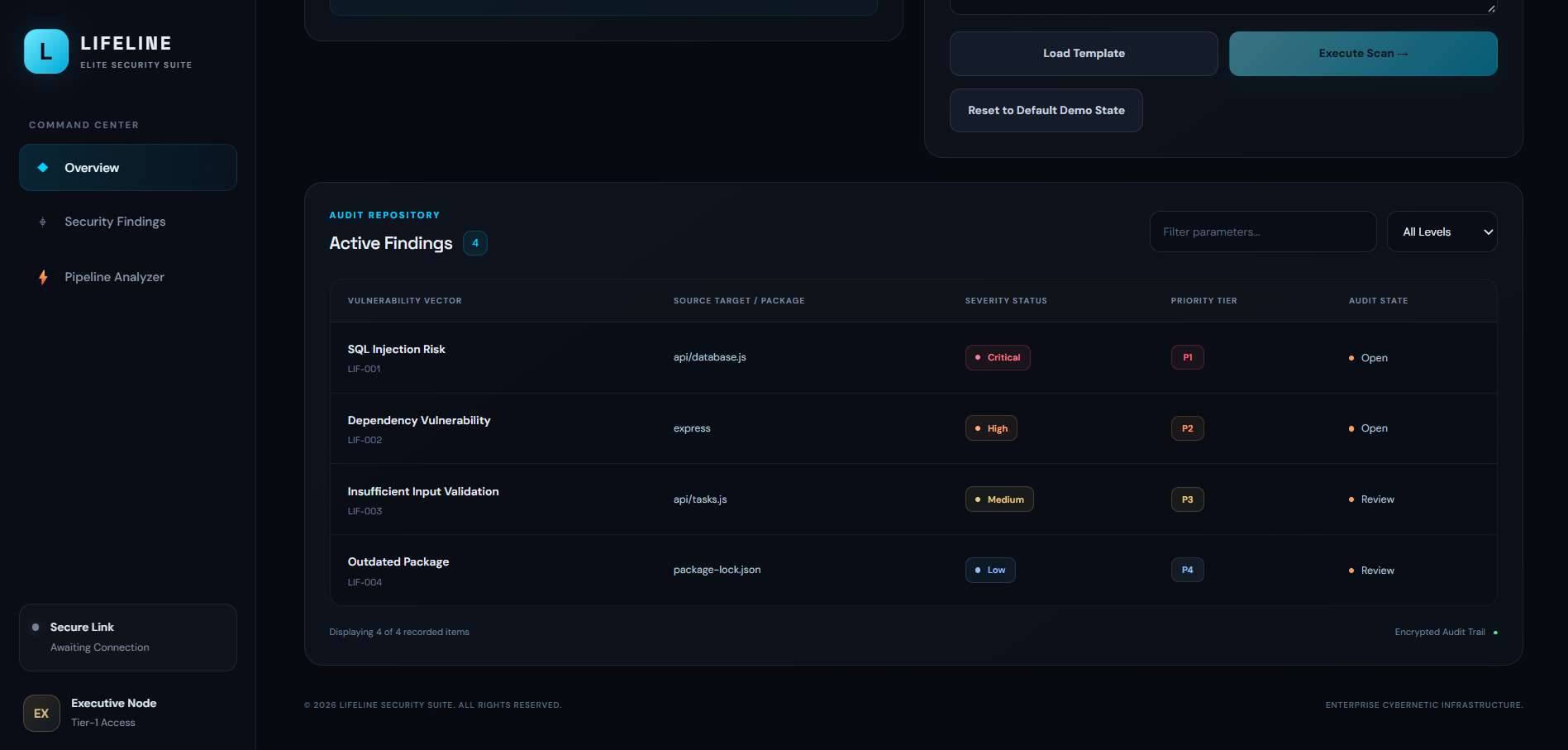
- Security Analysis: Processes vulnerability findings and evaluates their severity and priority.
- Verification Workflows: Organizes security-related tasks into structured workflows that support investigation and remediation.
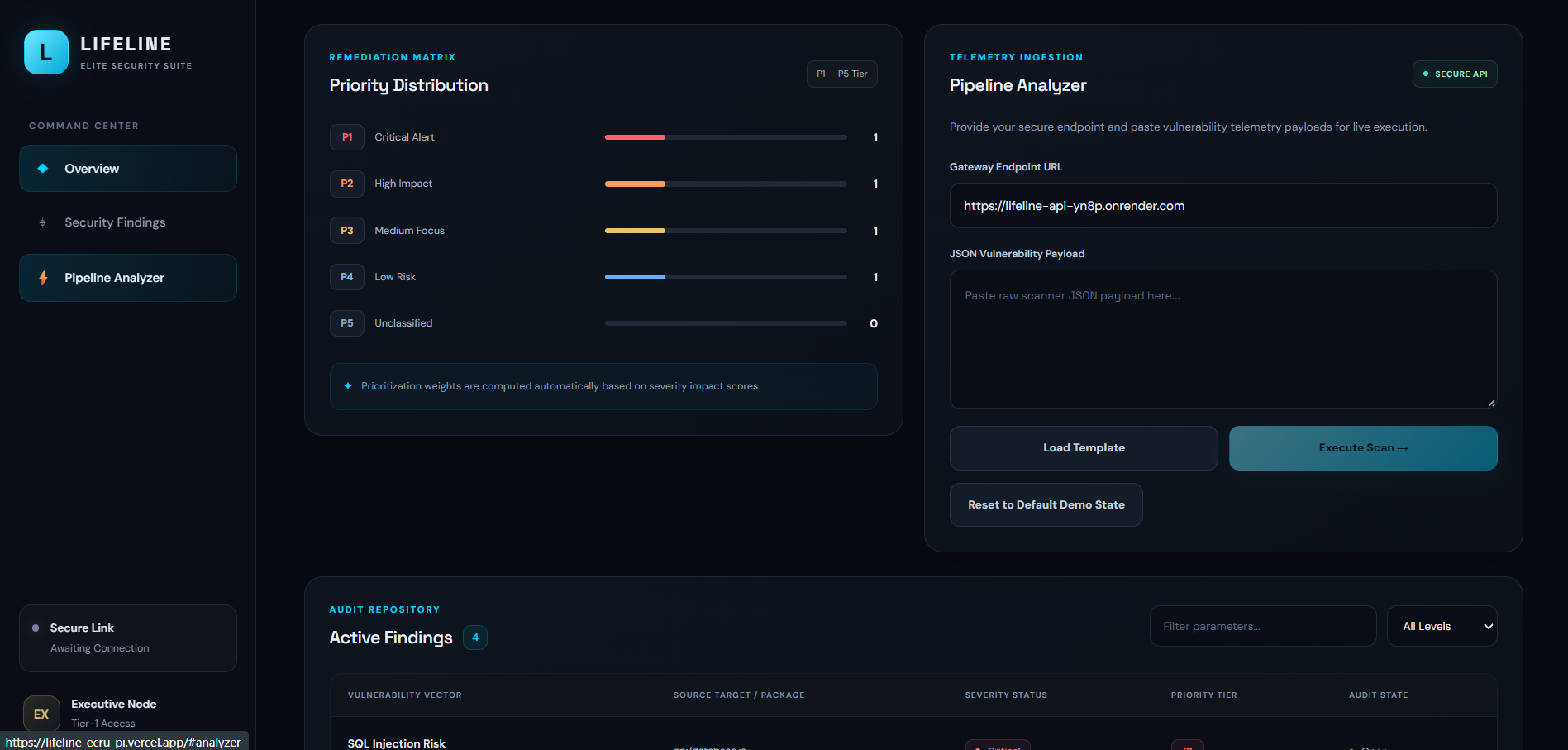
- Telemetry Ingestion: Provides a secure API endpoint for receiving vulnerability telemetry payloads.
- Pipeline Integration: Uses GitLab CI/CD to automate testing and security checks during the development process.
- Automated Testing: Helps validate application behavior and detect potential regressions before release.
- Deployment Readiness: Supports a repeatable workflow from development and verification to deployment.
LIFELINE aims to turn security findings into actionable information, helping developers understand what needs attention and what steps they can take next.
How we built it
We built LIFELINE using GitLab's development and automation ecosystem, with an emphasis on integrating security verification into the software delivery lifecycle.
Our implementation combines:
- Backend: Node.js and Express.js for API endpoints and application logic.
- CI/CD: GitLab CI/CD pipelines to automate testing and security verification.
- Security Processing: A pipeline analyzer that evaluates vulnerability information and assigns priorities based on severity.
- Telemetry Ingestion: A dedicated API interface for submitting structured vulnerability data.
- Automation: GitLab work items, agents, flows, and triggers to explore automated issue triage and security workflow orchestration.
- Deployment: An externally hosted application deployed through a repeatable development and release process.
We developed the project iteratively, moving from backend implementation and pipeline configuration to testing, security checks, and deployment.
Challenges we ran into
One of our biggest challenges was connecting individual components into a reliable end-to-end workflow.
During development, we encountered CI/CD configuration issues, pipeline validation errors, account verification requirements, and API execution failures. We had to investigate these problems, refine configurations, and validate changes through repeated testing.
Another challenge was designing security findings so they could be translated into meaningful priorities and actionable recommendations rather than simply displaying raw vulnerability data.
We also explored how automated agents and workflows could coordinate development tasks while maintaining a structured process for verification and release.
These challenges reinforced the importance of observability, reliable testing, clear error handling, and incremental development.
Accomplishments that we're proud of
We are proud to have taken LIFELINE from an initial concept to a deployed application with working development and verification infrastructure.
Our key accomplishments include:
- Successfully configuring and running GitLab CI/CD pipelines.
- Integrating automated tests and security checks into the development workflow.
- Building a security analysis component that prioritizes vulnerability findings.
- Implementing a telemetry ingestion interface for structured vulnerability payloads.
- Exploring GitLab's AI agent and workflow capabilities for issue triage and automation.
- Successfully deploying the application and making it accessible for demonstration.
Most importantly, we established a foundation for bringing security verification closer to the everyday developer workflow.
What we learned
Building LIFELINE taught us that security automation is not just about detecting vulnerabilities. It is also about presenting useful findings, establishing reliable verification processes, and helping developers determine what to do next.
We gained practical experience with GitLab CI/CD, automated testing, security pipeline configuration, backend API development, telemetry processing, and deployment.
We also learned that AI-driven automation works best when it is supported by clear workflows, structured inputs, meaningful validation, and reliable feedback.
The project strengthened our understanding of how development automation and security engineering can work together to make software delivery more dependable.
What's next for LIFELINE — AI-Powered Security Verification Engine
Our next goal is to evolve LIFELINE from a working security verification foundation into a more intelligent and comprehensive security platform.
Planned improvements include:
- Smarter Vulnerability Analysis: Enhance prioritization using contextual information about affected components, exploitability, and potential impact.
- AI-Assisted Remediation: Generate practical fix suggestions and explanations that developers can review before applying changes.
- Deeper GitLab Integration: Expand automated issue creation, triage, assignment, and verification workflows.
- Continuous Security Monitoring: Improve telemetry processing and tracking so teams can follow findings throughout their lifecycle.
- Verification After Fixes: Re-run relevant checks to help determine whether remediation resolves the original finding without introducing regressions.
- Improved Reporting: Provide clearer security summaries, verification results, and actionable recommendations.
- Production Readiness: Strengthen authentication, authorization, input validation, error handling, and observability as the platform evolves.
Our long-term vision is to make LIFELINE a trusted security verification layer that helps development teams move faster without losing sight of application security.
Built With
- ai-agents
- application-security
- automated-testing
- backend
- ci/cd
- express.js
- gitlab
- gitlab-ci/cd
- javascript
- node.js
- rest-api
- security-automation
- telemetry
- vulnerability-analysis
- workflow-automation


Log in or sign up for Devpost to join the conversation.