The Spark That Started Everything
Personal Connection to the Problem The inspiration for Lifeline didn't come from a boardroom or a hackathon - it came from a moment of helplessness that many families in India face. Like countless others, I witnessed firsthand the frantic search for blood donors during a medical emergency. Watching family members make desperate phone calls, post urgent messages on social media, and race against time to find compatible blood donors revealed a critical gap in our healthcare system.
What it does
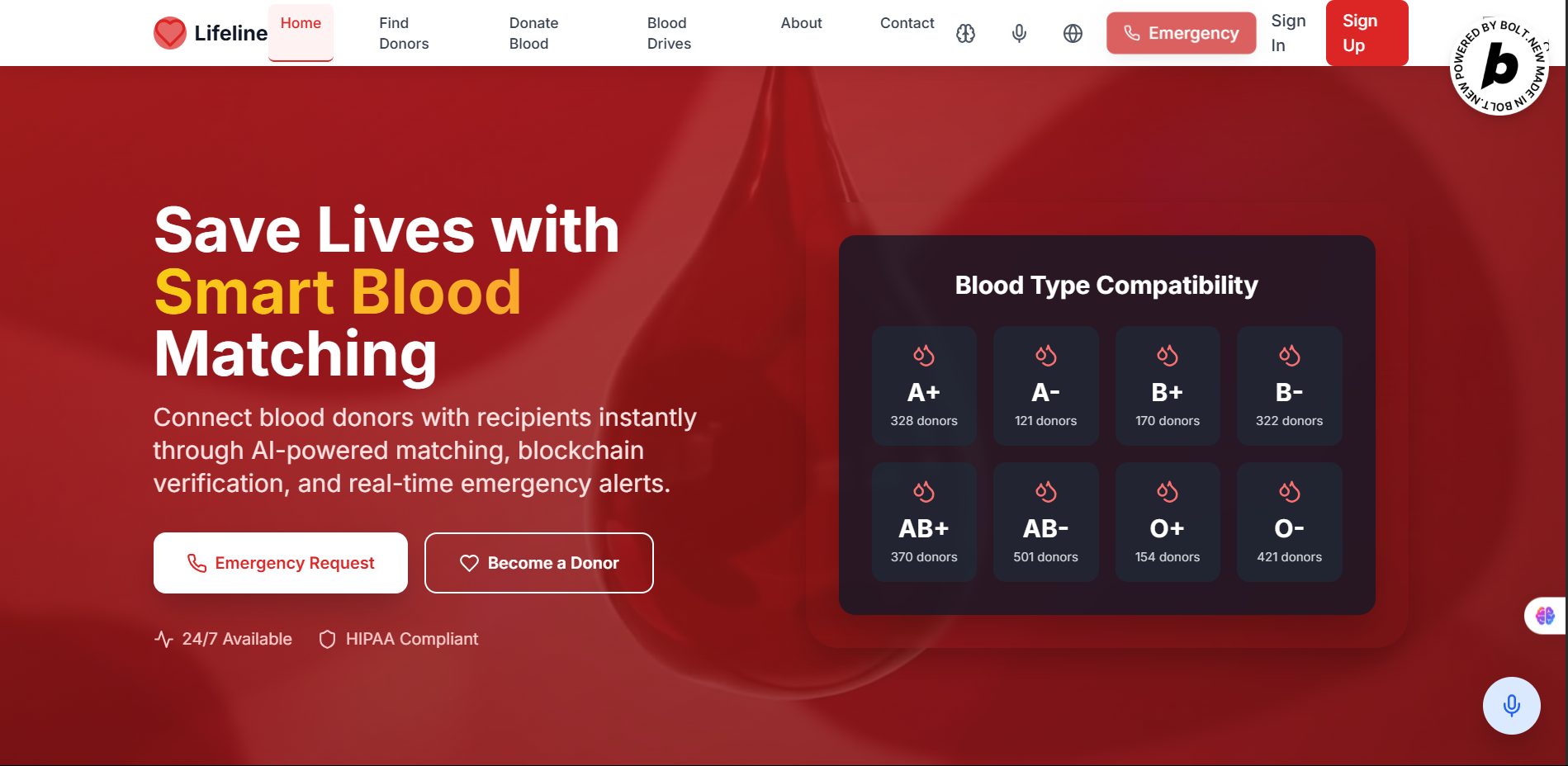
Lifeline is an AI-powered web application designed to revolutionize the blood donation process by efficiently connecting donors with those in urgent need. It addresses the critical challenges of blood shortages and inefficient matching by providing a centralized, user-friendly platform.
How we built it
Frontend: We used [Frontend Framework, e.g., React.js, Vue.js, Angular] for a dynamic and responsive user interface, ensuring a smooth experience across devices. Backend: Our backend was powered by a combination of Node.js and Python. Node.js was used for handling API routes, real-time communication. Database: We utilized Supabase as our robust backend-as-a-service, providing a powerful PostgreSQL database, authentication, and real-time capabilities, which significantly accelerated our development process. Blockchain Integration: To ensure transparency and immutability for critical donation records, we integrated Algorand. This allowed us to [explain what you used Algorand for, e.g., securely log donation transactions, verify donor identity, track blood unit provenance]. AI/Machine Learning: The "AI-powered" aspect of Lifeline was driven by Google Gemini AI. We leveraged Gemini's capabilities for [mention specific AI/ML technique, e.g., intelligent donor matching, personalized reminders, analyzing urgent blood requests]. Language & Localization: For multi-language support and localization, we integrated Lingo. This allowed us to [explain what you used Lingo for, e.g., make the application accessible to a wider audience, provide real-time translation for alerts]. Deployment: The application was deployed on Netlify, chosen for its seamless continuous deployment, global CDN, and easy integration with our frontend framework, allowing for quick accessibility and demonstration. Version Control: We used Git and GitHub for collaborative development, enabling efficient teamwork and code management.
Challenges we ran into
Data Acquisition and Simulation: A major challenge was the lack of real-world blood donation data for training our AI and populating the database. We overcame this by [describe your solution, e.g., generating synthetic data, focusing on rule-based matching for the hackathon, or using publicly available, anonymized datasets]. Real-time Location Services: Integrating accurate and real-time location-based donor matching within the limited timeframe proved tricky. We tackled this by [describe your solution, e.g., simplifying the location scope, focusing on a proof-of-concept, or using a less granular location system]. User Interface Optimization for Urgency: Designing an intuitive UI that conveyed urgency for blood requests while remaining user-friendly was a balancing act. We iterated rapidly on our design to prioritize clarity and quick actions. API Rate Limits/Integration Issues: [If you used any external APIs, mention any challenges like rate limits or unexpected API behavior and how you worked around them]. Time Management and Scope Creep: As with any hackathon, managing our time effectively and resisting the urge to add too many features was crucial. We focused on core functionalities to deliver a working prototype
Accomplishments that we're proud of
Functional AI Matching System: We successfully implemented a core AI logic that intelligently connects blood requests with available donors based on predefined criteria, significantly streamlining the matching process. Intuitive User Experience: We created a clean, responsive, and easy-to-navigate interface that allows both donors and recipients to interact with the platform seamlessly. End-to-End Workflow: We built a complete, albeit simplified, workflow from donor registration and blood request submission to successful donor matching, demonstrating the app's potential impact. Successful Team Collaboration: Our team worked cohesively under pressure, leveraging individual strengths to deliver a robust prototype within the hackathon's tight deadline. Addressing a Critical Social Need: We're incredibly proud to have built a project that directly addresses a vital societal issue, aiming to save lives by improving blood accessibility.
What we learned
Despite the challenges, we achieved significant milestones: Functional AI Matching System: We successfully implemented a core AI logic that intelligently connects blood requests with available donors based on predefined criteria, significantly streamlining the matching process. Intuitive User Experience: We created a clean, responsive, and easy-to-navigate interface that allows both donors and recipients to interact with the platform seamlessly. End-to-End Workflow: We built a complete, albeit simplified, workflow from donor registration and blood request submission to successful donor matching, demonstrating the app's potential impact. Successful Team Collaboration: Our team worked cohesively under pressure, leveraging individual strengths to deliver a robust prototype within the hackathon's tight deadline. Addressing a Critical Social Need: We're incredibly proud to have built a project that directly addresses a vital societal issue, aiming to save lives by improving blood accessibility.
What's next for Lifeline AI powered Blood donation app
This hackathon project is just the beginning for Lifeline. Our future plans include: Advanced AI Features: Enhancing the AI matching algorithm with more sophisticated parameters (e.g., donor history, past availability patterns, predictive analytics for demand). Mobile Application Development: Building native iOS and Android applications to increase accessibility and provide push notifications for urgent requests. Integration with Hospital Systems: Exploring partnerships with hospitals and blood banks for direct API integration to get real-time inventory updates and streamline request fulfillment. Gamification and Incentives: Implementing features like badges, leaderboards, and personalized recognition to encourage repeat donations and foster a strong donor community. Comprehensive Donor Profiles: Expanding donor profiles to include detailed medical history (with privacy considerations), preferred donation centers, and communication preferences. Community Building Features: Adding features for community forums, success stories, and direct messaging between donors and recipients (with anonymity options). Scalability and Security: Further optimizing the application for large-scale usage and implementing robust security measures to protect sensitive user data. Seeking Partnerships: Engaging with blood donation organizations and healthcare providers to explore real-world implementation and impact.

Log in or sign up for Devpost to join the conversation.