-
-
-
LifeLine
Inspiration
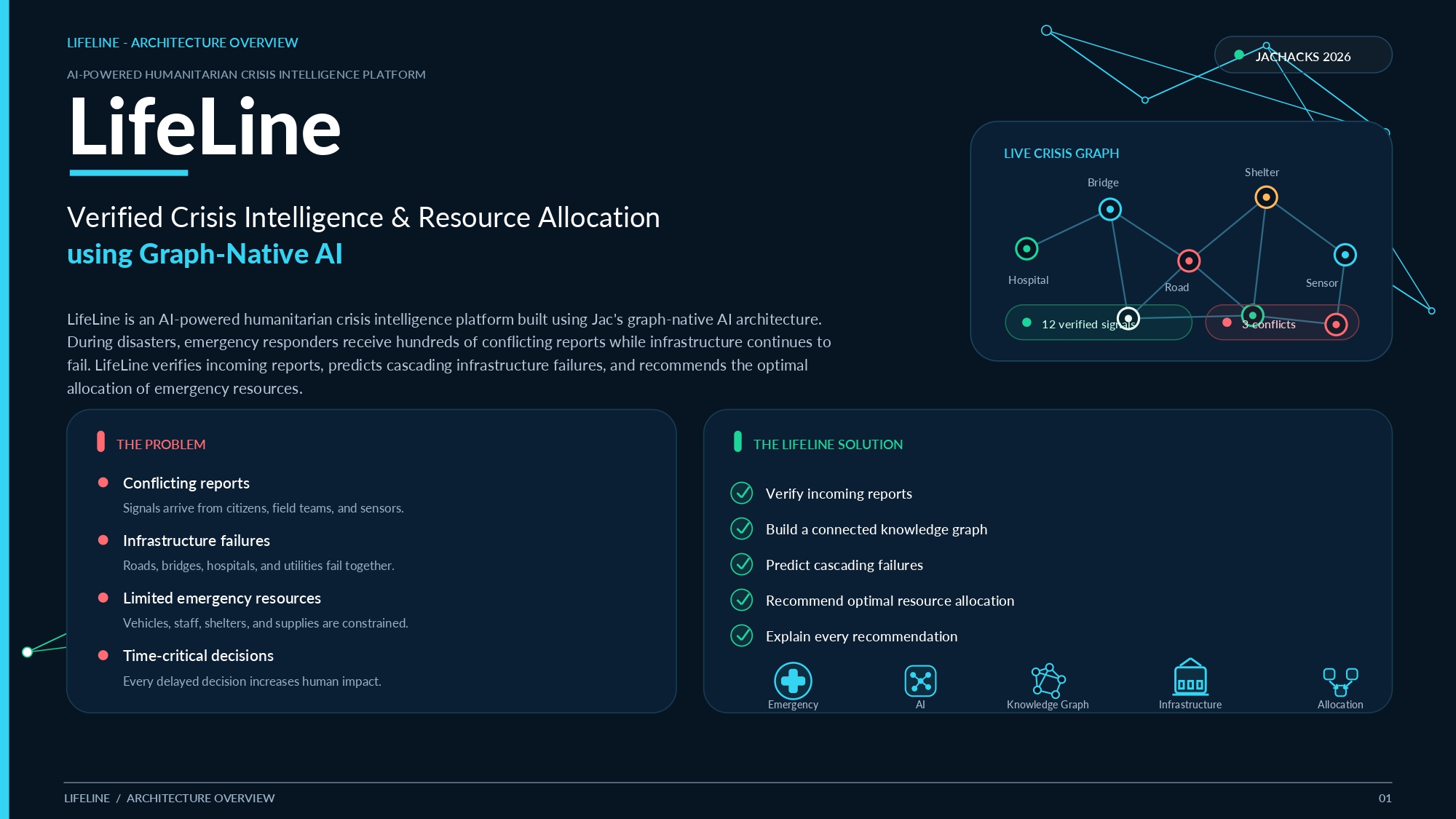
During natural disasters and humanitarian crises, emergency responders are flooded with reports from social media, civilians, sensors, and field teams. These reports are often incomplete or contradictory, making it difficult to determine what is actually happening while infrastructure continues to fail. We wanted to build a system that could transform fragmented information into trusted, actionable intelligence. Our goal was to show how graph-native AI can help responders make faster and more informed decisions when every minute matters.
What it does
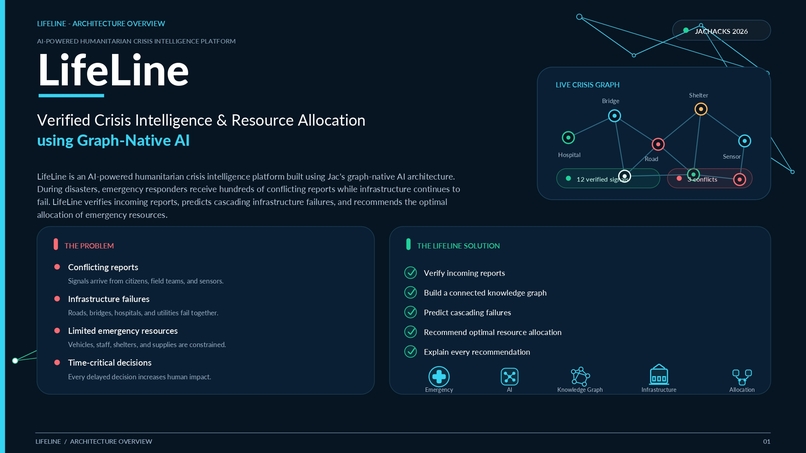
LifeLine is an AI-powered humanitarian crisis intelligence platform built on Jac's graph-native architecture.
Instead of treating incoming reports as isolated pieces of data, LifeLine models the crisis as a connected graph of people, locations, infrastructure, emergency resources, and events. AI agents continuously analyze this graph to verify conflicting reports, predict cascading infrastructure failures, and recommend how emergency resources should be allocated.
Responders can visualize the evolving situation, understand why recommendations were made, and make decisions with greater confidence.
How we built it
We built LifeLine using a modern full-stack architecture centered around Jac.
- Jac powers the graph-native AI agents and crisis reasoning.
- FastAPI serves as the backend integration layer.
- MongoDB stores reports, scenarios, and historical data.
- Next.js + React provides an interactive dashboard for visualizing the crisis graph.
Rather than placing business logic inside the backend, the application's intelligence lives inside Jac graph walkers. Incoming reports are converted into graph entities, AI agents traverse relationships across the graph, and recommendations are generated from the connected data model.
Challenges we ran into
One of the biggest challenges was designing a system that could reason over evolving disaster scenarios instead of processing reports independently. We also had to coordinate multiple technologies while keeping Jac as the primary source of intelligence rather than moving logic into traditional backend code.
Balancing explainability, scalability, and real-time updates required careful system design and clear interfaces between the graph engine, API, database, and frontend.
Accomplishments that we're proud of
- Built a graph-native AI system instead of a traditional CRUD application.
- Created an explainable decision-making workflow for emergency response.
- Designed an architecture where AI agents collaborate over connected graph data.
- Integrated Jac, FastAPI, MongoDB, and a modern React frontend into a unified platform.
- Demonstrated how graph-native programming can solve real-world humanitarian challenges.
What we learned
This project taught us that connected data is fundamentally different from relational data when modeling real-world systems. Using graphs made it much easier to represent relationships between infrastructure, responders, resources, and incidents.
We also gained hands-on experience designing AI-powered systems where explainability and transparency are just as important as prediction accuracy.
What's next for LifeLine
Our vision is to expand LifeLine into a production-ready humanitarian response platform.
Future work includes:
- Live integration with emergency management data sources
- Satellite imagery and drone intelligence
- Multi-agent coordination across multiple disasters
- Predictive evacuation and logistics planning
- Geographic Information System (GIS) integration
- Support for larger-scale disaster simulations
- Enhanced graph-native AI agents built with Jac


Log in or sign up for Devpost to join the conversation.