-
-
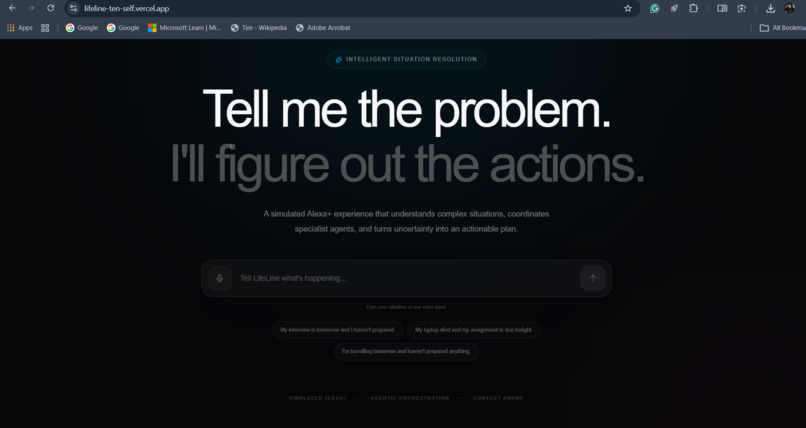
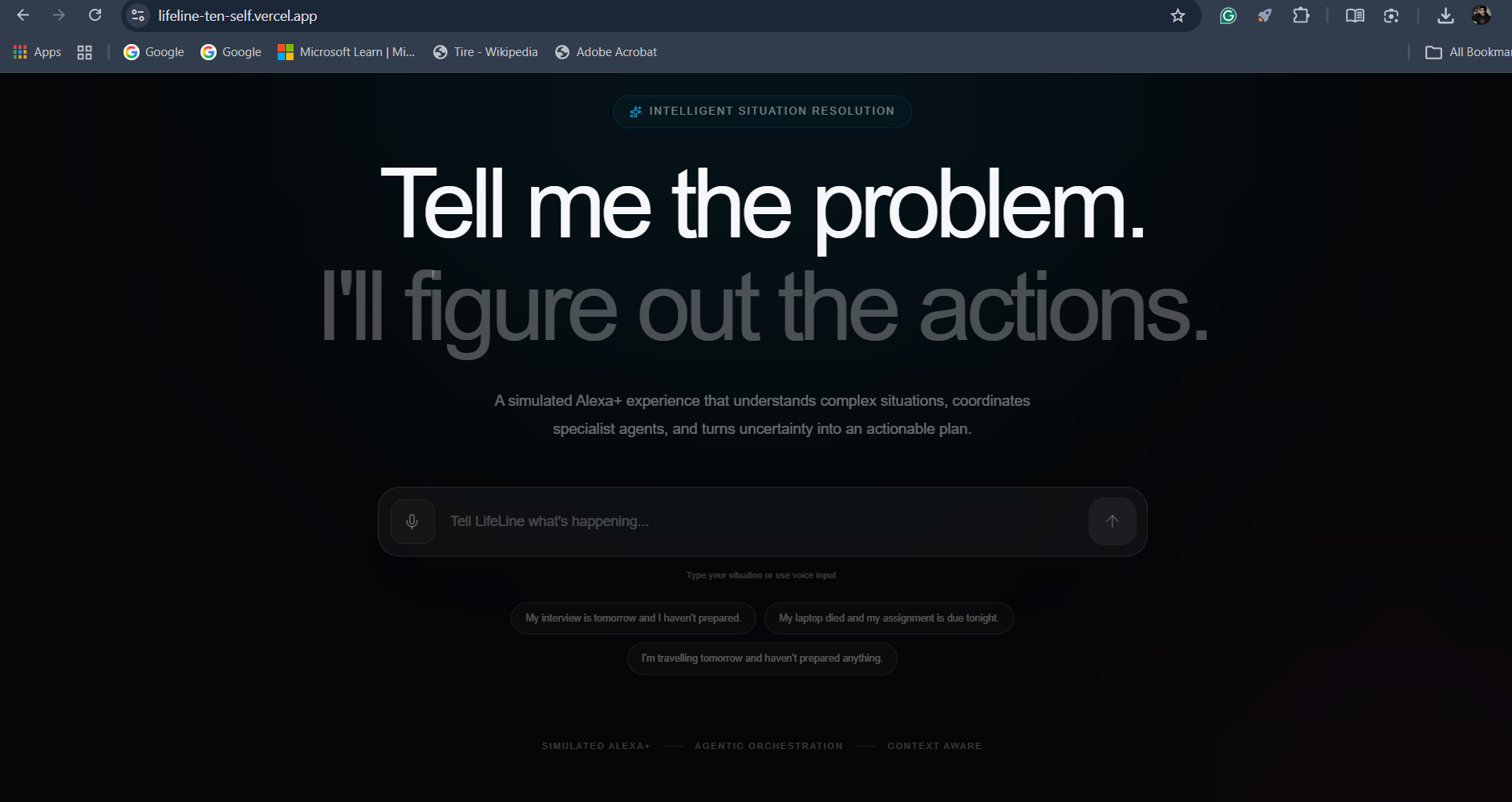
LifeLine — describe a real-world situation through voice or text.
-
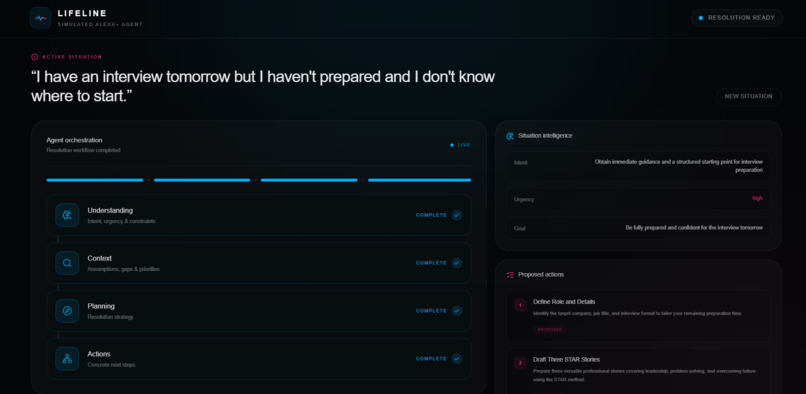
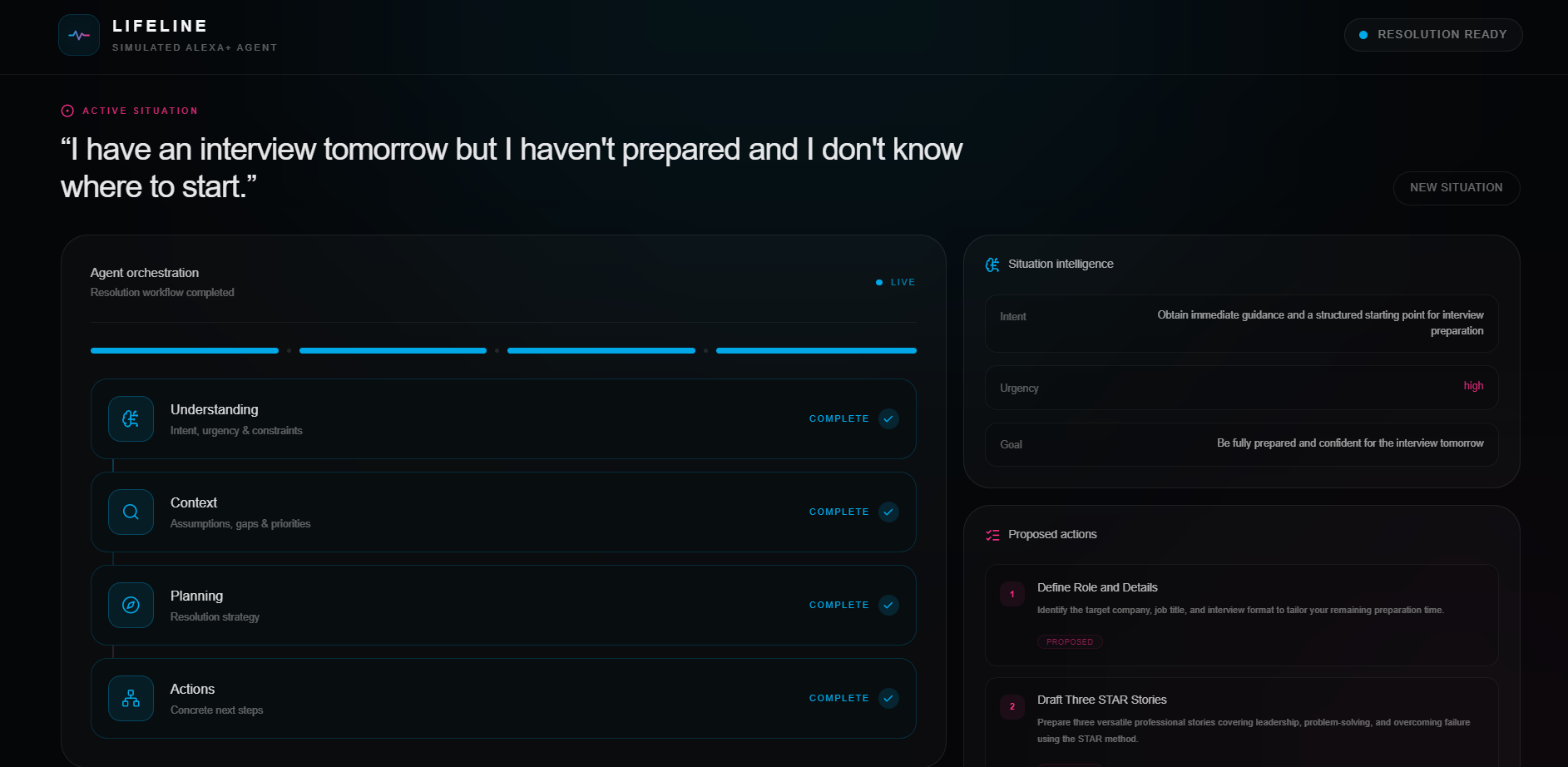
Four specialized AI agents understand, contextualize, plan, and generate actions.
-
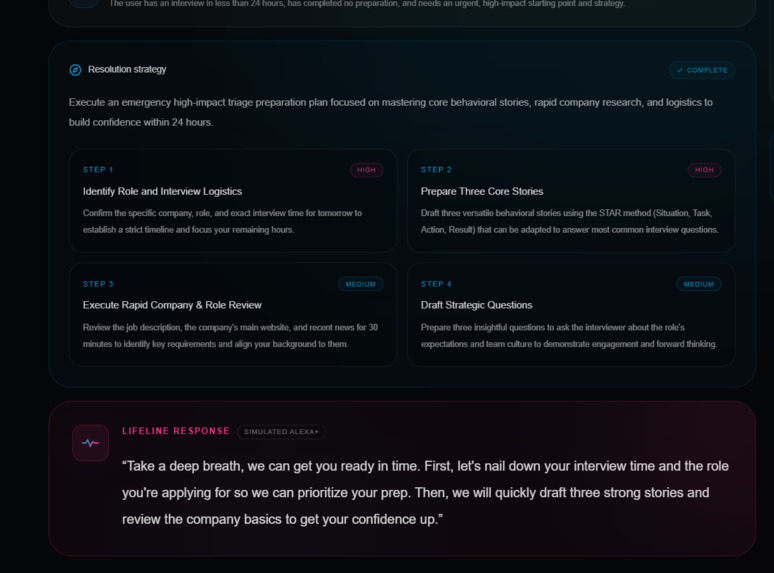
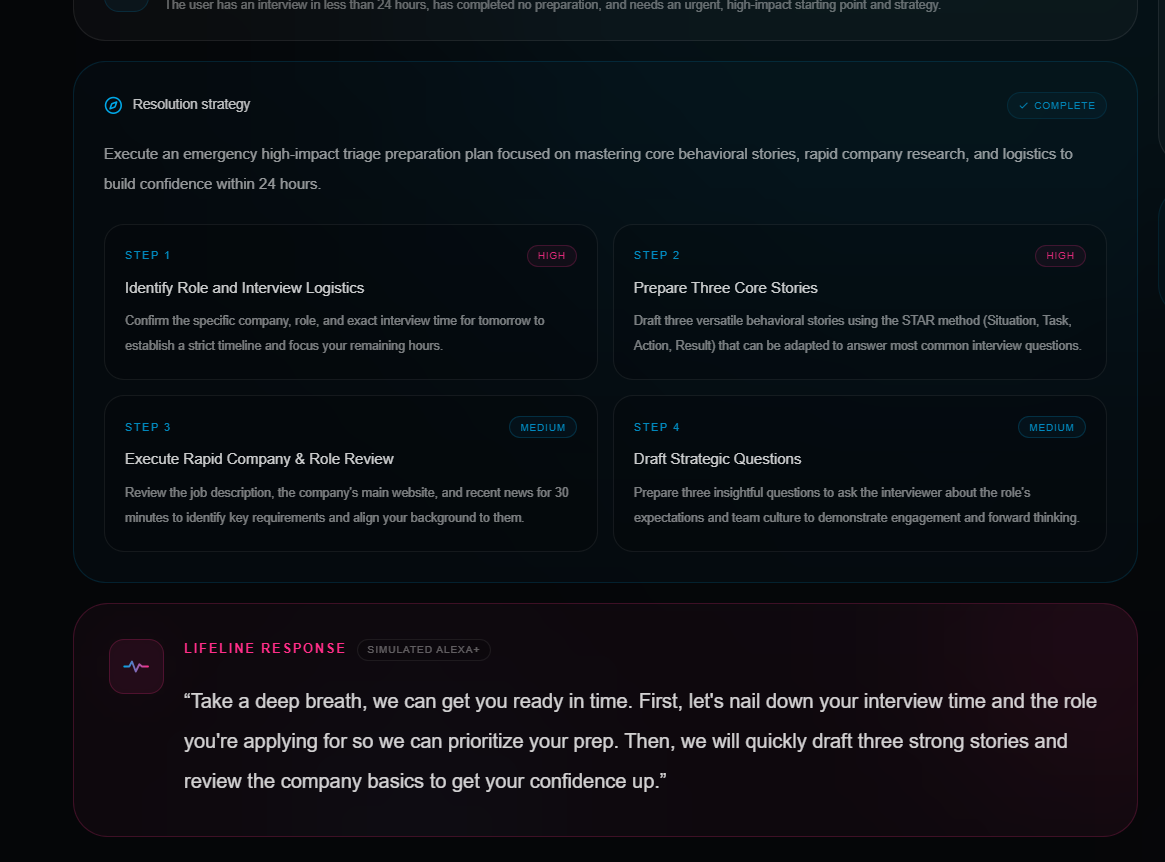
LifeLine transforms multi-agent reasoning into an actionable strategy and response.
-
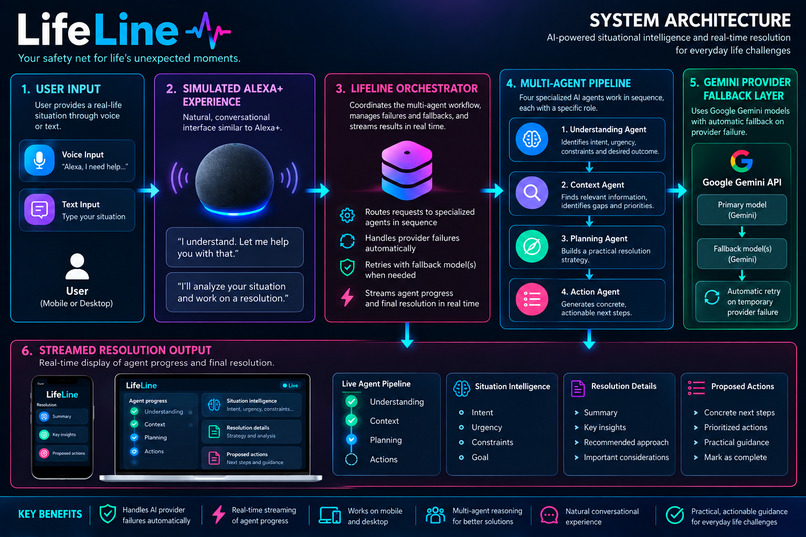
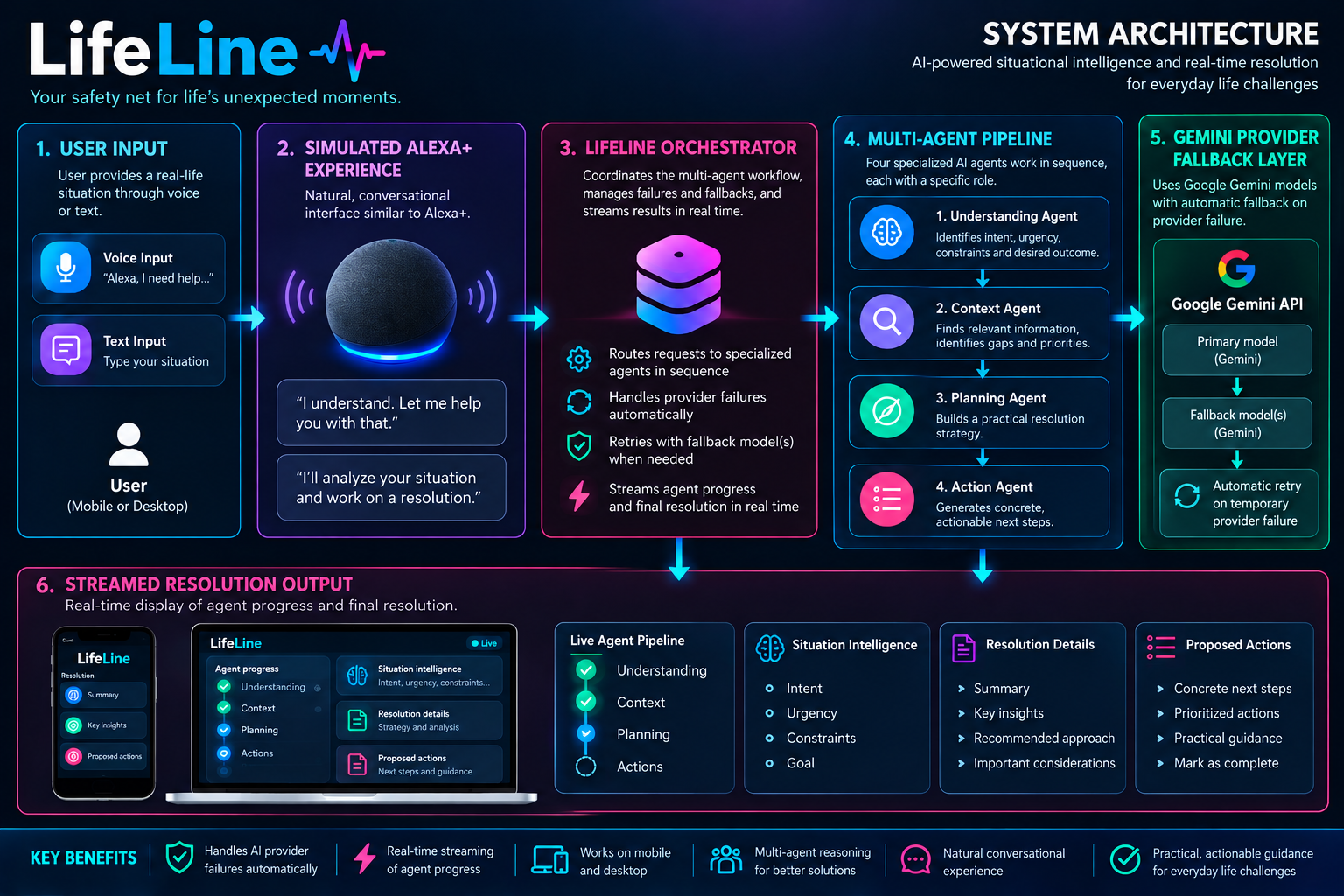
LifeLine system architecture: simulated Alexa+ experience, multi-agent orchestration, Gemini fallback, and real-time streaming.
Inspiration
Most AI assistants are great at answering questions, but real-life problems are rarely just questions.
When someone says, “My interview is tomorrow and I haven't prepared,” they don't need a generic paragraph of advice. The system needs to understand what they are trying to achieve, recognize the urgency, identify what information is missing, prioritize what matters, create a realistic plan, and turn that plan into immediate next steps.
That inspired LifeLine.
LifeLine explores what an Alexa+-style agentic experience could feel like if a conversational assistant didn't simply answer a prompt, but instead coordinated multiple specialized AI agents to resolve the situation.
The goal was simple:
Tell LifeLine what's happening. LifeLine figures out what to do next.
What it does
LifeLine is a simulated Alexa+ multi-agent situation-resolution system.
A user can type or speak a real-world situation such as:
“I have an interview tomorrow, but I haven't prepared and I don't know where to start.”
LifeLine then runs the situation through four specialized agents:
1. Understanding Agent
Determines the user's intent, urgency, constraints, and desired outcome.
2. Context Agent
Builds situational context by identifying assumptions, missing information, priorities, and relevant facts.
3. Planning Agent
Transforms that context into a practical resolution strategy with prioritized steps.
4. Action Agent
Converts the strategy into concrete proposed actions and a concise conversational response.
Instead of hiding this process behind a loading spinner, LifeLine streams the workflow to the interface in real time. Users can watch each agent move through waiting → working → complete while intermediate outputs become available.
The final experience provides situation intelligence, a resolution strategy, proposed next actions, and a conversational simulated Alexa+ response.
How we built it
LifeLine is built with Next.js, React, TypeScript, Tailwind CSS, Framer Motion, Lucide React, and the Google Gemini API.
The application uses a server-side orchestration architecture.
Voice / Text Input
        ↓
Simulated Alexa+ Experience
        ↓
LifeLine Orchestrator
        ↓
Understanding Agent
        ↓
Context Agent
        ↓
Planning Agent
        ↓
Action Agent
        ↓
Streamed Resolution
        ↓
User
Each agent has a specific responsibility and produces structured output that becomes context for the next stage.
The backend exposes a Next.js API route that streams workflow events to the browser using NDJSON over a streaming HTTP response. This allows the UI to update as individual agents begin and complete rather than waiting for the entire AI workflow.
Voice interaction uses browser speech recognition. Importantly, LifeLine places the transcription into an editable composer before submission instead of automatically triggering the workflow, allowing users to correct speech-recognition mistakes first.
Gemini credentials remain server-side through environment variables and are never exposed to the client.
Resilience and failure handling
One of the most interesting engineering problems was making a multi-agent workflow useful even when an AI provider temporarily fails.
During development, Gemini models occasionally returned temporary high-demand or availability errors.
Instead of treating that as a simple error screen, LifeLine gained a resilience layer with:
- model fallback
- request timeouts
- automatic retry behavior
- structured response validation
- clear interrupted-stage states
- preservation of completed agent outputs
For example, if Understanding completes but Context is temporarily interrupted, LifeLine preserves the Understanding output rather than discarding the entire workflow.
The user can retry the workflow, and the interface clearly communicates what completed and what requires attention.
This turned an API reliability problem into an important part of LifeLine's architecture.
Challenges we ran into
Building reliable multi-agent orchestration
The agents could not simply generate independent responses. Each stage needed predictable structured data that the next agent could safely consume.
Designing the schemas, prompts, orchestration flow, and error handling required several iterations.
Handling AI provider availability
Temporary model availability and high-demand responses created unpredictable failures during development.
We implemented fallback and retry behavior while ensuring the interface never falsely displayed a failed stage as completed.
Real-time streaming
We wanted users to actually see LifeLine working.
That required coordinating server-side agent execution with streamed frontend state so the pipeline could transition through waiting, working, complete, and interrupted states in real time.
Voice interaction
Speech recognition is imperfect. During testing, words could occasionally be transcribed incorrectly.
Instead of silently correcting or immediately submitting the transcription, we designed LifeLine so users can review and edit their spoken input first.
Responsive agent interfaces
The desktop interface contains significant structured information: agent states, situation intelligence, strategy cards, proposed actions, and final responses.
Making that remain usable on mobile required careful responsive layouts, text wrapping, grid behavior, and overflow handling.
Accomplishments that we're proud of
LifeLine evolved from a conversational concept into a working end-to-end agentic prototype.
We're particularly proud that it includes:
- a functioning four-agent orchestration pipeline
- real-time streamed agent progress
- voice and text interaction
- structured situational intelligence
- dynamic resolution strategies
- concrete proposed actions
- a simulated Alexa+ conversational experience
- model fallback and retry behavior
- partial-result preservation
- responsive desktop and mobile interfaces
- a production deployment rather than only a local prototype
The system was also tested against different scenarios—including academic deadlines, interview preparation, and travel preparation—to ensure the workflow adapts rather than returning a fixed response.
What we learned
The biggest lesson was that building an agentic system is very different from placing a chat interface in front of an LLM.
A useful multi-agent experience needs:
specialized responsibilities → structured communication → orchestration → observable progress → failure recovery → trustworthy presentation
We also learned how important transparency is.
LifeLine labels generated actions as proposed rather than pretending they have already been executed, and the Alexa+ portion is explicitly presented as a simulated Alexa+ experience.
That distinction matters when designing AI systems users can trust.
What's next for LifeLine
The current prototype focuses on understanding and planning.
The next evolution would allow LifeLine to move from proposed actions to permission-based execution through integrations such as calendars, email, reminders, maps, travel services, and productivity platforms.
Future versions could also introduce:
- persistent situational memory
- user approval checkpoints before external actions
- richer multimodal context
- personalized agent selection
- additional specialist agents
- deeper Alexa ecosystem integration when supported
- long-running situations that LifeLine can revisit as conditions change
The long-term vision is an assistant that doesn't just answer:
“Here's what you could do.”
Instead, it understands the situation, coordinates the right intelligence, builds the plan, and—when explicitly authorized—helps carry it through.
LifeLine turns uncertainty into an actionable path forward.
Built With
- next.js
- react
- tailwind
- typescript
- vercel

Log in or sign up for Devpost to join the conversation.