Inspiration
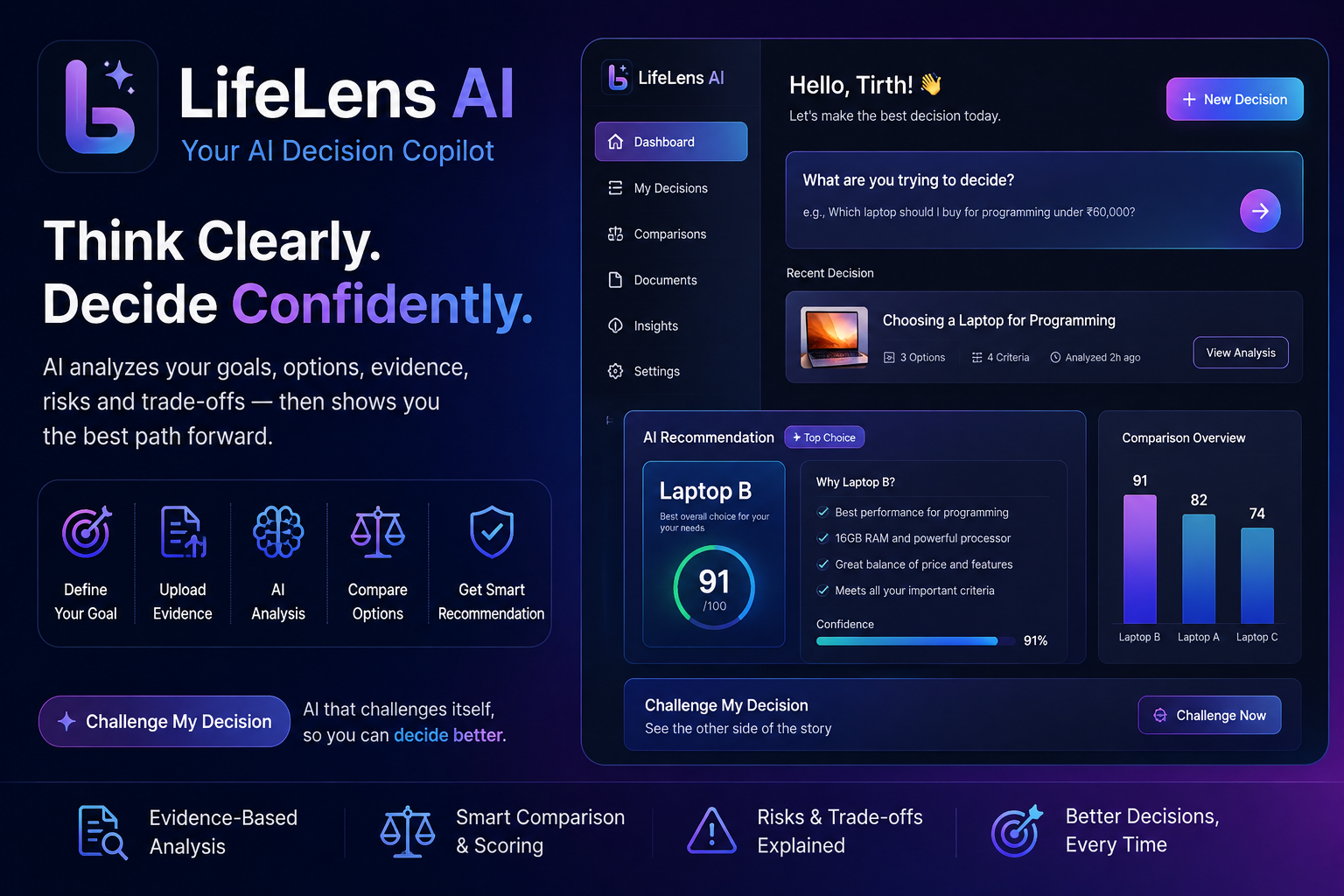
LifeLens AI is an AI-powered decision copilot designed to help people make clearer and more confident everyday decisions.
Users describe a decision, provide their goals and priorities, and can upload supporting evidence such as documents, images, or information about different options. LifeLens analyzes the available information and evaluates each option based on factors such as cost, benefits, risks, priorities, and trade-offs.
Instead of simply giving an answer, LifeLens provides:
🔍 AI-powered analysis of the available information ⚖️ Side-by-side option comparison 📊 Decision scoring and confidence levels ⚠️ Risk and trade-off identification 💡 Explainable AI recommendations 🧠 Personalized decision insights 🔄 Challenge My Decision, which asks the AI to argue against its own recommendation
The goal is simple: help users think clearly before they decide.
What it does
We built LifeLens AI as a modern web application with an AI-powered analysis layer.
The application follows a simple workflow:
User Decision → Information → AI Analysis → Comparison → Recommendation → Counter-Argument
The frontend provides an interactive dashboard where users can create decisions, provide relevant information, compare options, and explore AI-generated insights.
The AI layer analyzes the user's requirements and available evidence, identifies important criteria, evaluates trade-offs, and generates an explainable recommendation.
One of our key design decisions was to avoid making LifeLens just another chatbot. Instead, we structured the AI output into decision scores, comparisons, risks, reasoning, and recommendations, making the result easier to understand and act upon.
How we built it
One of our biggest challenges was making the AI useful for actual decision-making rather than simply generating convincing text.
AI can sometimes produce recommendations without clearly explaining the reasoning behind them. We addressed this by designing structured analysis around criteria, evidence, trade-offs, and risks.
Another challenge was handling different types of decisions. Choosing a laptop, selecting a career option, planning a trip, and comparing services all require different criteria.
We therefore designed LifeLens to dynamically identify the important factors for each decision instead of relying on a fixed set of rules.
We also wanted users to avoid blindly trusting AI. This led us to create Challenge My Decision, allowing users to see the strongest arguments against the AI's recommendation.
Challenges we ran into
Accomplishments that we're proud of
We're proud that LifeLens AI evolved beyond a conventional AI chatbot into a decision-support system.
Our biggest accomplishments include:
🧠 Turning unstructured user problems into structured decisions ⚖️ Building an AI-powered option comparison system 📊 Presenting recommendations with understandable reasoning ⚠️ Highlighting risks and trade-offs instead of hiding them 🔄 Creating the Challenge My Decision feature 🎨 Building a clean and intuitive decision dashboard 🌍 Designing the platform so it can be useful across education, careers, shopping, travel, productivity, and everyday life
Most importantly, we built LifeLens around one principle:
AI should help people make better decisions, not make decisions blindly for them.
What we learned
We learned that building an AI application is not just about connecting an API and generating responses.
The real challenge is designing how AI should think, what information it should consider, and how the result should be presented to the user.
We learned the importance of:
Designing AI outputs around real user problems Making AI recommendations explainable Handling uncertainty and trade-offs Creating interfaces that make complex AI results easy to understand Testing AI responses against different scenarios Giving users the ability to question AI instead of blindly trusting it
The project also taught us that sometimes the most useful AI experience isn't a longer answer—it is better reasoning presented in a simple way.
What's next for LifeLens AI
We want to turn LifeLens into a more powerful personal decision intelligence platform.
Future versions could include:
🔮 Multi-source research
Automatically gather and compare information from trusted sources before making a recommendation.
📈 Decision history
Track previous decisions and help users understand patterns in their choices over time.
🧠 Personal preference memory
Learn a user's priorities and decision style while keeping them in control of their data.
👥 Collaborative decisions
Allow multiple people to contribute preferences and find the best option for a group.
🎯 Decision outcome tracking
Let users record what happened after making a decision and use those outcomes to improve future recommendations.
🤖 Advanced AI agents
Allow LifeLens to independently research options, collect evidence, compare alternatives, and prepare a complete decision report.
Built With
- agents
- ai
- app
- artificial
- claude
- css
- decision
- generative
- html
- intelligence
- javascript
- language
- large
- natural
- netlify
- node.js
- processing
- react
- support
- web


Log in or sign up for Devpost to join the conversation.