-
-
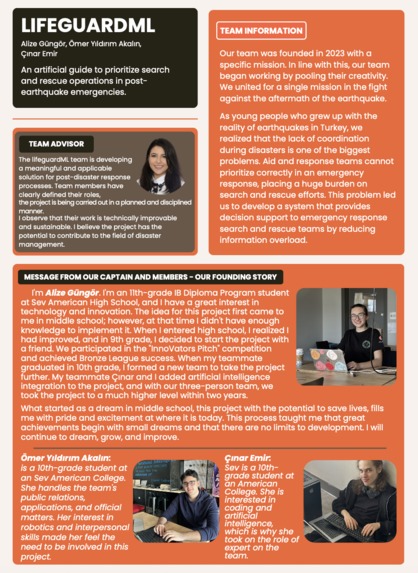
lifeguardML Promotional Poster
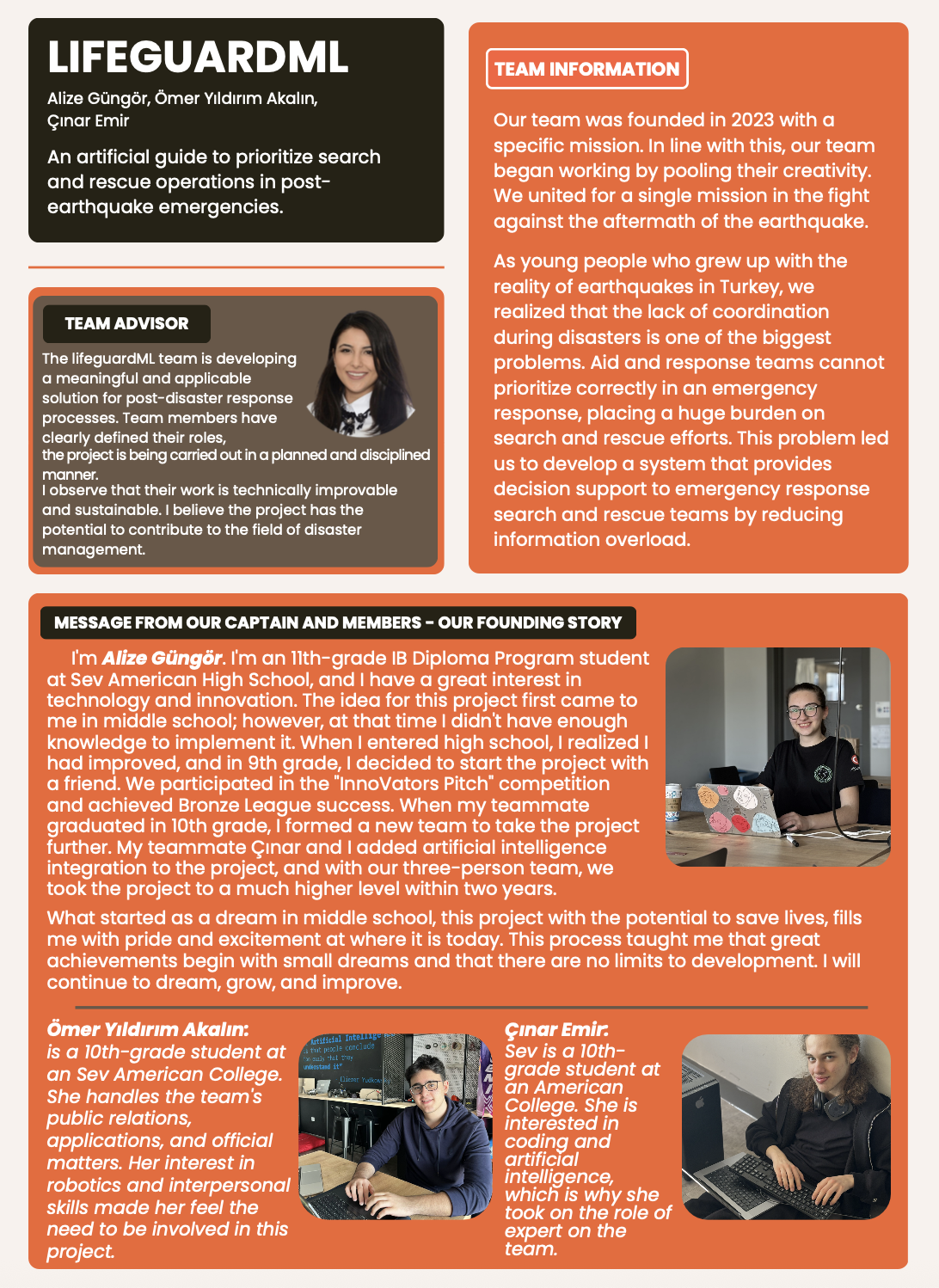
Inspiration
We are the lifeguardML team. As students who grew up in Türkiye experiencing the reality of earthquakes, we realized that one of the biggest problems during disasters is the lack of coordination and prioritization. In the first hours after an earthquake, as the number of reports increases, it becomes difficult for teams to decide which area to respond to first. Based on this problem, we developed the lifeguardML project.
lifeguardML is an AI-based decision support system. The system analyzes incoming event data according to location, intensity, and risk parameters. Then, it creates a priority score for each area and provides recommendations to the response teams. Our goal is to reduce time loss and ensure more efficient use of resources. We are developing our project according to a planned roadmap. We are progressing step-by-step in data set creation, model training, and scenario simulations. LifeguardML is not just software; it is a system that aims to contribute to making the right decisions after a disaster. We want to use technology to save lives.
What it does
“lifeguardML”, meaning lifeguard machine learning, is an AI-based navigation system aimed at identifying the number of people in buildings facing collapse or already collapsed during disasters and emergencies, and sharing this information with relevant units. We realized that this need is crucial during the high volume of reports and coordination during disasters and emergencies. Because this situation leads to time loss and increases the risk of loss of life.
Therefore, we set out to help people affected in such situations. “lifeguardML” is designed to understand the disaster and emergency situation. In this case, it calculates the priority of the problem and, by comparing it with other systems, transmits the location of the building, technical details, and the number of people present to the teams according to the diagnosis and priority. In this context, we wanted to offer a solution that can be used both centrally and in the field by using data analysis and image processing technologies with the resources we have.
The project aims to improve the speed of response in disaster management and crisis resolution, enabling both people and disaster and emergency management units to make more accurate decisions, which is in the best interest of humanity.
How we built it
The project is being developed using existing and accessible technologies. Hardware such as Raspberry Pi, Google Coral, and cameras make the system practical for real-world applications. This is important to reach a wider audience. In addition, the project is open to improvement in terms of design, cost, and technology, and can be expanded with more data and adapted to a wider range of disaster types.
Challenges we ran into
There were numerous problems related to the technicalities involved and also to the process of planning. First, research into how the AI model functioned and what data was to be used during training took much time. It was not easy to find data that was realistic.
In the case of hardware, the problem consisted in making sure that the Raspberry Pi 3, Google Coral, and camera could communicate. These tasks were performed by means of trial and error.
It is also worth mentioning that one needed to improve the efficiency of the AI model and its ability to detect images accurately and quickly. This was done because of limitations in hardware capacities.
As far as the team is concerned, there were problems with coordinating the tasks and managing the time effectively. However, as the process went on, the situation improved.
Nevertheless, there were no serious problems. All the difficulties were solved systematically and the project was developed in stages.
Project Preparation Process And Working Method
During the project preparation process, the problems experienced after the earthquake were investigated, and it was determined that there was a lack of prioritization in the intervention processes. Solutions to this were discussed within the group. Accordingly, the working structure of the system was planned in light of common decisions and ideas, and the necessary hardware was determined. Team members embraced their task assignments with importance and took their responsibilities seriously.
Our computers and the materials provided by our school, that is, the materials we possessed, provided great support in developing our solutions. In the software part, how the artificial intelligence model would work was investigated, and the basic algorithm structure was created. The team leader ensured project planning and overall coordination. In the hardware and integration phase, studies were conducted on the camera and processor components working together. The results obtained throughout the process were evaluated, and the project was developed step by step. Thus, a work process planned and implemented by the project was advanced.
What we learned
- The importance of having good data and quick decision-making was highlighted in our understanding of disaster technology.
- We witnessed how difficult and important the implementation of AI + edge devices can be in reality.
- We observed how teamwork, division of tasks, and time management play crucial roles in achieving project success.
What's next for lifeguardML
--> Enhance the precision of the AI model through augmentation with more data. --> Integrate live maps into the solution. --> Ensure the application is more appropriate for mobile usage. --> Customize the solution for various types of disasters (e.g., fire and flood).


Log in or sign up for Devpost to join the conversation.