-
-
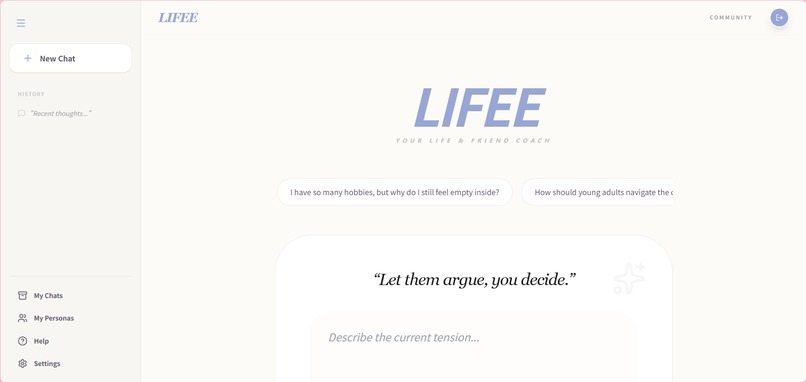
LIFEE Question Page
-
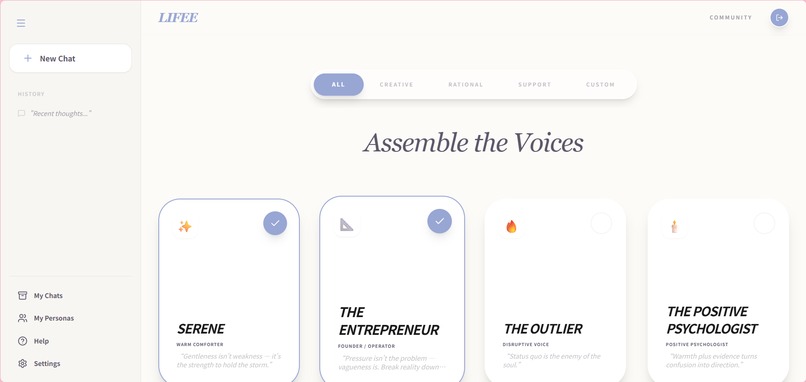
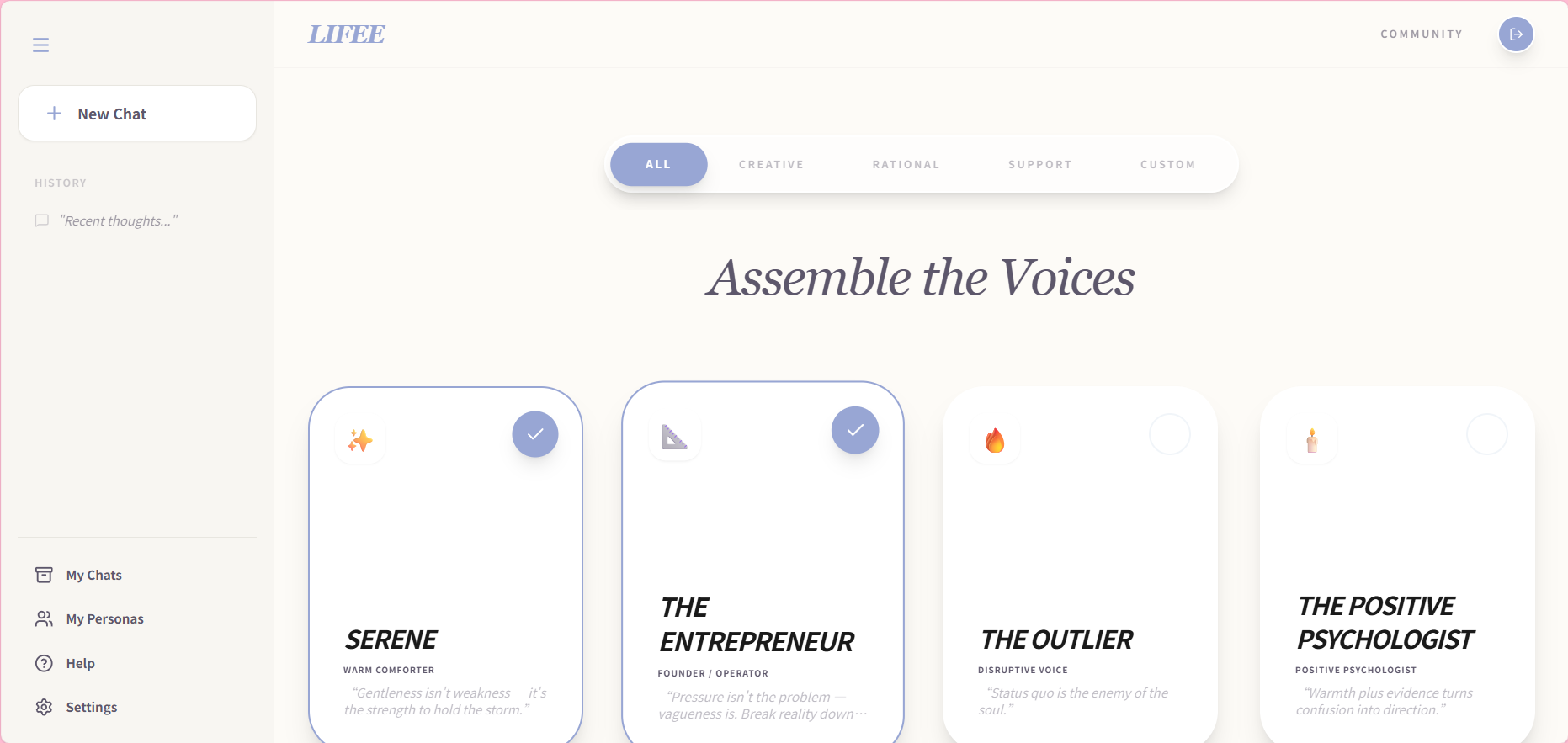
LIFEE Persona Page
-
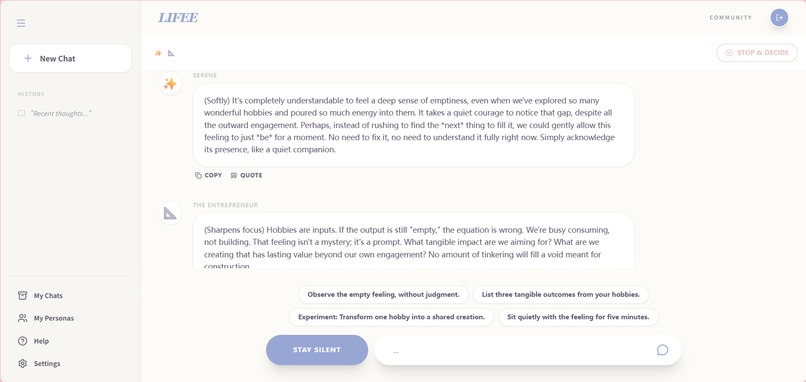
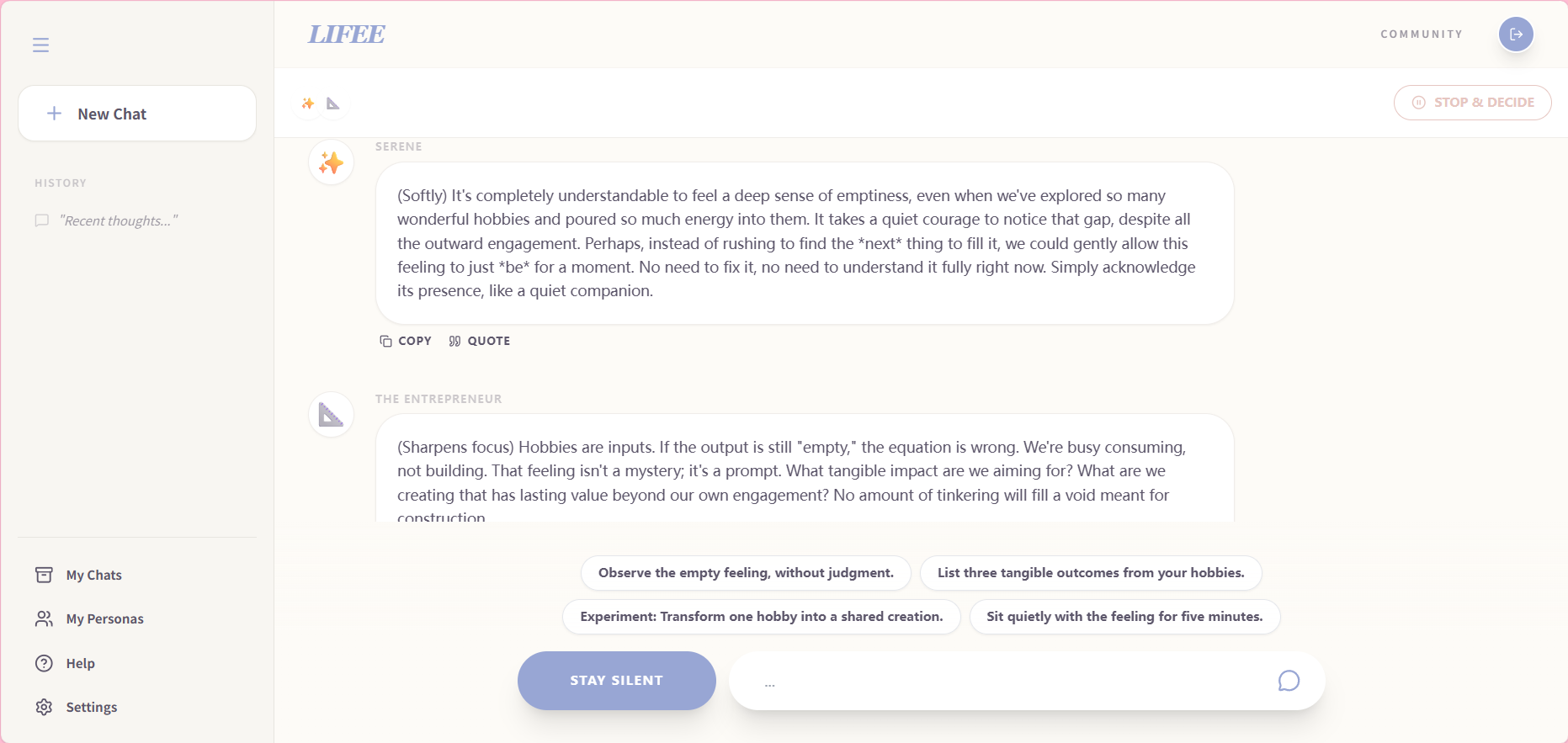
LIFEE Debate Page
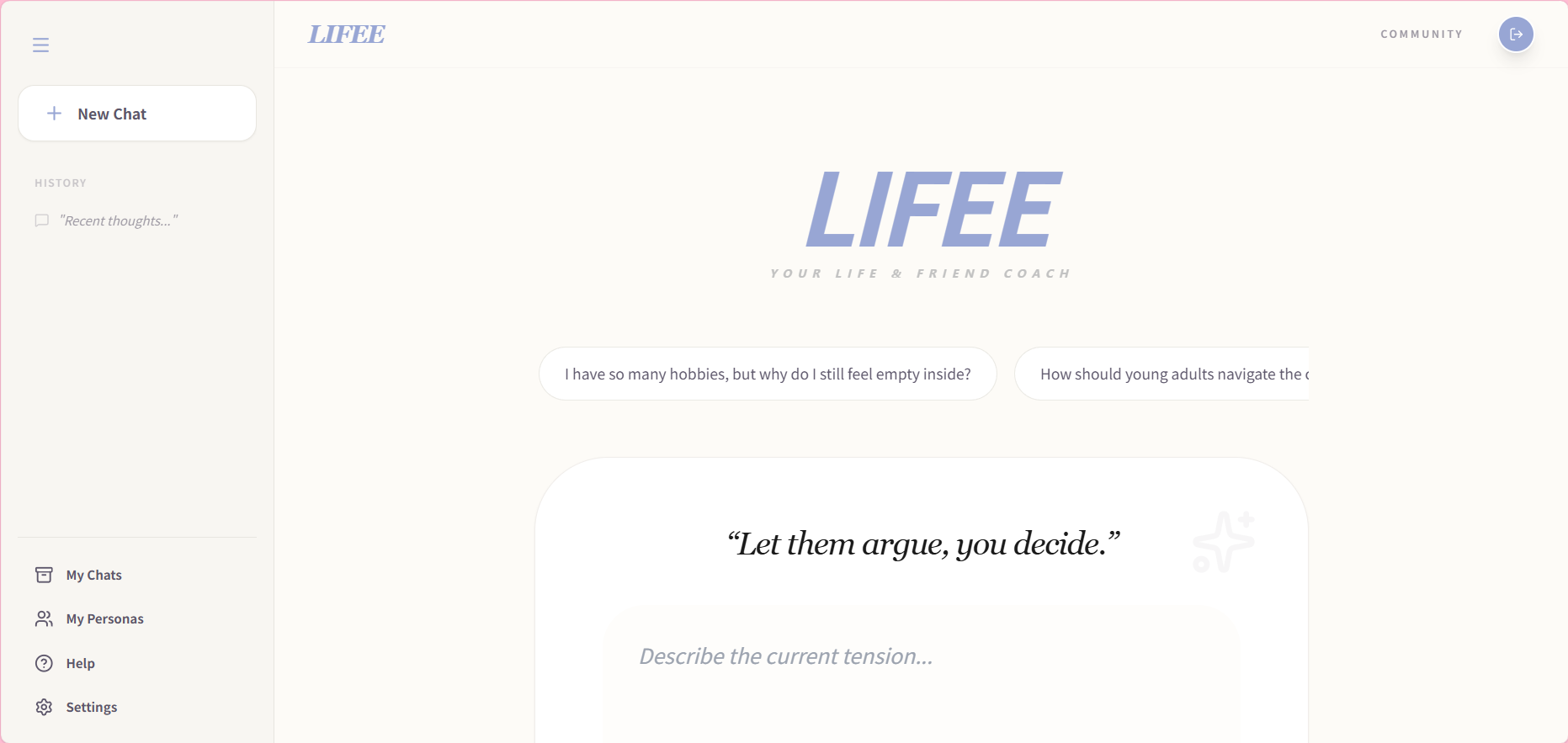
Inspiration
LIFEE started from a very human frustration: big life decisions rarely fail because of a lack of information—they fail because our thoughts argue with each other nonstop. Friends give conflicting advice, logic clashes with emotion, and online “answers” flatten complex lives into templates.
We were inspired by how people actually think: as internal debates. Instead of forcing clarity upfront, we asked—what if we let those voices fully argue it out? What if uncertainty wasn’t a bug, but the raw material?
That question became LIFEE: an AI life & friend debate coach that helps people decide without erasing complexity.
What it does
LIFEE turns life decisions into structured debates.
Users bring a dilemma—career, relationships, identity, creativity—and LIFEE generates multiple perspectives: rational, emotional, social, risk-averse, ambitious, even contrarian. These perspectives argue with each other in real time, exposing hidden assumptions, trade-offs, and blind spots.
There is no “right answer” output.
LIFEE’s core rule is simple:
[ \text{Decision Power} = \text{Clarity} \times \text{Agency} ]
We maximize clarity. The user keeps agency.
How we built it
We built LIFEE as a modular AI system rather than a single chatbot.
- Debate Engine: a multi-agent reasoning layer where each “voice” follows different value systems and cognitive biases.
- Reflection Layer: prompts that translate arguments into user-readable insights, not advice.
- Memory & Context: lightweight life-state tracking so debates evolve with the user, not reset each time.
- Interface Design: intentionally calm and minimal, borrowing from journaling tools rather than productivity apps.
The system is designed so that disagreement is productive, not smoothed over.
Challenges we ran into
- Avoiding authority bias: users tend to trust AI too much. We had to design LIFEE to argue with itself so no single voice feels dominant.
- Emotional safety: debates around life decisions can trigger anxiety. We tuned tone, pacing, and stopping points carefully.
- Not becoming therapy: LIFEE supports thinking, not mental health treatment. Drawing that boundary clearly was essential.
- Balancing structure and freedom: too much structure kills nuance; too little becomes noise.
Accomplishments that we're proud of
- Built a working multi-perspective debate system that feels surprisingly human.
- Users reported feeling more confident even when choosing harder paths.
- Early testers described LIFEE as “the friend group I wish I had at 2 a.m.”
- We resisted the urge to optimize for answers—and optimized for better questions instead.
What we learned
- People don’t want AI to decide for them; they want AI to help them think better.
- Conflict, when designed well, creates clarity rather than stress.
- Emotional reasoning is not the opposite of logic—it’s a different axis.
- The most meaningful metric isn’t speed, but post-decision peace.
What's next for LIFEE
Next, we’re expanding LIFEE in three directions:
- Richer personas: letting users customize the “voices” (mentor, sibling, skeptic, dream-self).
- Long-term arcs: connecting today’s debates to patterns across months and years.
- Social bridges: optional ways to invite real friends into structured, less chaotic discussions.
LIFEE isn’t here to tell you who to become.
It’s here to make sure every voice gets heard—before you choose.
Built With
- babel
- cloudflare
- googlegeminiapi
- html/css/javascript
- react
- supabase
- tailwind


Log in or sign up for Devpost to join the conversation.