-
-
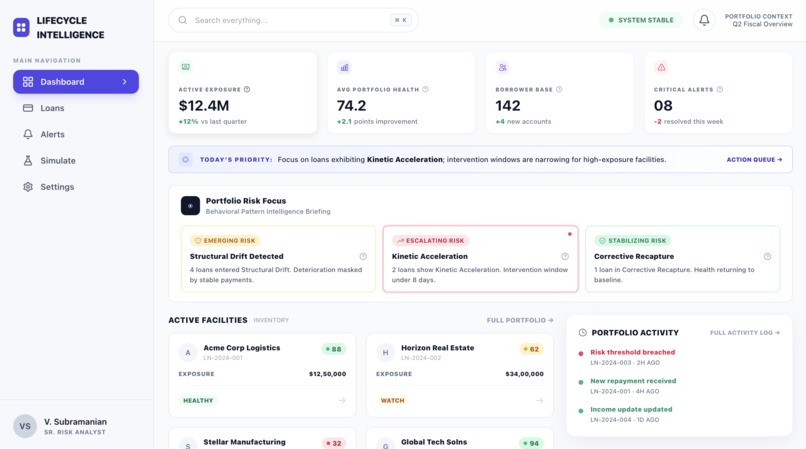
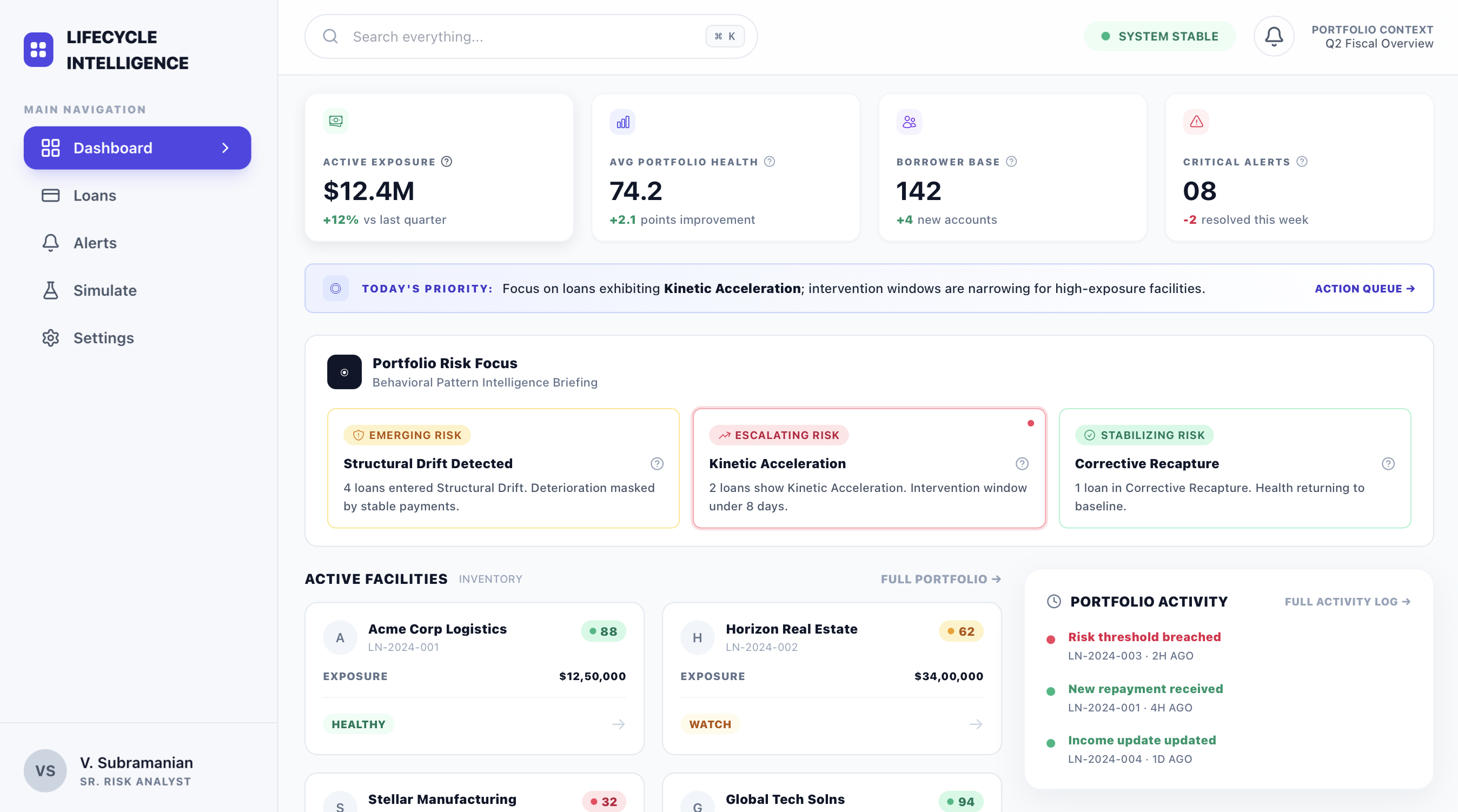
Lifecycle Core dashboard showing real-time portfolio health, early drift detection, exposure tracking, and priority risk signals.
-
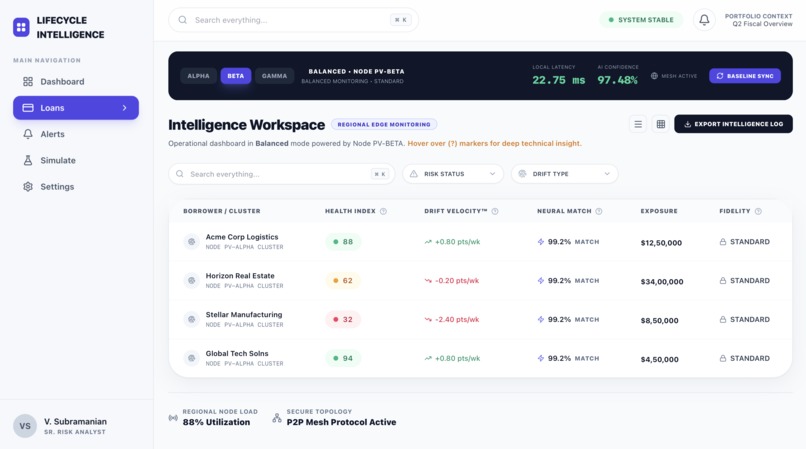
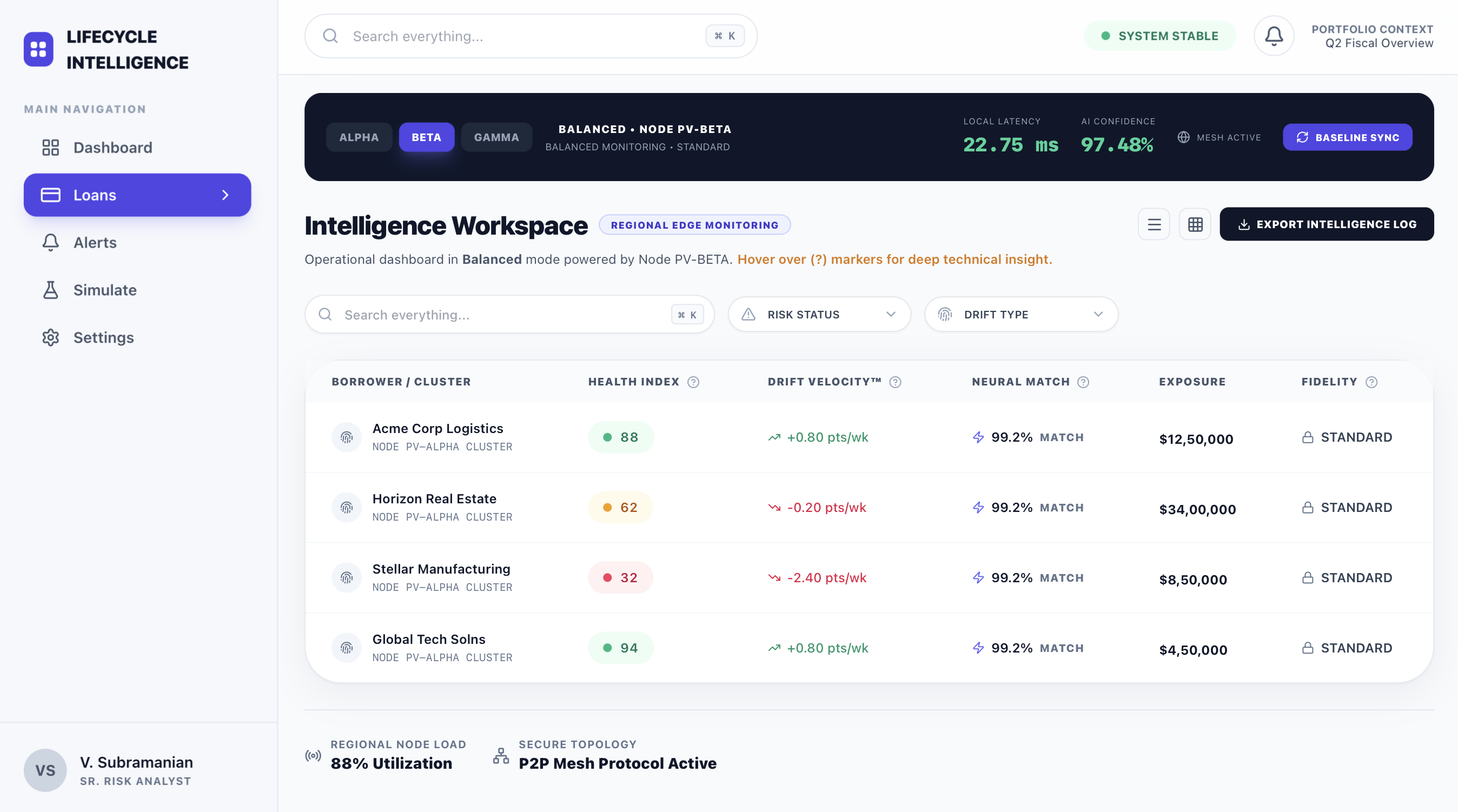
Loans view showing borrower-level health, drift velocity, neural match, exposure, and intelligence modes for proactive risk assessment.
-
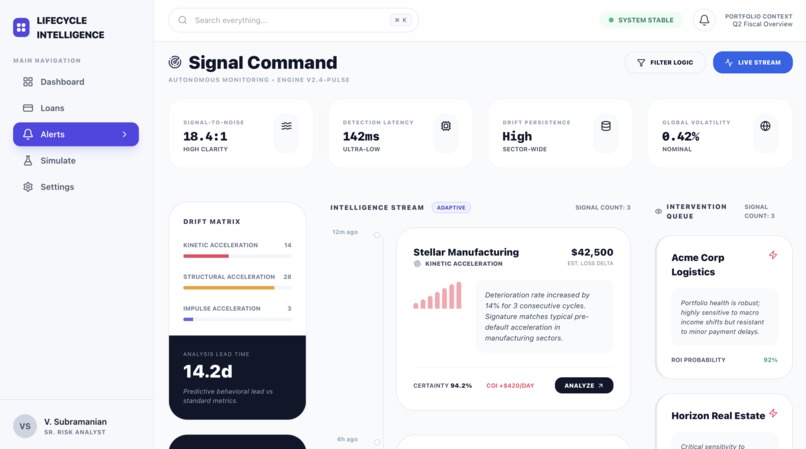
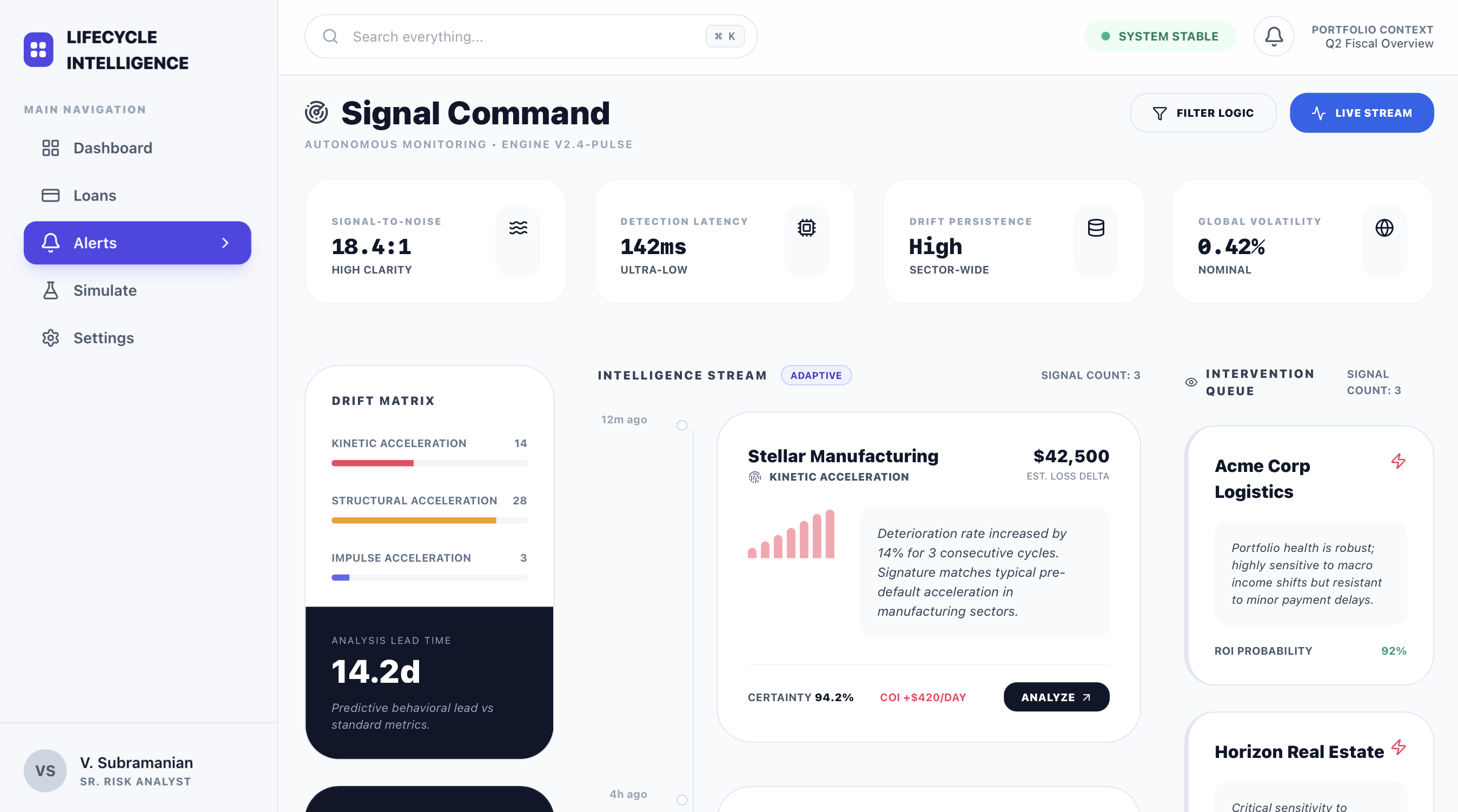
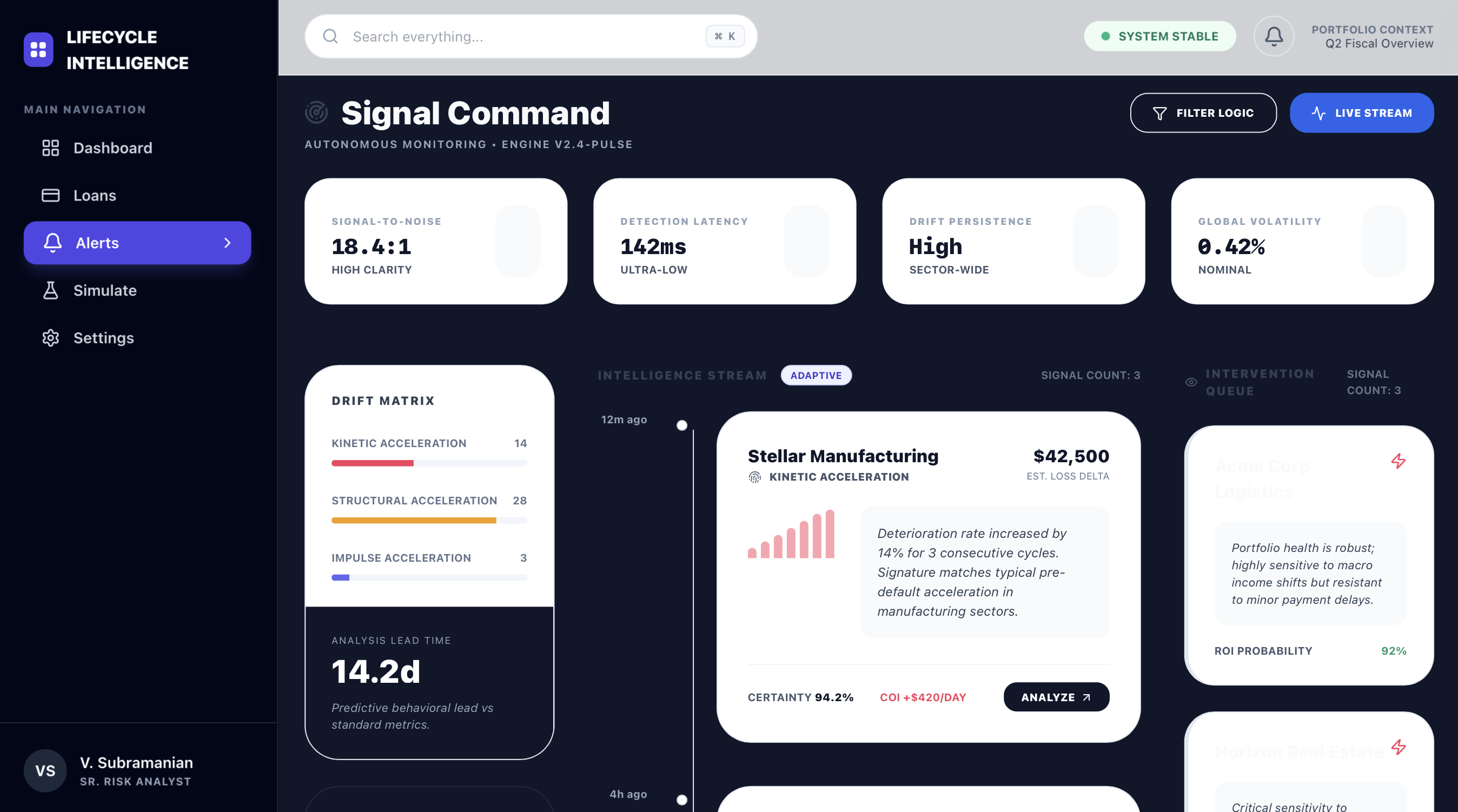
Alerts page streaming real-time risk signals with drift severity, confidence metrics, and an action queue for immediate intervention.
-
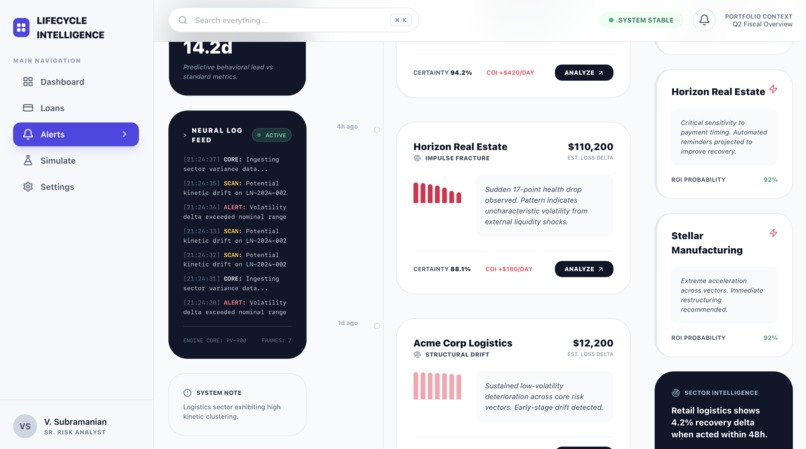
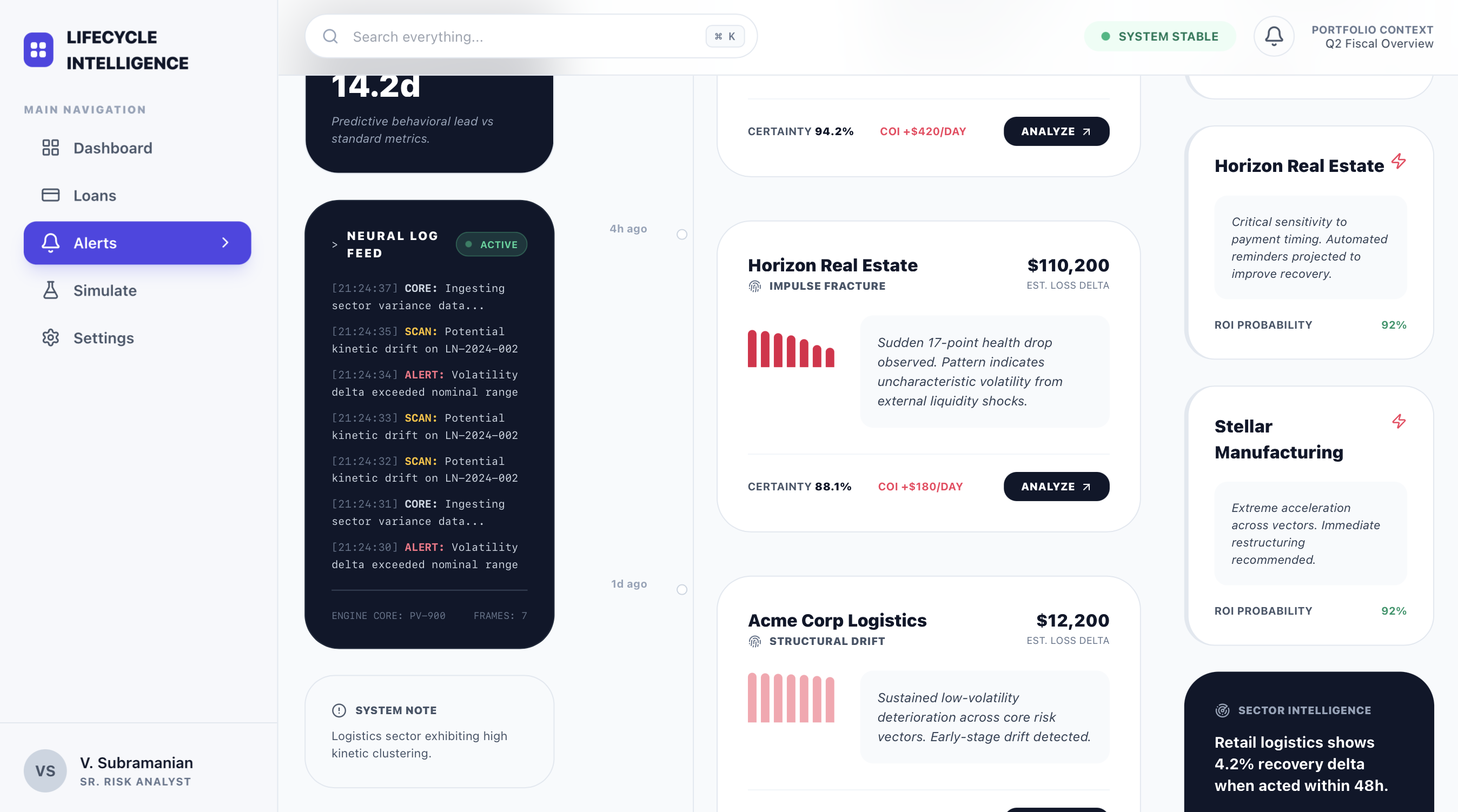
Live neural log streaming real-time intelligence signals, drift updates, confidence scores, and system activity across the portfolio.
-
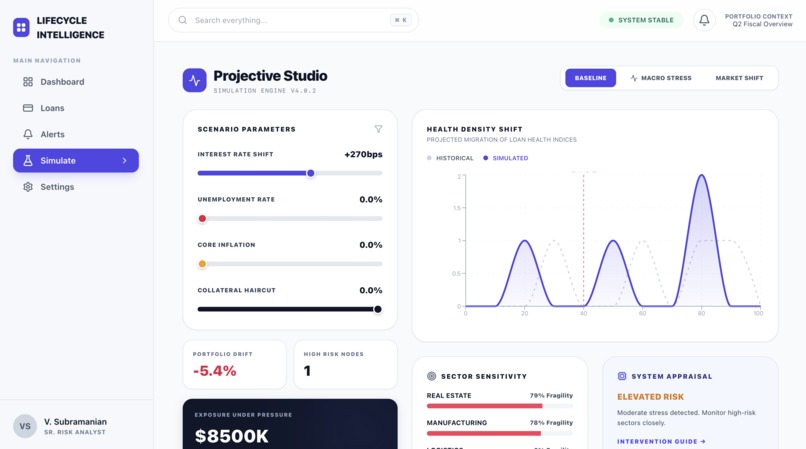
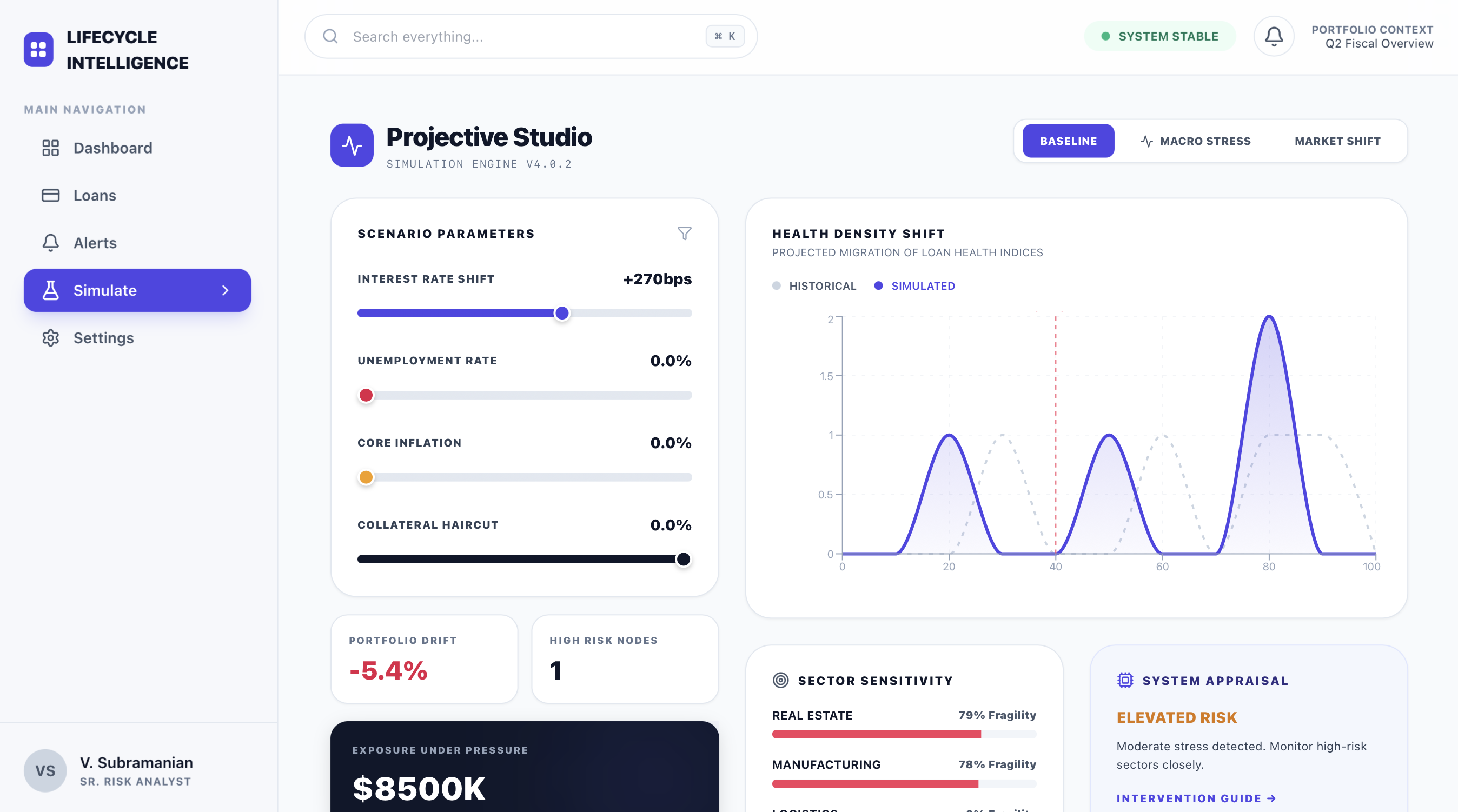
Scenario simulation view testing baseline, macro stress, and market shifts to predict portfolio risk trajectories and exposure changes.
-
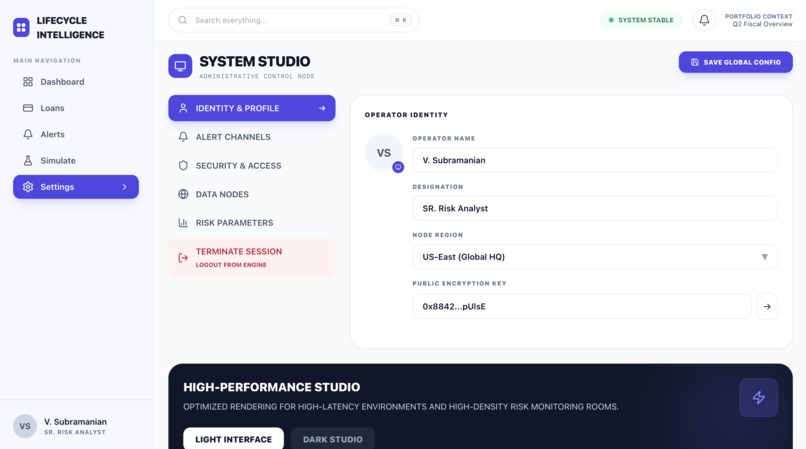
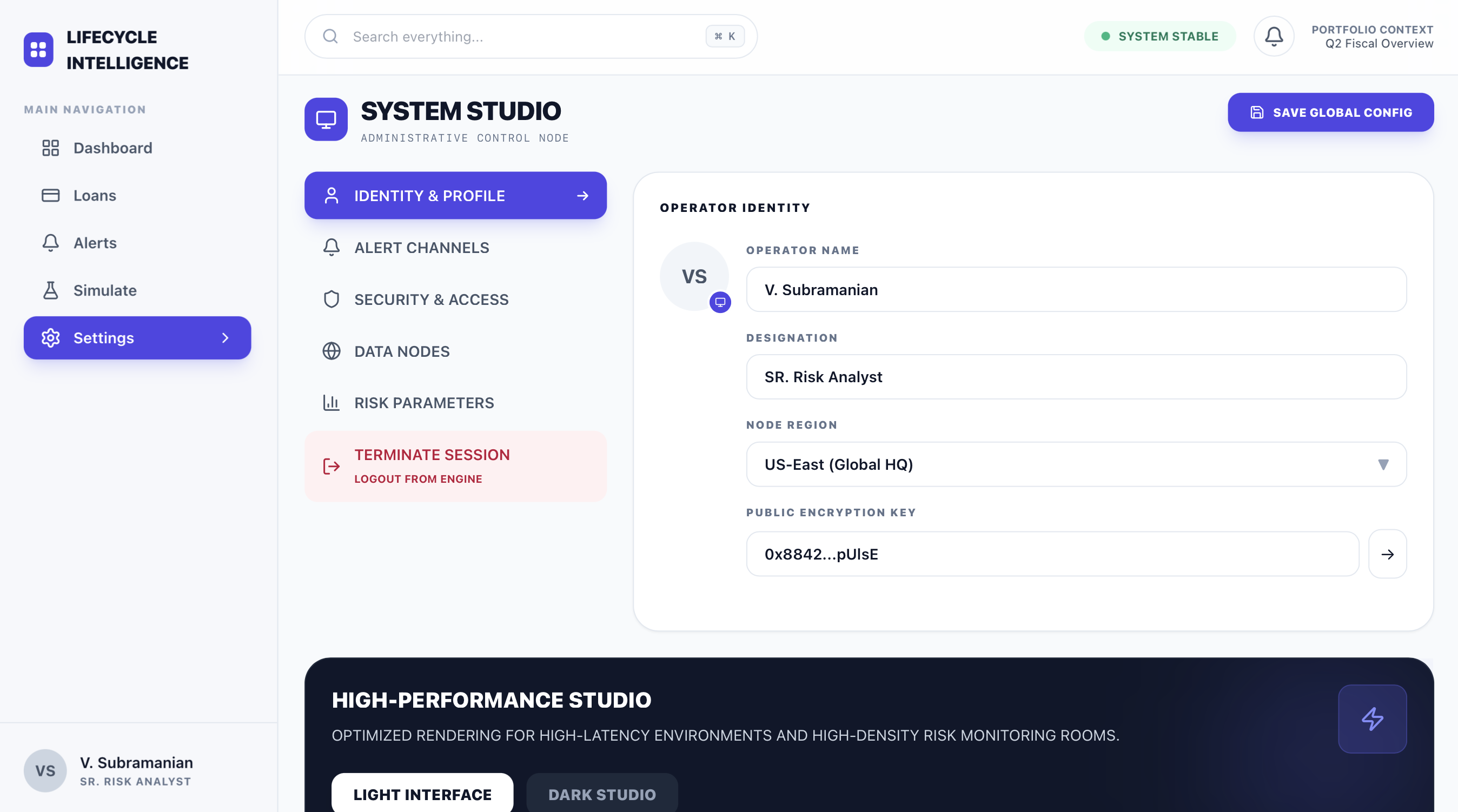
Settings page configuring intelligence modes, access control, system behavior, and performance parameters for secure institutional deploys
-
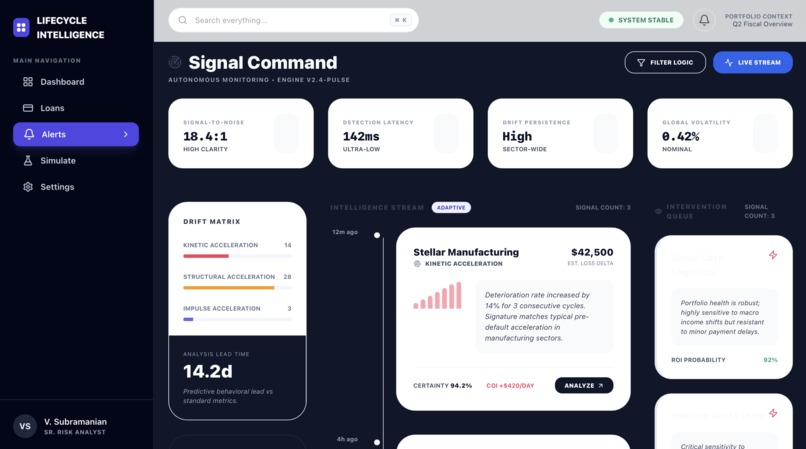
Dark theme interface optimized for low-light environment, enhancing focus, contrast, and continuous monitoring in high risk operations.
Lifecycle Core
Commanding the Credit Horizon
Predict Structural Drift up to 90 days before default.
Lifecycle Core enables institutions to move from reactive loss tracking to proactive credit control, using real-time intelligence and autonomous intervention workflows.
Problem
The Latency of Failure in Institutional Lending
Most institutional credit systems operate in a lagging feedback loop.
By the time a borrower misses a payment, the capital recovery window is already closing.
Traditional Loan Management Systems are designed to record failure, not prevent it.
This delay creates avoidable losses, missed intervention opportunities, and reactive decision-making.
Our Insight
Credit risk is not static. It moves.
Inspired by the physics of motion, Lifecycle Core treats risk as a dynamic system with direction and acceleration—not a single score frozen in time.
The key question we asked:
What if default risk could be detected before it becomes visible in payments?
Solution
Structural Drift Intelligence
Lifecycle Core detects Structural Drift—early divergence between a borrower’s current behavior and its historical baseline.
Instead of monitoring only current health, we track trajectory change, identifying when borrower stability begins to decay.
To detect this inflection point, we compute Kinetic Acceleration, a second-order signal that captures early instability:
$$ K_a = \frac{d^2H(t)}{dt^2} $$
This allows Lifecycle Core to surface risk weeks to months before traditional systems, enabling earlier and more effective intervention.
What Lifecycle Core Delivers
- Up to 90-day early warning signals for default risk
- Projective portfolio simulations under macroeconomic stress
- Sector-aware sensitivity modeling, not one-size-fits-all scoring
- Autonomous intervention workflows, not passive alerts
This is risk intelligence designed for action, not observation.
Platform Architecture
Built for Institutional Decision-Making
Lifecycle Core is engineered for clarity, speed, and trust at scale.
Decision Studio
A high-contrast interface optimized for fast, low-cognitive-load decisionsProjective Engine
Real-time simulations showing how macro factors shift portfolio risk densityMotion Intelligence
Subtle kinetic signals that visually communicate severity and instabilityAutonomous Action Queue
Execute restructurings and interventions directly from live risk signals
Sample Projective Logic (Illustrative)
const calculateStressedScore = (baseline, macroStress) => {
  const driftSensitivity = 1.42;
  const volatilityIndex = 0.08;

  return Math.max(
    0,
    baseline - (macroStress * driftSensitivity * volatilityIndex)
  );
};
Built With
- autoprefixer
- css-react
- framer-postcss
- javascript
- tailwind
- typescript
- vite


Log in or sign up for Devpost to join the conversation.