-
-
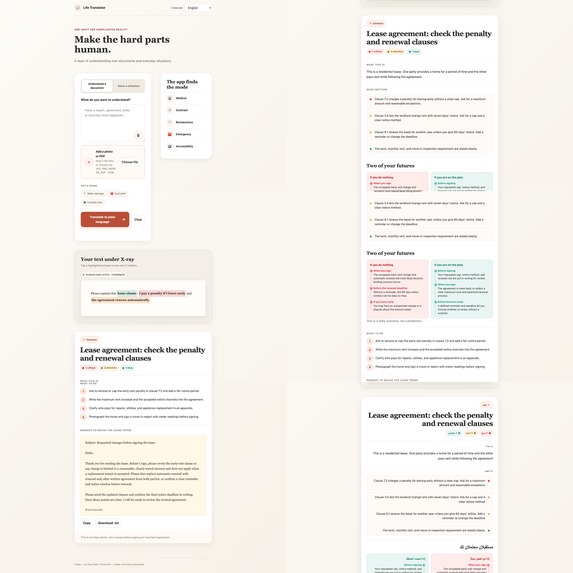
00-overview
-
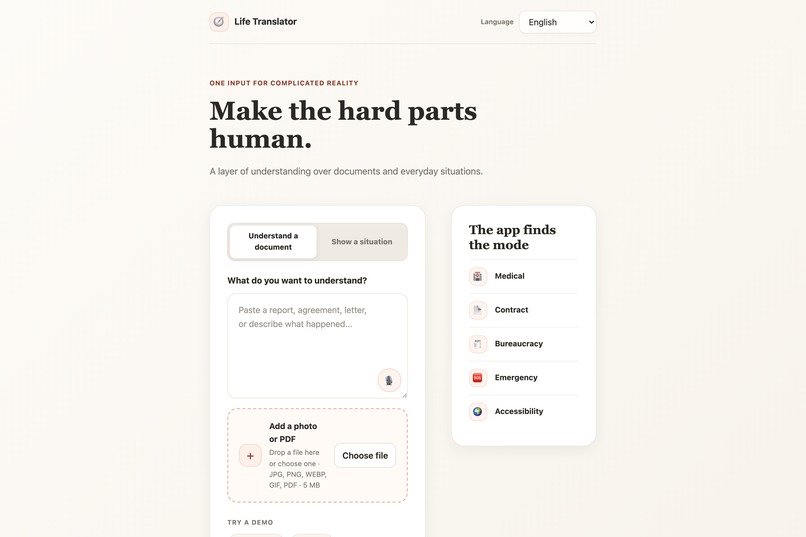
01-hero
-
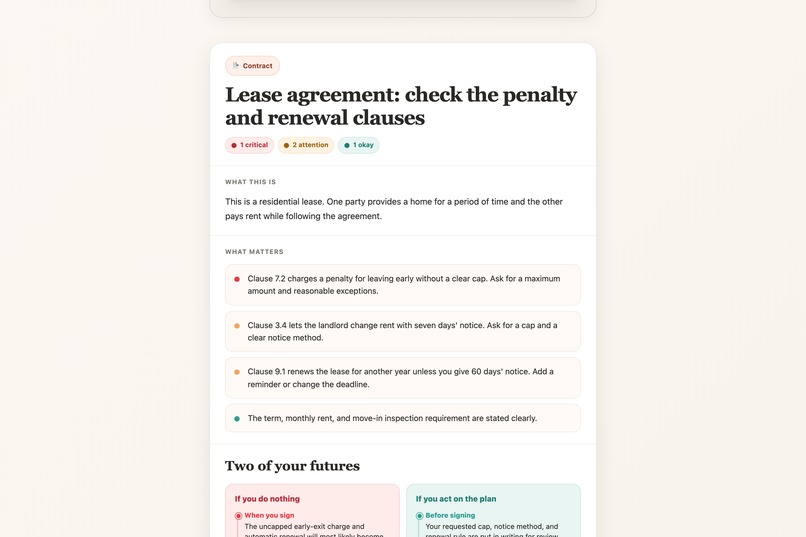
02-contract-result
-
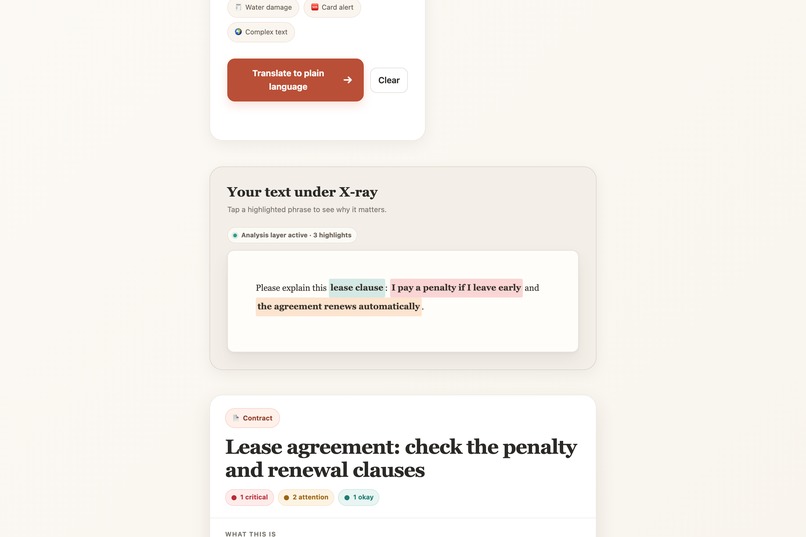
03-xray
-
04-futures
-
05-artifact
-
06-rtl-arabic
-
07-situation-input
-
08-situation-quick-view




Inspiration
Every day people sign contracts they don't understand, get medical results they can't read, and receive letters that scare them. For thousands of years, documents served the people who write them. We wanted to build the first tool that takes the side of the person who reads — a quiet layer of understanding between a person and a complicated world.
What it does
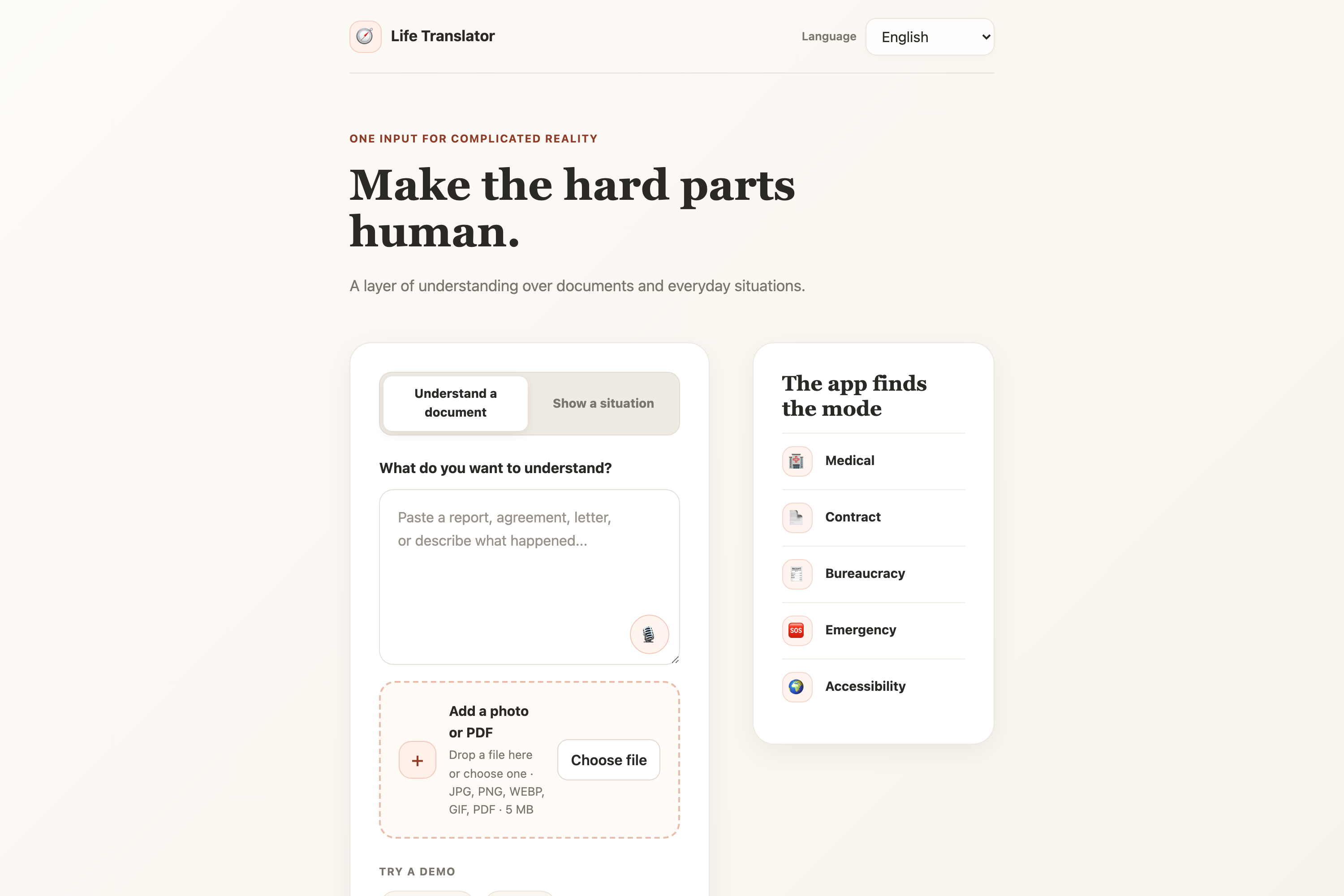
Life Translator takes anything life throws at you — with zero prompting:
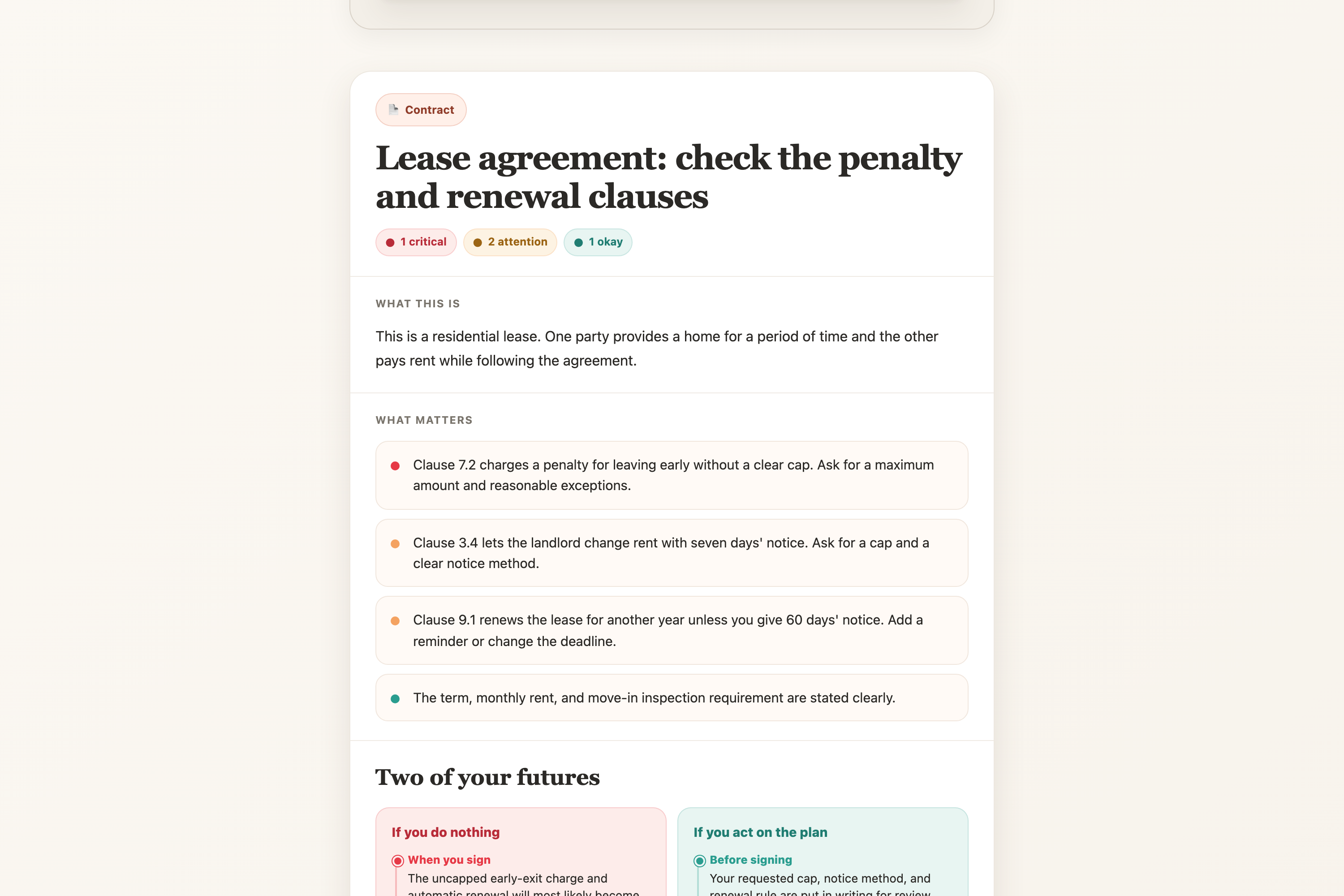
- Routes automatically. GPT-5.6 classifies every request into one of 5 modes: medical, contract, bureaucracy, emergency, accessibility.
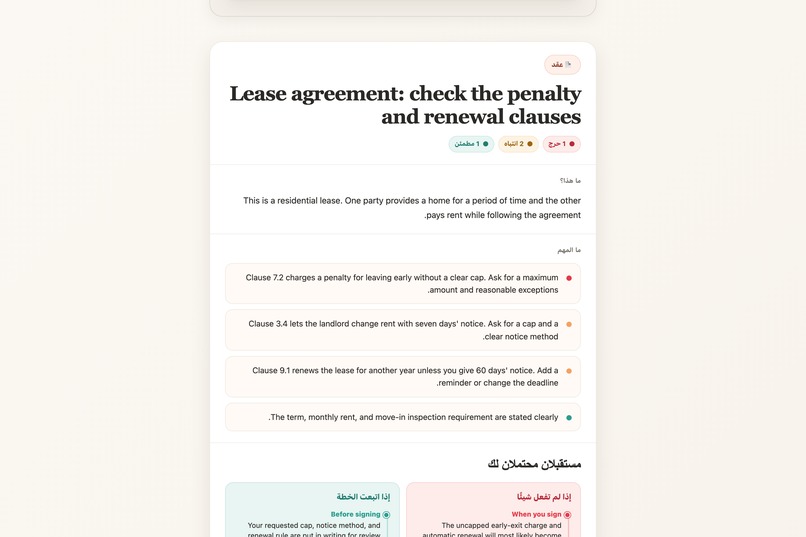
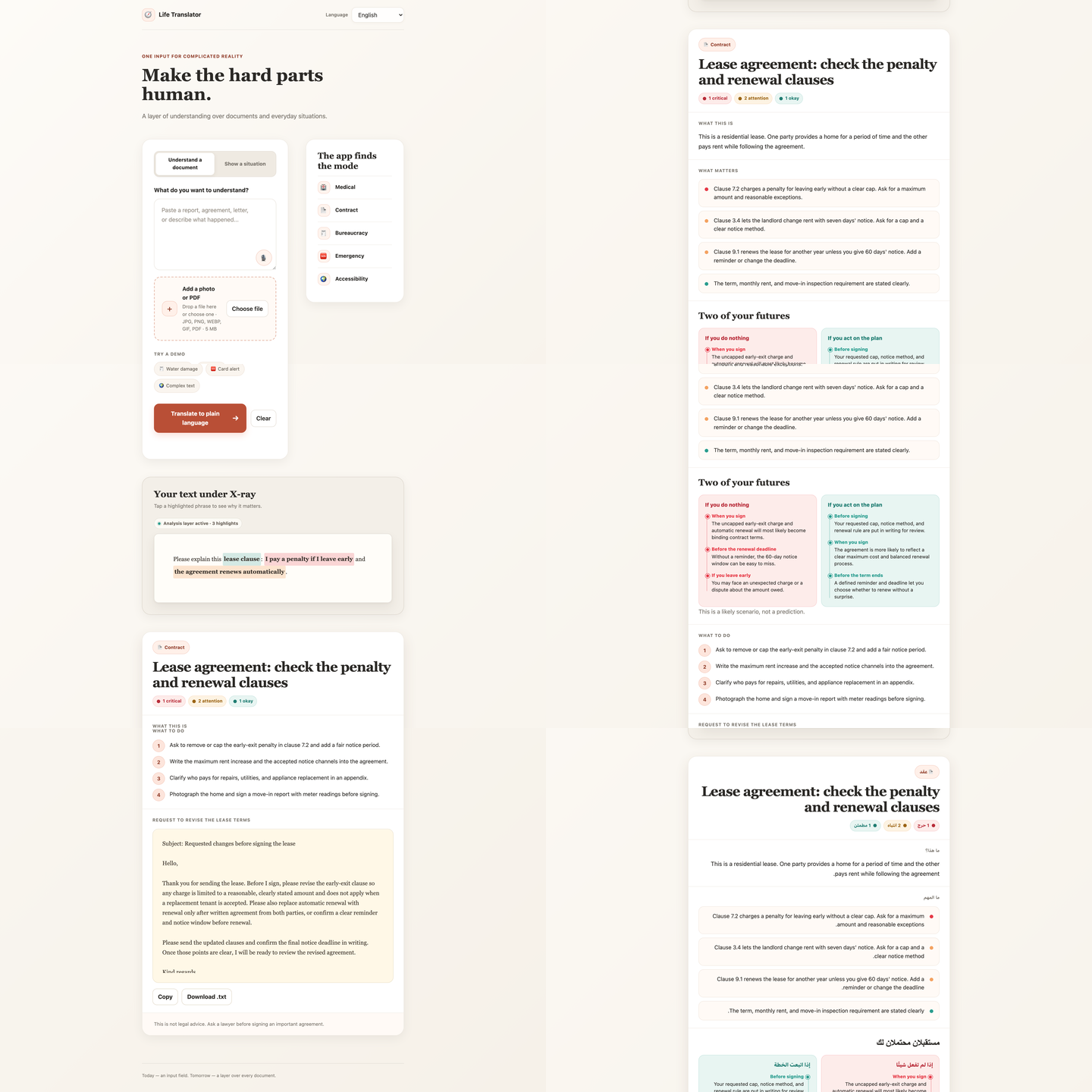
- X-rays your own text. 3–6 verbatim quotes from your document are highlighted red / yellow / green — tap any of them to see why it matters.
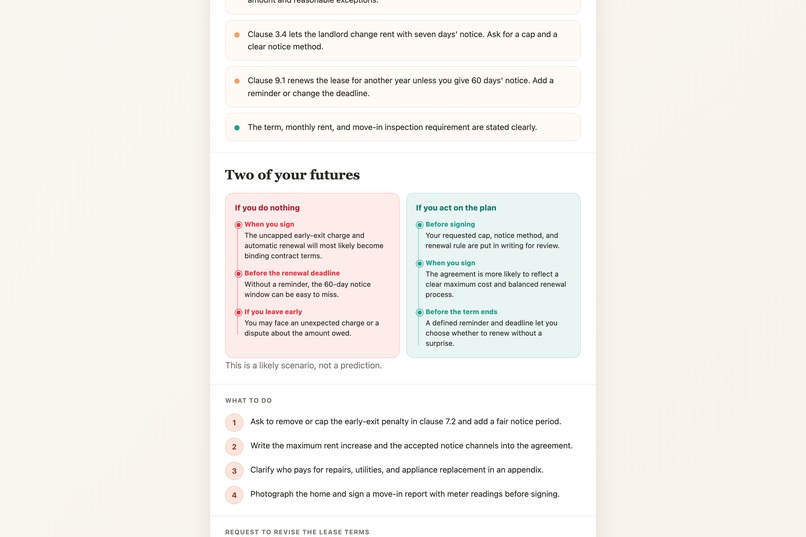
- Shows two futures. Side-by-side timelines of what likely happens if you ignore it vs. if you act. The first tool that shows both of your futures.
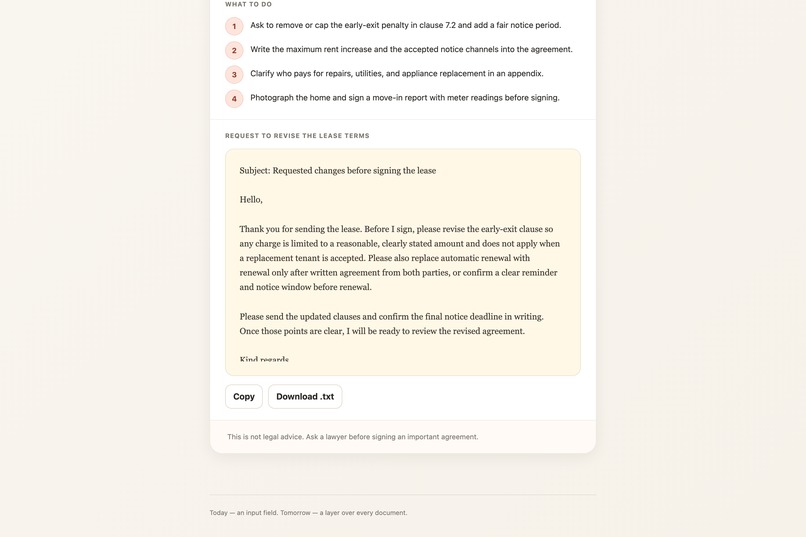
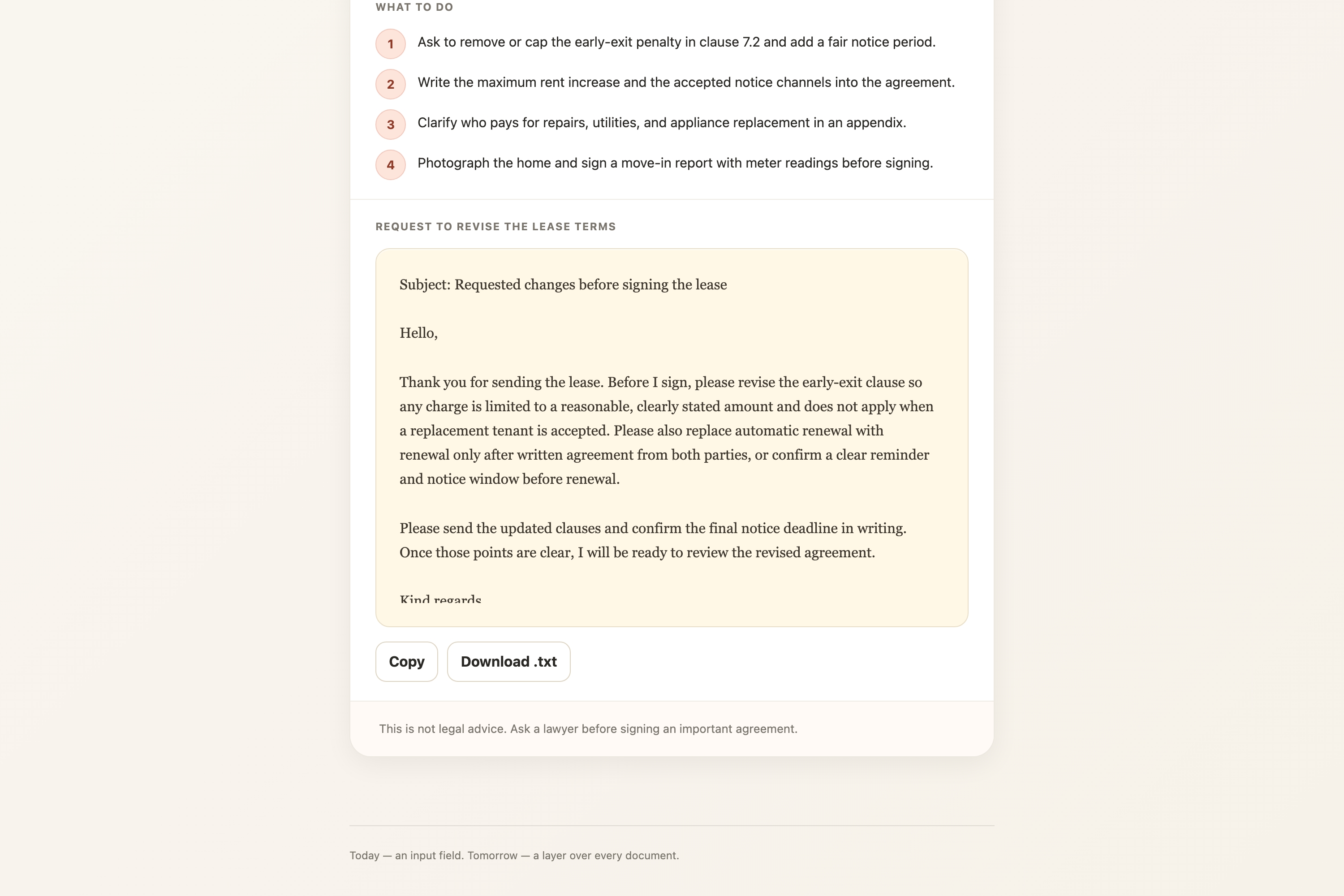
- Writes the document for you. A ready-to-send letter, formal claim, doctor questions, or call script — copy or download in one click.
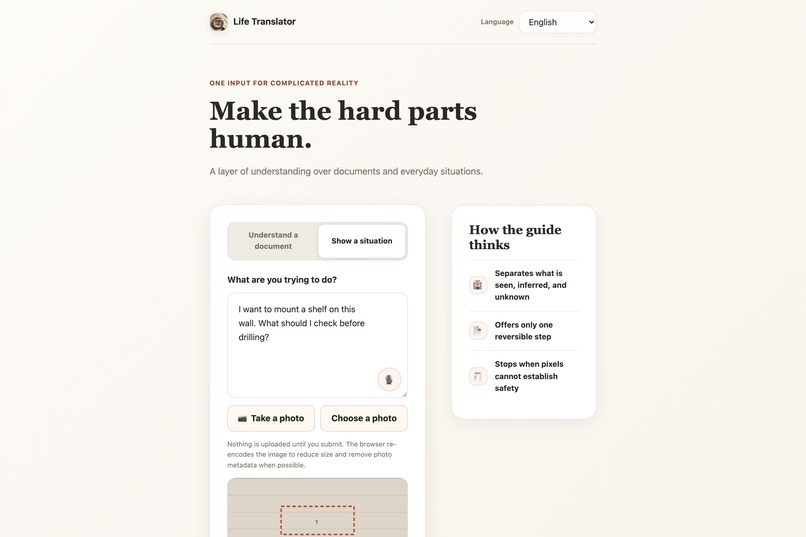
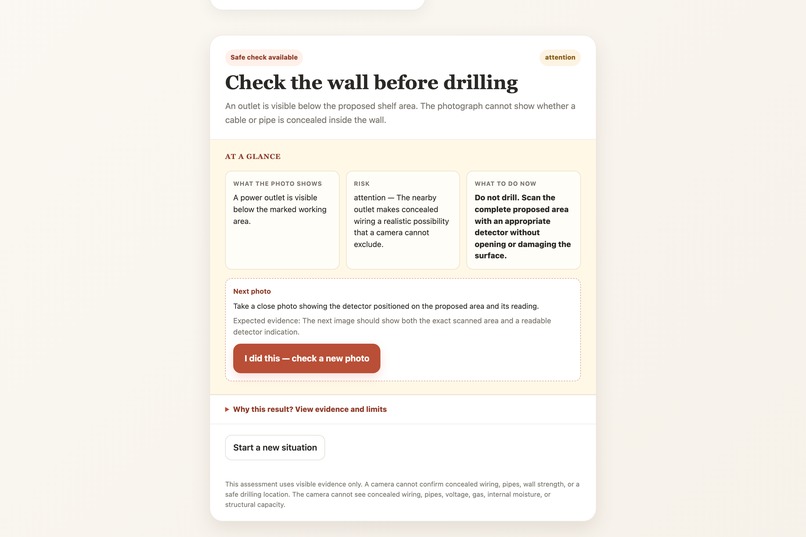
- Guides real-world situations (beta). Photograph a household situation — a wall you're about to drill, a leak under the sink — and get an evidence-grounded assessment: what is directly visible, what is only inferred, what remains unknown, exactly one reversible safe step, and a verification checkpoint before continuing.
- Speaks your language. 8 languages with auto-detection, full RTL support, and voice input.
How we built it
The entire project was built in Codex CLI with GPT-5.6, strictly test-driven: contracts and failing tests first, minimal implementation second, one feature per commit. Node.js + Express backend, a single-file dependency-free frontend, and strict schema-validated JSON contracts (Zod) for every response — including a separate versioned safety protocol for the situational guide, where a stop state technically cannot contain further instructions. A demo mode with realistic fixtures runs with no API key, and Codex reviewed its own UI through Playwright screenshots across desktop, mobile, and Arabic RTL.
Challenges we ran into
Making highlights verbatim substrings of the user's input (safe DOM-only rendering, no innerHTML), keeping every new JSON field optional so older responses never break the UI, localizing every string into 8 languages including right-to-left Arabic, and designing a camera feature that is honest about its limits — a photo cannot prove a wall is safe to drill.
Accomplishments that we're proud of
- A complete, working product in one build week: 5 modes, X-ray highlights, a two-futures simulator, ready-to-send documents, voice input, 8 languages with RTL — all behind one input box.
- A deterministic safety protocol for real-world guidance: observations, inferences, and unknowns are always separated, and high-risk scenes force a hard stop instead of advice.
- ~40 green tests written before the features they verify, including tests that check every demo quote is a verbatim substring of the demo texts.
- A demo mode that needs no API key — clone the repo and try everything in one command.
What we learned
A strict, schema-validated output contract turns an LLM from a chatbot into a dependable product: the traffic-light structure, verbatim quotes, single safe steps, and ready documents are guaranteed by schema — not by hope.
What's next for Life Translator
Today it is an input box and a camera snapshot. Tomorrow — a quiet layer over everything you see: a browser extension highlighting risks on any page, a phone camera that explains what it sees, smart glasses that analyze any document or situation the moment you look at it, built into mail and messengers.
Built With
- codex
- css3
- express.js
- gpt-5.6
- html5
- javascript
- node.js
- openai
- playwright
- web-speech-api
- zod


Log in or sign up for Devpost to join the conversation.