
Inspiration
When I started exploring WebMCP, the obvious use case was giving an AI structured tools so it could help a person operate an application.
I wanted to explore a different relationship.
What if the human and the AI controlled different sides of the same software?
Games and simulations made that idea immediately visible. I chose a life simulation because it requires no specialized domain knowledge. Everyone understands making a decision and wondering where it might lead.
That became LIFE//SHIFT.
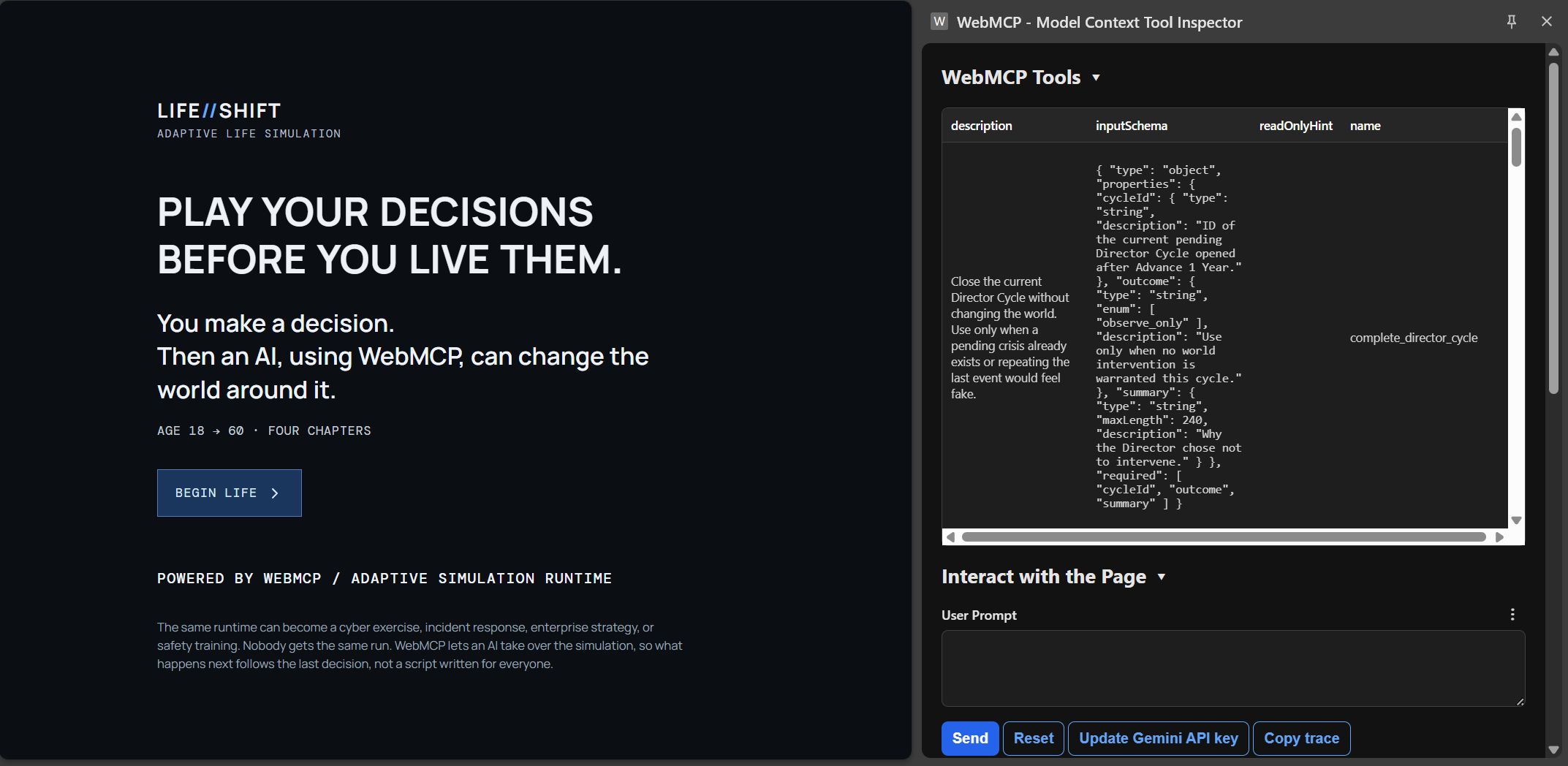
Play your decisions before you live them.
You make the choices. An AI Director, operating through WebMCP, can change the circumstances around them.
You control the life. The AI controls the world. The engine keeps the rules.
What it does
LIFE//SHIFT is an adaptive life simulation built around one shared beginning and many possible lives.
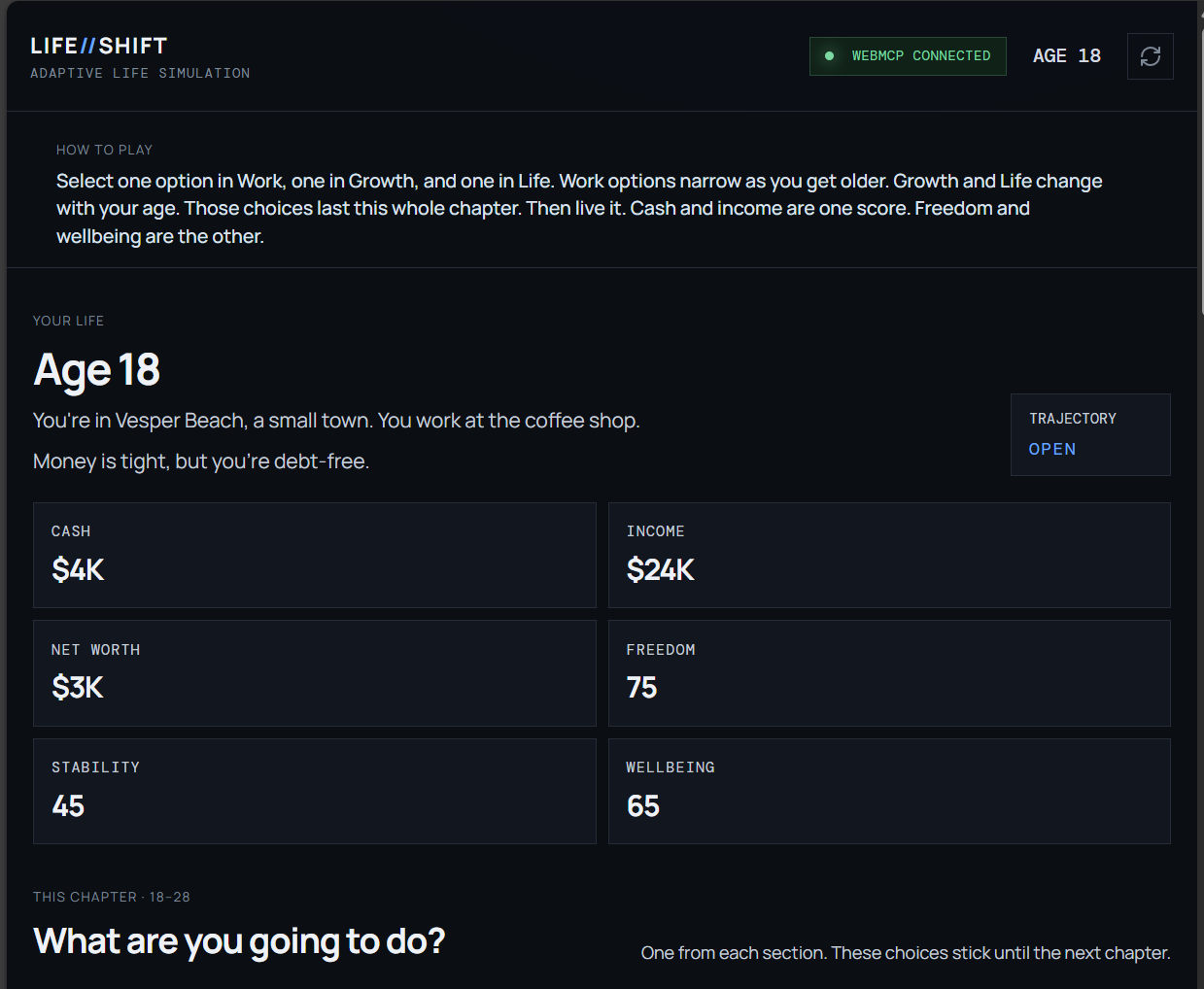
Every player starts as the same fictional 18-year-old: a coffee-shop barista in the small town of Vesper Beach. From there, four chapters carry that life from 18 to 60:
18–28 · 28–40 · 40–50 · 50–60
In each chapter, the player makes one decision in Work, one in Growth, and one in Life.
Those choices do not come from a static decision tree. The available decisions evolve with the life being built. Growth and Life choices change with age and history. Work options can narrow as the decades pass because decisions accumulate and some exits become harder later in life.
The direct consequences are deterministic. Cash, income, freedom, stability, wellbeing, skills, career progression, and future eligibility are calculated by the simulation engine.
But the world around that life is adaptive.
After a chapter resolves, a Director Cycle opens. An external AI Director can use native WebMCP tools to inspect what happened and decide whether the world should respond.
It may introduce at most one bounded external change: a job opportunity, setback, financial shock or windfall, a door opened by another person, a housing event, a business opportunity, or a broader shift in conditions such as hiring, housing, or demand.
The AI chooses the context and reason.
The engine chooses the consequences.
There is no setLifeState. The Director cannot choose the player's Work, Growth, or Life decisions. It cannot invent a salary or directly rewrite the simulation.
And sometimes the correct response is no response at all. Observe-only is a valid Director outcome.
The collaboration is intentionally asymmetric:
The human owns the decisions.
The AI owns bounded circumstances.
The deterministic engine owns the rules.
Same beginning. Different decisions. Different life.
How we built it
LIFE//SHIFT separates authority rather than giving the AI control of the entire simulation.
The deterministic engine owns authoritative state, chapter progression, eligibility, economics, compounding consequences, and which decisions can appear next.
WebMCP is the capability layer for the AI Director.
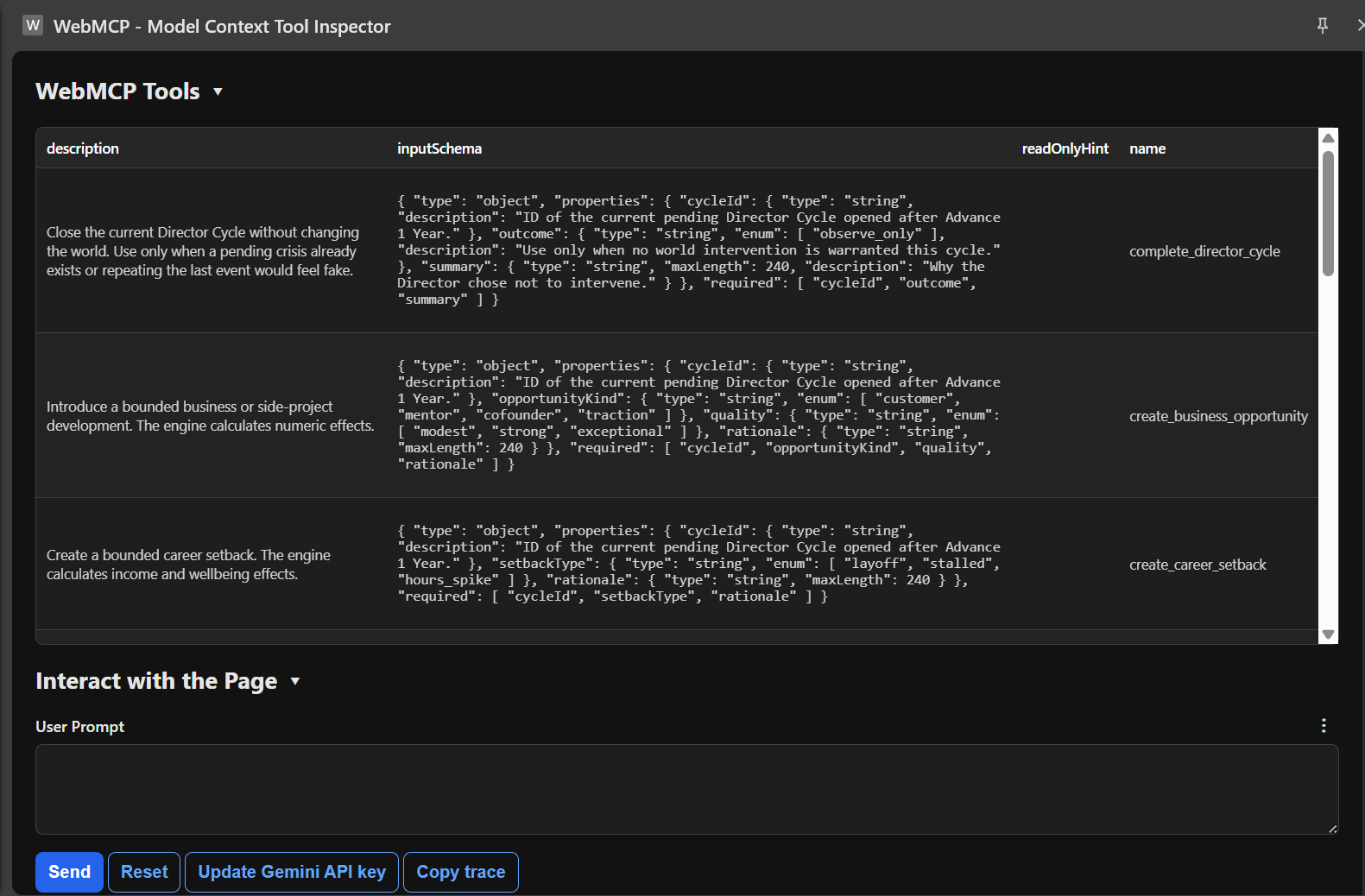
The page registers native, schema-defined WebMCP tools that expose specific capabilities rather than requiring the agent to navigate or reverse-engineer the interface.
Read tools expose structured context including:
- life state and history
- decision profile
- open threads
- finances and career
- world conditions
- available opportunities
- Director budget
- the pending Director Cycle
Mutation tools expose a deliberately small set of world interventions.
Every mutation is bound to the current cycleId and paid from a Director Budget. Inputs are validated, qualities and severities are constrained to defined values, and the deterministic engine maps the Director's semantic choice to actual numerical effects.
After each chapter resolves, the Director Cycle becomes available. In a WebMCP-capable host such as ChatGPT, the agent can inspect get_pending_director_cycle, gather whatever additional context it needs through the read tools, and then choose zero or one intervention.
Without a native WebMCP host, a local adapter uses the same underlying tool boundary so the simulation can still complete.
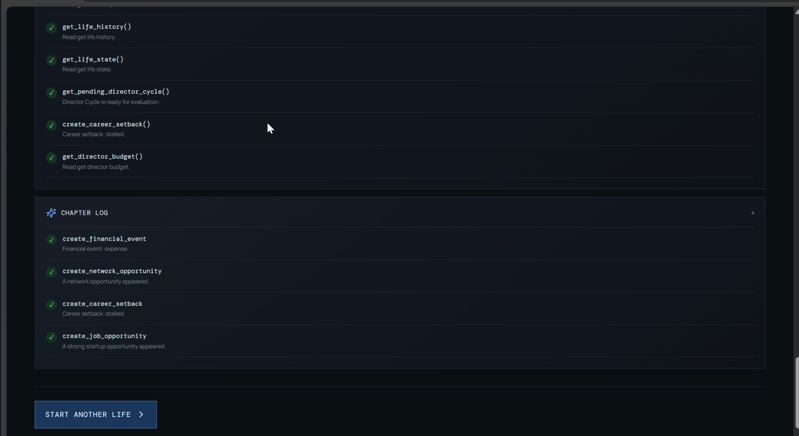
The architecture is also visible to the player. Life Review shows how the world responded, the remaining Director budget, the Director's interpretation, and actual WebMCP activity.
The agentic layer is therefore inspectable rather than hidden behind the experience.
Challenges we ran into
The hardest question was not how much the AI could control.
It was how much the AI should control.
If an LLM owned the entire simulation, LIFE//SHIFT would be adaptive, but its outcomes would become difficult to reason about or trust. If everything were pre-authored, the rules would be reliable, but the experience would eventually collapse into another branching decision tree.
The solution was to split authority.
Player decisions stay human. Their direct consequences stay deterministic. The AI Director receives a bounded surface for influencing external circumstances, with at most one intervention per chapter and a limited budget.
Another challenge came directly from the WebMCP interaction model: exposing tools does not automatically wake an external agent when application state changes.
We solved that with the Director Cycle.
When a chapter resolves, LIFE//SHIFT creates an explicit cycle containing the new state and the boundary for the Director's turn. The application can expose that a cycle is pending, identify it with a cycleId, tell the agent what it may inspect, enforce zero or one intervention, and prevent an already-completed cycle from being replayed.
We also had to make the simulation genuinely path-dependent.
"Invest in skills" cannot mean the same thing at 18 and 50. Growth and Life choices therefore change across chapters. Work opportunities narrow or evolve. Moving to Kestrel is different from returning to Vesper Beach. Repeated investments have history-dependent consequences.
The life has to remember how it got there.
Accomplishments that we're proud of
The accomplishment I am most proud of is that WebMCP is not an integration added to LIFE//SHIFT after the simulation was built.
It enables the interaction model.
The agent is not playing the life for you. It is not simply clicking through the UI. It is participating in the world in which your decisions take place.
Two players can begin on the same coffee-shop stool in Vesper Beach and build completely different trajectories through Work, Growth, and Life.
The Director can inspect the history each player actually created through structured WebMCP tools and respond to that context, while deterministic boundaries preserve the player's authority over their own life.
We also made that architecture observable.
The experience exposes when a Director turn is ready, provides a simple prompt for invoking it, supports local resolution when native WebMCP is unavailable, and records the Director's interpretation, budget, and real tool activity in Life Review.
The result is an agentic experience where the boundary between human agency, AI agency, and deterministic authority is visible by design.
What we learned
The biggest lesson was simple:
Giving AI more control does not necessarily make an agentic experience stronger. Giving AI the right control does.
WebMCP allowed us to expose a small, explicit capability surface instead of asking an agent to reverse-engineer an interface or giving it unrestricted access to application state.
That produced a reusable pattern:
Human authority + deterministic rules + bounded agent authority.
The AI can become a meaningful participant in an application without becoming its source of truth.
We also learned that having a tool available does not mean the agent should use it.
Sometimes nothing significant happens.
An adaptive Director that manufactures drama every chapter is not actually responding intelligently to the simulation. That is why observe-only is a first-class outcome.
And the pattern extends beyond a life simulation. In a traditional training simulation, every participant can eventually encounter the same authored script. With this architecture, an AI can adapt bounded parts of the scenario to the decisions a participant actually made.
The next situation can follow the last decision without surrendering the rules of the exercise to the model.
What's next for Life Shift
LIFE//SHIFT is intentionally accessible, but the architecture is broader than the life simulation itself.
The same authority model could support adaptive cyber exercises, incident-response scenarios, enterprise strategy simulations, crisis exercises, and safety training where humans retain decision authority while an AI dynamically controls bounded external conditions.
Imagine the same runtime applied to a cyber exercise.
A security team begins with a simulated incident: unusual authentication activity appears on a production system. The humans investigate, form hypotheses, isolate systems, escalate, communicate, and decide what actions to take. A deterministic engine owns the infrastructure, policies, permissions, dependencies, and consequences of those actions.
But instead of every team progressing through the same prewritten incident script, an AI Director observes the exercise through WebMCP.
If the team isolates the compromised host quickly, the Director might decide the attacker shifts to another foothold. If they overlook an identity signal, a new credential event might appear later. If they shut down a critical service, the deterministic engine calculates the operational impact while the Director may introduce a customer escalation or executive request. If the team's response is already creating enough pressure, the Director can simply observe and do nothing.
The participants still own every response decision. The AI cannot declare a server compromised, change production state arbitrarily, or decide whether the team contains an incident. It can only introduce the bounded circumstances exposed to it. The simulation engine remains authoritative.
That turns a static exercise into an adaptive one: the scenario responds to how the team actually behaves instead of waiting for them to reach the next page of a script.
LIFE//SHIFT itself can also become deeper: relationships, housing, entrepreneurship, education, family, economic cycles, and more nuanced long-term consequences can all be added without changing the underlying authority model.
But the larger question behind the project remains the same:
Most agentic software asks: "How can an AI help a human operate an application?"
LIFE//SHIFT asks: "What happens when the human and the AI operate different sides of the same application?"
Built With
- chatgpt
- html
- react
- typescript
- vite
- vitest
- webmcp
- zod
- zustan

Log in or sign up for Devpost to join the conversation.