-
-
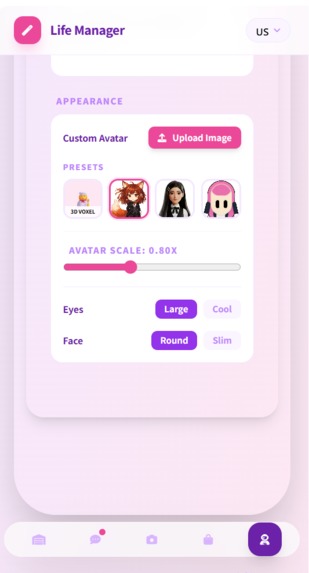
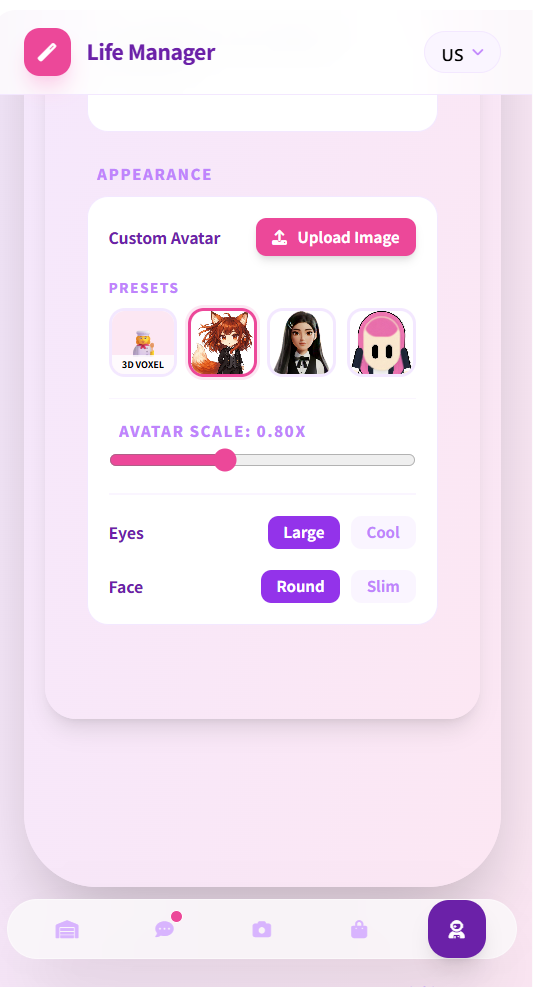
We designed three classic butler style. If you like other avater, you can upload image to customize the appearance of the butler you like.
-
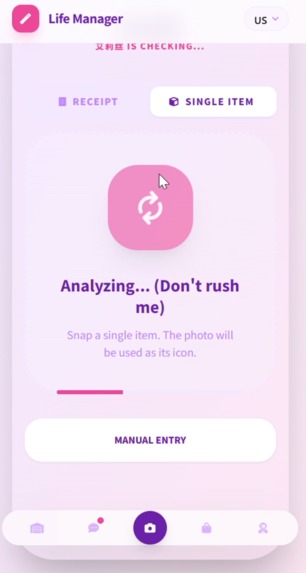
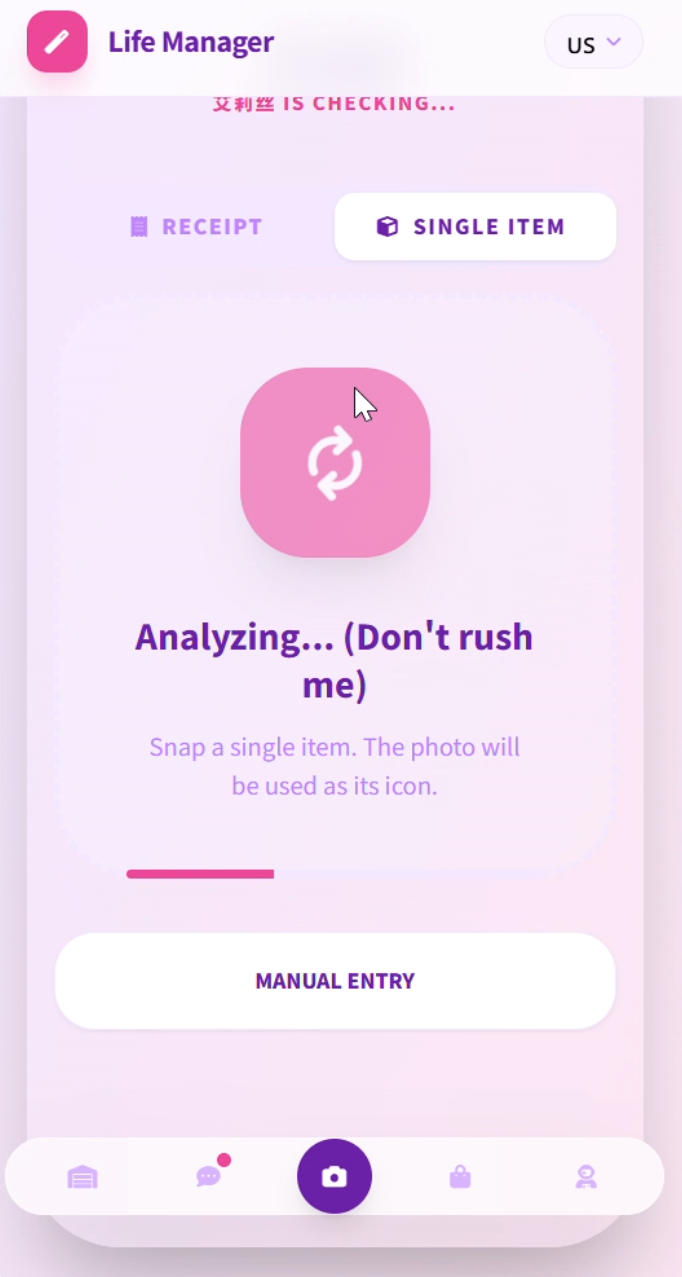
screen market receipt or upload single item that you want to directly sell on plaze.
-
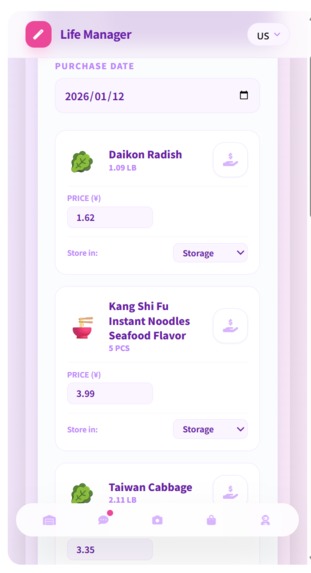
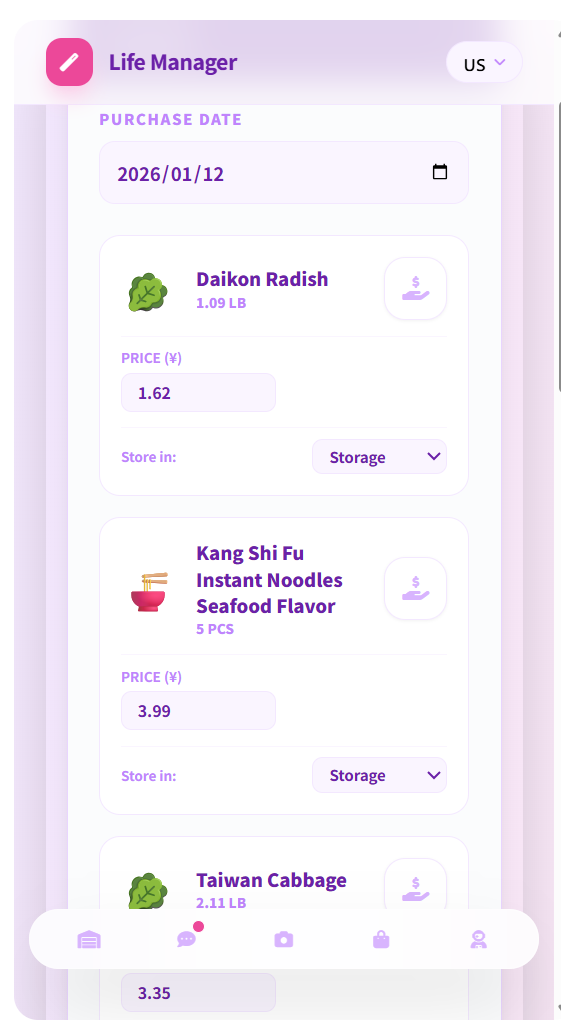
After screen the receipt, it will be record the price and value. It like tally book help you know living expenses by pre month.
-
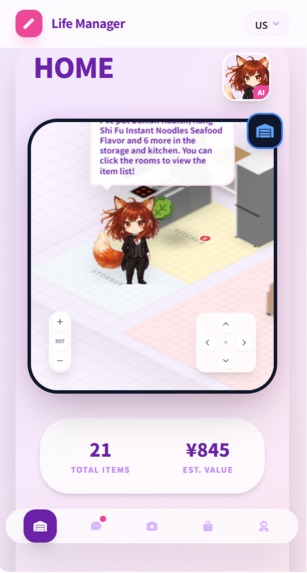
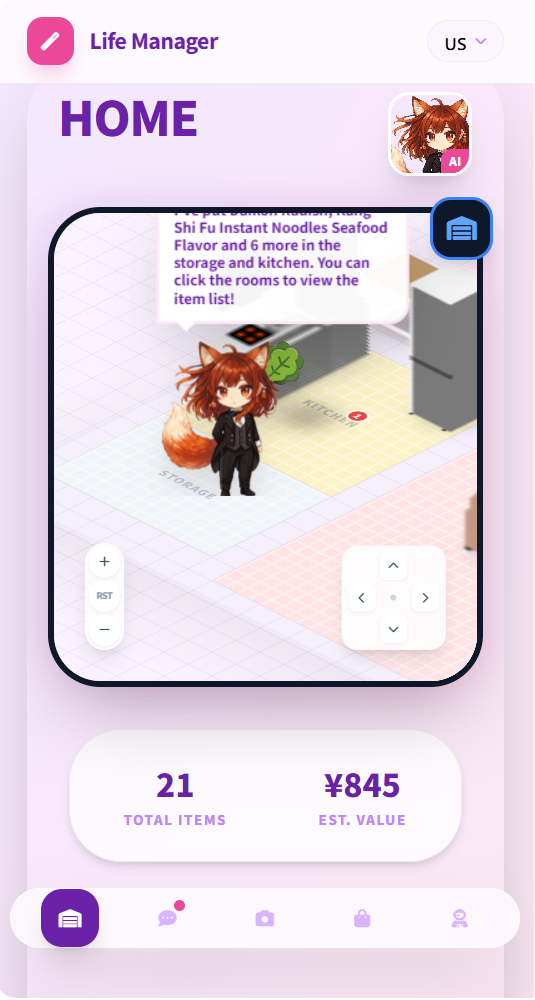
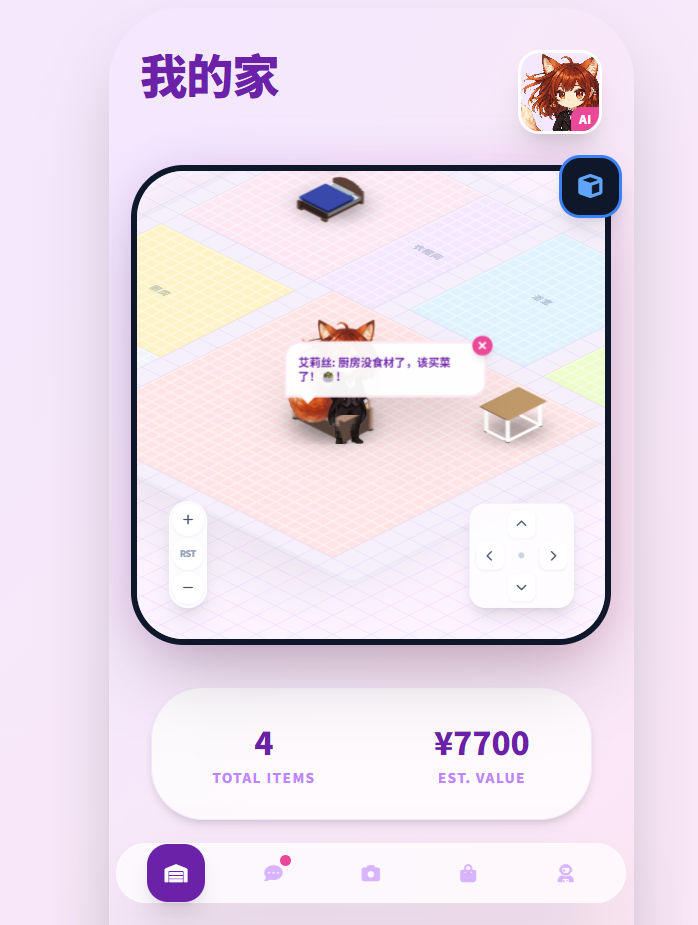
After you screen the receipt, butler will walk and tell you where them stored. Also, you can ask AI where items are stored when you forget.
-
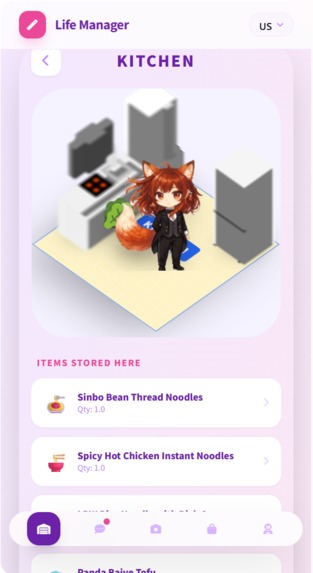
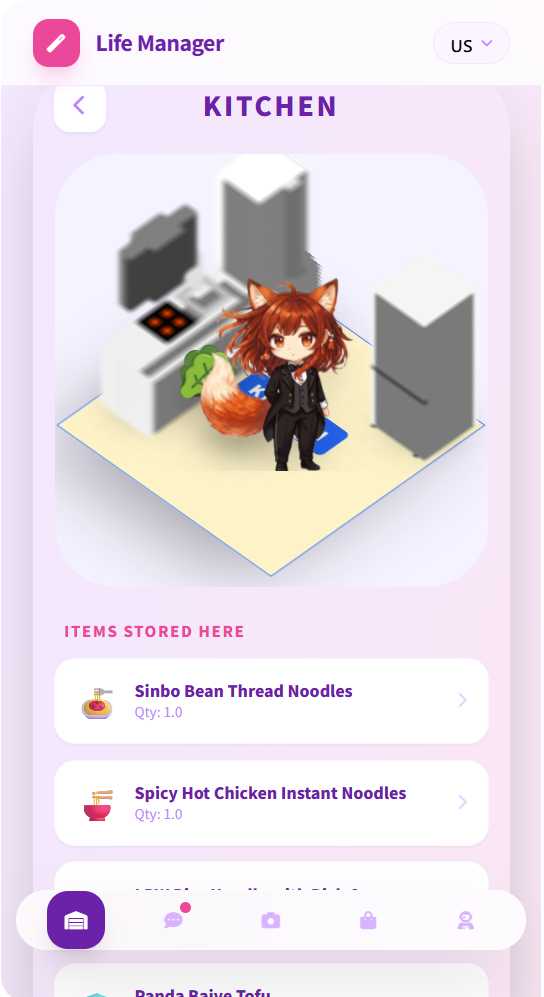
Different room are like storage rooms in real space. When you click on a room, such as a kitchen, you will see the list of items you store.
-
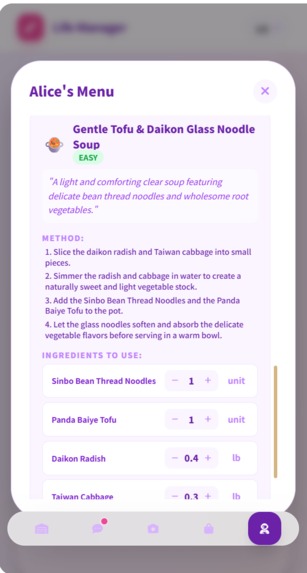
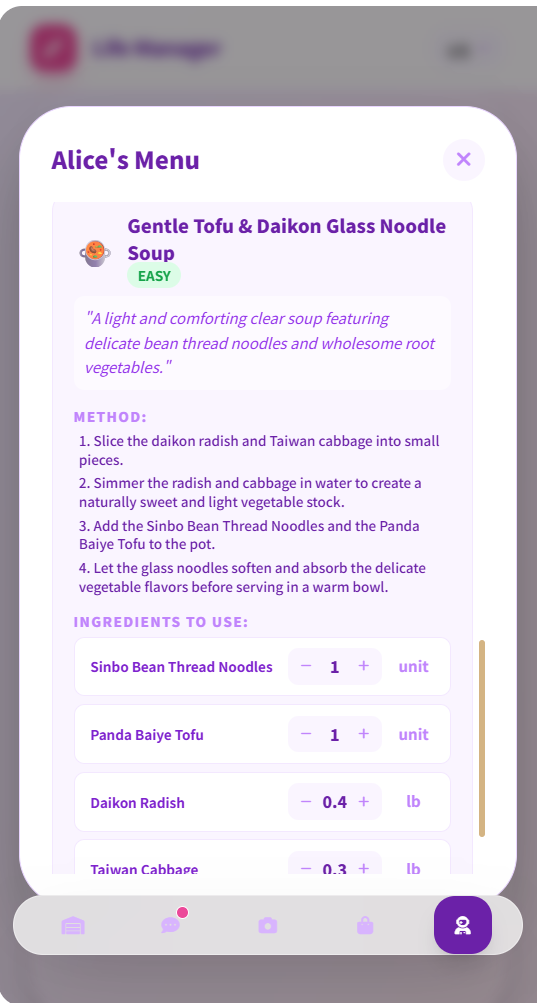
Cooking recipes that can help you different delicacies. The consumption of ingredients required will automatically update data.
-

App have multiple language you can choose.
-
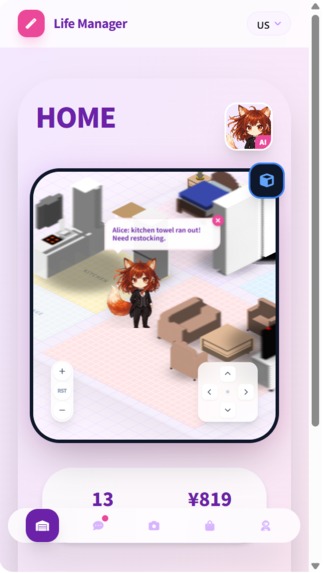
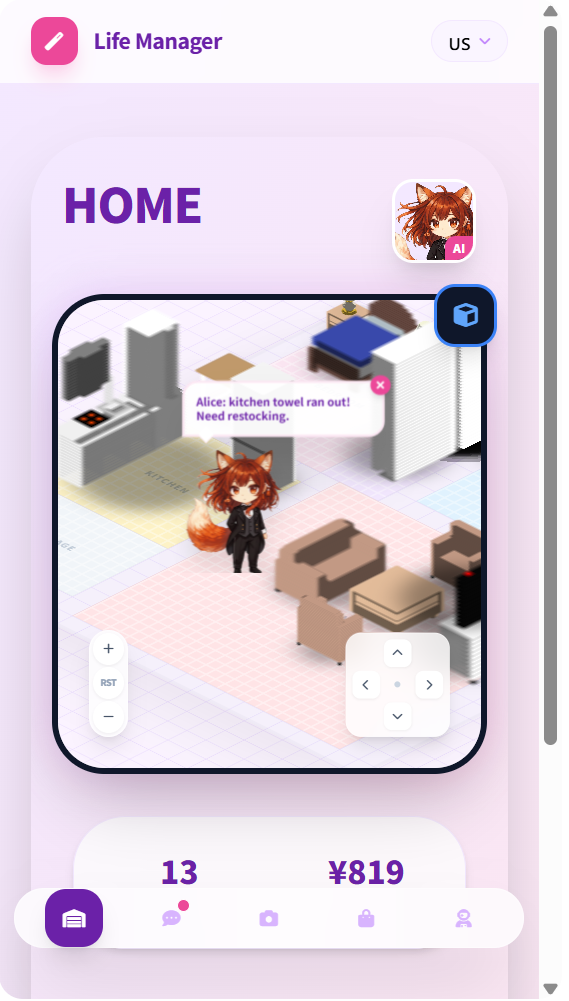
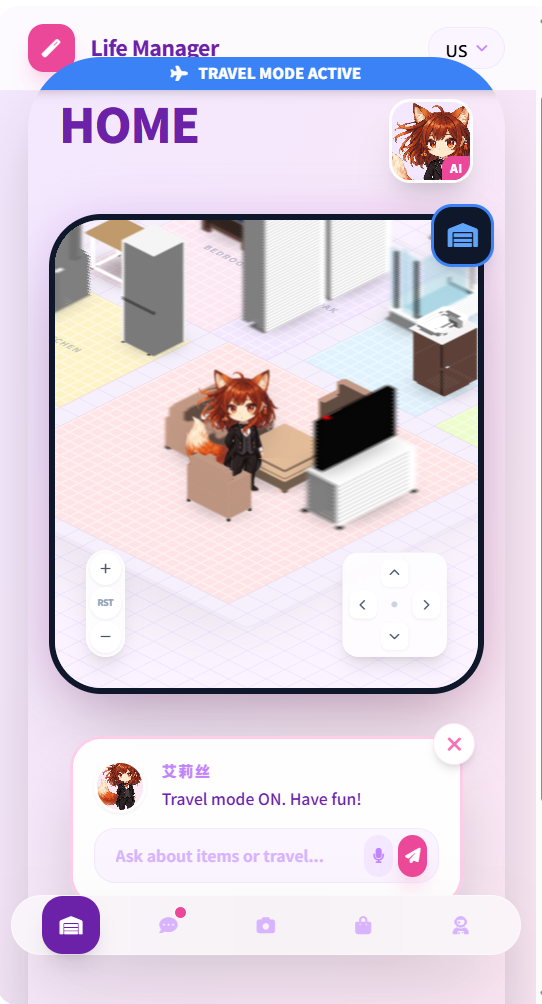
The butler will remind you that your daily necessites inventory is insufficient or that there are not enough ingredients.
-
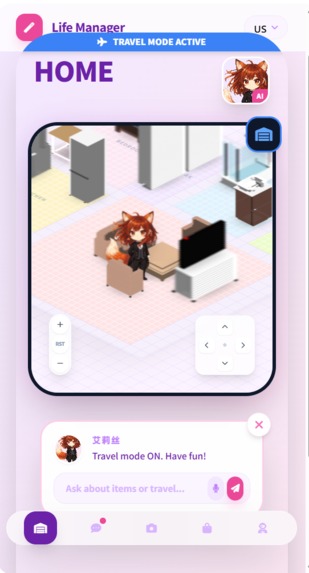
When traveling, we can tell the AI Manager to activate the travel mode, and the consumption calculation of daily necessities will be paused.
-
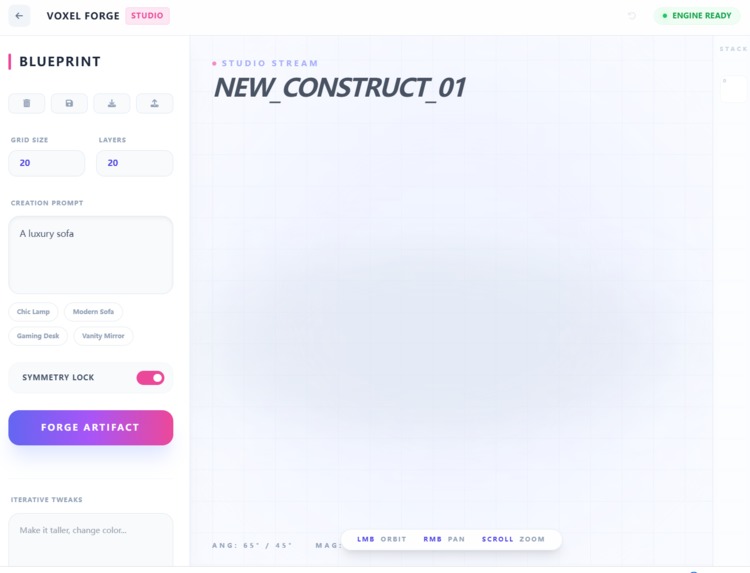
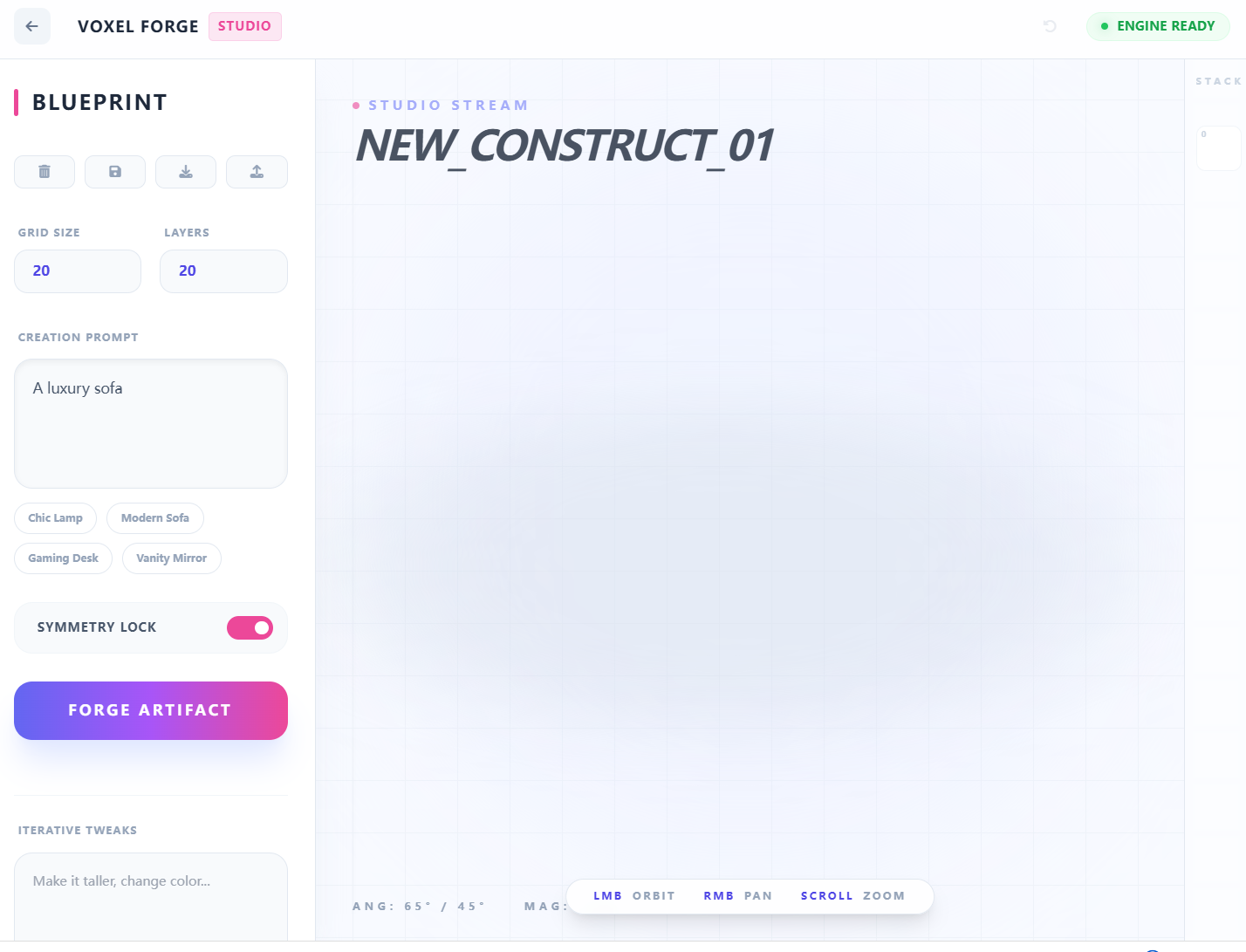
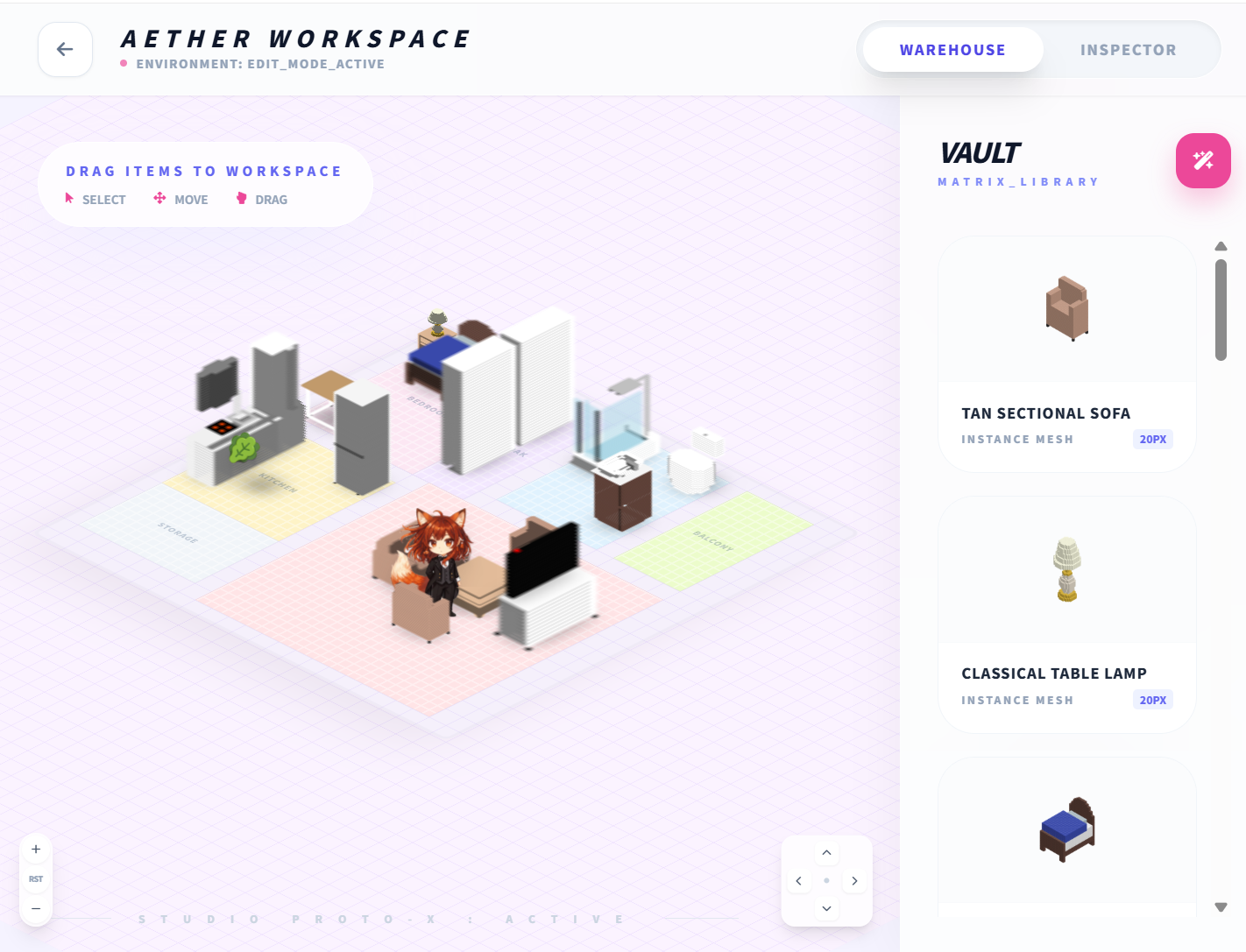
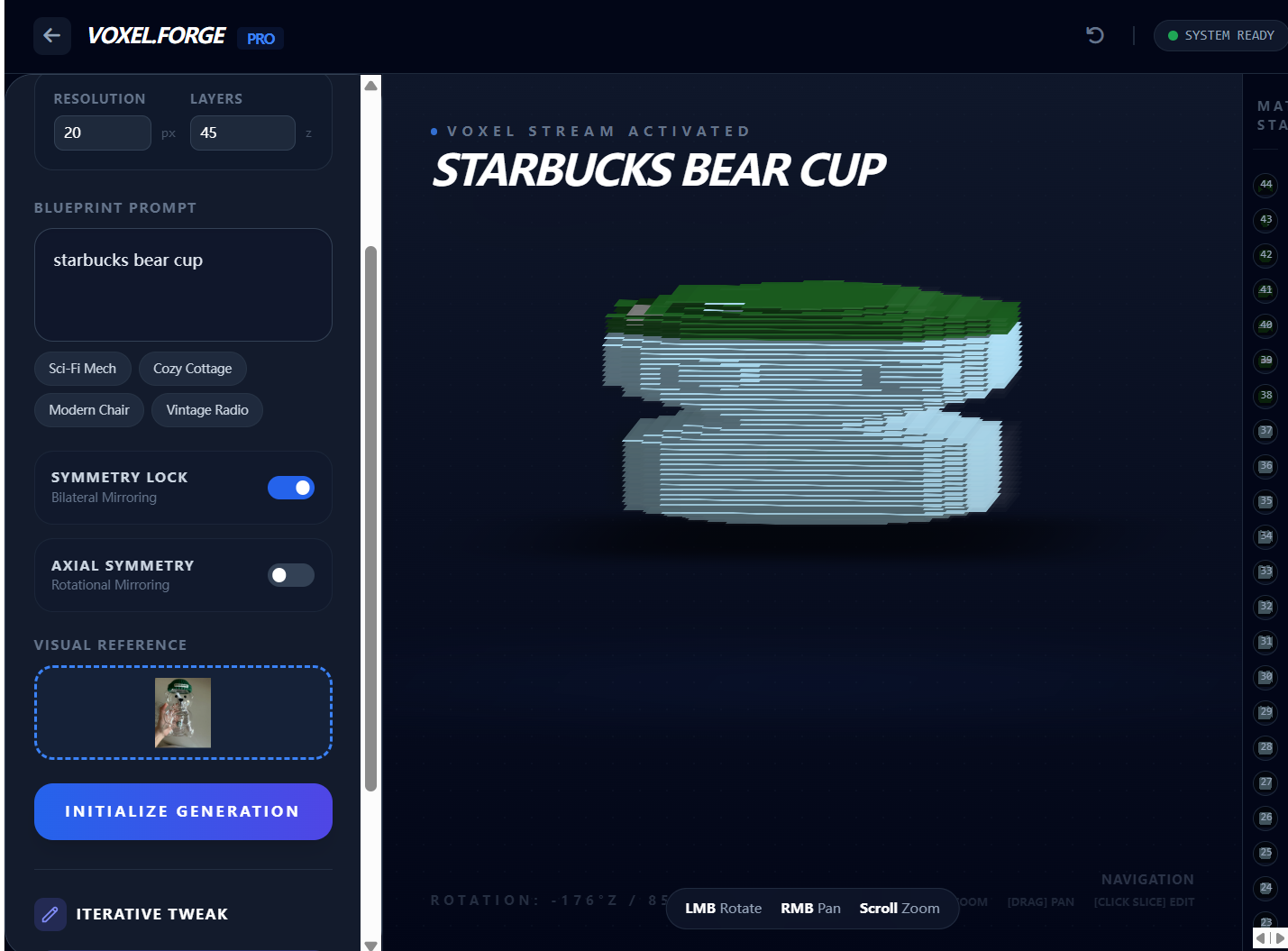
you can create a 3D voxel furniture with your furniture pictures and place it in your space. It truly restor your house.
-
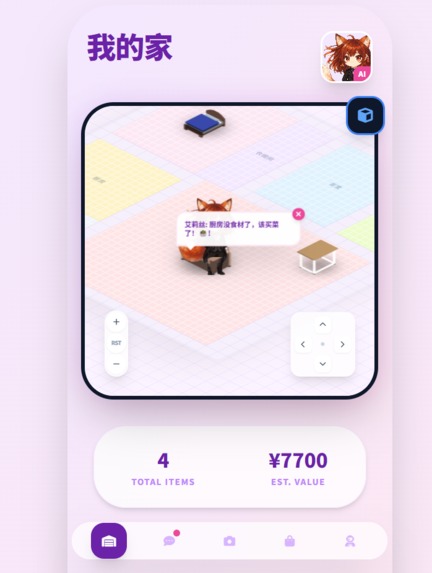
you can design the arrangement of the furniture ot recreate your real living space.
-
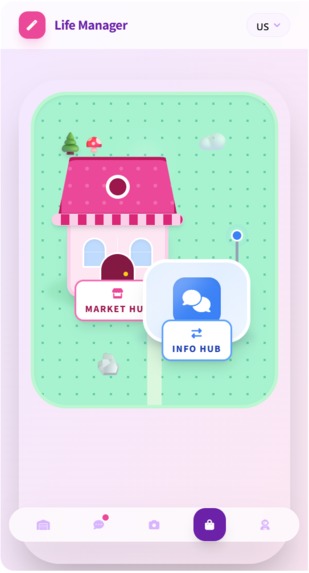
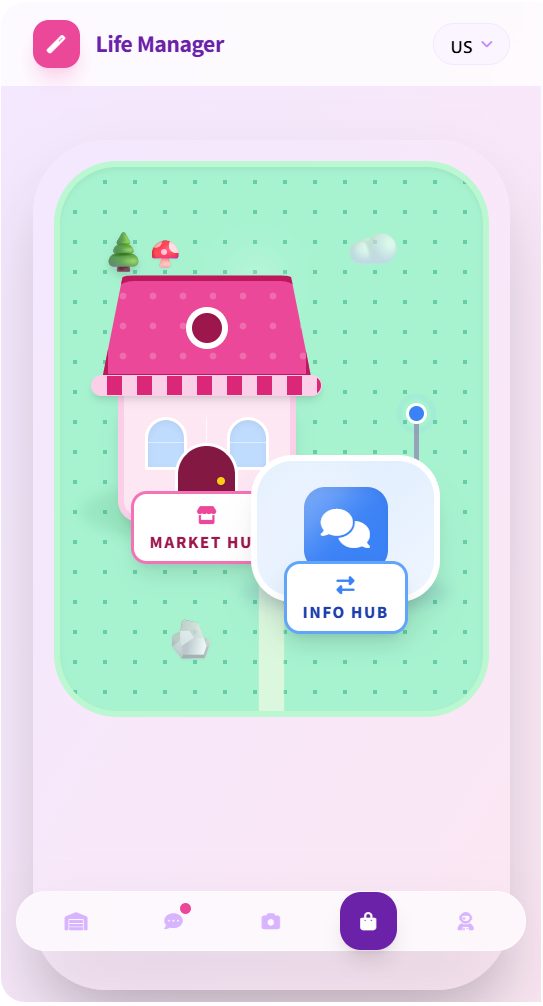
Community plaza: you can sell your second-hand goods, furniture or post to other know what second-hand furniture you need.
-
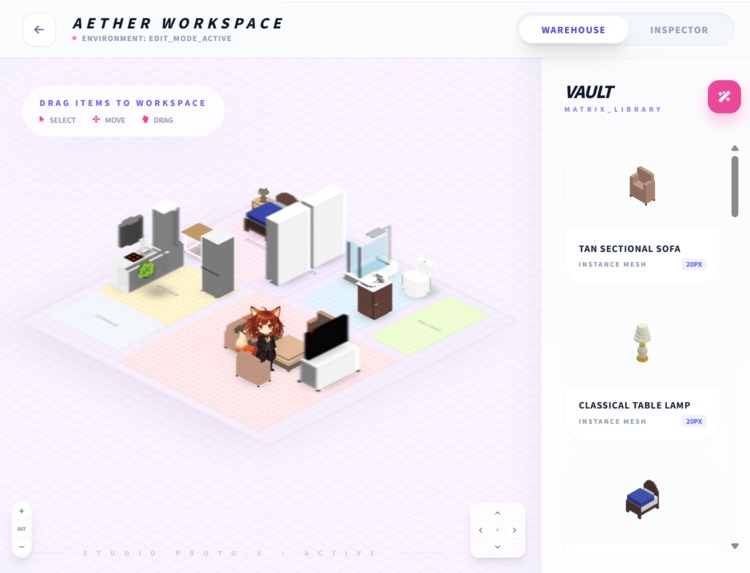
move furniture to create own space. right side red pen is to upload your picture to create voxel funiture.
-
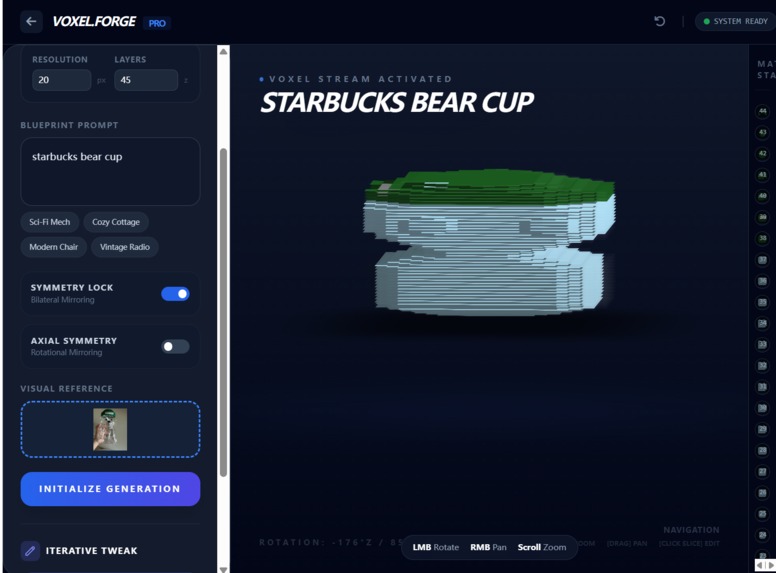
you can upload picture of your furniture or goods to create own voxel goods.

Inspiration
From the Stress of Constant Moving to a "Digital Sanctuary"
As someone who has lived a nomadic lifestyle and moved frequently, I noticed a recurring paradox: the more I moved, the more "stuff" I accumulated, yet the less I actually used.
- The Spatial Black Hole: We own things but don't know where they are or what we have (e.g., a garage filled with forgotten boxes).
- The "Excel Fatigue": Traditional apps are just glorified, tedious spreadsheets. They turn organization into a chore, leading users to lose the motivation to even open the app.
Life Manager was born to bridge the gap between digital data and physical space, turning the tedious task of inventory into an intuitive, visual, and rewarding game.
What it does
- AI Butler: Leveraging Google Gemini 3 Flash to transform messy receipts or natural language into precise spatial data; Beyond simple tracking, the AI provides emotional value and proactive management, acting as a true "Butler" for your digital home.
- Voxel-Based Digital Twin: A lightweight, interactive 3D replica of your home rendered directly in the browser via a custom engine.
- Gamified Organization: Turning the tedious task of inventory into an intuitive, visual, and rewarding game.
- Gamified Inventory: Organize your life like a game of The Sims. Drag, drop, and map every asset to a specific coordinate: $$P_{asset} = (x, y, z)$$
How we built it
| Category | Technology |
|---|---|
| Frontend | React, TypeScript, Vite |
| AI Engine | Google Gemini 3 Flash |
| 3D Rendering | Custom Voxel Engine (CSS 3D / HTML5 Canvas) |
| Deployment | Vercel |
- Spatial Mathematics: Implemented a smooth transition matrix for camera navigation: $$T_{final} = S \cdot T(-x_c, -y_c)$$
Challenges we ran into
1. Structural Chaos in Voxel Generation
The Problem: In the early stages of VoxelForge, the AI-generated blueprints often resulted in "structural noise." Furniture would manifest with irregular jagged edges and asymmetrical blocks, making the 3D models look chaotic rather than functional.
The Solution: I refined the System Prompt to prioritize structural integrity and axial symmetry. By instructing the AI to treat furniture as a collection of symmetrical primitive shapes, the output became significantly more recognizable and aesthetically pleasing.
2. The "AI Over-edit" Conflict
The Problem: As the application grew more complex, I encountered a "fine-tuning paradox." When I asked the AI to modify a specific detail (like changing a chair's color), the LLM would occasionally "hallucinate" and rewrite unrelated core logic, leading to broken features or lost functionality.
The Solution: I transitioned from a purely AI-driven approach to a Hybrid Development Model. Instead of relying solely on prompt-based iterations for every minor fix, I identified the critical code segments and performed manual surgical edits. This ensured that the delicate logic of the Voxel engine remained intact while still leveraging AI for high-level creative tasks.
Accomplishments that we're proud of
1. From Scratch: The VoxelForge
We built a custom 3D Voxel from the ground up to solve a critical limitation: standard AI tools struggled to accurately recognize and render complex furniture structures.
2. Seamless AI-to-Spatial Mapping
We successfully bridged natural language and 3D coordinates. For instance, when asking "Where is my printer?"The AI Butler navigates to the exact, forgotten storage location within the virtual 3D space, solving the "Spatial Black Hole" problem.
3. Smart Consumption Sync
- Automated Prediction: The system analyzes purchase intervals to learn usage habits, automatically deducting stock and sending "Butler reminders."
- Context-Aware Sync: The algorithm pauses tracking during trips or vacations to keep the digital inventory perfectly optimized with your real life.
4. From "Owning Assets" to "Planning Life"
We successfully closed the loop between inventory and utility. The system no longer just records what you own; it actively guides how you use it.
- Waste Reduction Logic: The AI prioritizes recipes that utilize high-stock items or ingredients nearing their "Automated Consumption" limit.
- Real-Time Inventory Sync: Once a meal is confirmed, the VoxelForge engine automatically deducts the corresponding ingredient voxels, maintaining the "Digital Twin" integrity through a seamless transition from data to kitchen.
What we learned
- The Art of AI Collaboration: We learned to balance LLM speed with manual precision, discovering that the best results come from a Human-in-the-Loop approach.
- Browser-Based 3D Optimization: Mastering mathematical transformations and performance profiling to render complex voxel grids without frame drops.
- Data-Driven User Empathy: Realizing that users don't just want data; they want a system that understands their habits and provides emotional reassurance.
What's next for Life Manager 3
My aspiration for Life Manager extends beyond personal organization:
- Spatial Community: Visit friends' virtual homes for design inspiration and social interaction.
- Smart Commerce: AI receipt scanning to automatically find the best local discounts for the community.
- High-Fidelity Furniture Rendering : Improve furniture visual quality to more closely match real-world shapes, proportions, and materials, while maintaining performance efficiency in the browser.
- Realistic-to-Stylized Apparel Projection
Support clothing visualization that can:- Accurately resemble real garments based on photos or descriptions
- Or be diffracted into a cartoon-style representation, balancing recognizability with visual clarity
- Accurately resemble real garments based on photos or descriptions
Built With
- gemini-3-flash
- geminiapi
- google-ai-studio
- languages:
- typescript
- voxel


Log in or sign up for Devpost to join the conversation.