-
-
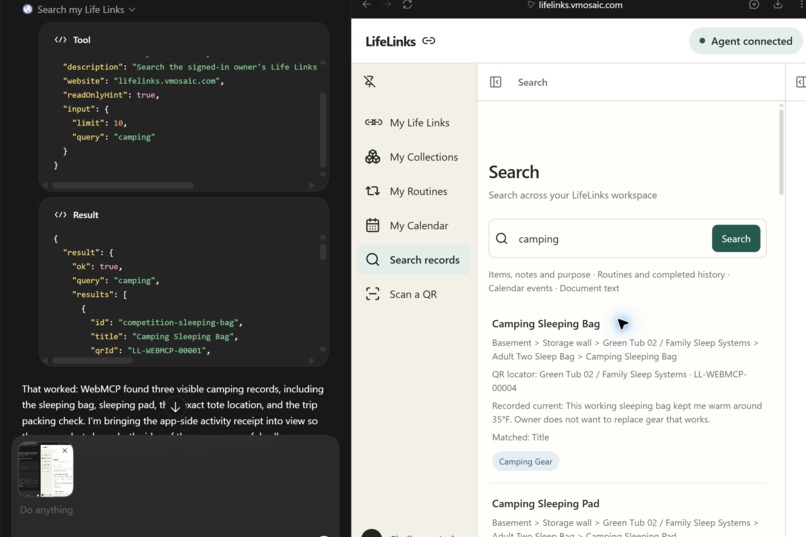
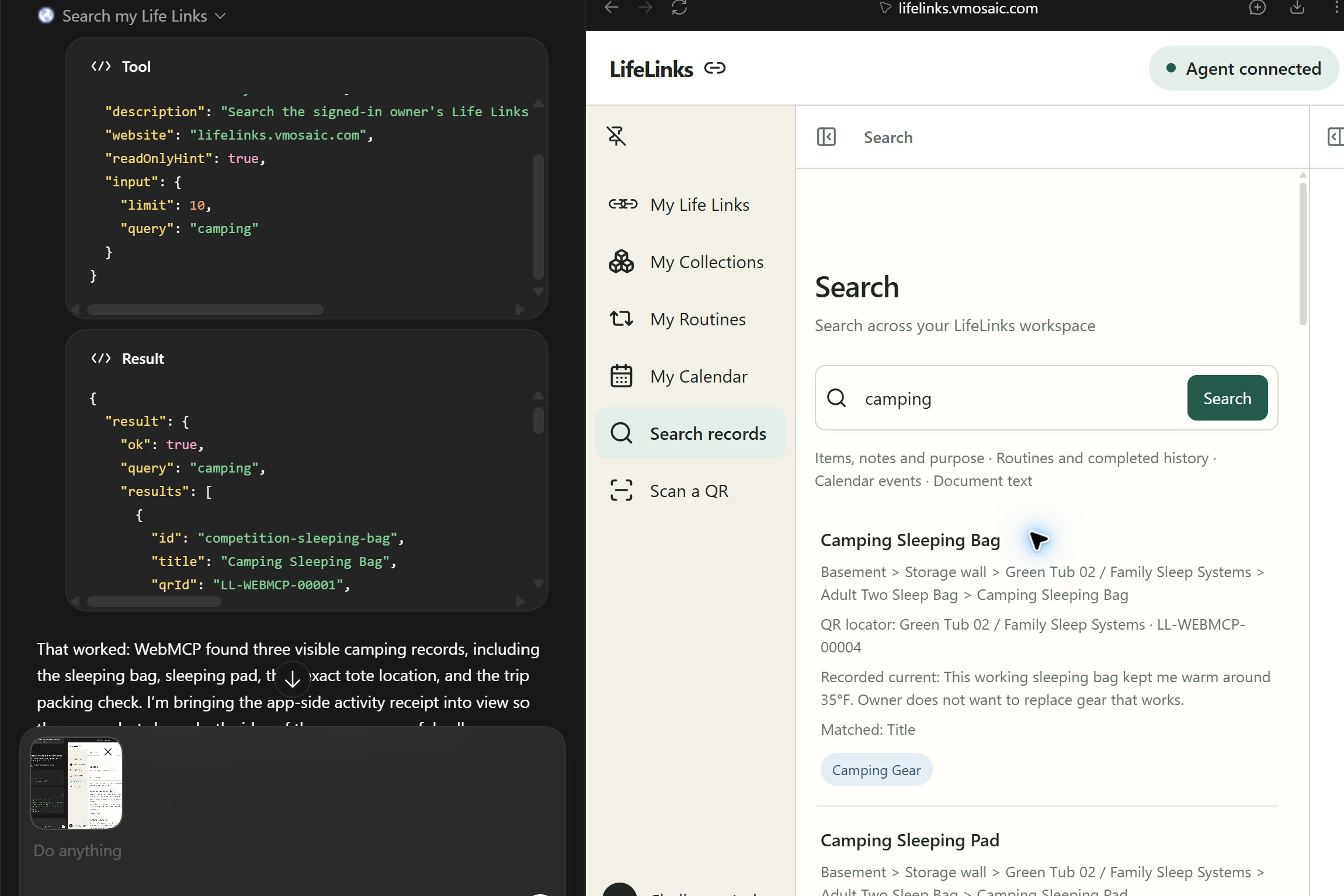
Browser WebMCP: Codex invokes LifeLinks’ page-local search tool, and the signed-in page displays the same records, physical paths, and QR
-
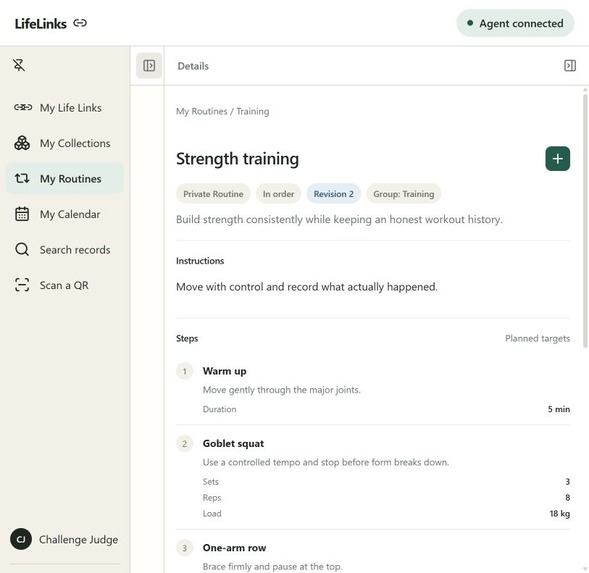
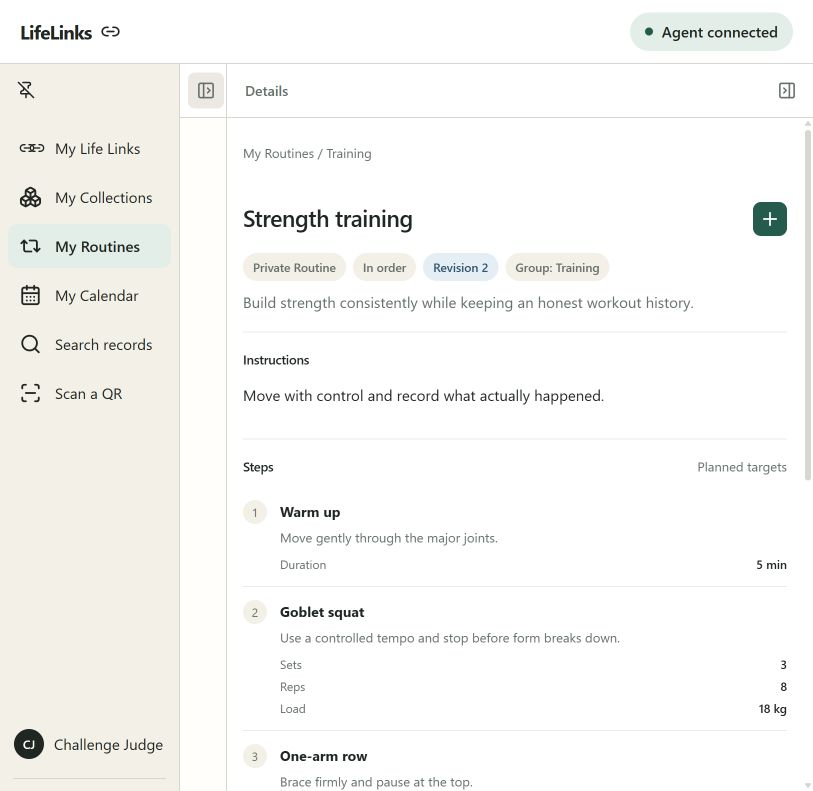
Organize ordered routines with instructions and measurable targets.
-
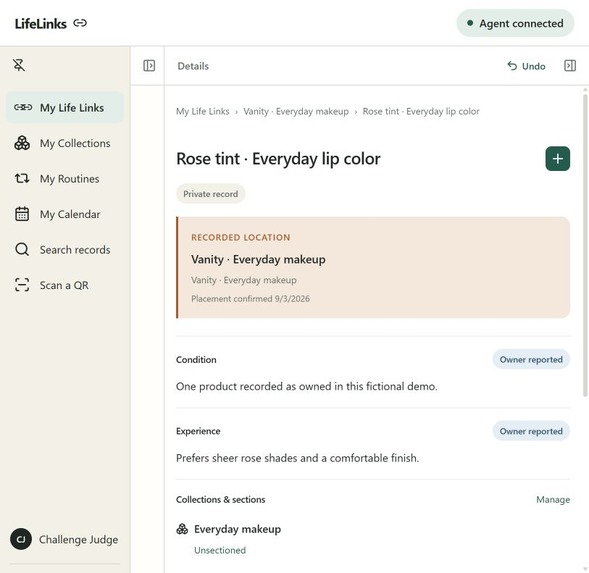
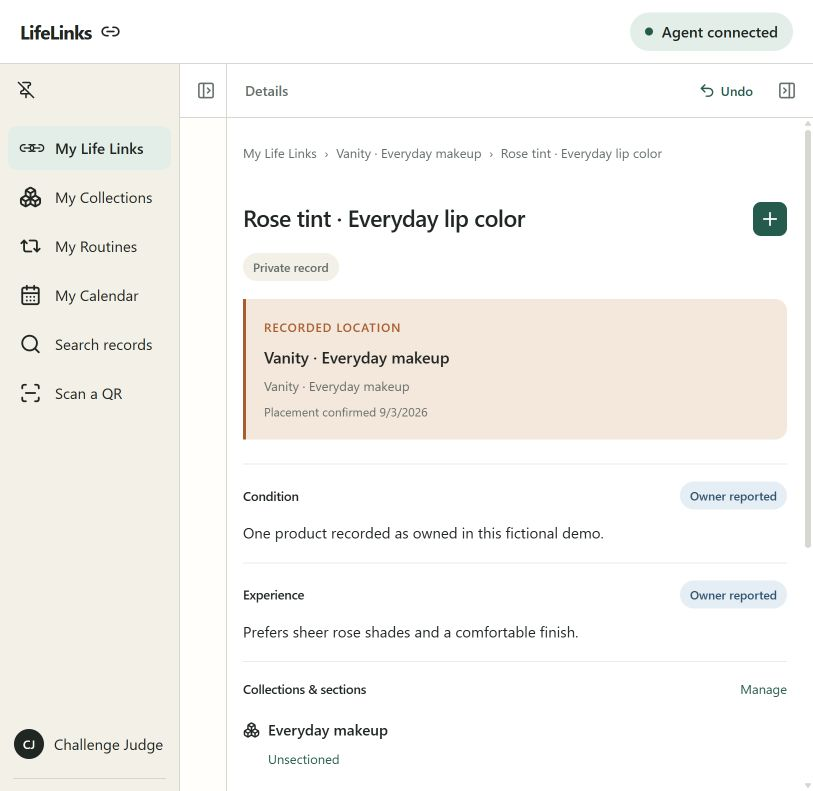
Keep product ownership and personal preferences together—no QR required.
-
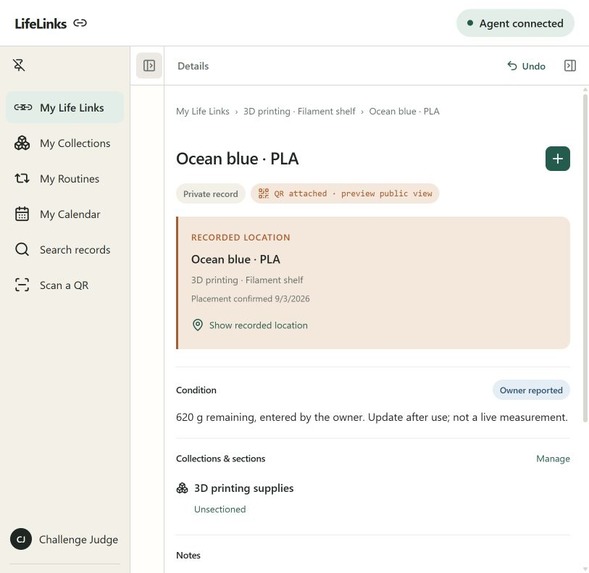
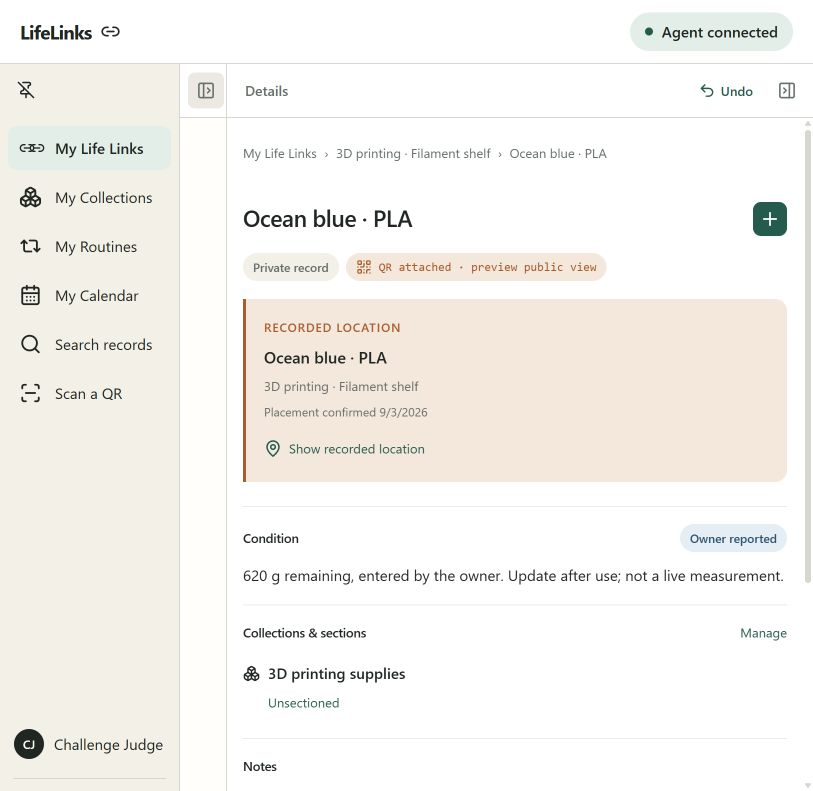
Track materials, recorded locations, and owner-reported quantities.
-
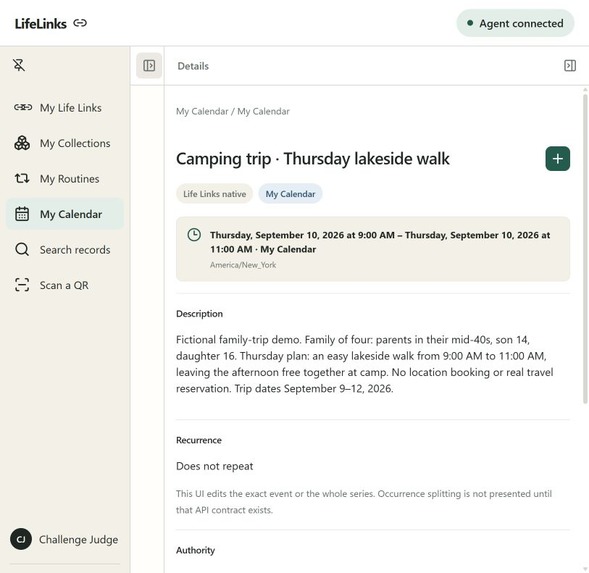
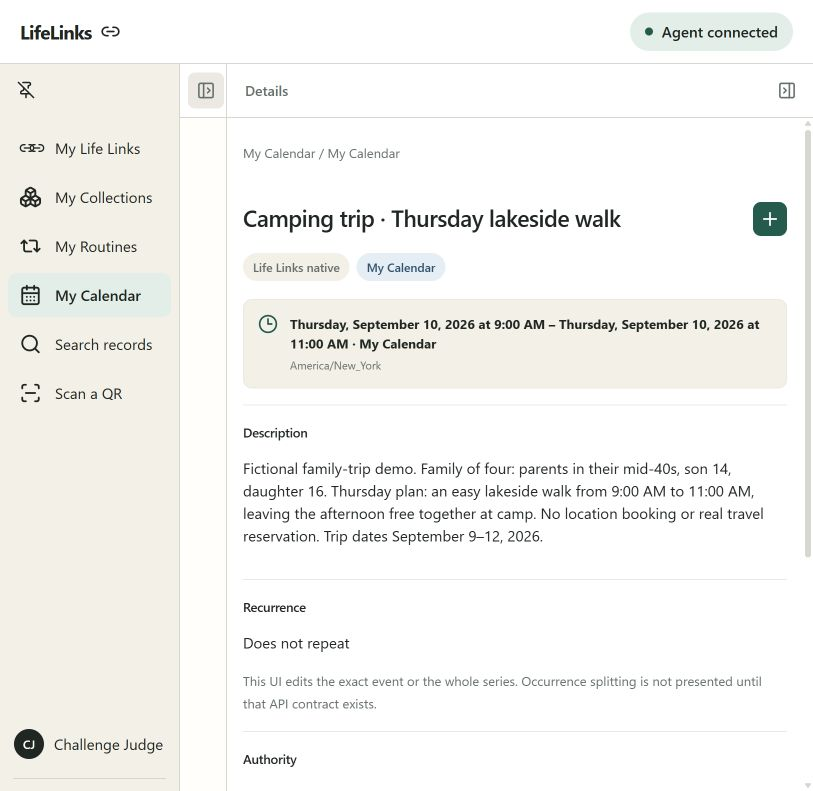
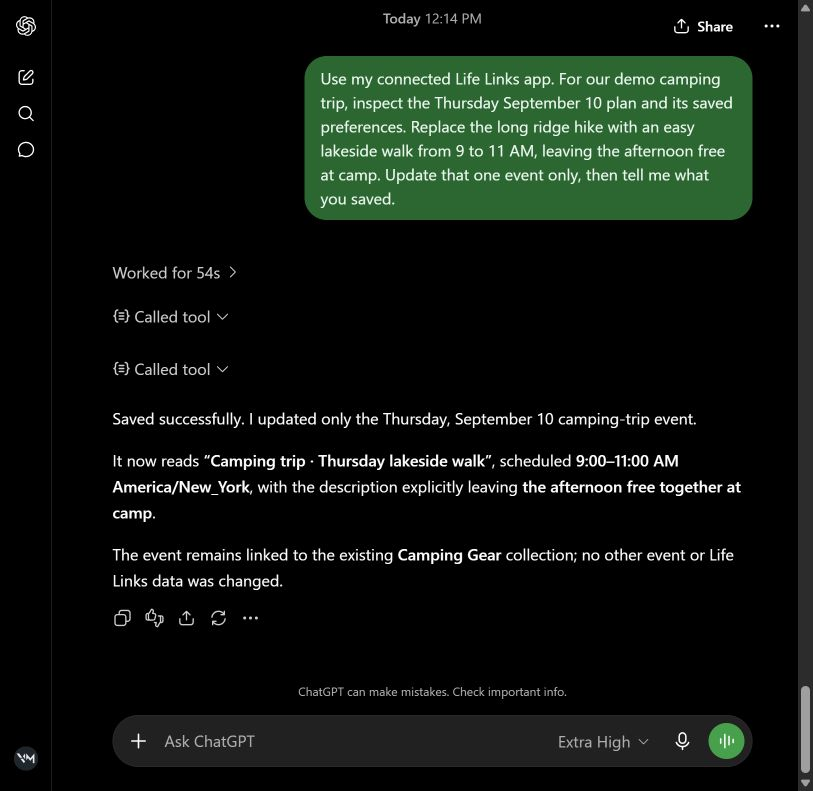
| The updated Thursday plan appears in Life Links.
-
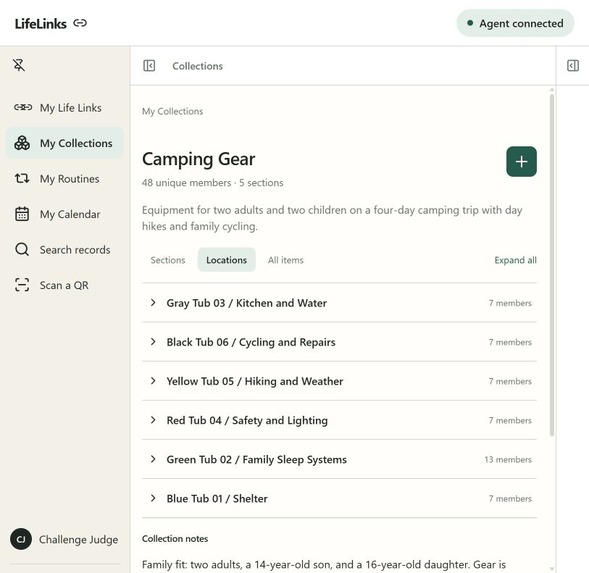
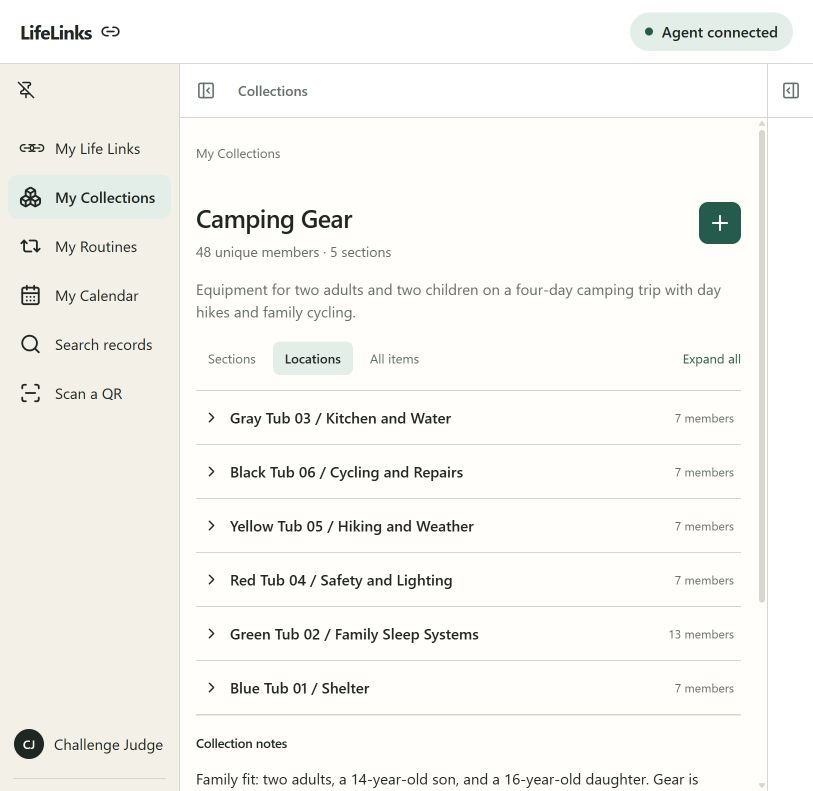
Plan with a collection, then see where its items are stored.
-
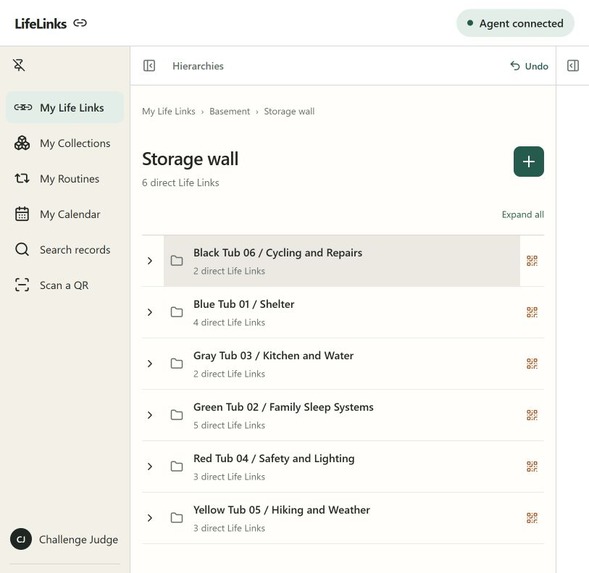
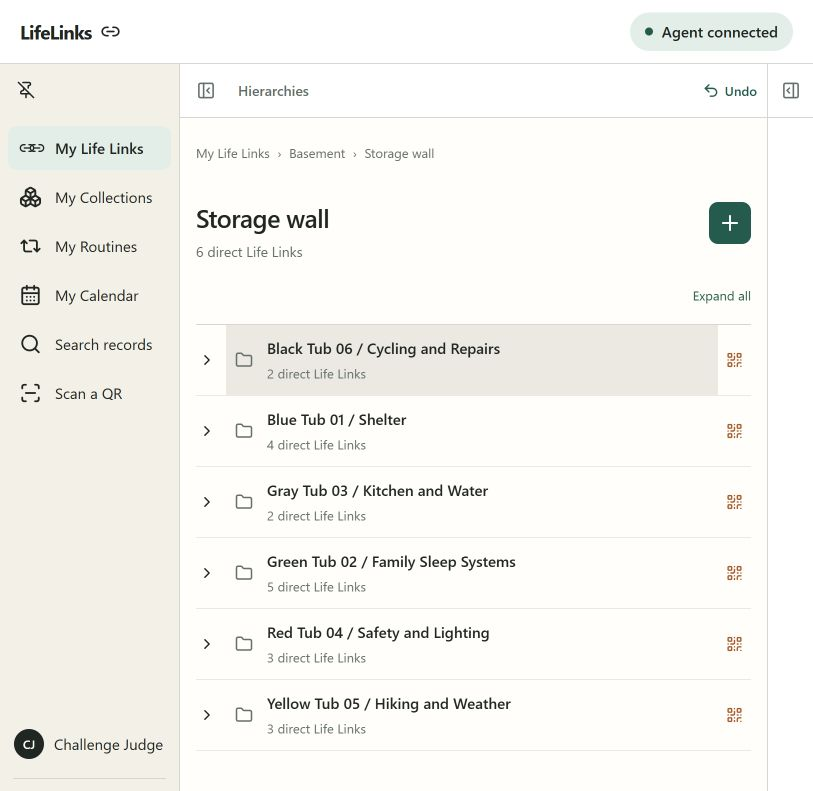
Give your life's gear a recorded place in a nested storage hierarchy.
-
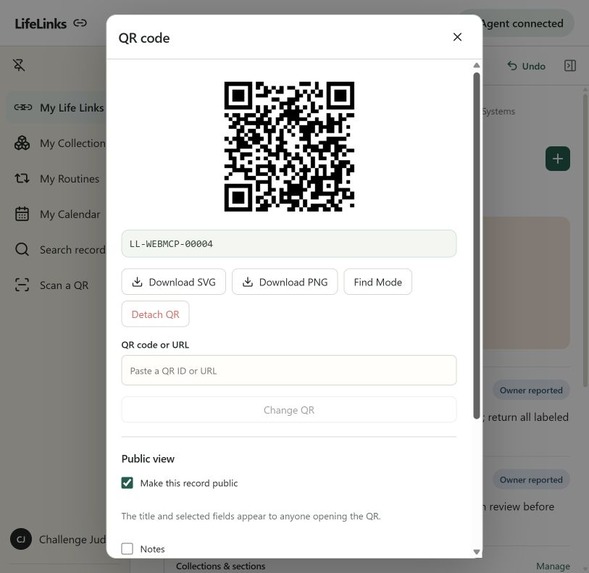
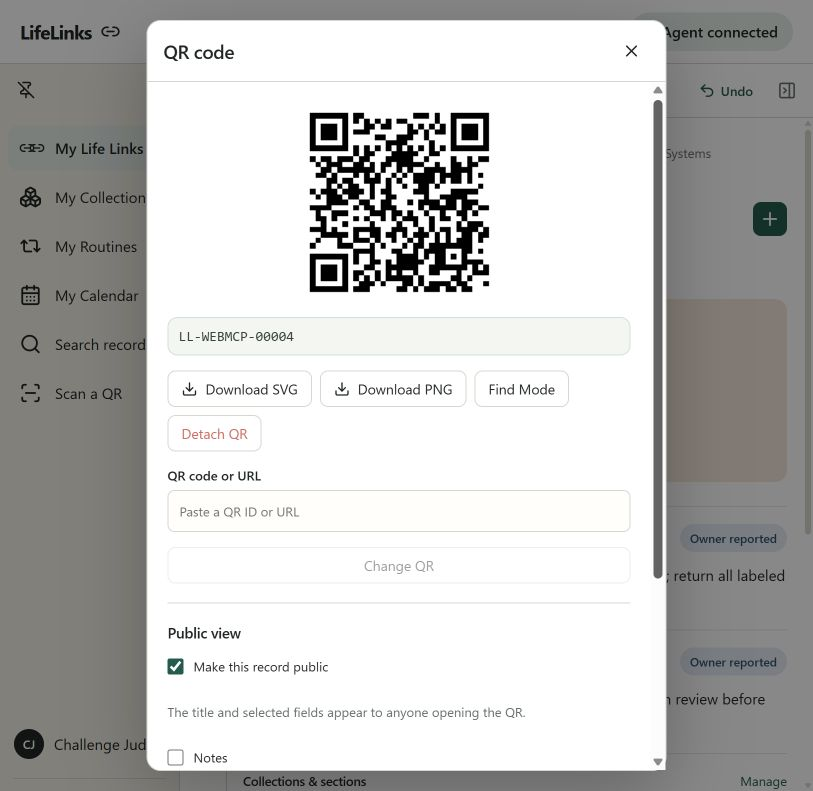
| Generate an optional QR label for a physical storage needs.
-
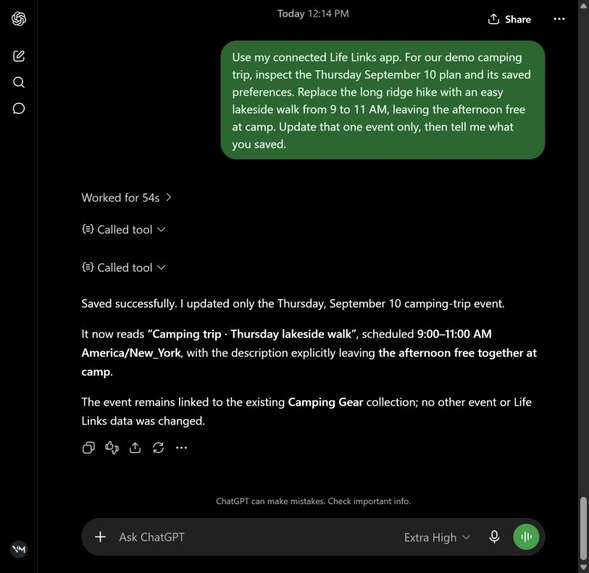
| A connected agent updates one calendar event and reports the saved result.
Inspiration
LifeLinks began with a simple idea I heard about: a service that provided QR labels people could attach to belongings so they could locate things later or associate useful information—such as instructions or tutorial videos—with a physical object.
That was useful, but it led me to a much bigger question: what if those records were not merely pages for people to open, but part of a persistent context layer that an AI agent could understand and help maintain?
General-purpose AI already knows an extraordinary amount about the world. What it does not naturally know is your world: what you own, where you put it, what you prefer, what worked last time, what you are planning, and what has changed.
Products such as ChatGPT Projects demonstrate the value of retaining context, but that context can still be fairly open-ended. I wanted something more structured without making it rigid: organized enough for an agent to retrieve an exact item, relationship, location, event, or routine, but dynamic and personal enough to evolve alongside somebody’s real life.
Several personal use cases shaped the product.
My brother is an avid camper, skier, and cyclist in Denver. He and his wife have a small basement filled with carefully packed storage totes, but they still struggle to remember which tote contains a particular piece of equipment. That inspired the physical hierarchy and QR features. An AI should not merely know that they own a tent—it should be able to tell them that the tent is inside a particular tote in a particular part of the basement. Not every object needs its own QR code; one label on the nearest container can provide the physical bridge to everything recorded inside it.
I also own a 3D printer and have many rolls of filament in different colors and materials. I used LifeLinks to create an actual filament library so an agent can help me compare a future project with the supplies and owner-reported quantities I already have.
When I first explained LifeLinks to my wife, her immediate reaction was that she could use it for her makeup and beauty collection, as well as nonphysical information such as routines. That made me smile because I had already imagined the same thing. Product names, brands, shades, preferences, and experiences can become useful context for future conversations without requiring a QR code at all.
The larger goal is to help people—including people who rarely use AI agents—experience how useful AI can become when it has an organized, properly labeled, persistent context layer around the things they are actually doing.
What it does
LifeLinks is a personal context system that connects everyday information with authorized AI agents.
My Life Links
Physical places and objects can be represented as nested Life Links. A storage wall can contain totes, a tote can contain camping equipment, and an individual item can carry its own notes, attachments, history, and recorded location.
Collections
Collections organize the same records by purpose rather than location. Camping gear can be divided into sections such as Shelter, Sleep Systems, Camp Kitchen, and Cycling Kit without changing where any of those items are physically stored.
This distinction is important: “Where is it?” and “What is it for?” are different questions.
Optional QR labels
Users can generate and print QR codes for places, containers, or individual records. Scanning one opens the corresponding LifeLinks record.
QR codes are a useful bridge between the physical and digital worlds, but they are not required. Many LifeLinks use cases—including routines, project information, calendars, and personal preferences—do not need QR codes at all.
Search and attachments
Search covers Life Links, Collections, current Routines, recorded Routine history, authorized Calendar events, and supported attachment text. Users can also keep private notes, photos, and documents with the records they describe, making LifeLinks useful for hobbies and project work rather than just inventory.
Routines
Routines can contain flexible activities or ordered steps, instructions, planned targets, revisions, and completion history. This makes it possible to plan what should happen while preserving what actually happened.
Calendar
The Calendar combines native LifeLinks events with selected Google Calendar and Microsoft Outlook calendars. Calendar visibility and agent permissions remain under the user’s control.
Together, Routines and Calendar allow an agent to understand not only what someone owns, but also what they intend to do, when they plan to do it, and what progress they have recorded.
Connected agents
LifeLinks supports two distinct agent experiences:
- Browser WebMCP exposes authorized tools from an eligible, signed-in LifeLinks page.
- Remote MCP allows compatible agents to use authorized LifeLinks tools after account linking, even when the website is closed.
Connected agents can perform supported searches, create and edit information, organize Collections, work with Routines and Calendars, move records, and prepare supported deletions within the user’s permissions and confirmation boundaries.
How we built it
LifeLinks existed before this challenge as a narrower human-facing QR and record application. During the WebMCP Challenge, I substantially expanded it into a structured human-and-agent workspace with recursive Life Links, purpose-based Collections, Routines, Calendar integration, broader search, richer attachments, browser WebMCP tools, and a separately authorized remote MCP server.
The responsive web application is built with React, Vite, and TypeScript. A Node.js and Express API manages the application workflows, while PostgreSQL provides durable storage. The system also uses OpenAPI, OAuth 2.0, the Google Calendar API, Microsoft Graph, QR generation and scanning, and a Docker-based Railway deployment.
The human interface and connected-agent tools reuse the same underlying identities, permissions, queries, and commands. An agent does not write into a separate demonstration database or generate a temporary chat summary. An authorized change is a real application change that appears in LifeLinks and remains available later.
The browser WebMCP and remote MCP connections are deliberately separate. Browser WebMCP belongs to the active webpage, while remote MCP uses an OAuth-linked connection designed to work without depending on an open page or browser cookies.
Challenges we ran into
The biggest challenge was making context persistent without making agent authority unrestricted.
Agent actions needed exact targets, revision checks, safe retries, owner isolation, explicit permissions, and understandable confirmation for destructive operations. A useful agent must be able to act, but it should never silently gain more authority than the owner granted.
Another challenge was modeling several relationships without collapsing them together. Physical location, membership in a Collection, inclusion in a Routine, and appearance on a Calendar all mean different things. LifeLinks needed one canonical record that could participate in those different forms of organization.
External calendars introduced provider identities, authorization renewal, multiple calendars per account, time zones, visibility settings, and per-calendar agent permissions.
Performance also mattered. Large Collections and nested locations initially required too many requests, so I measured specific user journeys and reduced unnecessary loading while preserving the existing behavior.
Finally, the competition presentation required a careful boundary between illustration and proof. The family scenes in the video illustrate how LifeLinks can fit into everyday life, while the application screens and agent results come from the working system.
Accomplishments that we're proud of
I am proud that LifeLinks is a functioning end-to-end application rather than a static prototype.
I tested it through a mobile browser, generated and printed a real QR label, scanned it with a phone camera, and opened the correct hosted record. I connected real Calendar accounts, exercised both browser and remote agent workflows, and verified that agent changes appeared back in LifeLinks.
The competition demonstration brings the different pieces together through one family story: organizing camping equipment, locating it in storage, planning a trip, updating a Calendar event through an agent, recording the experience, and using that accumulated context to make a better decision next year.
The filament and makeup examples then demonstrate that the same model extends beyond camping—and that QR codes are only one optional part of the product.
The accomplishment that matters most is that the context persists. Whether information is updated through the website or an authorized agent, it remains available for a later task or conversation.
What we learned
I learned that useful personal AI context requires much more than a large document or a longer prompt. It needs stable identities, meaningful relationships, permissions, history, and tools capable of making precise changes safely.
I also learned that recorded facts, owner-reported information, plans, preferences, and agent inferences need to remain distinguishable. Knowing that somebody owns a makeup product does not automatically prove that they prefer it. Recording a filament quantity does not turn LifeLinks into a live inventory sensor. A suggestion is not the same as a purchase.
Most importantly, I learned that QR codes work best as an optional physical entry point—not as the product’s entire identity. The real product is the persistent, organized context layer behind them.
What's next for LifeLinks
Next, I want to continue improving onboarding, search, attachment workflows, Calendar integration, performance, accessibility, and the mobile experience.
I also want to make Collections and metadata even more expressive so LifeLinks can support both physical organization and increasingly sophisticated hobby or project work. Better collaboration could eventually allow households to maintain shared context while preserving clear ownership and permissions.
A natural future direction is BusinessLinks: applying the same structured, agent-accessible context model to professional equipment, projects, operations, and institutional knowledge. BusinessLinks is a future direction rather than part of the current LifeLinks release, but it grows from the same core idea:
AI knows the world. LifeLinks lets it know yours.
Built With
- express.js
- google-calendar-api
- mcp
- microsoft-graph
- node.js
- oauth2
- openapi
- playwright
- postgresql
- qr-code
- railway
- react
- typescript
- vite
- webmcp

Log in or sign up for Devpost to join the conversation.