-
-
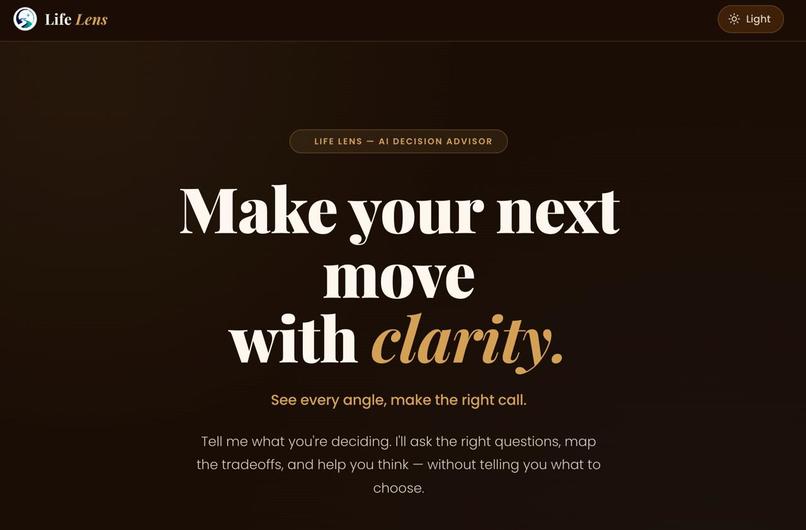
Landing Page
-
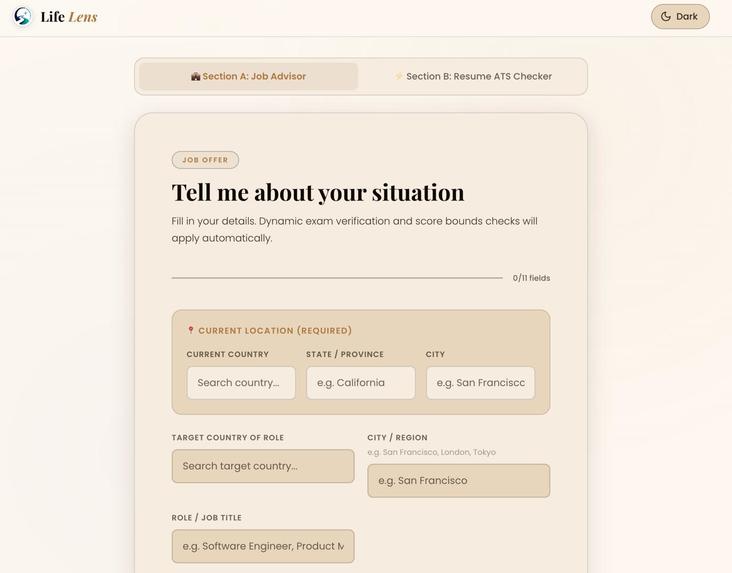
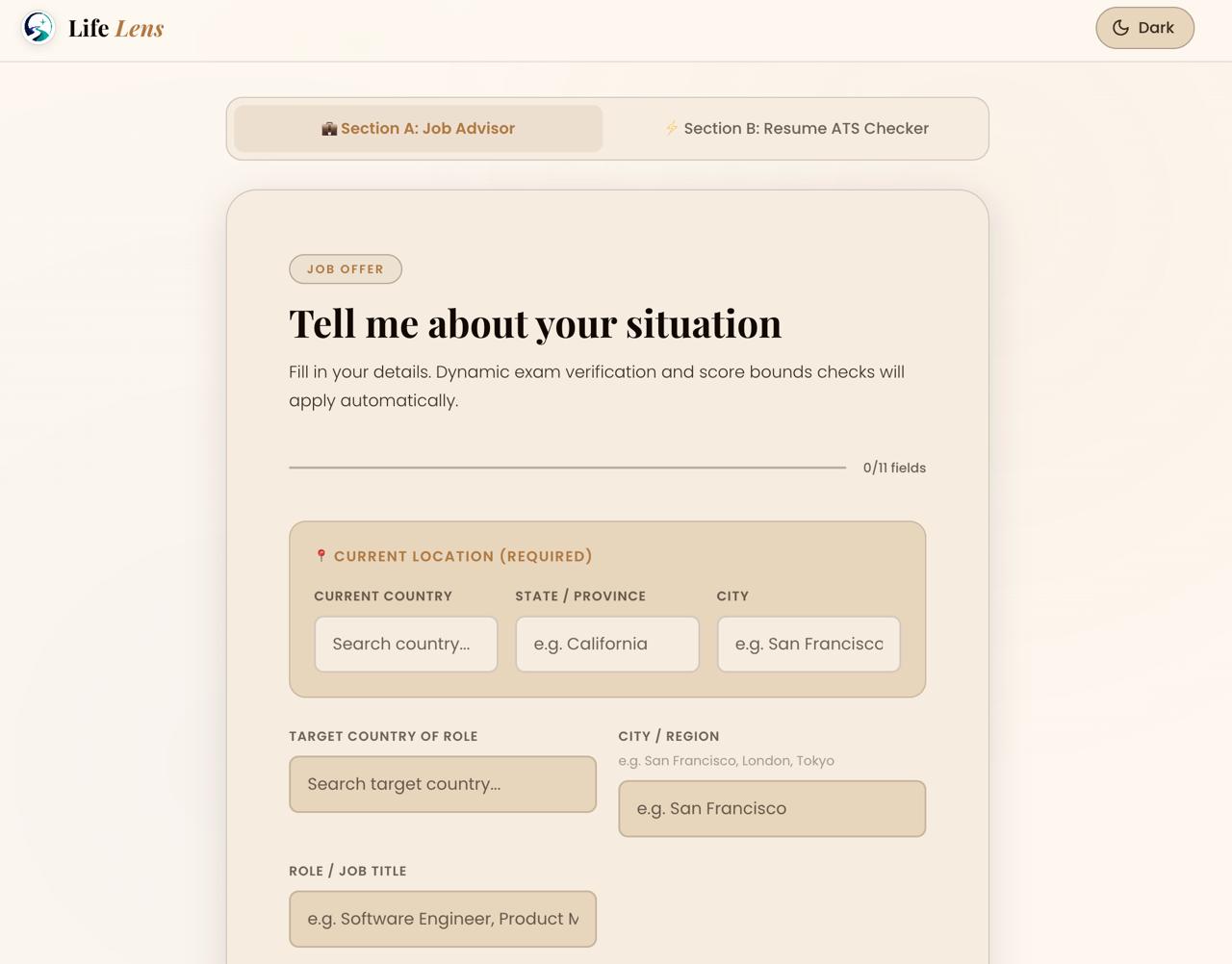
Light Mode
-
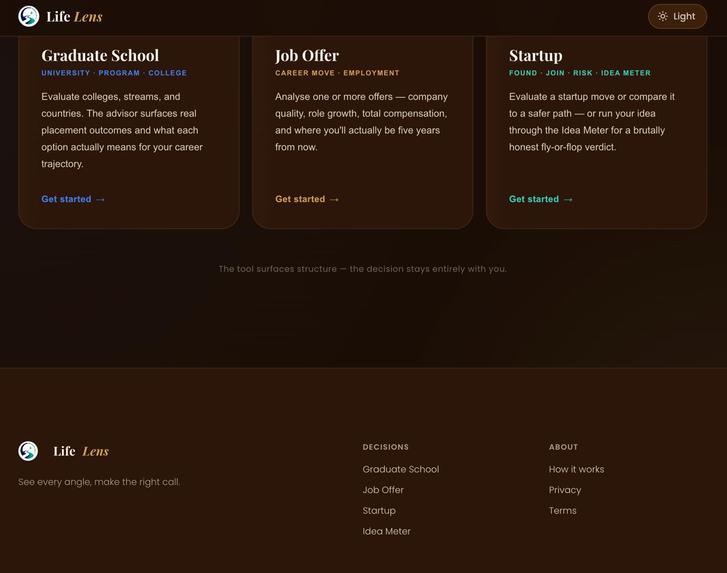
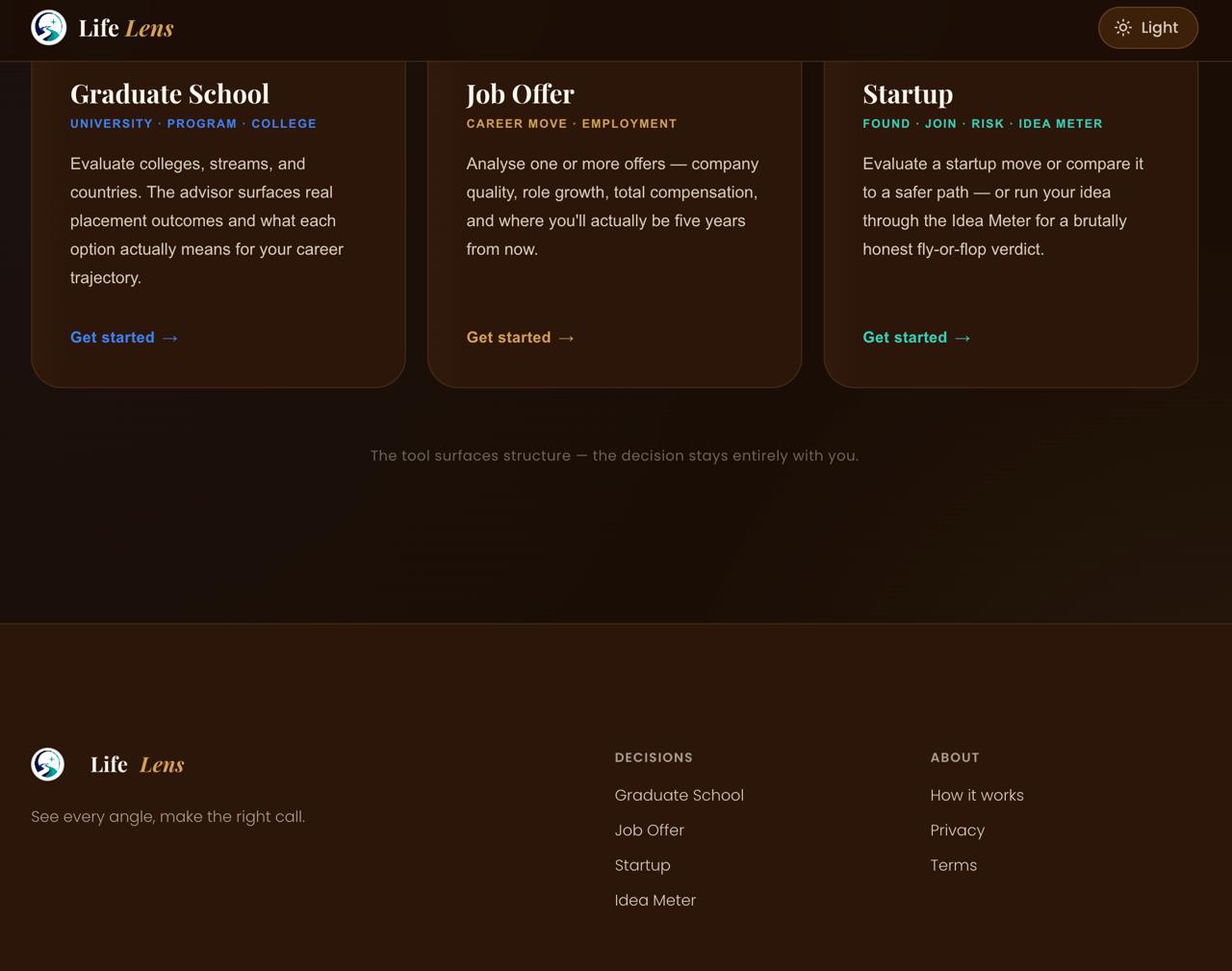
Footer/Dark Mode
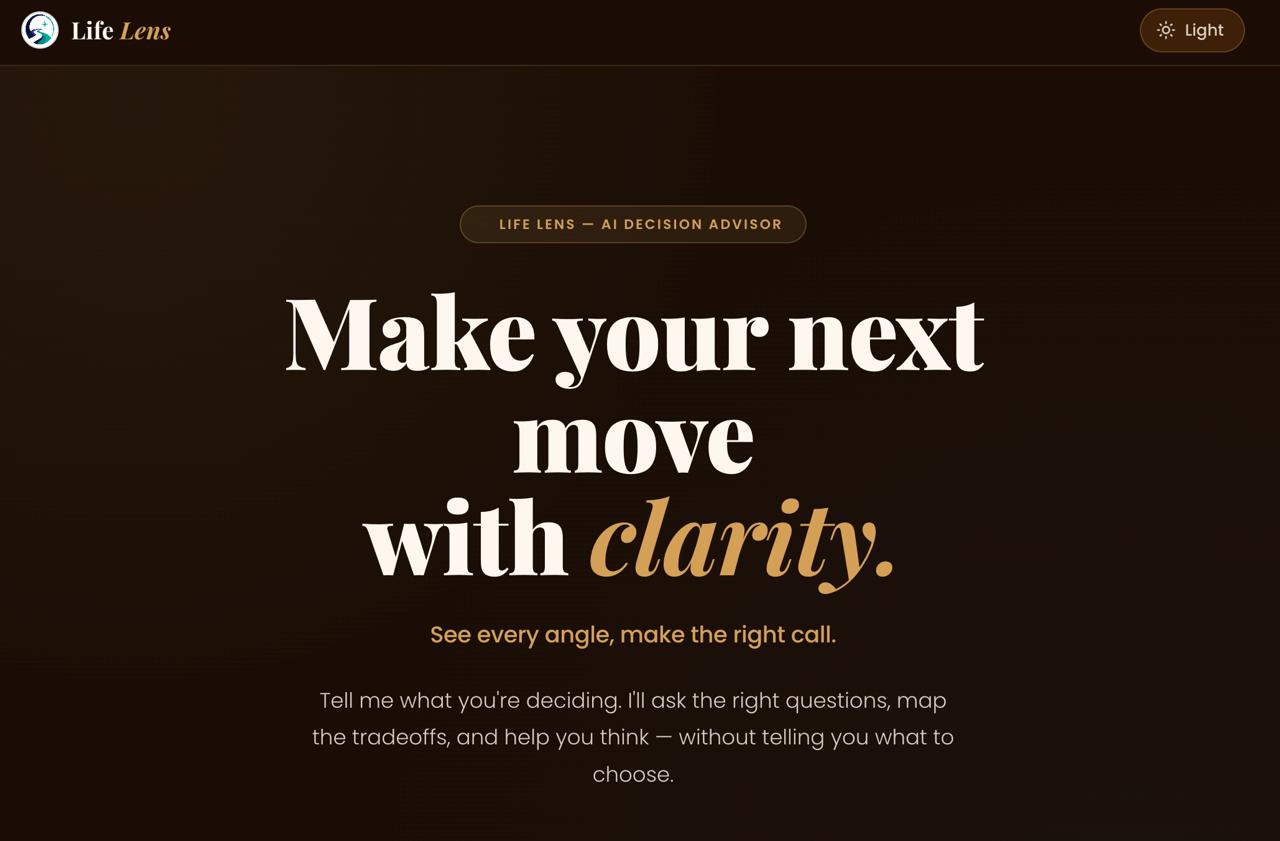
Inspiration
Choosing a graduate program, evaluating a startup idea, or deciding between competing job offers are some of the most high-stakes, stressful decisions students and early-career professionals make. Today’s internet is filled with immediate, generic lists of pros and cons, which often increase anxiety rather than offering clarity. We were inspired to build LifeLens—a tool that does not tell you what to choose, but instead acts as a structured mirror. By asking one thoughtful question at a time and mapping your answers into an objective, data-driven Dossier, LifeLens makes the underlying trade-offs of your choices visible, preserving your agency.
What it does
LifeLens takes the user through a clean, 3-phase guided discovery flow:
- Decision Selector: Choose between three major paths: Graduate School, Job Offer, or Startup.
- Context-Specific Intake: A dynamic form with staggered animations, interactive progress tracking, and custom dropdowns captures key location, career, and financial parameters.
- Conversational Advisor & Dossier: An interactive chat session (powered by AI) explores your choices, asking exactly one question at a time. After approximately 4 turns, the AI compiles a structured Dossier inline, detailing short/long-term projections, hidden tradeoffs, branch questions, and a confidence rating. If the advisor detects distress or if you remain deeply confused, it triggers a Responsible AI Counselor Card, connecting you directly with real-world human counseling (UCAS in the UK, College Board in the US, iCall in India) based on your location. ## How we built it
- Frontend: Built with React and Vite for lightning-fast loads. We designed a premium aesthetic using pure Vanilla CSS, integrating custom animations, theme-aware spring dropdown selectors, and auto-growing textareas.
- Backend: A Node.js and Express API handles stateless session compilation, LLM system prompt wrapping, and regional counselor matching.
- Inference: Powered by a swappable LLM client running Groq (Llama 3.3 70B) for blazing-fast inference, with fallback support for OpenAI (GPT-4o-Mini) and Anthropic (Claude 3.5 Sonnet).
- Deployment: Fully deployed on Vercel as a multi-service monorepo using unified service routing. ## Challenges we faced
- Stateless Chat Integrity: Implementing multi-turn JSON-structured conversational steps in a stateless REST API required carefully bootstrapping the intake parameters into the hidden message history on each call.
- Sibling Stacking Contexts: Handling absolute dropdown overlays in a highly animated form created z-index clipping issues. We resolved this by elevating parent focus contexts (
:focus-withinand:has(.open)) dynamically. - Regional Dynamic Lookup: Implementing country-sensitive placeholder text and preserving the full master competitive exam database (marking degree matches as "Best Match" without hiding other options) required designing custom React filtering logic.
## What we learned
We learned how to design human-in-the-loop AI applications that prioritize user agency rather than generating decisions for them. We also gained deep experience configuring polyglot/multi-service monorepos on Vercel using
vercel.jsonrouting. ## What's next for LifeLens We plan to integrate live salary benchmarking APIs, expand real-time college database integrations, and partner with university wellness centers to directly embed human advisor bookings inside the counselor fallback system.
Built With
- claude-3.5-sonnet
- express.js
- git
- gpt-4o-mini
- groq
- llama-3.3-70b-versatile
- mermaid.js
- node.js
- openai-api
- react.js
- vanilla-css
- vercel
- vite


Log in or sign up for Devpost to join the conversation.