Inspiration
Most financial calculators are boring spreadsheets. They assume life is perfect, markets only go up, and surprises never happen. I wanted to build a realistic life simulator that feels like a game, showing how major choices at age 18 shape your next 30 years.
What it does
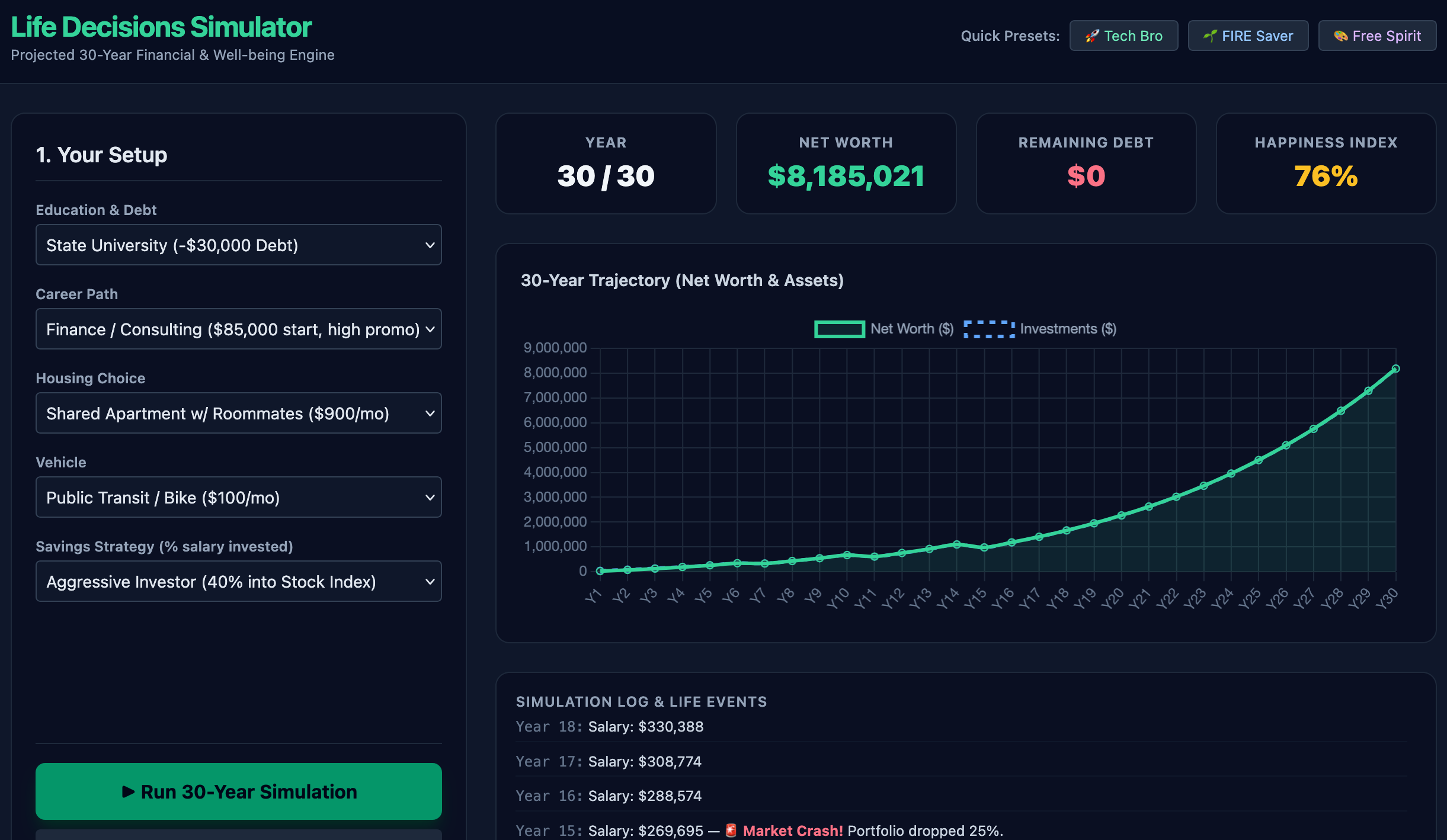
The app takes your choices—like college debt, career paths, and cities—and runs a fast-paced, 30-year simulation. Every 150 milliseconds represents one year. As the clock ticks, your salary grows, investments compound, and random events like market crashes or promotions disrupt your plans in real time.
How I built it
I built a serverless Single Page Application using plain JavaScript, Tailwind CSS, and Chart.js. Everything runs directly in your browser. The Math: Simple formulas calculate your salary growth each year based on your career track. The Engine: JavaScript timers handle the game loop, feeding data straight into a live, animating line graph.
Challenges I ran into
Laggy Graphs: Updating the UI and a visual chart every 150ms caused really bad stuttering. We fixed this by freezing inputs during the run and optimization-tuning Chart.js to bypass heavy redraw animations. Pure Chaos: Early random events were too harsh, wiping players out instantly. We changed the math so random setbacks add tension without completely destroying your strategy.
Accomplishments that I'm proud of
I built a responsive, visually engaging dashboard with zero backend lag. Seeing the chart smoothly plot out a user's entire financial life story in just a few seconds feels incredibly satisfying.
What I learned
You do not need heavy frameworks or massive backends to build something fast and beautiful. Plain JavaScript is highly capable. Building this also proved a timeless life lesson: your earliest choices carry the absolute most leverage.
What's next for Life Decisions Simulator
I want to expand the game mechanics to make the simulation even richer. Next steps include: Letting expenses scale up automatically as your income rises. Family milestones: Factoring in the real-world costs of marriage, kids, and buying a house. More choices: Adding paths for trade schools, side hustles, or early retirement options.


Log in or sign up for Devpost to join the conversation.