Inspiration
We all take thousands of photos and videos throughout our lives, but the moments that mean the most often end up buried in camera rolls, cloud storage, and social media feeds. Life Canvas was inspired by a simple idea: our memories deserve to be more than a collection of files—they deserve to become a story.
We wanted to create a way to turn scattered photos, videos, and milestones into a cohesive, interactive “Story of My Life.” Instead of endlessly scrolling through a camera roll, users can see their experiences connected chronologically and presented as a meaningful visual journey.
Our vision is to make preserving memories feel less like organizing files and more like creating something people can return to, experience, and share for years to come.
What it does
Life Canvas is an AI-powered platform that transforms personal photos, videos, and milestones into beautiful, interactive, and shareable timelines.
Users provide their memories, and an AI agent organizes them chronologically, connects related moments, and generates thoughtful reflections that add context and personality to each memory. Rather than simply displaying a gallery of files, Life Canvas turns individual moments into a connected narrative.
The result is a personalized digital timeline wrapped in a modern glassmorphism interface, where users can explore their journey by year and milestone. Once complete, their timeline can be easily shared with friends and family through an integrated sharing experience.
Life Canvas can be used for much more than an individual life story—from documenting a child's childhood and preserving family history to capturing weddings, trips, celebrations, community events, and organizational milestones.
How we built it
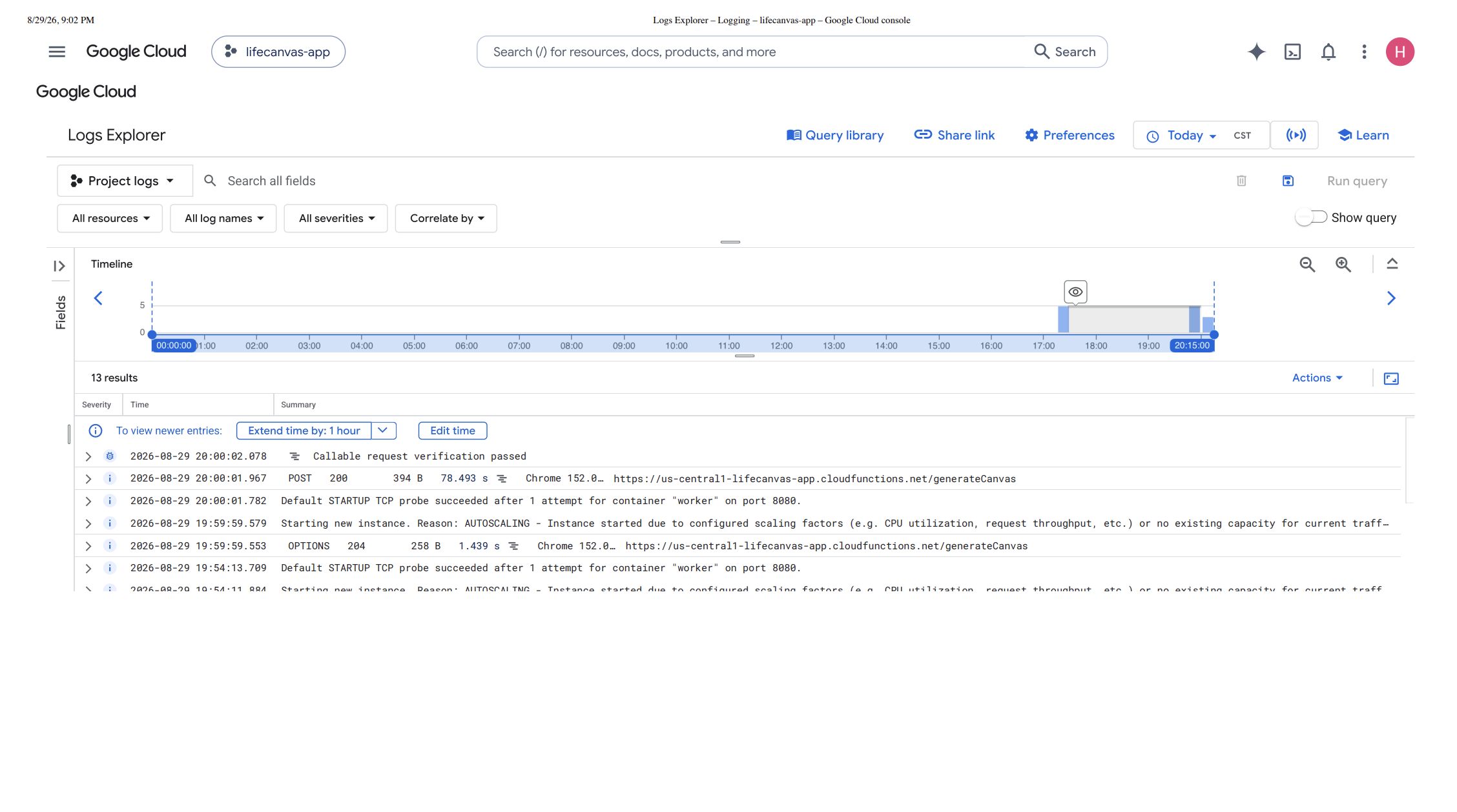
We built Life Canvas on a serverless architecture using Firebase, including Cloud Functions, Firestore, and Cloud Storage. The intelligence behind the experience is powered by the Google Gen AI SDK and Gemini, allowing the application to move beyond traditional one-shot AI generation.
We designed Life Canvas around an autonomous, multi-turn agent workflow. The agent is equipped with custom tools that allow it to retrieve a user's memories from Firestore, organize and sort the data chronologically, generate the timeline, and validate its own output before delivering it.
We also built a validation layer that checks the generated HTML, CSS, and JavaScript against specific UI and functionality requirements. If the generated canvas does not meet those requirements, the agent receives feedback and automatically attempts to correct its output.
The final canvas is stored in Firebase Cloud Storage and delivered to the user through a shareable URL. The frontend uses HTML, CSS, JavaScript, and FontAwesome to create the interactive experience, while Firebase and Stripe handle backend services and subscription management.
Challenges we ran into
Our biggest challenge was making the AI behave less like a content generator and more like a reliable autonomous developer.
Early versions could produce beautiful-looking timelines but occasionally missed important requirements. The model might use the wrong chapter labels, omit required social icons, generate inconsistent HTML structures, or introduce UI elements that violated our design constraints.
We quickly learned that simply adding more instructions to a prompt was not enough. We needed a mechanism that could actually test the AI's work and tell it what went wrong.
To solve this, we developed a self-correcting validation workflow. After generating the canvas, the agent runs its output through our validation tool. If something is missing or incorrect, the tool returns a specific error, and the agent uses that feedback to revise its code and try again.
We also faced challenges around generating secure, shareable URLs and ensuring that the dynamically generated timelines rendered consistently across different devices and environments. Solving these problems required careful routing, state management, backend architecture, and error handling.
Accomplishments that we're proud of
We are most proud of transforming Life Canvas from a traditional AI-powered application into a true agentic system that can build, inspect, and improve its own work.
The agent doesn't simply receive a prompt and return HTML. It can retrieve real user data, reason about how that information should be organized, generate an interactive experience, test its output against a strict set of requirements, and correct itself when necessary.
This self-correcting loop significantly improved the reliability and consistency of the generated timelines.
We are also proud of the final user experience. Combining AI-generated storytelling with a polished glassmorphism interface makes Life Canvas feel less like a technical AI demo and more like a product people could genuinely use to preserve important moments in their lives.
What we learned
One of our biggest lessons was that reliable AI applications require more than good prompts.
When an LLM is asked to generate complex, deterministic code, instructions alone cannot guarantee consistent results. Giving the agent tools to retrieve information, evaluate its own output, receive structured feedback, and try again creates a much more reliable workflow.
We also gained valuable experience orchestrating multi-turn AI interactions within a serverless architecture, managing state across agent iterations, and building robust error-handling mechanisms.
Most importantly, we learned how dramatically the role of AI changes when it is given the ability to take action, use tools, evaluate its work, and make corrections autonomously. That shift is what turned Life Canvas from a simple AI generator into an agentic application.
What's next for Life Canvas
We want Life Canvas to become more than a personal timeline—we want it to become a place where people can preserve the stories that matter most.
Our next step is expanding customization. We plan to introduce additional visual themes that the AI can intelligently select based on the tone and character of a user's memories, creating timelines that feel even more personal.
We also plan to add collaborative timelines, allowing multiple people to contribute memories to the same story. This could make Life Canvas especially meaningful for families, weddings, group trips, reunions, schools, communities, and organizations.
Over time, we envision Life Canvas becoming a digital heritage platform—a place where memories are not simply stored, but organized, understood, experienced, and passed on.
Our ultimate goal is simple: turn the moments we don't want to forget into stories we'll never stop remembering.

Log in or sign up for Devpost to join the conversation.