-
-
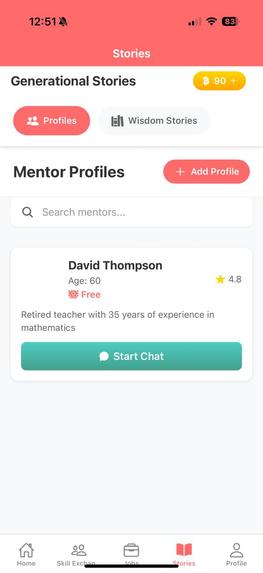
Generational Knowledge
-
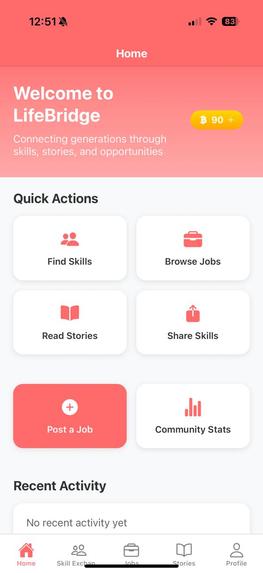
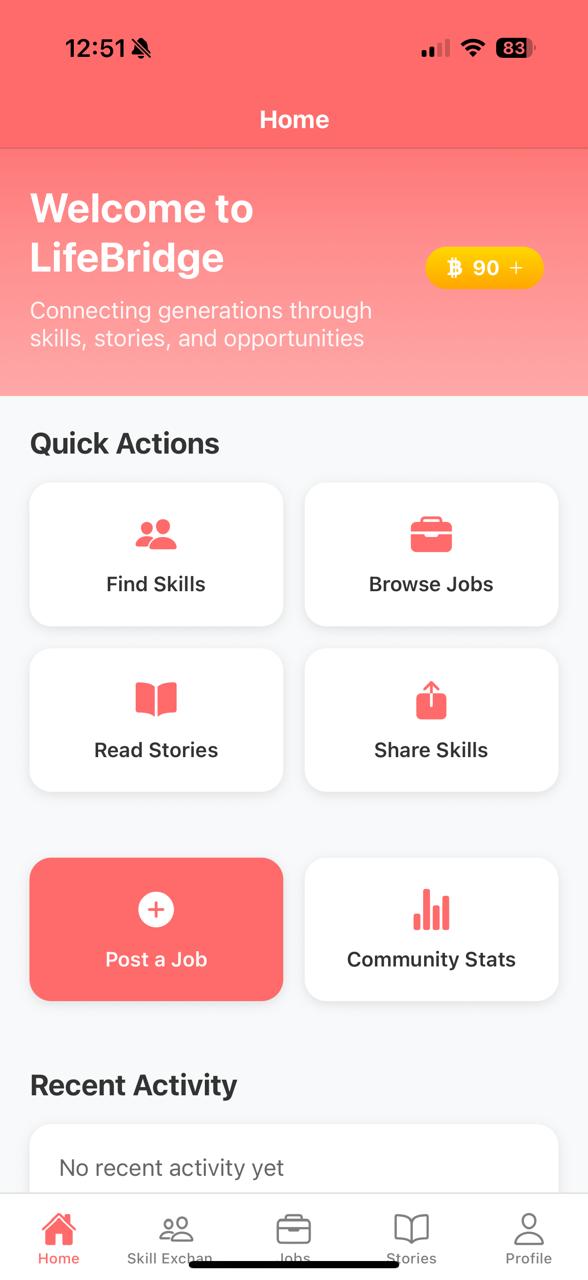
Home Page
-
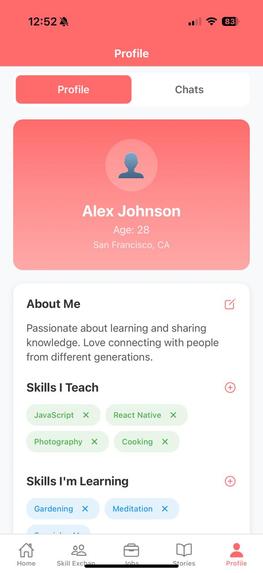
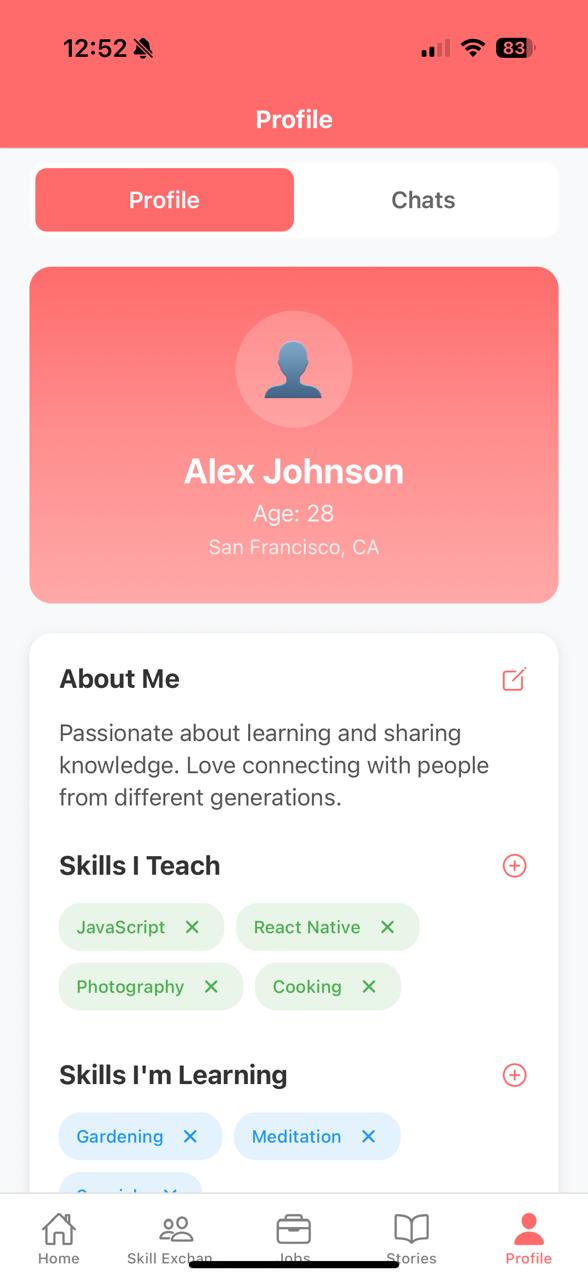
Profile
-
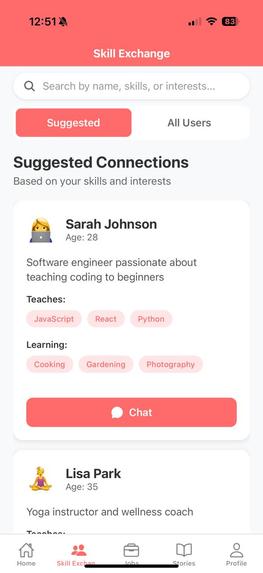
Skill Exchange
-
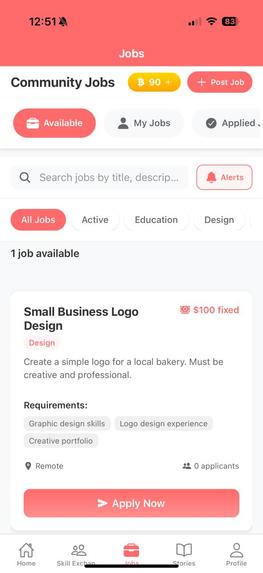
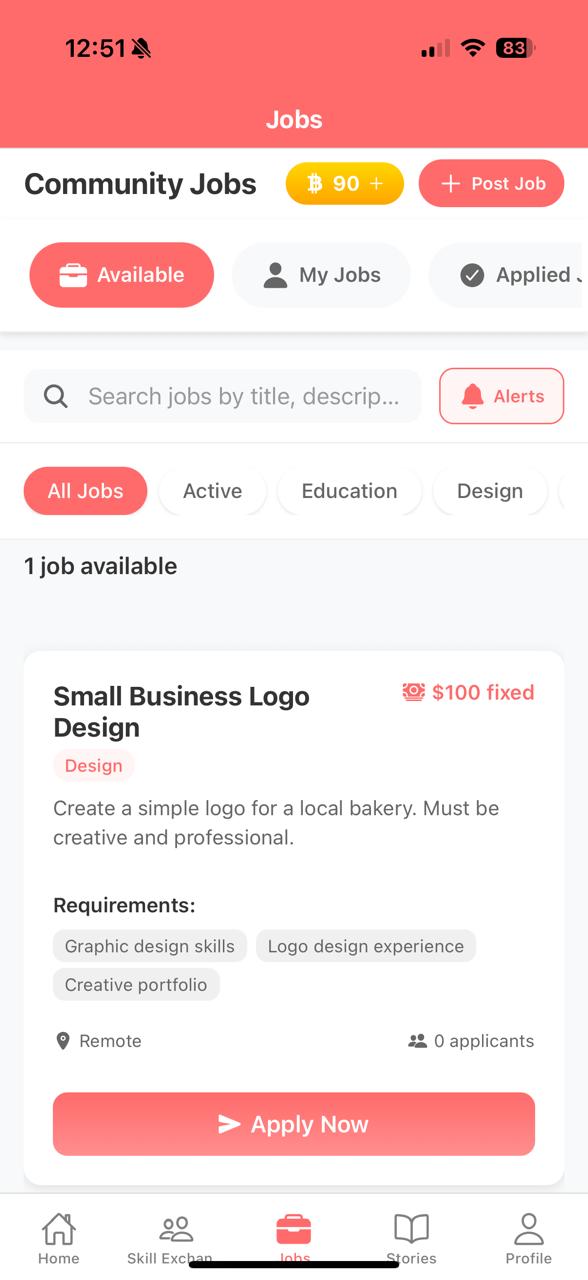
Jobs Page

Inspiration The idea for LifeBridge was born from observing a fundamental gap in our society: millions of people lack access to affordable education, meaningful work opportunities, and intergenerational wisdom. Students struggle to afford tutors, talented youth can't find entry-level jobs, and elderly individuals possess decades of valuable knowledge but have no platform to share it. We witnessed how skills, opportunities, and wisdom exist in abundance but remain disconnected—trapped in silos with no bridges between them. During the pandemic, we saw firsthand how isolation affected both young students who needed mentorship and retirees who wanted to contribute but had no outlet. This inspired us to create LifeBridge: a digital ecosystem that transforms how communities learn, work, and preserve cultural heritage by building three essential bridges—between skills, between opportunities, and between generations.
What it does LifeBridge is a comprehensive mobile platform that creates a community-driven economy connecting people across three core bridges:
Skills Exchange (Peer-to-Peer Learning) Users create profiles listing skills they can teach and skills they want to learn. Our AI-powered matching engine pairs users with complementary skills—for example, someone who teaches graphic design but wants to learn guitar gets matched with a guitar teacher seeking design skills. The platform includes a unique token economy where every user starts with 100 tokens, making learning accessible regardless of economic status. Users can exchange skills, send tokens through in-app chat, and build meaningful learning relationships without money being a barrier.
Jobs Marketplace (Micro-Work & Opportunities) LifeBridge provides a space for discovering and posting community jobs—from tutoring and translation to design work and local gigs. Users can browse available jobs with clear filters, apply with one tap, and track their applications in real-time (pending, accepted, declined). Job posters can manage applicants, accept candidates, and communicate directly through integrated chat. Payment can be made in tokens or cash, creating flexibility for students and youth to gain experience and income while building their portfolios.
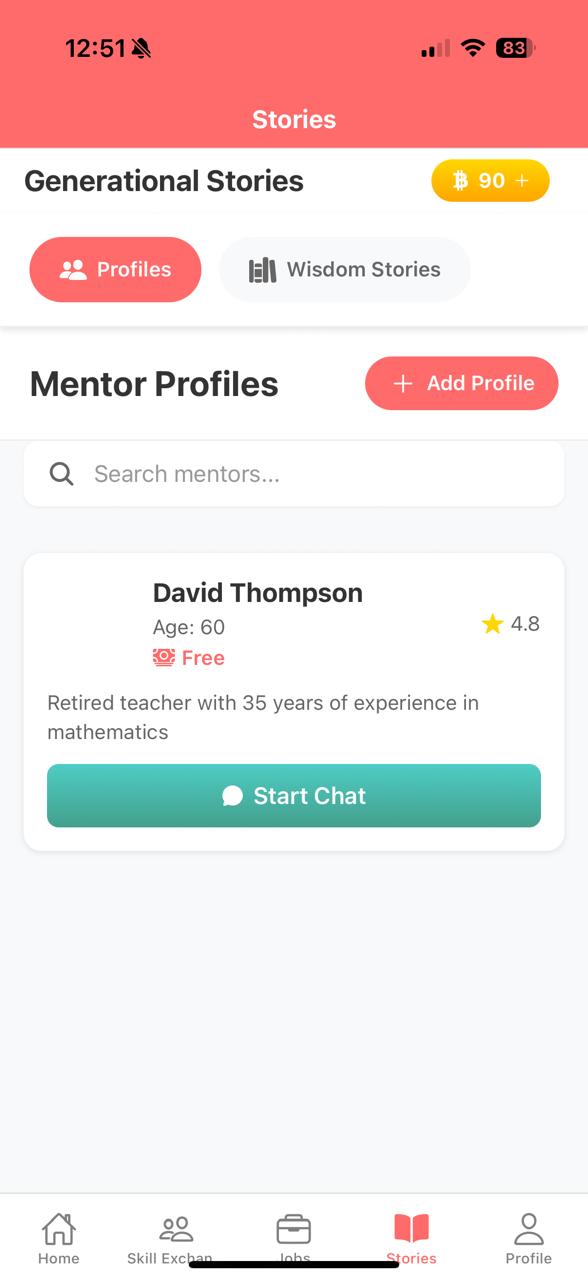
Generational Stories (Wisdom & Cultural Preservation) This unique feature creates a digital archive where elderly users and experienced professionals share life stories, cultural traditions, career advice, and professional wisdom through text, audio, or video. Youth can browse stories by category (Life Lessons, Career Advice, Cultural Heritage), save their favorites, react with meaningful emojis (inspiring, heartwarming, insightful), and request one-on-one mentorship sessions. Contributors can track their impact through analytics showing views, likes, and comments—giving them recognition for their contributions and preserving cultural knowledge that would otherwise be lost.
Core Features Across All Bridges:
Token Economy: Start with 100 free tokens, earn more by teaching or working, spend on learning or hiring
Real-time Chat: Instant messaging between users for collaboration, mentorship, and job coordination
Smart Notifications: Actionable alerts that open directly to relevant chats or profiles
Personal Dashboard: Track your impact—skills exchanged, jobs completed, stories shared, tokens earned
Profile Management: Edit skills, view your contribution history, manage saved content
Community Stats: See platform-wide impact metrics celebrating collective achievement
LifeBridge is more than a platform—it's a movement toward equitable opportunity where everyone has value to share and barriers to learning, earning, and cultural connection are removed.
How we built it We developed LifeBridge using a modern, scalable mobile-first architecture designed for cross-platform accessibility and real-time collaboration:
Frontend: Built with React Native and Expo SDK to ensure smooth performance across iOS and Android devices. We used React Navigation with bottom tabs and stack navigators to create intuitive, hierarchical screen flows. The UI follows a consistent design system with warm coral-pink-purple gradients (#FF6B6B, #FF9B9B, #4DB6AC), rounded corners (12px for cards, 24px for buttons), and generous spacing (16px padding) to create a modern, community-focused aesthetic.
Backend & Database: Firebase powers authentication, real-time messaging, and secure data storage. Cloud Firestore manages structured data including user profiles, jobs, applications, stories, chats, and token transactions. This NoSQL approach allows flexible data modeling and real-time synchronization across devices.
State Management: We implemented Context API with a global AppContext to manage user sessions, token balances, job applications, and chat threads efficiently across all screens.
Key Technical Implementations:
AI Matching Algorithm: A recommendation system that analyzes users' "teach" and "learn" skills, calculates overlap scores, and suggests optimal skill-exchange matches
Token Transfer System: Real-time token transactions integrated directly into chat, with instant balance updates and transaction history
Job Application Flow: Complete CRUD operations with status tracking (pending → accepted/declined) and notifications triggering relevant actions
Story Media Handling: Support for text, image, audio, and video content with preview functionality using Expo AV
Chat System: Real-time messaging with typing indicators, message persistence, and embedded action buttons (send tokens, view profile)
Design Process: We started with user flow mapping, created wireframes for each of the three bridges, then iteratively refined UI based on testing. We prioritized accessibility with readable font sizes (16px body, 20px headers), high-contrast colors, and touch-friendly button sizes (minimum 44px).
Development Challenges Solved:
Implemented KeyboardAvoidingView to prevent input fields from being hidden by the keyboard
Created consistent card layouts across Jobs and Stories with dynamic height adjustment
Built reusable components (ProfileCard, JobCard, StoryCard) to maintain design consistency
Added proper error handling and loading states for all asynchronous operations
Challenges we ran into Building LifeBridge pushed us to solve complex technical and design problems:
Designing Intuitive Multi-Feature UX: Creating an app that handles skill exchange, job marketplace, and storytelling without feeling cluttered was challenging. We solved this by implementing clear bottom-tab navigation, consistent card-based layouts, and purposeful use of whitespace. Each feature needed its own identity while maintaining visual cohesion across the platform.
Token Economy Logic: Implementing a fair, intuitive token system required careful state management. We had to ensure tokens deducted correctly when applying for jobs, transferred accurately in chat, and synced in real-time across devices. Preventing negative balances and handling edge cases (what if a user tries to spend more tokens than they have?) required robust validation logic.
Real-time Data Synchronization: Managing job application statuses, chat messages, and token balances in real-time across multiple users was complex. We had to structure Firestore collections efficiently, implement listeners for live updates, and optimize queries to prevent performance issues. Ensuring that when a job poster accepts an applicant, the applicant's screen updates instantly required careful event handling.
Generational Accessibility: Designing for users aged 16-80 meant balancing modern aesthetics with simplicity. We tested with older users and learned to increase touch target sizes, add clear visual hierarchies, and provide multiple ways to accomplish tasks (buttons + swipe gestures). Audio/video story features needed simple upload interfaces that didn't intimidate less tech-savvy users.
Chat Integration Everywhere: Building a chat system wasn't just about messaging—we needed contextual chat that opened from job applications, skill matches, and story mentorship requests. Ensuring the chat always knew the correct recipient and conversation context required careful navigation parameter passing and data structure planning.
Scalable Data Structure: Designing Firebase collections that could scale from 5 demo users to thousands required forethought. We learned to denormalize data strategically (storing user names in job posts to avoid repeated lookups) while maintaining data integrity and implementing proper security rules.
Polish vs. Functionality Trade-offs: With limited hackathon time, deciding between adding new features or polishing existing ones was difficult. We learned to prioritize core flows working perfectly over having many half-functional features. The delete/edit functionality, for example, went through three iterations before achieving the clean, consistent UX we wanted.
Accomplishments that we're proud of Creating a Truly Unique Platform: LifeBridge successfully combines three distinct social impact areas—education access, employment opportunities, and cultural preservation—into one cohesive ecosystem. Few platforms address all three, and fewer still do so with a unified design language and user experience.
Token Economy Innovation: Building a working alternative currency system that removes financial barriers to learning is our proudest technical achievement. Users can genuinely learn skills, find work, and access mentorship without spending money—the 100 free tokens ensure everyone starts with equal opportunity.
Intergenerational Bridge: The Generational Stories feature with mentorship requests creates genuine value exchange between age groups. This isn't just nostalgia—it's preserving cultural knowledge, providing career guidance, and giving retired professionals purpose and recognition. Early testing showed elderly users felt valued and connected, which validated our core mission.
Professional UI/UX Design: Achieving a clean, modern interface that feels like a production app rather than a hackathon prototype. Consistent spacing, thoughtful color choices, smooth navigation, and attention to details like loading states and error messages make LifeBridge feel polished and trustworthy.
Real Social Impact Potential: LifeBridge addresses multiple UN Sustainable Development Goals (Quality Education #4, Decent Work #8, Reduced Inequalities #10). It has genuine potential to help underserved communities access learning and work opportunities that were previously out of reach.
Complete Feature Loops: Every major feature works end-to-end—you can post a job and receive applications, request a skill exchange and start chatting, share a story and see analytics. This completeness demonstrates our commitment to building something real, not just a concept.
Winning Most Creative at OneHacks: This early validation proved that LifeBridge's concept resonates with judges and audiences. It motivated us to refine and expand the platform for Youth Coders Hack.
What we learned Iterative Design is Essential: We learned that starting with core features, testing them, and progressively adding polish leads to better products than trying to build everything at once. Our initial UI was cluttered; through iteration, we achieved clarity and elegance.
User Experience Drives Technical Decisions: Choosing Firebase over a custom backend, implementing Context API for state management, and structuring our navigation—these technical choices were all driven by UX goals (real-time updates, smooth transitions, minimal loading). We learned to prioritize what makes the experience better, not just what's technically impressive.
Accessibility Requires Empathy: Designing for ages 16-80 taught us that assumptions about "obvious" UI patterns don't hold across generations. We learned to test with diverse users, provide clear labels, and design for different levels of tech literacy. This made LifeBridge better for everyone, not just elderly users.
Balancing Breadth and Depth: With three major features (skills, jobs, stories), we learned the importance of ensuring each one works completely rather than having many half-built features. Depth of implementation matters more than feature count in creating trust and usability.
Community-Driven Design: LifeBridge taught us that platforms connecting people need to feel warm, inclusive, and empowering—not transactional. Our color choices (warm corals and purples), language ("bridges" not "services"), and features (tokens, not just payments) all emerged from this philosophy.
Real-time Systems are Complex: Implementing chat, live status updates, and synchronized token transfers taught us about race conditions, optimistic updates, and the importance of proper error handling. We learned to think about what happens when networks fail or users act simultaneously.
Impact Storytelling Matters: Building great technology isn't enough—clearly articulating who benefits and how is crucial. We learned to frame LifeBridge not as "a multi-feature app" but as "a bridge between learning, earning, and living." This narrative thinking will serve us beyond hackathons.
What's next for LifeBridge Near-Term Enhancements (3-6 months):
Video Integration: Add video call functionality for remote mentorship sessions, job interviews, and live skill-teaching. This transforms LifeBridge from asynchronous to synchronous connection.
AI-Powered Recommendations: Implement machine learning models to suggest optimal skill matches, relevant jobs based on browsing history, and stories aligned with user interests. Partner with Google Cloud's Vertex AI for scalable ML capabilities.
Enhanced Token Marketplace: Expand earning opportunities—tokens for writing reviews, contributing helpful comments, completing profile sections, daily check-ins. Create a secondary market where users can exchange tokens for real services or donate to causes.
Skill Verification System: Add peer endorsements and completion certificates for skill exchanges to build trust and credibility. Users can showcase verified skills on their profiles, making LifeBridge a legitimate credential platform.
Language Localization: Launch Hindi, Spanish, and Mandarin versions to expand global reach, particularly in underserved communities where LifeBridge can have maximum impact.
Medium-Term Growth (6-12 months):
NGO & School Partnerships: Collaborate with educational NGOs, community colleges, and schools to onboard students and provide structured skill-learning pathways. Offer institutional dashboards for educators to track student progress.
Payment Gateway Integration: Add Stripe/Razorpay for users who want to purchase tokens or offer paid premium services while maintaining the free token economy for accessibility.
Advanced Analytics Dashboard: Provide users with insights into their learning progress, skill development metrics, job application success rates, and community contribution scores.
Mobile App Optimization: Launch native iOS and Android apps (beyond Expo) for better performance, offline functionality, and push notification reliability.
Long-Term Vision (1-2 years):
Global Expansion: Scale LifeBridge internationally with regional customization—localized job categories, culturally relevant story themes, and country-specific skill demands.
Corporate Skills Training: Partner with companies to offer LifeBridge as an employee upskilling platform where colleagues teach each other, earning recognition and building internal knowledge bases.
Impact Measurement: Build tools to quantify LifeBridge's social impact—tracking educational outcomes, job placements, preserved cultural stories, and economic value created through the token economy.
Blockchain Token System: Explore decentralized token infrastructure using blockchain to make tokens portable across platforms and enable true peer-to-peer value exchange.
Ultimate Goal: Transform LifeBridge into a globally recognized platform that proves learning, working, and cultural preservation can be accessible, community-driven, and economically sustainable. We envision a world where geographic location, economic status, and age are no longer barriers to opportunity—where everyone can contribute their unique value and access what they need to grow.
Built With
- expo.io
- firebase
- javascript
- reactnative
- reactnavigation

Log in or sign up for Devpost to join the conversation.