Inspiration
Life Bank was born out of a critical observation of health emergency responses across the lake victoria region in East Africa and Western Kenya region: during disasters, accidents, or sudden humanitarian crises, centralized blood banks frequently experience acute shortages. Traditional systems rely heavily on rigid logistics or panicked appeals to close relatives. However, medical science demonstrates that directed donations from first-degree relatives carry severe risks, such as Transfusion-Associated Graft-Versus-Host Disease (TA-GVHD).
I was inspired to build a decentralized, community-driven early warning and rapid response platform that harnesses the power of localized community networks—connecting vulnerable patients with safe, verified, non-relative donors within minutes.
What it does
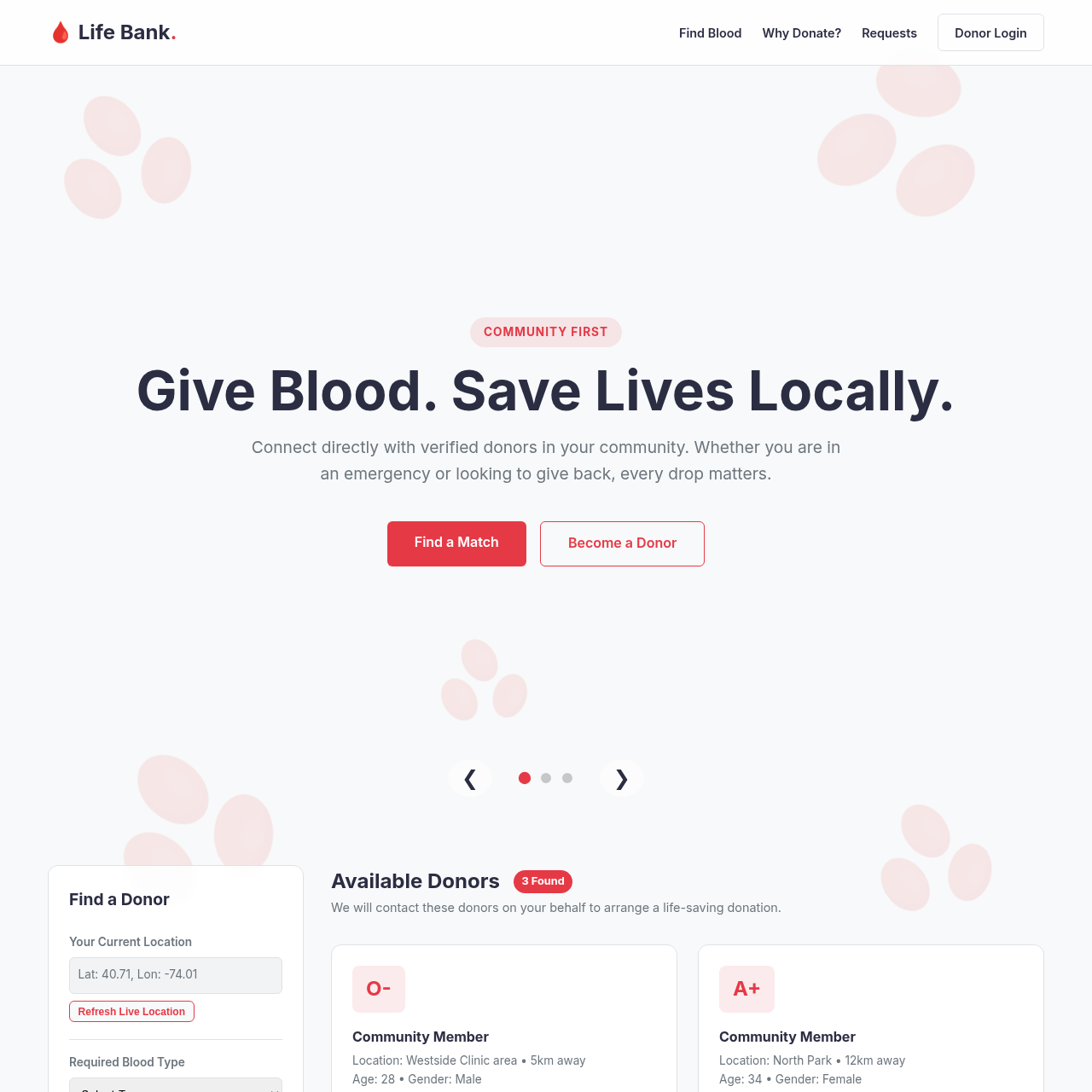
** Localized Blood Matching ** Connects users directly with verified, non-relative donors within their community based on specific blood types and geographic proximity, reducing the medical risks associated with relative-to-relative transfusions (such as TA-GVHD).
** Real-Time Geolocation Tracking ** Utilizes browser-based geolocation and radius filters to find and display nearby available donors instantly during health emergencies.
** Instant Emergency Requests ** Allows users to request donations with a single click, instantly transforming button states, logging requests via local Storage, and triggering live confirmation feedback toasts.
** Admin-Controlled Verification Workflow ** Routes pending donation requests through a secure relational database and role-based access structure (built on Go and PostgreSQL) to ensure administrative validation and prevent false requests.
How we built it
I am designing Life Bank as a full-stack solution optimized for speed, reliability, and modern user experience:
Frontend Architecture: Built using a mobile-first, responsive interface featuring a simple design system. It integrates the browser Geolocation API to track recipient coordinates, calculating real-time proximity and distance radii to filter nearby donors instantly.
Interactive UI/UX State Management: Implemented dynamic DOM manipulation to provide immediate feedback, such as transforming request buttons to "Requested" states and triggering custom notification toasts without page reloads.
Backend & Database Foundation: Engineered for scalability using Go (Golang) for its high performance and concurrency handling, paired with a robust PostgreSQL/MySQL relational database structured to securely manage users, roles, and administrative request workflows.
Challenges we ran into
Real-Time Proximity Mapping: Accurately calculating distance matrices and radius filters directly in the browser while maintaining high performance required fine-tuning our geographic search logic.
Balancing UI Responsiveness and Data Integrity: Ensuring that user actions—such as clicking a donation request—instantly reflected visual changes while securely staging the transaction state for backend validation posed a design challenge. I solved this by pairing local state caching with robust schema design (users and donation_requests tables) ready for server-side enforcement.
Humanitarian Workflow Constraints: Balancing open community accessibility with strict administrative verification to prevent false requests and protect sensitive medical data required careful role-based access planning.
Accomplishments that we're proud of
Decentralized Community Model: Successfully engineered a localized blood-matching network that mitigates the severe medical risks associated with directed relative-to-relative transfusions, such as Transfusion-Associated Graft-Versus-Host Disease (TA-GVHD).
Responsive Glassmorphism UI: Built a modern, mobile-first frontend featuring an interactive hero slider, custom background animations, and real-time browser Geolocation API tracking for rapid emergency matching.
Seamless State Management & UX: Implemented dynamic DOM state changes (transforming buttons to "Requested" and triggering custom toast notifications) and a persistent local storage workflow for immediate user feedback.
Resilient Technical Foundation: Designed a full-stack architecture pairing a high-performance Go (Golang) backend with a robust relational PostgreSQL database schema (users and donation_requests tables) ready for production deployment.
What we learned
Building Life Bank taught me that effective early action technology requires a seamless blend of empathetic user experience and resilient backend engineering. I realized that in a health emergency, every second counts—meaning a clean, frictionless interface is just as critical as a secure, concurrent database. This project deepened my understanding of how localized digital infrastructure can fundamentally strengthen regional health resilience.
What's next for Life Bank (Blood Bank)
As I look beyond the current prototype and prepare for broader deployment, the roadmap focuses on transforming Life Bank into a fully resilient, production-ready humanitarian platform. Here is what is next for the project:
To ensure the platform remains accessible even during severe network disruptions, infrastructure failures, or low-connectivity disaster zones, we will convert Life Bank into a Progressive Web App (PWA):
Offline-First Capabilities: Implement service workers and local caching so users can view emergency guidelines, cached donor profiles, and their request histories even when offline.
Push Notifications: Enable instant, low-latency device notifications for nearby donors when an urgent blood request is broadcasted in their radius, bypassing traditional SMS delays.
Installability: Allow users (especially rural health clinics and mobile emergency responders) to install the web app directly to their home screens like a native mobile application without needing an app store.
To give the community seamless access to Life Bank, our rollout strategy focuses on inclusive onboarding, decentralized distribution, and offline-resilient access methods:
Community-Led Onboarding Workshops: Partner with local community centers, youth groups, and grassroots health organizations to educate residents on how to register safely as verified donors without relying solely on centralized hospital drives.
SMS & USSD Fallback Integration: Since internet connectivity or smartphones can be unreliable during disasters or in remote areas, we plan to integrate a lightweight SMS/USSD gateway alongside our web app and PWA. This ensures community members without data access can still receive urgent alerts and trigger matching requests via basic feature phones.
Local Health Clinic Integration: Equip rural and neighborhood clinics with dedicated kiosk access, allowing community health workers to submit emergency blood requests on behalf of patients directly into our PostgreSQL backend database.
Transparent Trust & Privacy Protocols: Establish clear, community-facing privacy guidelines and consent checkboxes (built right into our registration workflow) to assure users that their phone numbers and locations are only shared during verified medical emergencies, building long-term trust in the platform.
Lastly, I am building a WhatsApp Chatbot for the Application that will allow community members to request donation via WhatsApp and get feedback immediately from the backend while matched to the nearest donors. Donors will also have a page to select nearby donation centers of their choice to donate blood.

Log in or sign up for Devpost to join the conversation.