-
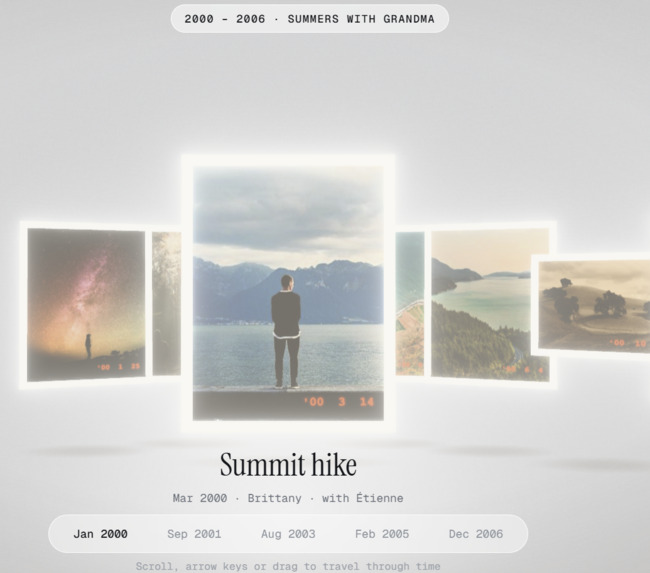
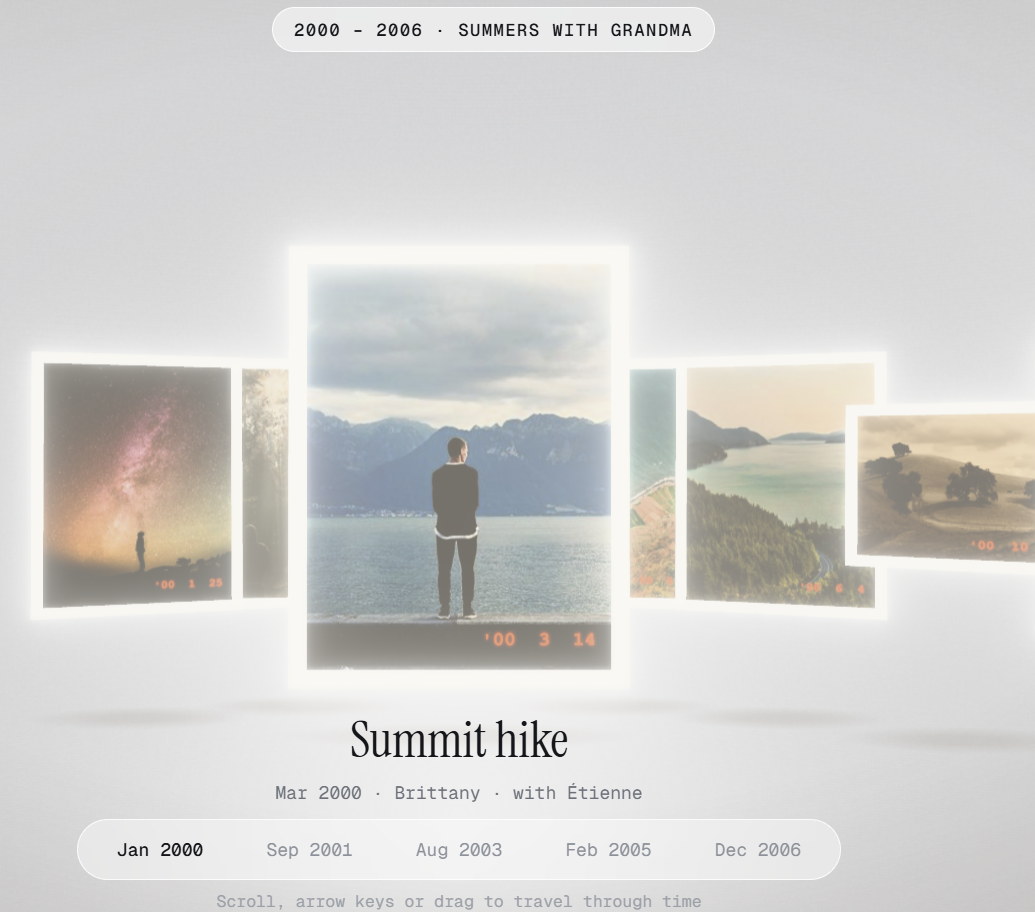
Immersive chapter view — era music, photos and narration inside one memory
-
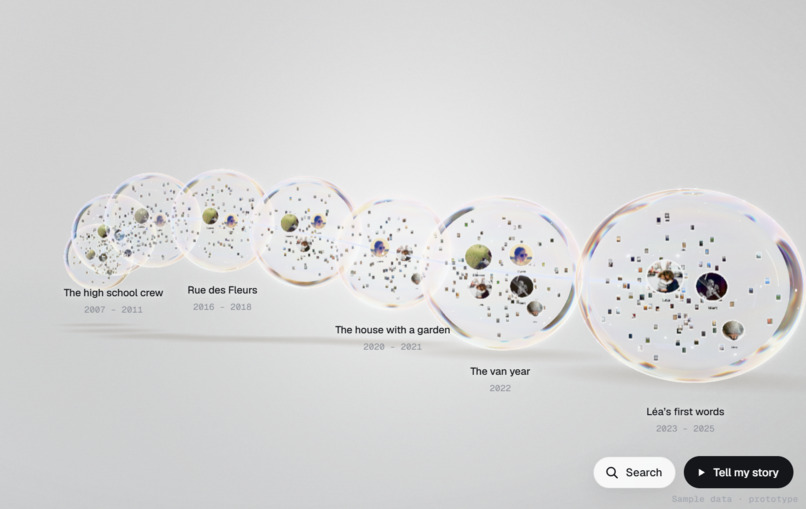
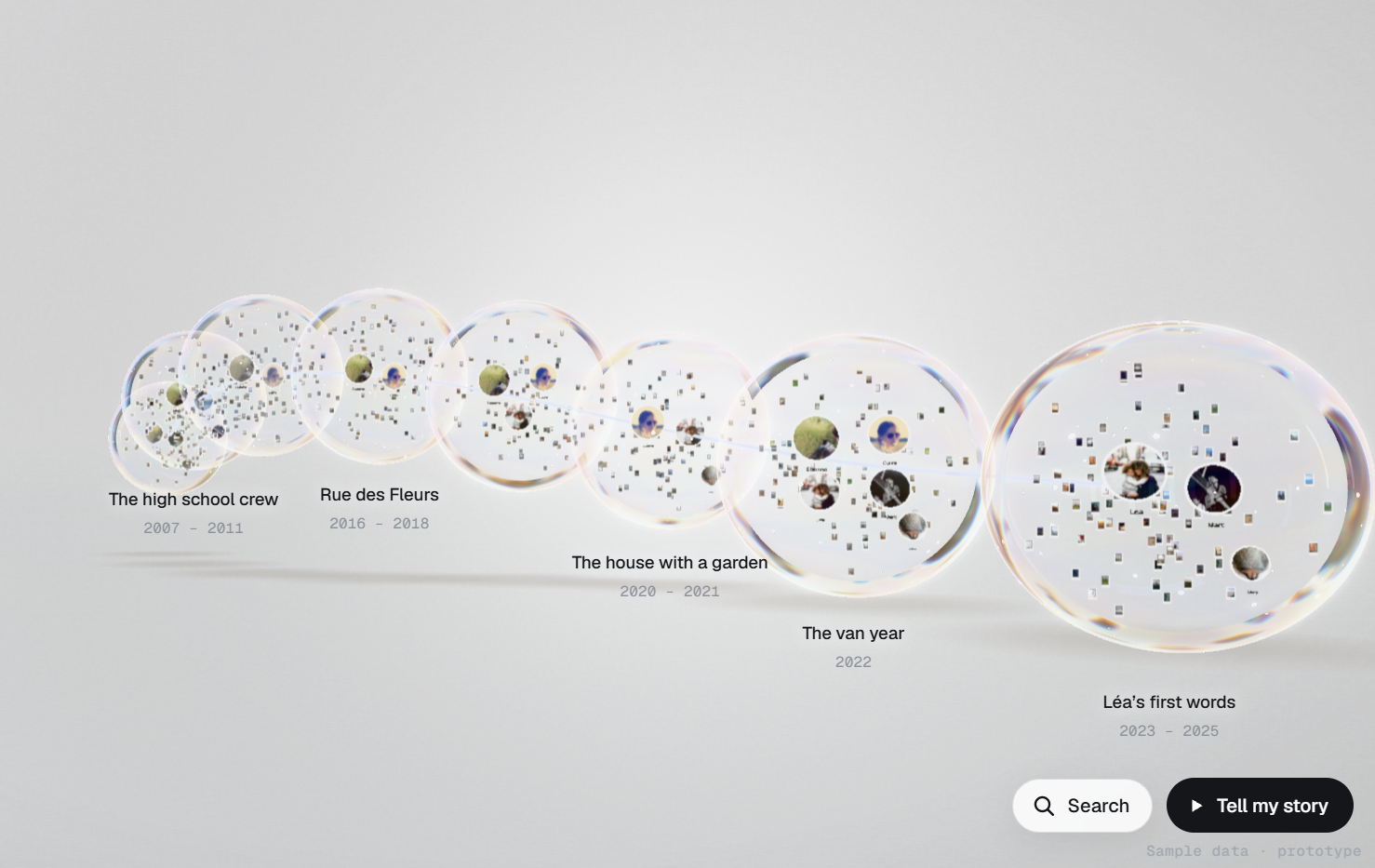
Chapter overview — life chapters as glass bubbles along the river of time
What it does
Life Story Atlas turns the photos, papers, and music on your UGREEN AI NAS into one self-contained, interactive 3D story file. Memories become life chapters floating along a river of time — each with written narration, era music, and a guided story flight that flies the camera from your oldest chapter to your newest. Everything runs on the device; no file ever leaves home.
Inspiration
Our families own tens of thousands of photos nobody ever revisits. Folders and flat timelines can retrieve a single image, but they never reveal a life story — and cloud "memory" features demand uploading your most intimate data to someone else's servers. Your NAS already holds your whole life; we wanted it to tell it back to you, as a beautiful object you can explore, not a search box.
How we built it
We built a Uliya Skill (life-story-atlas) for the Bring Memories to Life track, orchestrating five registered expert agents through supported UGOS CLI capabilities:
- photo-agent (
ug-photo) indexes timelines, people, places, and AI descriptions; - document-agent (
ug-document) anchors dated events from papers; - media-agent (
ug-music) matches era music per chapter period; - knowledge-agent (
ug-knowledge) writes evidence-bound narration plus a deterministicAtlasSpecmanifest; - file-agent (
ug-filesystem) writes the single atlas HTML file after explicit user approval.
The manifest is the whole contract between generation and rendering: identical sources plus an identical manifest always render an identical scene. Chapter (c) of (C) centers on
$$x_c = \left(c - \frac{C-1}{2}\right) \cdot 95$$
and node (k) in a chapter is placed with the golden angle (G = \pi(3-\sqrt{5})):
$$a = a_0 + kG, \quad r = 5 + 2.8\sqrt{k}, \quad y = 1 + 0.7\,(k \bmod 5)$$
where (a_0) is a seeded fraction (mulberry32 over seed (\oplus) hash32 of the chapter id). Node ids are stable across editions via 32-bit FNV-1a:
$$h_{i+1} = ((h_i \oplus c_i) \cdot 16777619) \bmod 2^{32}, \quad h_0 = 2166136261$$
so regeneration keeps approved texts byte-identical and unchanged photos pixel-identical. The viewer is one dependency-light page: pinned three.js (CDN, with local-copy and 2D fallbacks), positional chapter audio, and a story mode whose timing derives from the manifest, making every replay identical.
Challenges we ran into
- No NAS access in Round 1 — we designed purely against the capability catalog and the official static checker, and wrote the skill to report honestly what is implemented vs. pending NAS validation.
- Determinism — every coordinate had to be a pure function of stable ids plus a fixed seed; zero unseeded randomness anywhere in the layout path.
- Honest narration — every sentence must trace to real evidence. We wrote strict anti-invention rules (no made-up people, dates, or causes; conflicts reported, never resolved silently).
- Real-time glass — no raytracer in a browser, so the bubble realism comes from transmission materials, fresnel rim light, and a procedural HDRI studio, tuned over many measured passes.
What we learned
How to design within a real agent-orchestration standard: capability evidence, approval gates, empty-result handling, and completion states are first-class design material, not afterthoughts. That constraints breed quality — a 1024-character skill description and a 500-word proposal forced us to find the sharpest possible version of the idea. And that determinism is a feature users feel: a life story you can re-read, regenerate, and trust.
Built With
- ai
- css3
- html5
- javascript
- three-js
