Inspiration
"Can we use your illustration?" starts a long thread. For what? How many copies? For how long? With credit? Can it train a model? Small buyers, like a museum printing a guide, don't know what to ask for, and independent artists don't have time to negotiate each request. Then, after payment, the file and the terms live in different emails. We wanted one place where the use, the approval, the payment and the delivered work stay together.
What it does
- New: Found uses: start from a screenshot of your work appearing somewhere. It matches the screenshot to your catalogue, sizes a license offer to the kind of use, lets you edit it in words ("social only, one year"), and produces the PayPal link and a polite message to send.
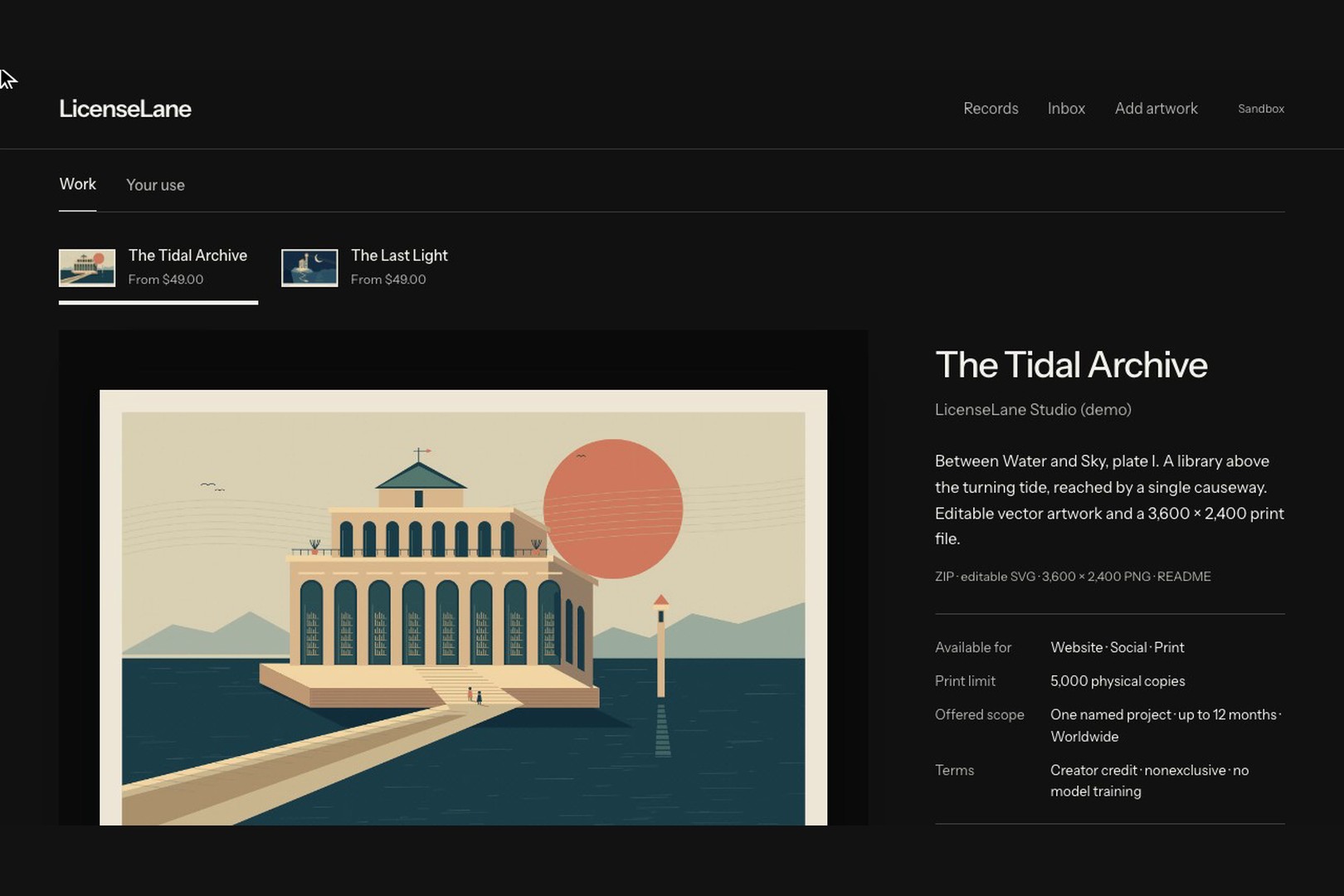
- Each artwork has a page with its price and the artist's own policy: allowed uses, print limits, term, territory, credit, exclusivity, model training.
- The buyer pastes the brief they already wrote. A model proposes licence fields (usage, number of copies, duration, territory, credit, exclusivity, training) and shows the sentence each one came from. The buyer picks which suggestions to apply and can edit everything by hand.
- Deterministic checks compare the request with the artist's policy and price it.
- The buyer saves a proposal. Nothing is charged at this point.
- The artist reviews the saved terms in an inbox and approves them or asks for changes. That decision is separate and human.
- Only an approved request can be paid. LicenseLane creates a PayPal order for the agreed amount; the buyer pays on PayPal, then confirms the capture.
- When PayPal confirms a completed capture for the right amount and licence reference, the licence is issued. One download contains the original artwork, the exact terms and a certificate. Later edits to the catalogue don't change what an existing buyer holds.
In the demo: a museum asks to print an illustration on 600 exhibition guides for six months. The model reads the brief, the price comes to $73, the artist approves, the museum pays in the PayPal Sandbox, and the verified licence and files are issued.
How we built it
- Node.js server using only built-in modules; HTML, CSS and JavaScript in the browser. No npm dependencies.
- AI: a local open-weight model through Ollama (Qwen2.5 7B in the demo) for brief-to-fields extraction with quoted evidence. Responses are schema-checked, and nothing is applied without the buyer selecting it.
- PayPal: Sandbox OAuth and Orders v2. Create order, buyer approval, explicit capture, then a separate read of the order before issuing. Issuance checks capture status, USD amount and licence reference.
- Records, approved files and terms are stored on the server so an issued licence survives reloads and later catalogue changes.
Challenges we ran into
- An early AI feature tried to explain rights in free text. It sounded confident and was sometimes wrong, so we replaced it with field extraction that always shows its source sentence.
- Keeping "what was approved" stable: the artist can edit or pause an artwork later, so the approved edition and terms are retained with the record.
- Payment recovery: a buyer can close the tab between approving on PayPal and returning, so the app can inspect the existing order and continue without creating a second one.
Accomplishments that we're proud of
- A complete real run in the PayPal Sandbox, from brief to verified licence and file delivery.
- Suggestions a buyer can trust because every one points at their own words.
- Two clear human decisions, the artist's approval and the buyer's payment, that software never makes for them.
What we learned
People don't want an AI to decide rights. They want help turning what they already wrote into something precise, and they want to see where each field came from.
What's next
- More than one creator per installation, with proper accounts.
- Renewals and extensions of an existing licence (more copies, longer term) priced against what was already paid.
- Real payouts to creators.
Built With
- css
- html
- javascript
- node.js
- ollama
- paypal
- paypal-orders-api
- paypal-sandbox
- qwen
