-
-
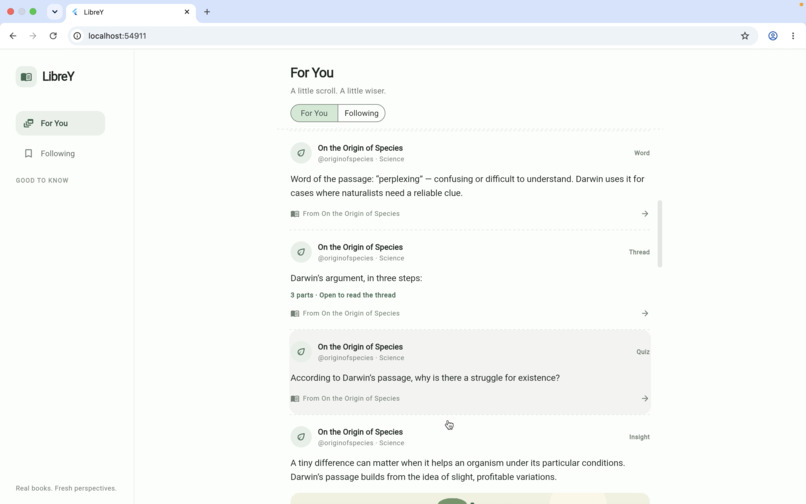
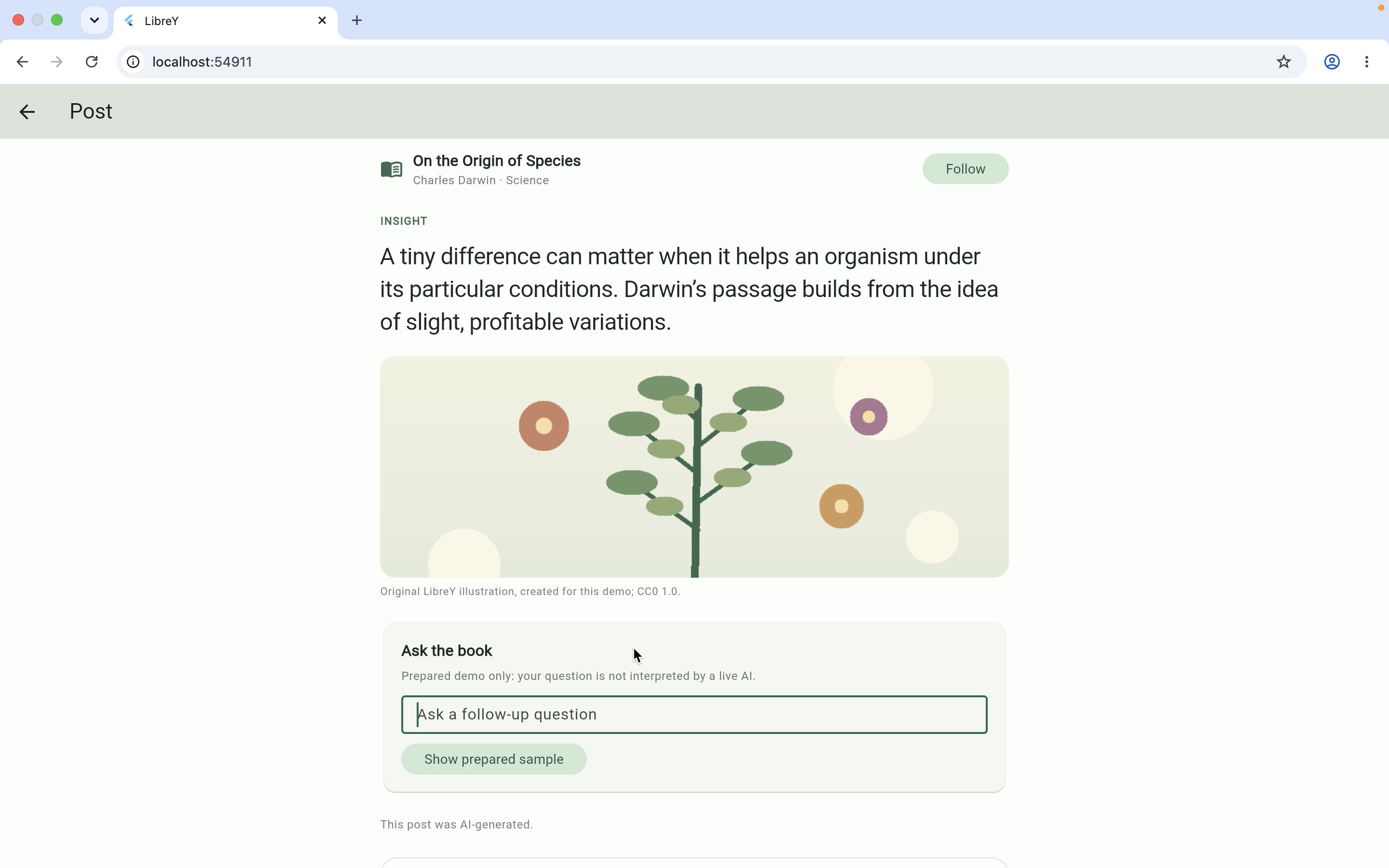
The feed showing the posts
-
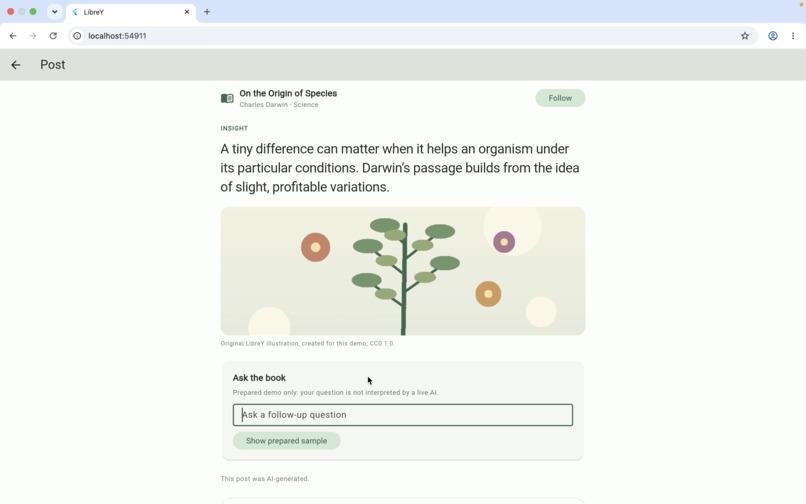
An example of interactive post
-
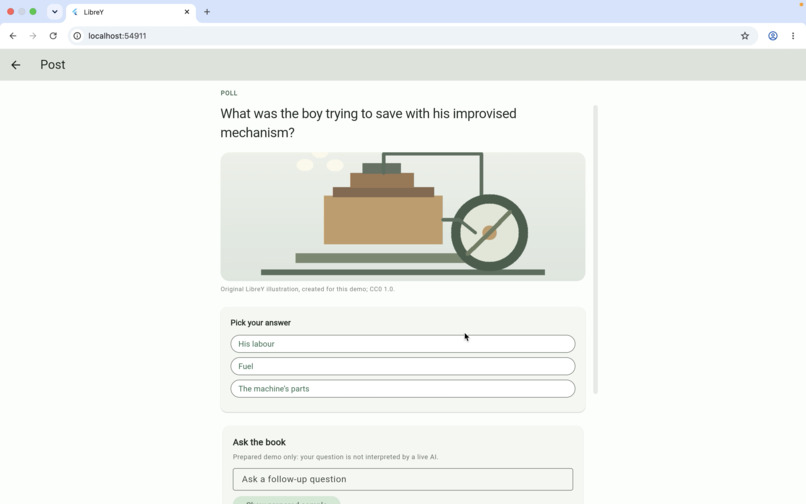
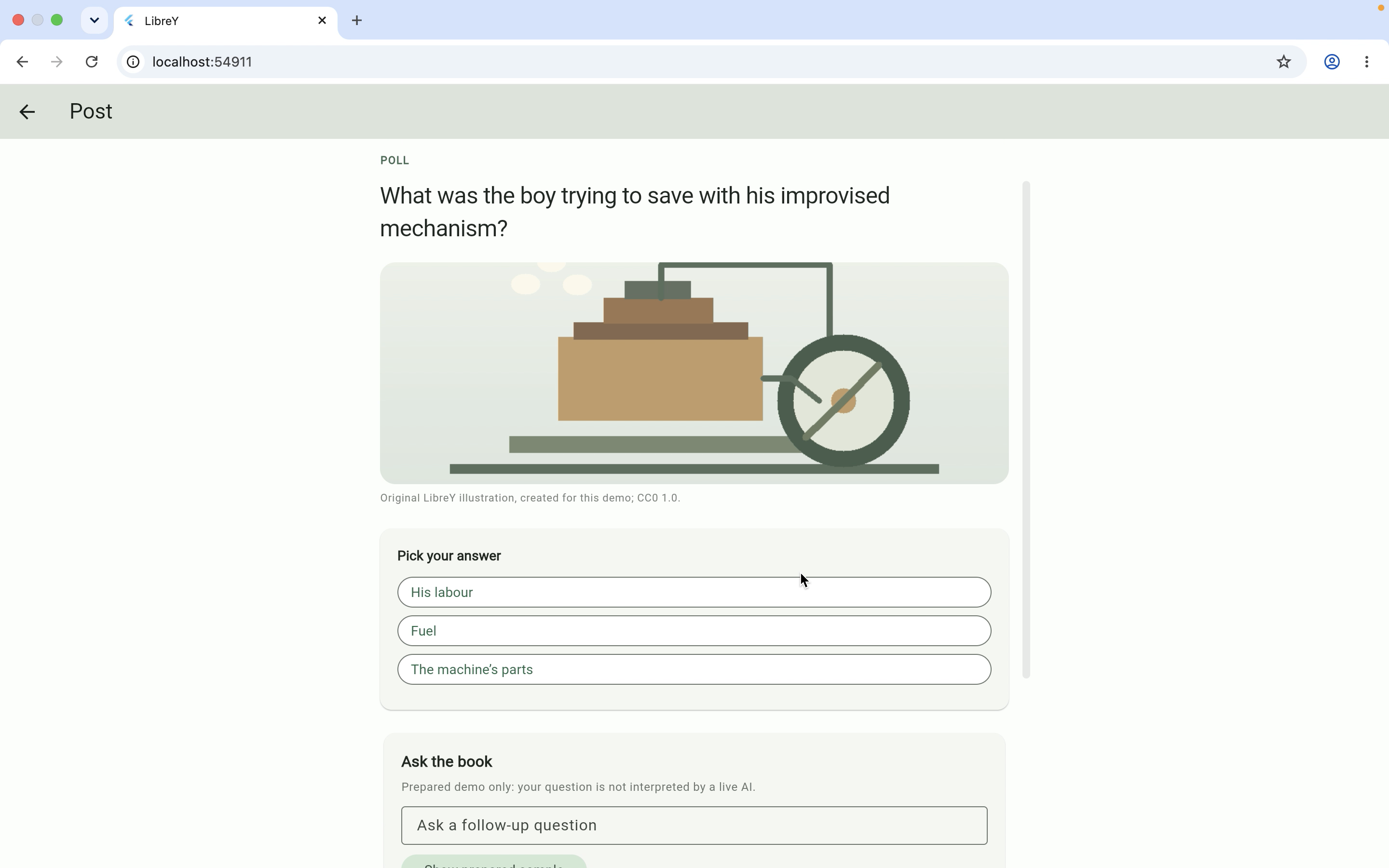
Another example of interactive post
Inspiration
Most modern social feeds capture attention with low-value content, while reading long-form classics is rewarding but intimidating to start in short bursts of free time. LibreY bridges the two: it transforms public-domain classic books into a modern, bite-sized social feed. Readers get micro-learning content on demand, with a direct pathway into deep reading whenever a post piques their interest.
What it does
LibreY presents classic literature through a social feed where every post is strictly grounded in a real book passage.
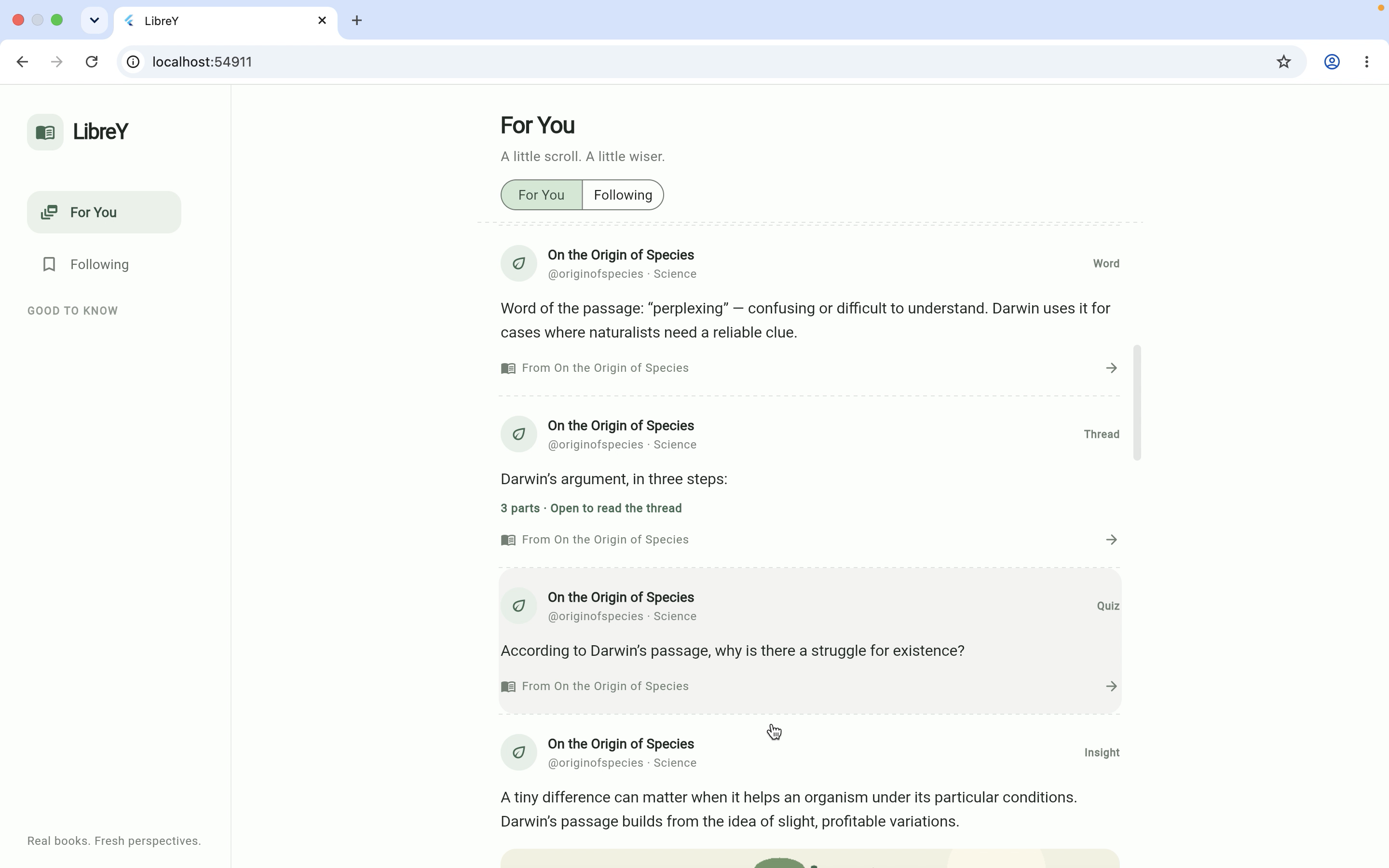
6 Grounded Post Kinds: Insight (thesis analysis), Quote (verbatim excerpts), Word (vocabulary definitions), Thread (multi-part breakdowns), Quiz (interactive multiple-choice), and Debate (community polling).
Exact Citation & Reader Jump: Every card cites the exact sentence in the passage that supports it. Tapping a card opens the distraction-free reader scrolled to the highlighted text, with links to the full book on Project Gutenberg.
Client-Side "For You" Feed: Ranks posts using local engagement signals (dwell time, saves, votes, topic follows),maintaining book diversity (no book repeated twice within three cards) and reserving 1 in 6 slots for topic discovery.
Book Following & Word Bank: Allows users to follow specific book accounts (e.g., @OriginOfSpecies,@Meditations), save archaic vocabulary, and track reading progress stored in local browser memory.
Interactive AI Demo: Demonstrates context-aware "Ask the Book" Q&A on post detail screens, showing how readers can question the text directly.
How we built it
Framework: Built with Flutter 3.44.6 and Dart 3.12.2 targeting responsive Web execution (Chrome and static web-server builds).
Architecture: Designed with a decoupled structure separating content repository logic (lib/data/), screens (lib/screens/), and UI components (lib/widgets/).
Data Fixtures: Bundled raw text, passages, and original image assets directly under assets/data/ and assets/images/for zero-latency, offline-capable performance.
Testing Suite: Comprehensive unit and integration test coverage (flutter test) verifying text string integrity, feed ranking formulas, discovery slot rules, and mobile/desktop responsive rendering.
Challenges we ran into
Natural AI Text Generation: Prompting and structuring AI outputs so dense 18th- and 19th-century prose translates into authentic, natural-sounding social media formats (hot takes, "POV:", "TIL", cliffhangers) without feeling robotic or distorting the author's original message.
Asset & Image Generation: Sourcing, generating, and compressing custom post illustrations to maintain high visual appeal while keeping overall package size low and web load speeds fast.
Strict Grounding Integrity: Ensuring exact character-for-character verification between social post claims/quotes and raw bundled book passages.
Client-Side Feed Balance: Constructing an algorithmic feed in pure Dart that balances user affinity scoring with strict visual diversity rules without requiring a backend server.
Cross-Platform Responsive Layouts: Designing a UI that feels natural as a single-column mobile feed while efficiently utilizing screen real estate on desktop browsers.
Accomplishments that we're proud of
Natural, Edutaining Content Tone: Successfully engineering AI prompt structures so posts feel like authentic social media: fun, punchy, and hook-driven; allowing users to scroll casually while seamlessly learning complex concepts.
Textual Precision at Scale: Converting dense historical texts (On the Origin of Species, The Wealth of Nations, and Meditations) into modern micro-formats without sacrificing textual accuracy.
Zero-Backend Architecture: Building a fully testable web proof-of-concept with local state persistence for user engagement signals.
Seamless Reader Flow: Delivering an immediate transition from bite-sized feed scrolling to focused, long-form reading in a single tap.
What we learned
- Fast Iteration with AI: Participating in the Build with AI hackathon showed us how effectively LLMs can be harnessed during rapid development, enabling fast iteration on content pipelines, prompt templates, and feature prototyping under tight hackathon constraints.
- Text Chunking & Indexing: Structuring unstructured public-domain books into micro-learning assets linked back to exact source coordinates.
- Client-Side Feed Engineering: Practical techniques for building responsive web layouts and multi-factor ranking algorithms in Flutter without a server.
- Educational Retention UX: Balancing bite-sized social mechanics with genuine literary depth.
What's next for LibreY
Book Rooms & Reader Community: Dedicated live discussion rooms and topic study spaces for readers to connect, exchange thoughts, and discuss their favorite books with like-minded readers.
Live AI Models: Connect live LLM APIs for real-time context-grounded Q&A and dynamic post generation.
Library Expansion: Expand bundled text processing across thousands of Project Gutenberg titles across science, philosophy, and fiction.
Spaced-Repetition Study Tab: Implement a full Leitner review schedule for saved vocabulary words.
Shareable Web Previews: Add server-side rendering for /p/:id URLs with OpenGraph cards for direct sharing across social networks.
Built With
- dart
- flutter


Log in or sign up for Devpost to join the conversation.