-
-
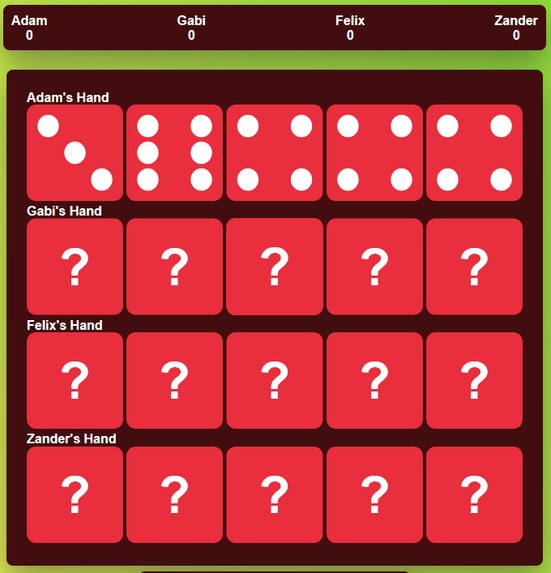
The dice table with Adam's turn showing on the board.
-

Titlecard Felix made for the project
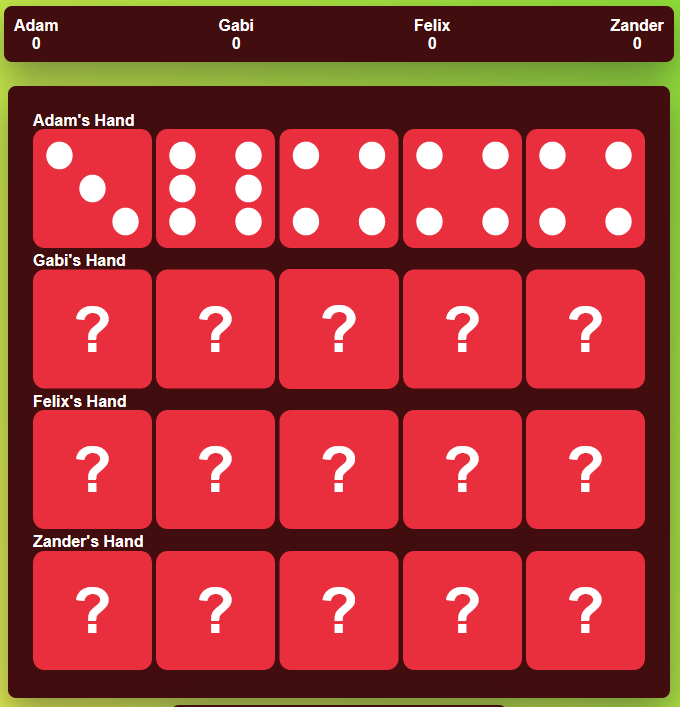

Inspiration
We based our project after a game shown in a deleted scene from Pirates of the Caribbean: Dead Man's Chest which is based off a real life tabletop game game, Perudo. Perudo, or Liar's Dice, is a game of deception whereas each player rolls their dice privately and makes claims as the the total amount of a face rolled across the table. When a person challenges, all the dice are shown and points are distributed whether or not the claim was true.
What it Does
Liar's Dice is a web hot seat game where four friends can play Liar's Dice. The game permits the user to input up to four player names and allows for a local version of Liar's Dice to be played, complete with instructions and prompts to continue turns.
How We Built it
We used HTML, CSS, and JavaScript to build three pages: the menu, the game, and the win screen. We used local storage to reuse names if the users decide play again and share them between the three webpages. The game itself was developed through an external Javascript sheet that takes in the user's names, rolls all hands on game load, and permits the first player to claim a die face and an amount. Gameplay continues with each turn going clockwise around the table.
Challenges We Ran Into
Using name input from the players for the main game and winning screens from the menu was an issue since it would not save across the pages. We fixed this issue by using the browser session storage to save the names and updating them when appropriate.
Formatting issues with CSS
Accomplishments that we're proud of
Animated CSS background in the start and end pages.
Custom die and amount selectors made with custom SVG graphics.
Animated highlighting of the die in the game.
Live log of events that happen during the game.
What We Learned
In working on this project, most of us had never worked with others in a project-based environment before, let alone a thirty-six hour hackathon. Javascript was definitely none of our fortes, so we all had to learn some form of Javascript in order for our project to come to fruition. In addition, making our UI look stylish definitely required time to comprehend and implement as well. In particular, Zander was in charge of programming game logic and creating vector assets, Adam was in charge of styling for the pages and the menu, Gabi was in charge of time management and creating the rules (and some mechanics) for the game, and Felix also worked on the frontend in regards to styling. Everyone, in their category, learned in regards to styling, javascript mechanics, using and creating vector assets, and working in a project-based environment through github.
What's Next for Liar's Dice?
-Implement better, more efficient website design -Improve the UI of the game to look more appealing and intuitive -Online Multiplayer version -Option to change the number of players


Log in or sign up for Devpost to join the conversation.