-
-
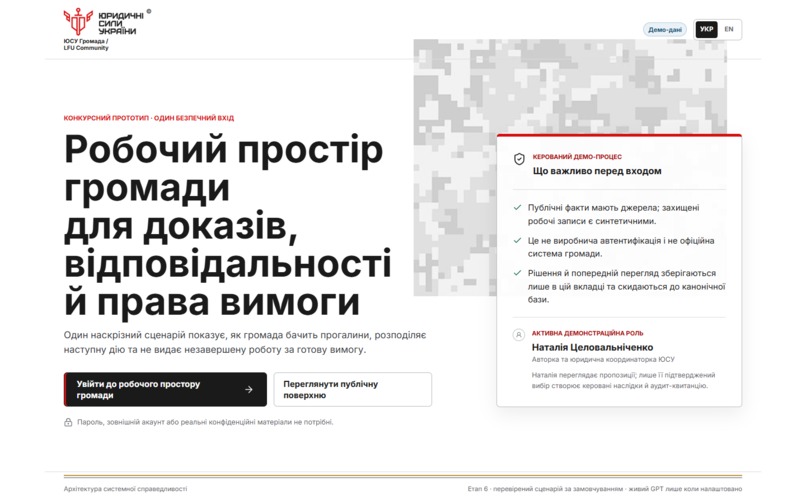
LFU Community: governed entry to the community justice workspace
-
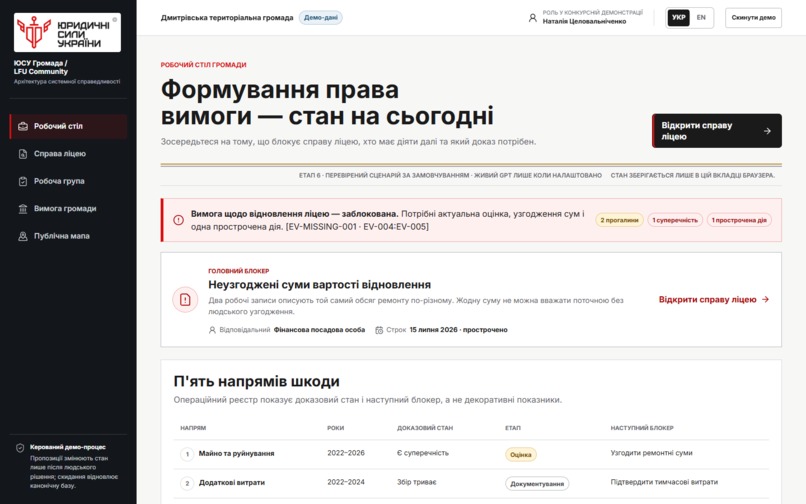
Governed memory, evidence readiness, and visible blockers
-
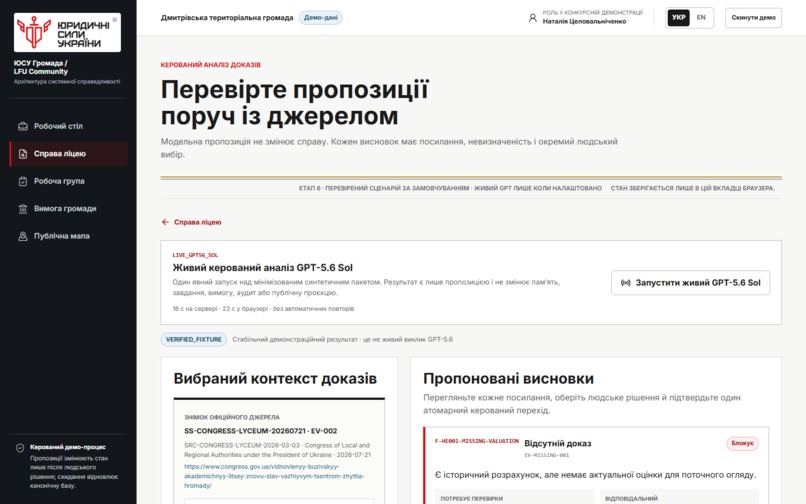
AI proposes, human decides: cited and reviewable findings
-
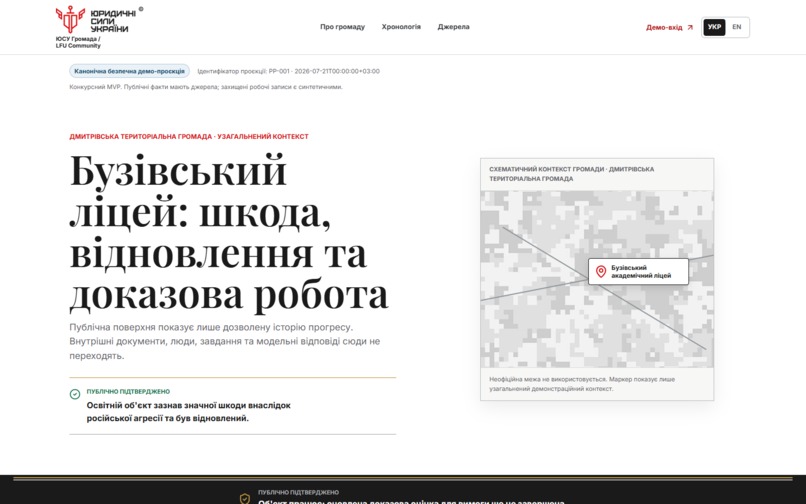
Privacy-safe public projection for the community
Inspiration
When Russian aggression destroys a school, home, or community asset, a Ukrainian territorial community faces a second battle: proving what happened across changing records, incomplete evidence, different valuation periods, and sometimes conflicting official figures.
The challenge is not merely collecting documents or filing a form. Communities need a trustworthy institutional memory that preserves where every fact came from, what has been verified, what remains disputed, who made each decision, and whether the evidence is actually ready for legal action.
LFU Community grew from the real work of the Legal Forces of Ukraine project with Ukrainian territorial communities affected by Russian aggression.
What it does
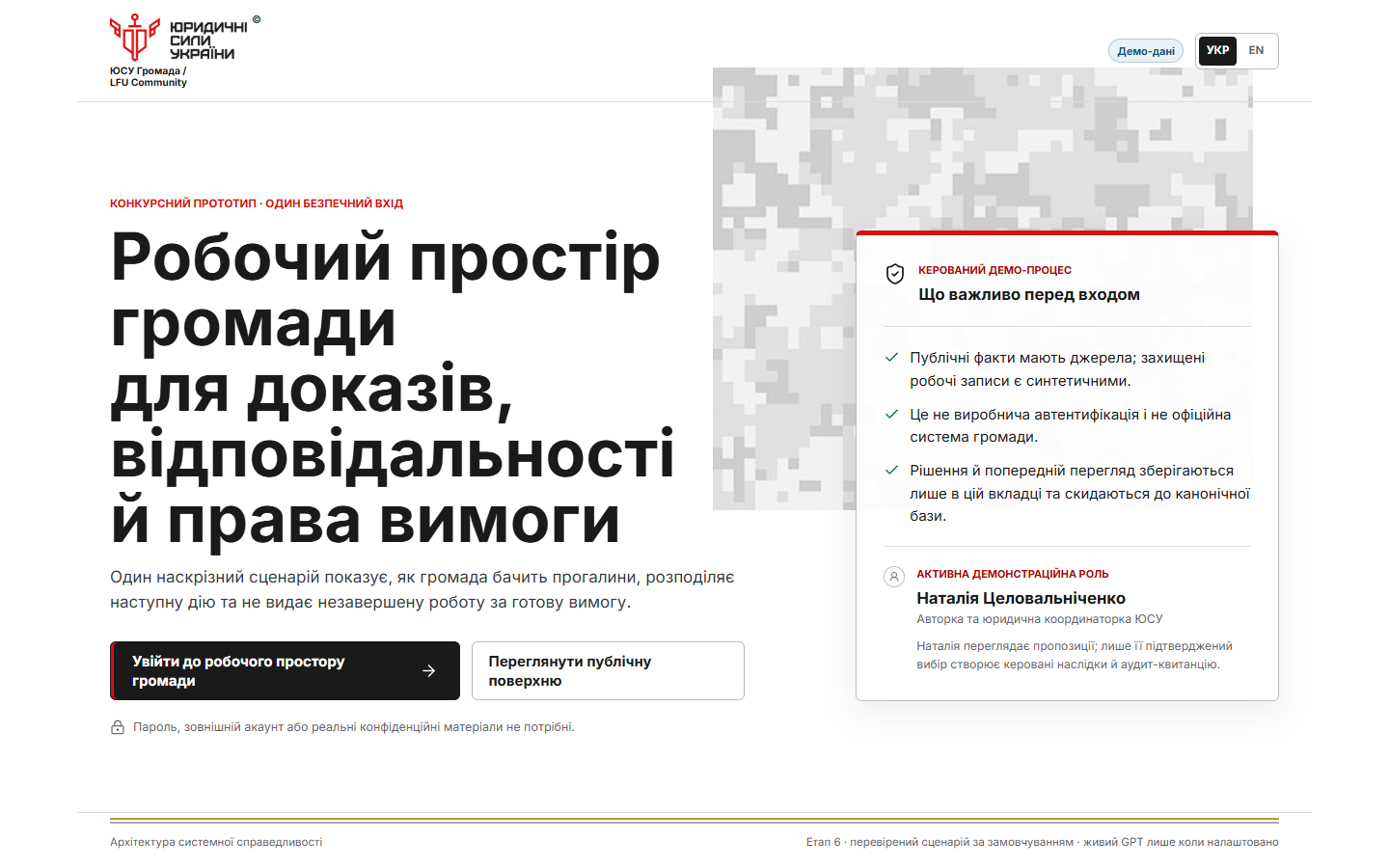
LFU Community is a bilingual, governed community-justice workspace for transforming fragmented war-damage evidence into a transparent, human-authorized path toward justice.
The MVP demonstrates one complete workflow for the Dmytrivska Territorial Community in Bucha district:
- preserves sources, snapshots, assertions, versions, and provenance;
- distinguishes public facts from synthetic protected demonstration records;
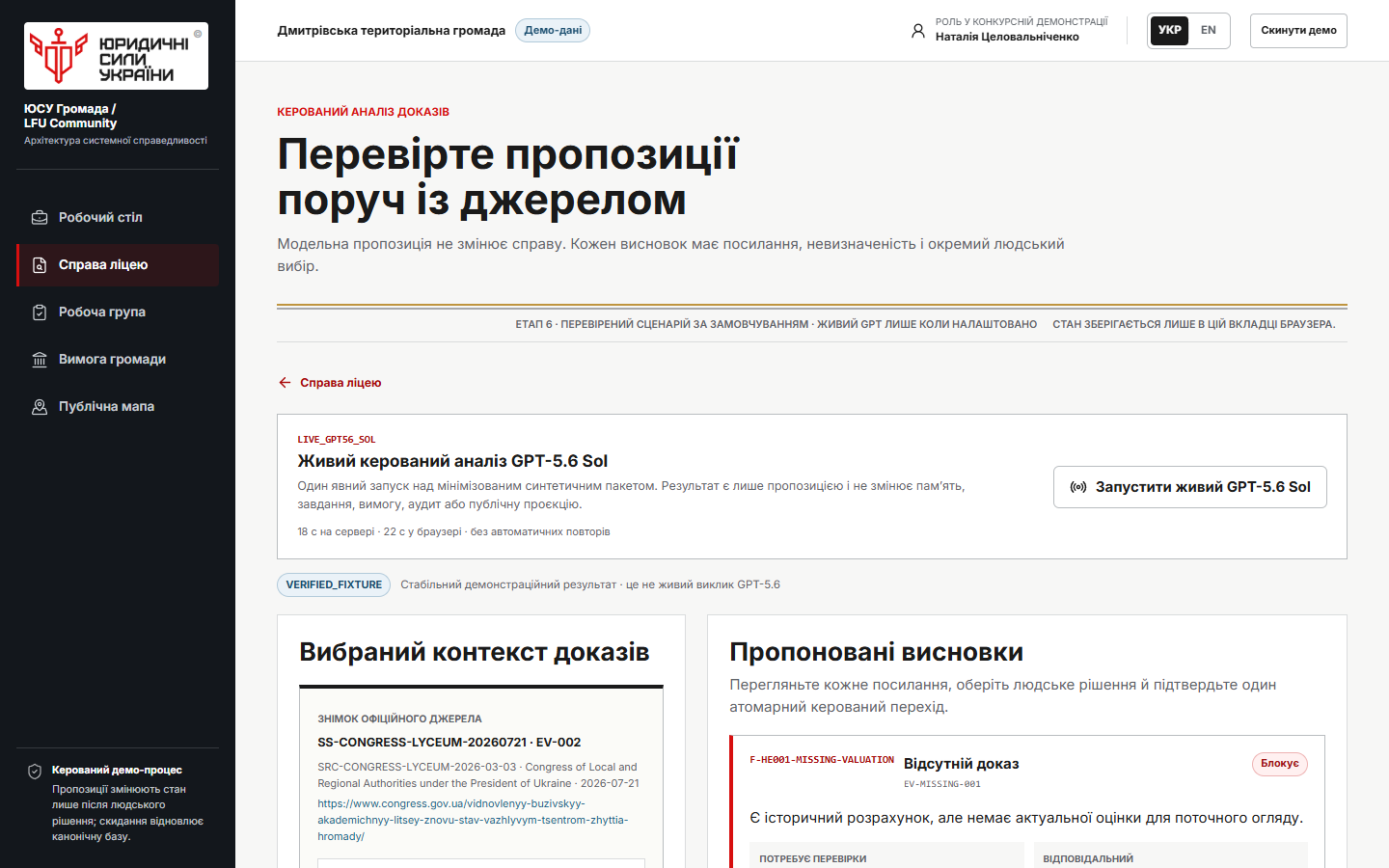
- lets AI analyze evidence and propose structured findings;
- requires an authorized human to admit, reject, defer, or supersede every AI finding;
- creates tasks and audit receipts from those decisions;
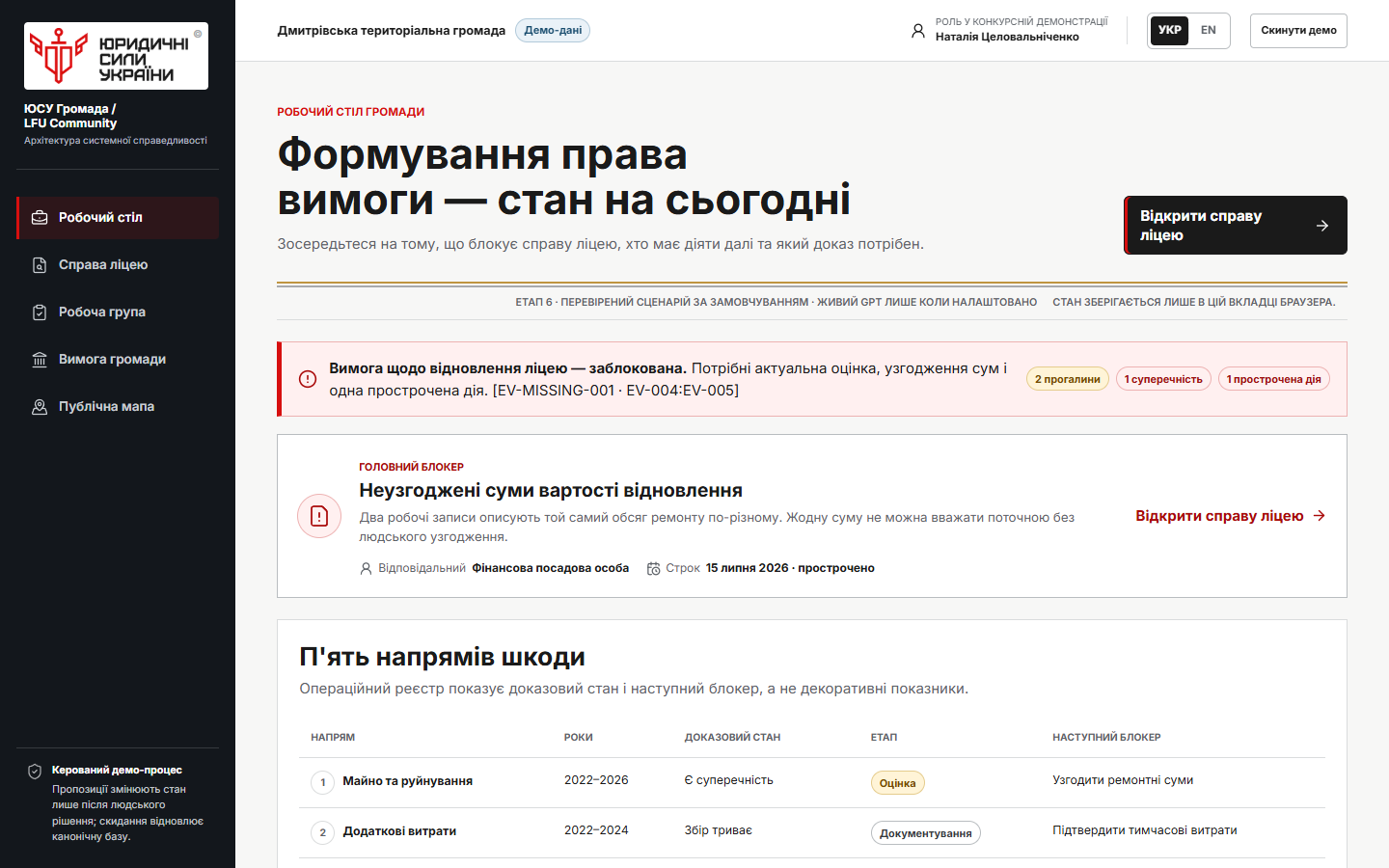
- calculates dossier readiness without concealing missing or contradictory evidence;
- keeps the claim correctly marked as BLOCKED when the evidence is insufficient;
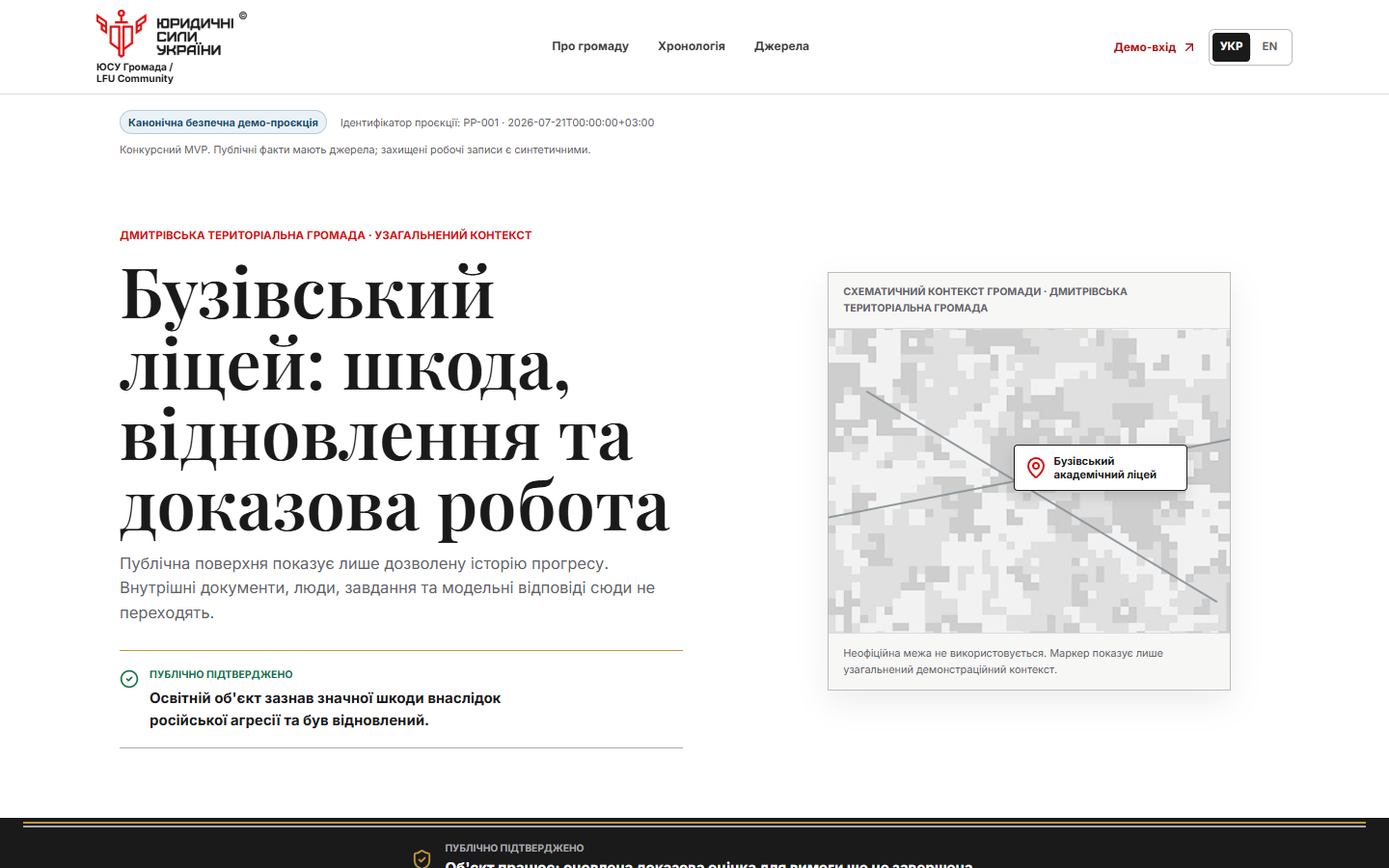
- creates a privacy-safe public projection using a positive allowlist.
The public surface communicates verified community recovery information without exposing internal people, tasks, protected amounts, model responses, or confidential evidence.
How we built it
Codex was our primary engineering environment. The application was built through eight gated stages: a pinned technical scaffold, bilingual visual system, typed domain graph, governed product memory, deterministic human-decision workflow, GPT-5.6 integration, reliable Windows runtime, and final accessibility, privacy, and reliability hardening.
Primary Codex task Session ID: 019f8361-b31f-7232-8ce8-798049a943ed.
The application uses Next.js, React, TypeScript, Zod, Vitest, Playwright, and Vercel.
The AI boundary integrates gpt-5.6-sol through a server-only OpenAI Responses API adapter. It:
- sends only a minimized synthetic evidence packet;
- requires strict structured output and valid evidence references;
- supports citations, uncertainty, and abstention;
- enforces bounded timeouts and zero automatic retries;
- rejects malformed or injection-like output;
- cannot mutate governed memory, publish information, or make legal decisions.
The submitted demonstration is transparently labelled VERIFIED_FIXTURE. No API key is stored in the repository, and the fixture is never represented as a live model call.
Challenges we ran into
The hardest challenge was designing memory that could be trusted in a legal and public-sector context. A conventional database can store the latest value, but it does not necessarily preserve why that value changed, which source supported it, or who authorized the change.
We also had to solve several tensions:
- transparency versus protection of personal and sensitive information;
- useful AI assistance versus prohibited automated legal decision-making;
- conflicting official sources versus the temptation to choose one silently;
- a clear demonstration versus honest disclosure of MVP limitations;
- bilingual accessibility versus visual and semantic consistency;
- local Windows reliability versus hosted demonstration requirements.
One real example became a central product test: two official sources contained different population figures. LFU Community preserves both, identifies the contradiction, and blocks readiness instead of inventing certainty.
Accomplishments that we're proud of
We are proud that the successful demonstration does not end with a false green status. It ends with a justified BLOCKED decision because the available evidence is not yet sufficient. For a justice product, refusing to manufacture readiness is a core capability.
We also built:
- append-only governed memory with provenance and version history;
- human authorization for every consequential AI proposal;
- visible audit receipts explaining what changed and why;
- strict separation between internal and public information;
- a newly constructed positive-allowlist public projection;
- bilingual Ukrainian and English interfaces;
- deterministic fixture and live-AI paths that are visibly distinguished;
- extensive automated regression, browser, privacy, and runtime checks;
- a deployable demonstration that works both locally and through a hosted URL.
What we learned
We learned that trustworthy AI for justice depends less on producing confident answers and more on preserving uncertainty, provenance, institutional responsibility, and the right to abstain.
AI is most valuable here as a disciplined analyst and coordinator. It can find gaps, compare records, identify contradictions, and propose next actions. It must not silently rewrite institutional memory or replace the authorized human decision-maker.
We also learned that public transparency should not be implemented as a filtered copy of internal data. The safer approach is to construct the public view independently from an explicit allowlist of publishable fields.
What's next for LFU Community
The next step is a supervised pilot with the Dmytrivska Territorial Community using formally authorized workflows and protected infrastructure.
The product roadmap includes:
- production authentication and role-based access;
- encrypted persistent storage and secure document handling;
- evidence upload, validation, and document-quality assessment;
- support for dated commission acts and multiple damage categories;
- monitoring of Ukrainian legislation, case law, and compensation mechanisms;
- coordinated workflows for local authorities, civil-society institutions, counsel, and affected people;
- consultations and evidence support for individual victims;
- integration of the public community map with municipal and LFU websites;
- interoperable standards for a nationwide network of community-controlled local systems.
The long-term goal is a distributed, interoperable platform in which each community retains control over its own data while LFU provides shared legal methodology, coordination, and privacy-safe national analytics.
Built With
- chatgpt-5.6
- codex
- next.js
- openai
- playwright
- react
- typescript
- vercel
- vitest
- zod

Log in or sign up for Devpost to join the conversation.