-
-
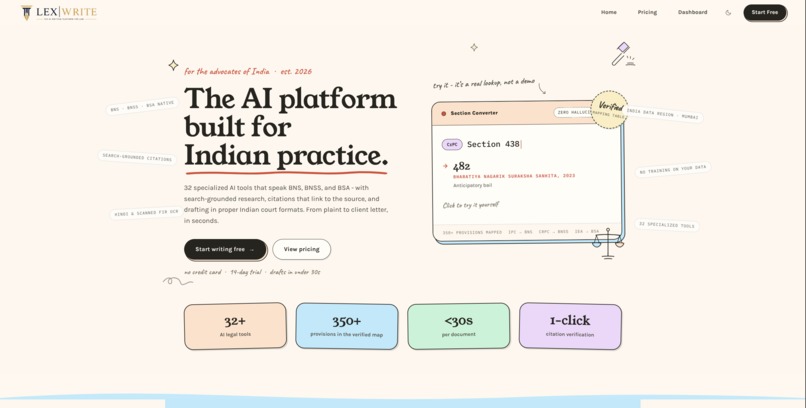
Home Page
-

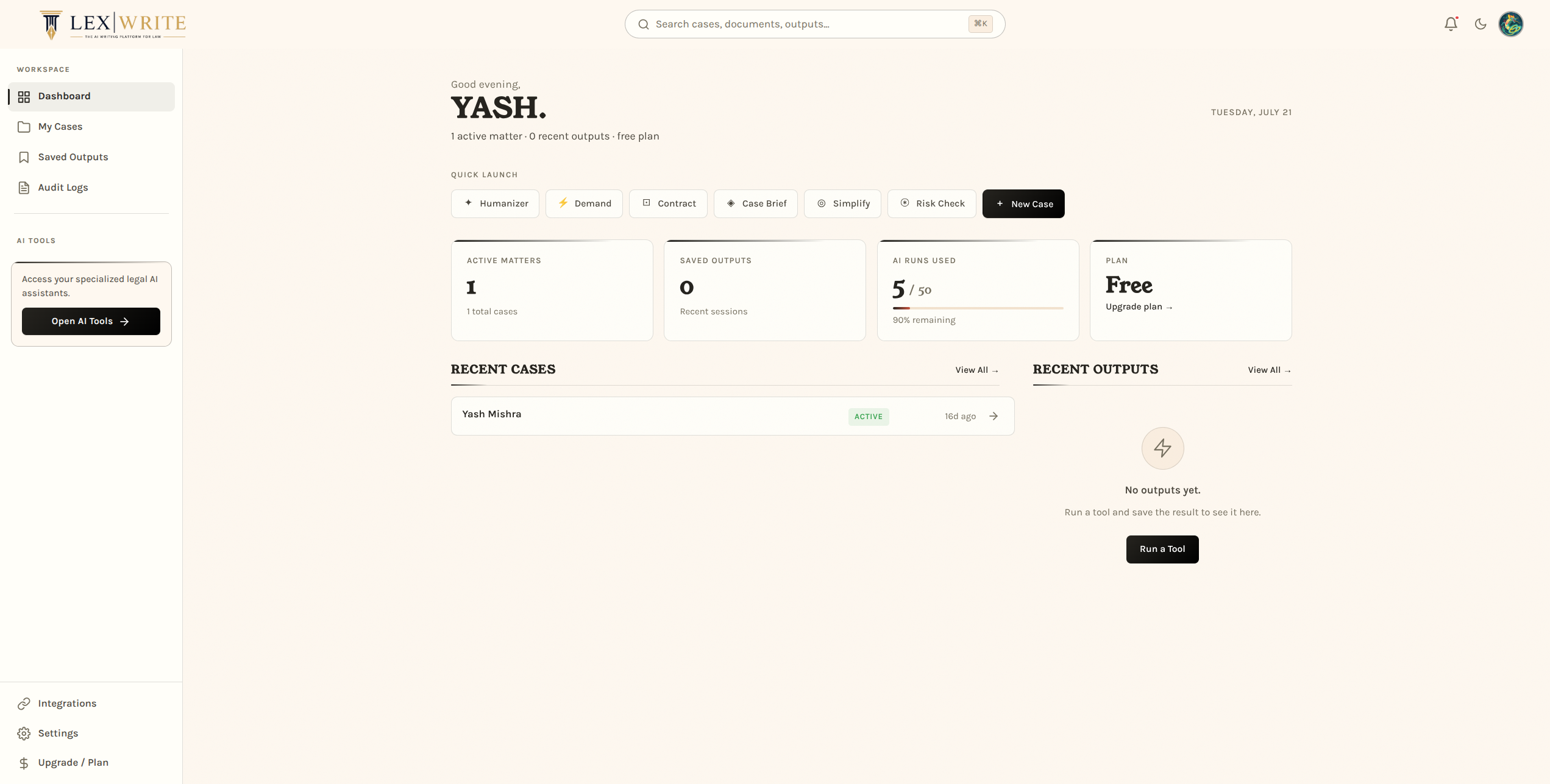
Dashboard
-
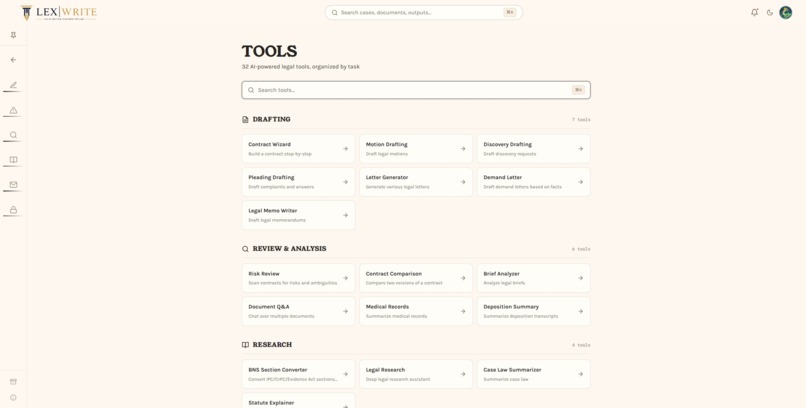
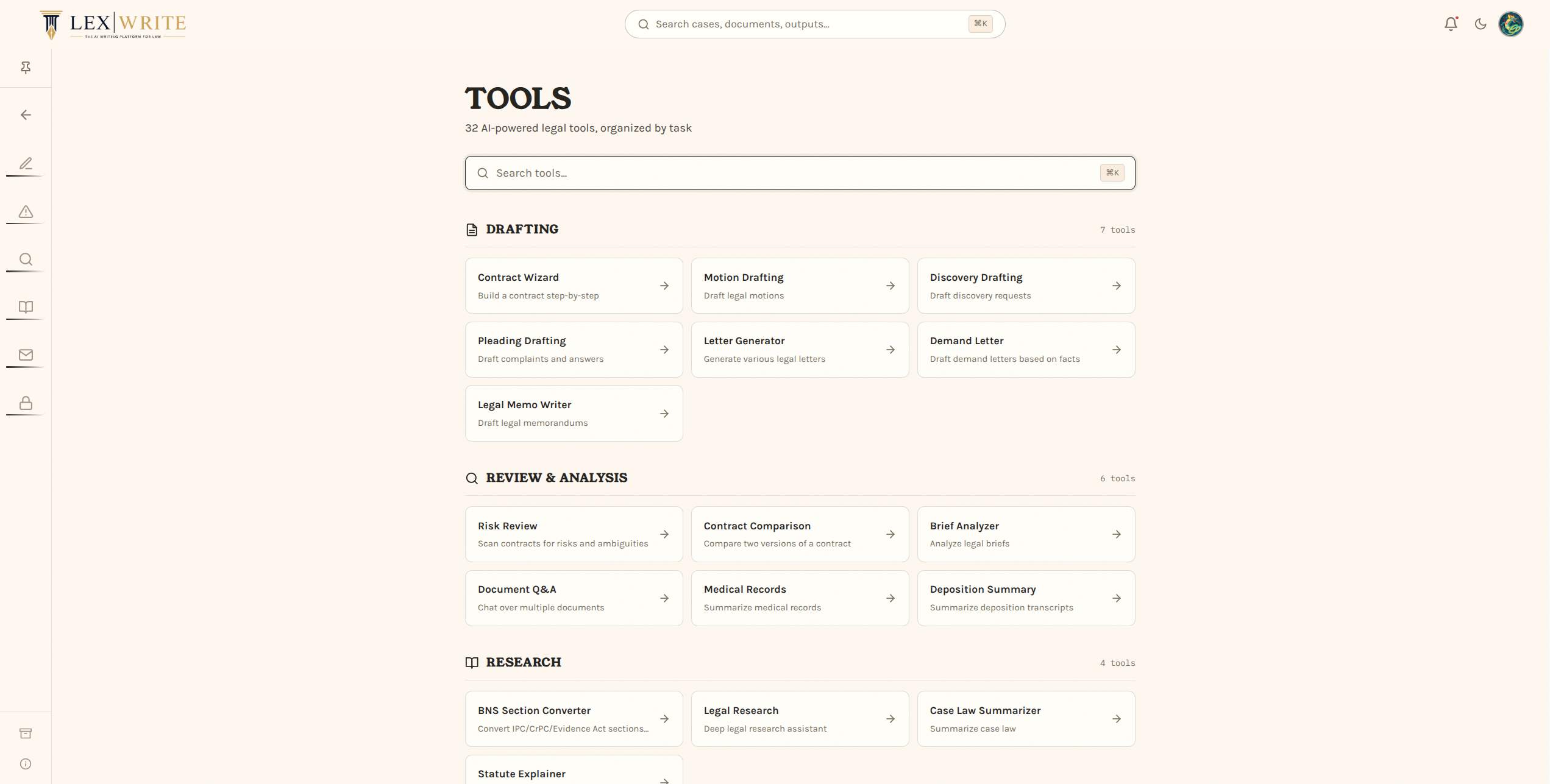
All Tools
-
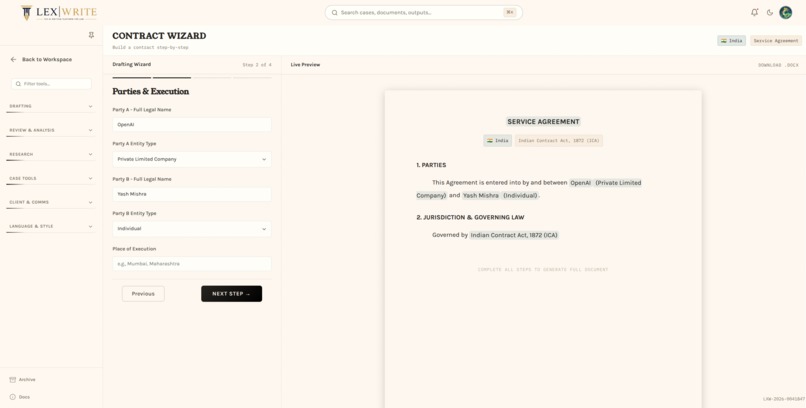
Tool Demo
-
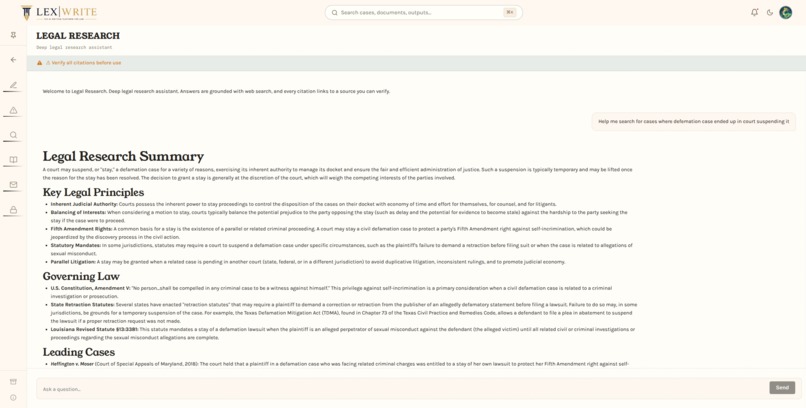
Tool Demo Research
-
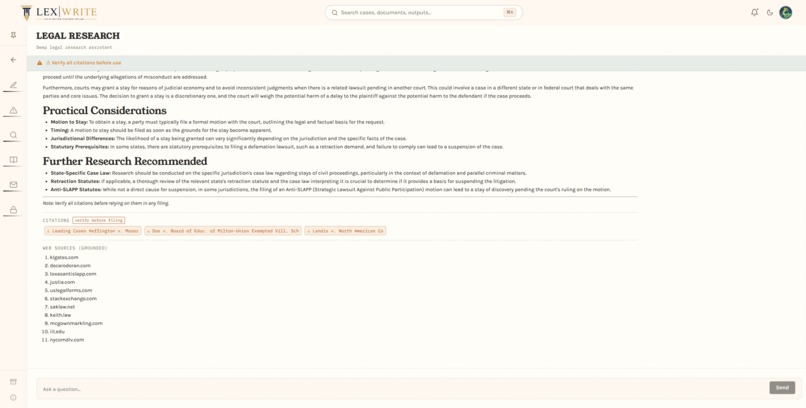
Search Grounding
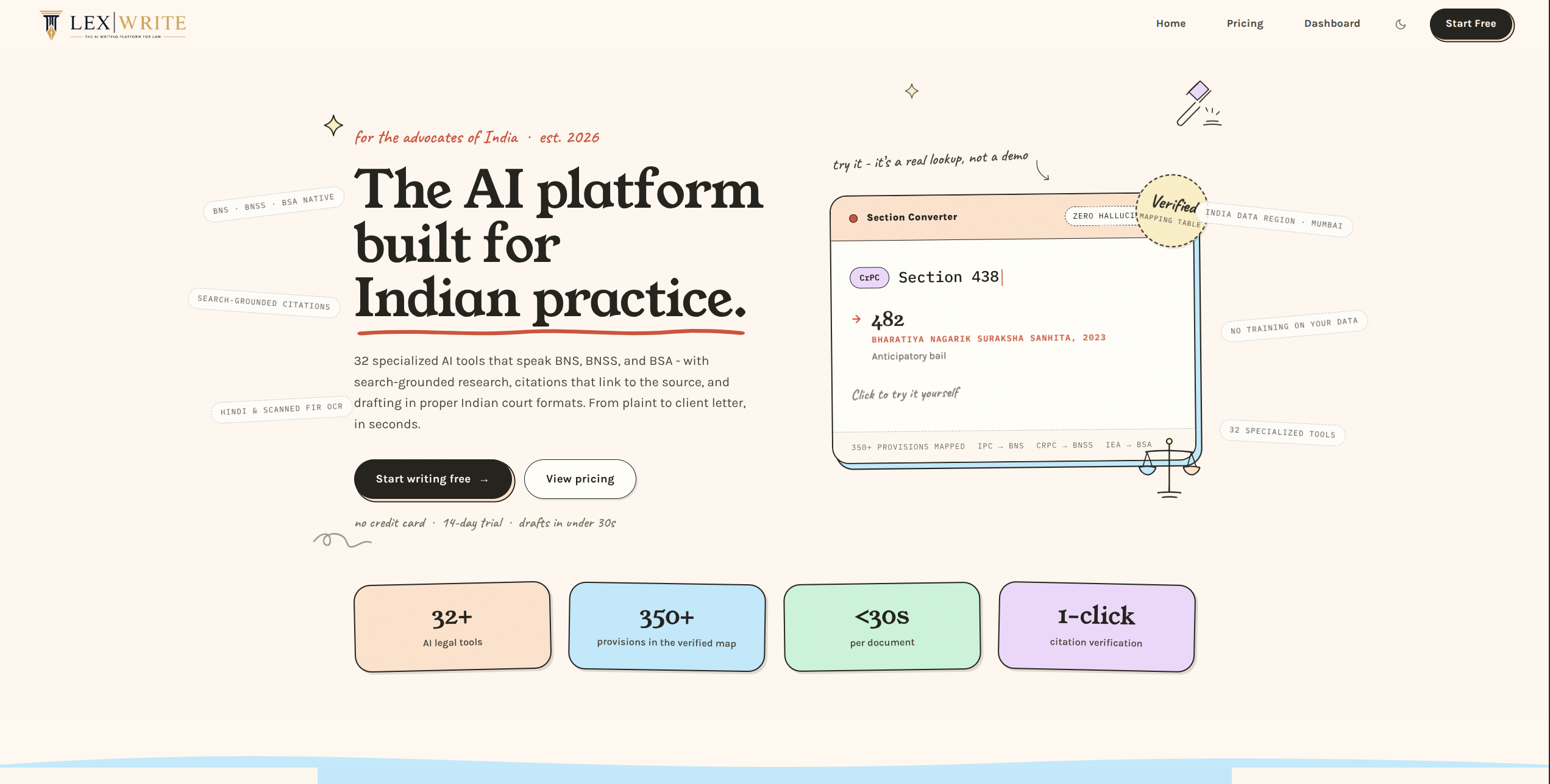
LexWrite - The AI Platform Built for Indian Legal Practice
Inspiration
Legal AI has advanced rapidly, but most products are still built around generic chatbots. They can generate legal-looking text, but they don't understand how lawyers actually work. Indian advocates need documents drafted in Indian court formats, guidance through the transition from IPC to BNS, verifiable legal research, and outputs they can confidently review before filing.
While speaking with advocates and law students, we repeatedly heard the same problems:
- AI hallucinated statutes and case law.
- Research citations were difficult to verify.
- Drafts followed foreign legal conventions instead of Indian practice.
- Lawyers still had to manually review every document for missing facts, procedural requirements, and filing defects.
- Every task required prompt engineering instead of following a structured legal workflow.
We realized the problem wasn't that legal AI was missing another model, it was missing the workflows that lawyers actually follow.
That became the foundation of LexWrite.
What We Built
LexWrite is an AI platform built specifically for Indian legal practice.
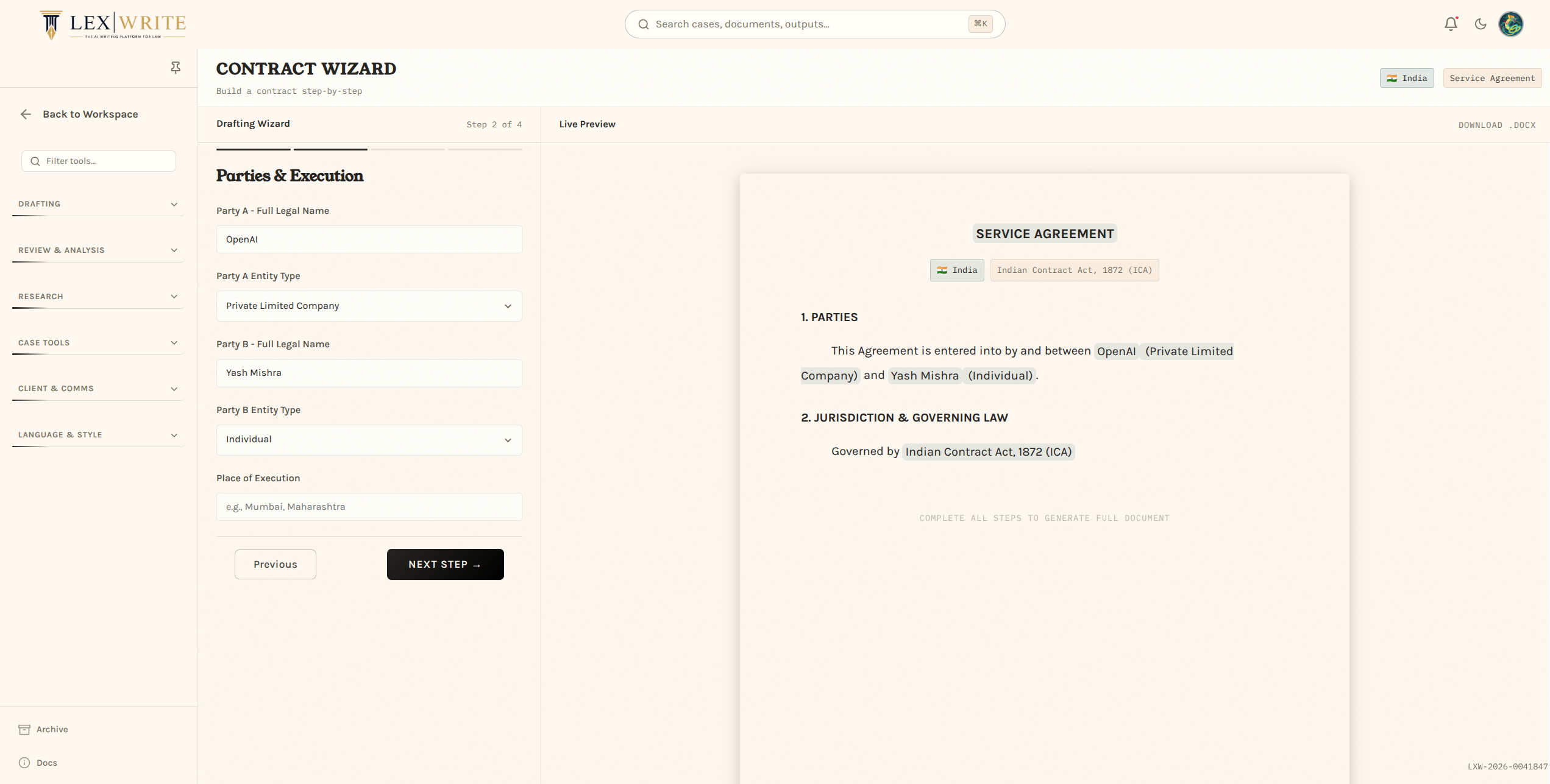
Instead of offering a single chatbot, LexWrite provides 32 specialized legal workflow tools covering litigation drafting, legal research, document review, contract analysis, evidence extraction, client communication, case strategy, legal writing, and statutory conversion.
More importantly, these are not AI prompts wrapped in a UI.
Each tool has been engineered as a complete legal workflow that combines deterministic validation with AI reasoning.
Depending on the task, LexWrite performs structured intake, document retrieval, authority planning, evidence extraction, rule-based validation, citation verification, risk analysis, and post-generation quality checks before presenting the final result.
This allows the platform to produce outputs that are transparent, reviewable, and significantly more reliable than traditional AI assistants.
How We Built It
LexWrite combines modern language models with deterministic legal systems.
Our architecture includes:
- Large Language Models for drafting, reasoning, summarization, and language transformation.
- Deterministic validation engines that verify inputs before AI generation.
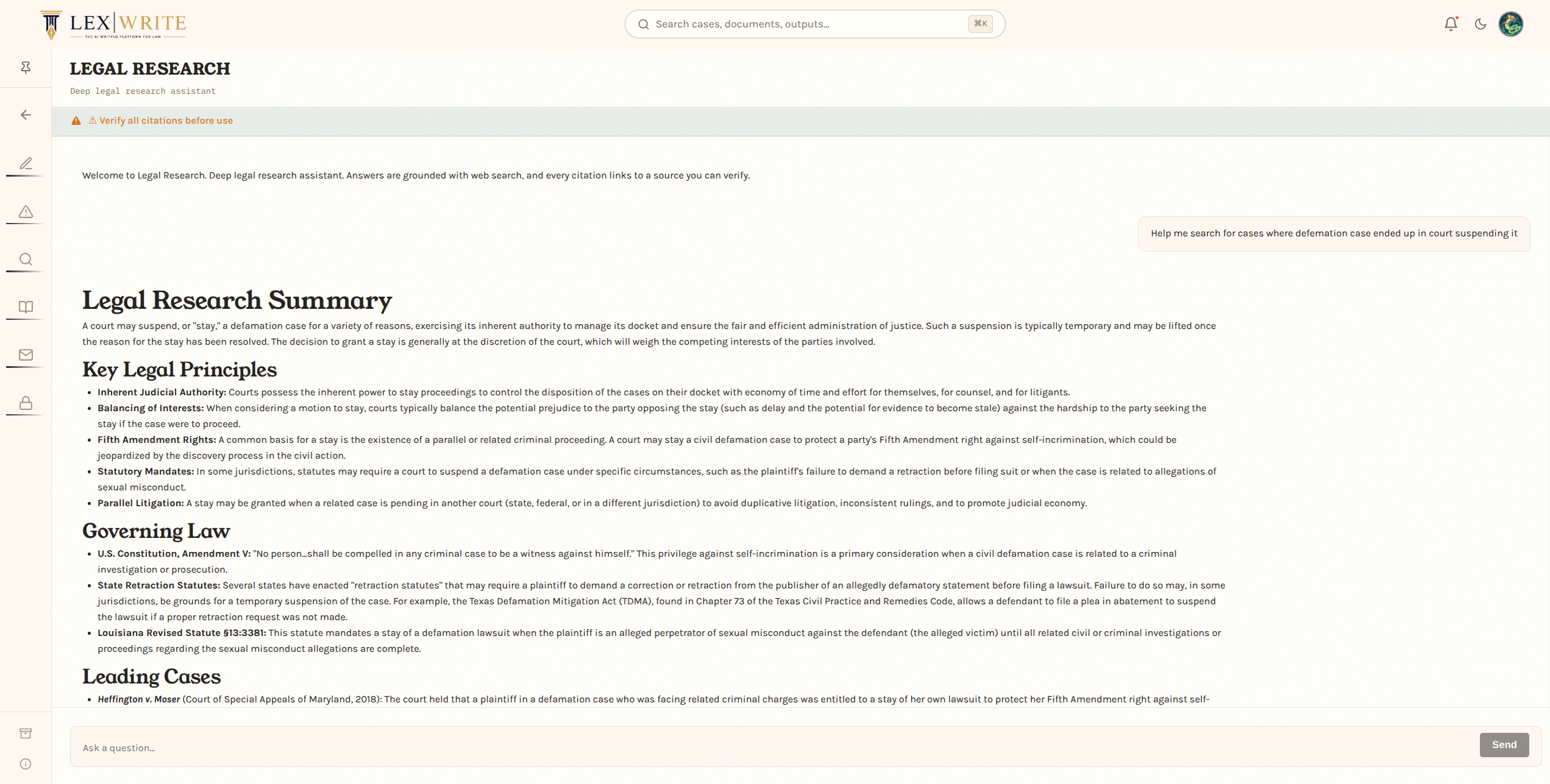
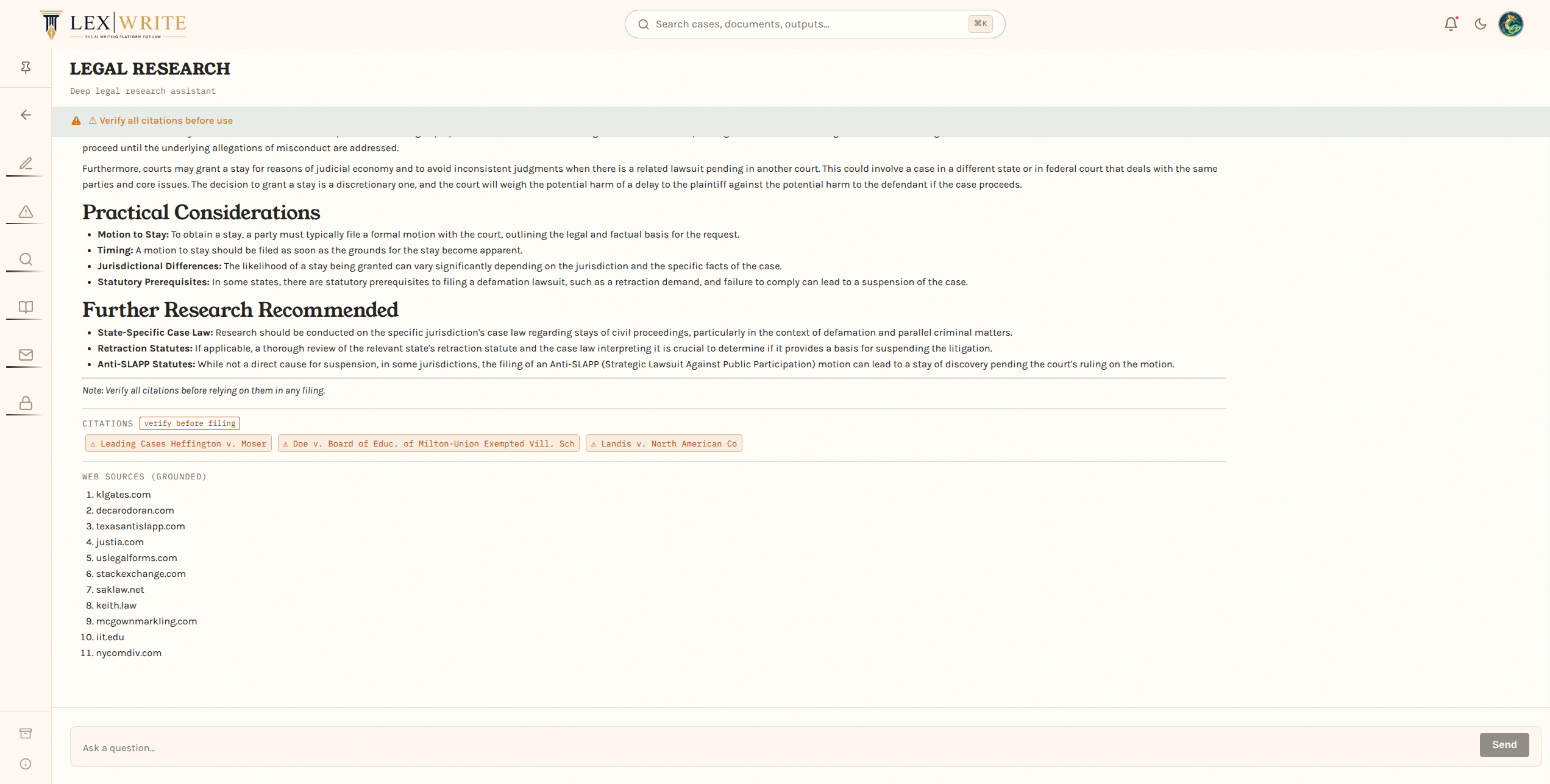
- Search-grounded legal research instead of relying solely on model memory.
- A verified statutory mapping database for IPC ↔ BNS, CrPC ↔ BNSS, and Evidence Act ↔ BSA conversions.
- OCR pipelines for scanned FIRs, photographs, PDFs, and Hindi legal documents.
- Matter-scoped document retrieval so AI only works from documents belonging to the selected case.
- Structured output rendering that exposes verification status instead of hiding it.
Rather than asking users to "trust the AI," LexWrite shows why a result should be trusted.
Research tools generate authority plans before analysis.
Document Q&A verifies whether uploaded documents actually answer the user's question.
Contract review performs deterministic clause analysis before AI commentary.
Settlement estimation combines rule-based valuation models with AI reasoning.
Litigation drafting validates procedural requirements before generating court-ready drafts.
Section conversion is handled using verified statutory mapping tables instead of AI prediction.
What Makes LexWrite Different
The biggest engineering challenge was transforming generic AI prompts into reliable legal software.
Every one of the 32 tools follows the same product philosophy:
- Collect structured legal facts instead of relying on free-form prompts.
- Run deterministic validation before AI generation whenever accuracy matters.
- Ground outputs in uploaded documents, verified mappings, or trusted legal sources.
- Surface missing information, confidence, verification status, and review tasks instead of hiding uncertainty.
- Render audits and control sheets directly in the interface.
- Protect every workflow with regression tests so tools cannot silently regress into generic AI responses.
For example:
- Contract Review generates clause-level control sheets, identifies missing protections, and highlights negotiation blockers.
- Legal Research builds jurisdiction-aware authority plans, separates binding from persuasive authority, and provides verification checklists.
- Document Q&A determines whether uploaded documents actually support an answer before responding.
- Pleading Drafting validates jurisdiction, valuation, limitation, court fees, verification clauses, and procedural requirements before generating pleadings.
- Case Strategy tools identify proof gaps, missing evidence, admissions, and litigation risks rather than simply summarizing documents.
- The BNS Section Converter performs deterministic statutory lookups with transition guidance instead of AI-generated mappings.
These workflows transform LexWrite from a writing assistant into a legal work product platform.
Challenges We Faced
Legal software demands a much higher standard than general-purpose AI.
Some of the biggest challenges included:
- Minimizing hallucinations in legal research and drafting.
- Designing deterministic validation systems alongside AI generation.
- Supporting India's transition to BNS, BNSS, and BSA while maintaining compatibility with legacy IPC, CrPC, and Evidence Act references.
- Building workflow-specific pipelines for 32 completely different legal tasks.
- Creating document-grounded AI that respects matter boundaries.
- Designing interfaces that expose verification metadata without overwhelming users.
- Building comprehensive automated regression tests so product quality improves rather than degrades over time.
Balancing AI flexibility with legal reliability became the defining engineering challenge of the project.
What We Learned
Throughout development, we learned that legal professionals don't simply need better language models.
They need software that mirrors how legal work is actually performed.
The strongest results came from combining deterministic systems with AI rather than replacing one with the other.
Rule-based validation handles procedural accuracy, statutory mappings, document retrieval, and evidence extraction, while language models provide reasoning, drafting, summarization, and analysis.
We also learned that transparency builds trust.
Instead of hiding uncertainty, LexWrite exposes missing facts, verification requirements, authority plans, confidence indicators, filing audits, and review checklists so lawyers remain fully in control of every document.
What's Next
Our goal is to make LexWrite the operating system for Indian legal practice.
Upcoming work includes:
- Deeper case-law research and citation verification.
- Additional litigation and transactional workflows.
- Court-specific filing templates across Indian jurisdictions.
- Collaboration features for law firms.
- Matter management and document versioning.
- Expanded multilingual legal support.
- Integrations with legal document management systems and court workflows.
We believe the future of legal AI isn't replacing lawyers it is giving them software that produces work they can verify, trust, and confidently file.
Built With
- actions
- ai
- docker
- embeddings
- fastapi
- github
- gpt-5
- langchain
- markdown
- next.js
- ocr
- openai
- pnpm
- postgresql
- pydantic
- pymupdf
- python
- react
- search
- tailwind
- tesseract
- typescript
- vercel
- vitest

Log in or sign up for Devpost to join the conversation.