-
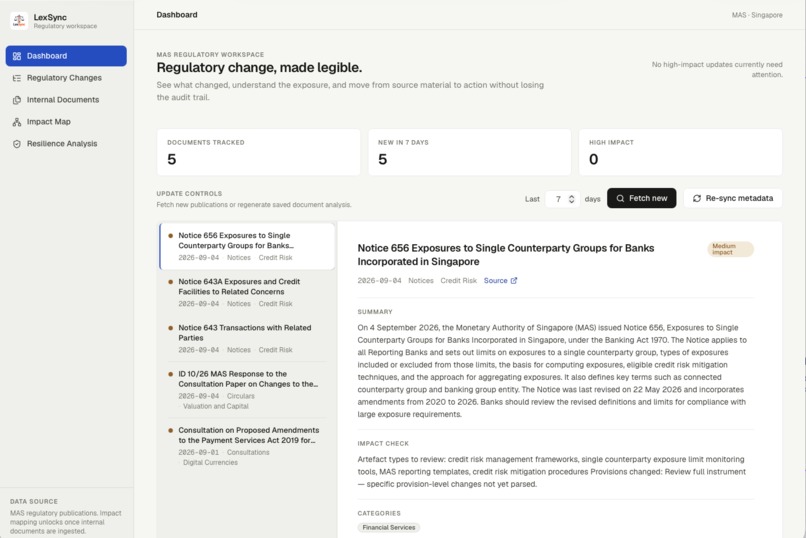
Main Landing Page
-
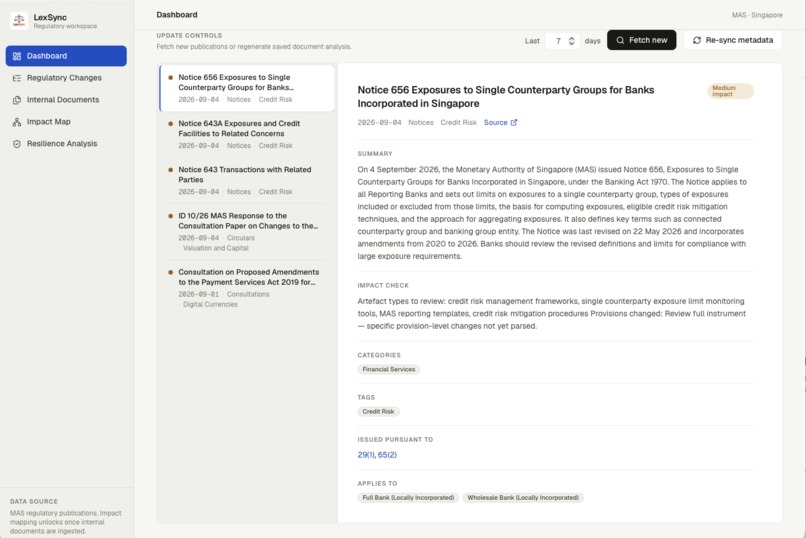
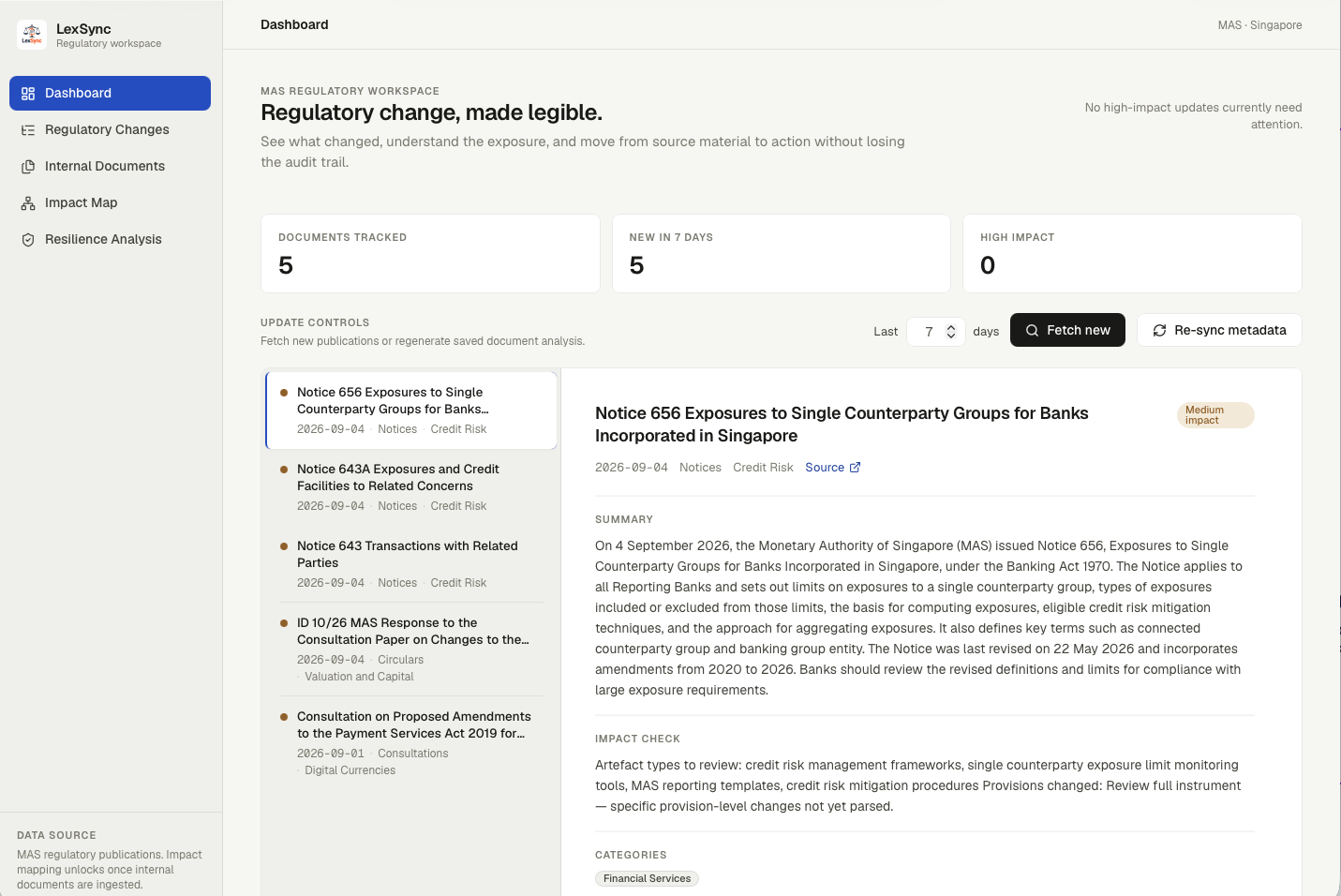
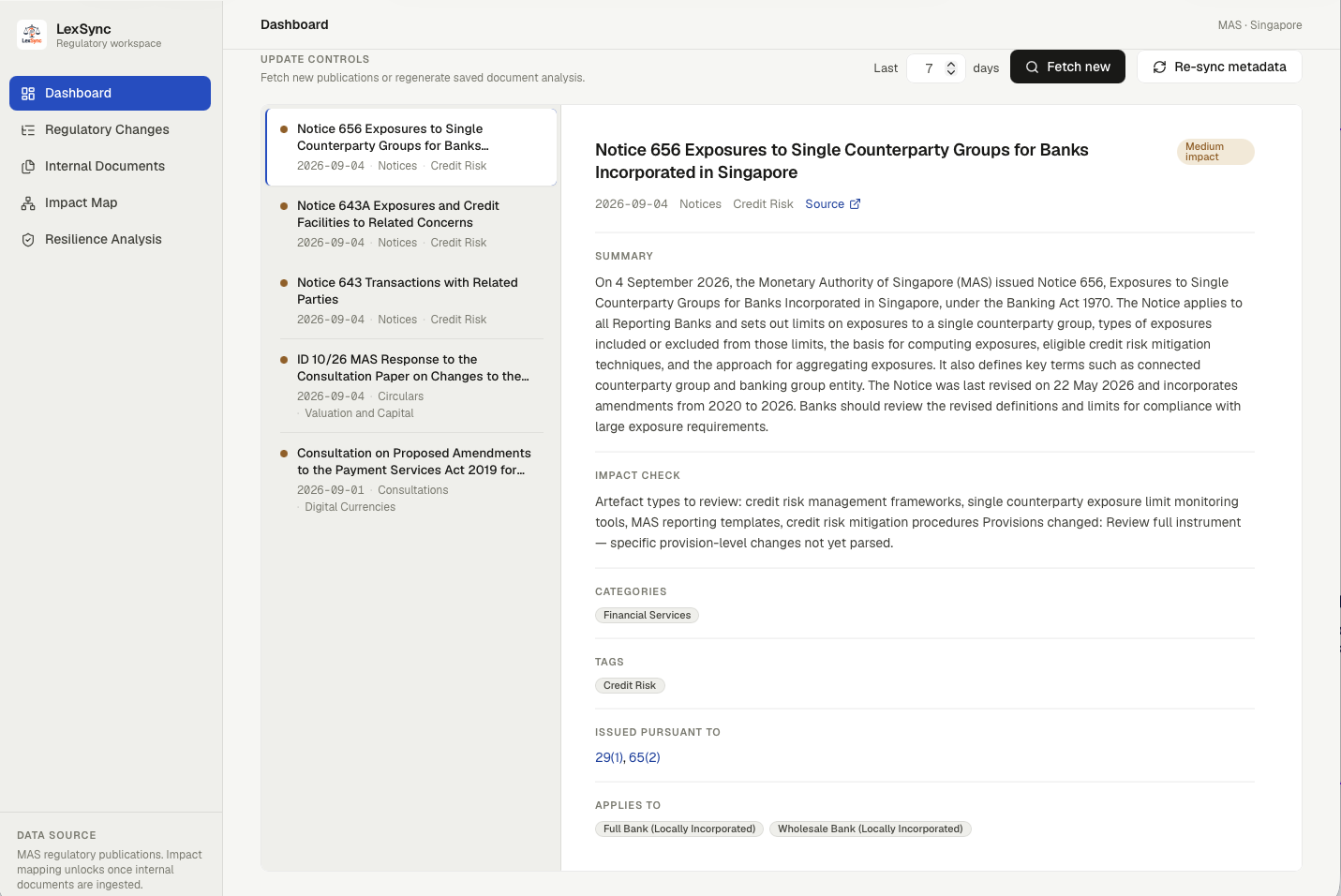
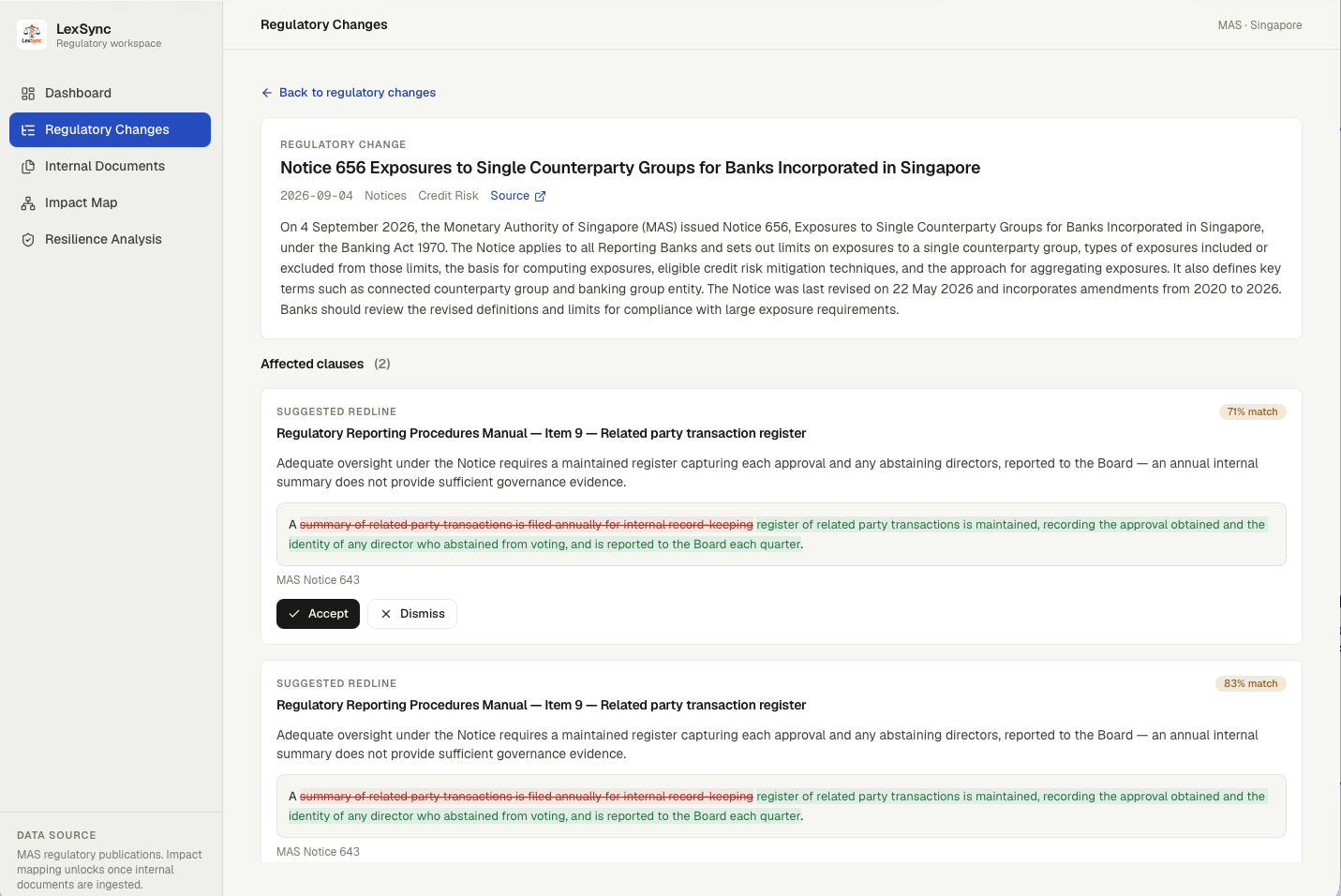
LexSync will extract text and produce a short, objective summary of each update. Users can check the source documents to verify the details.
-
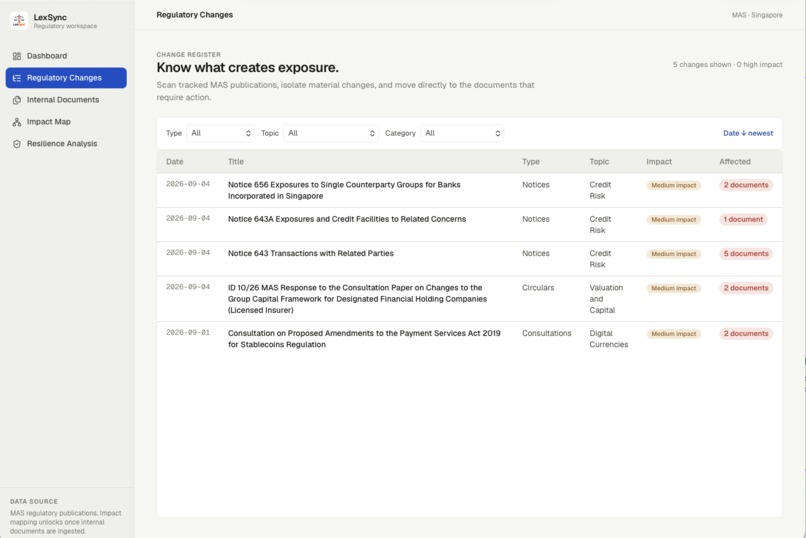
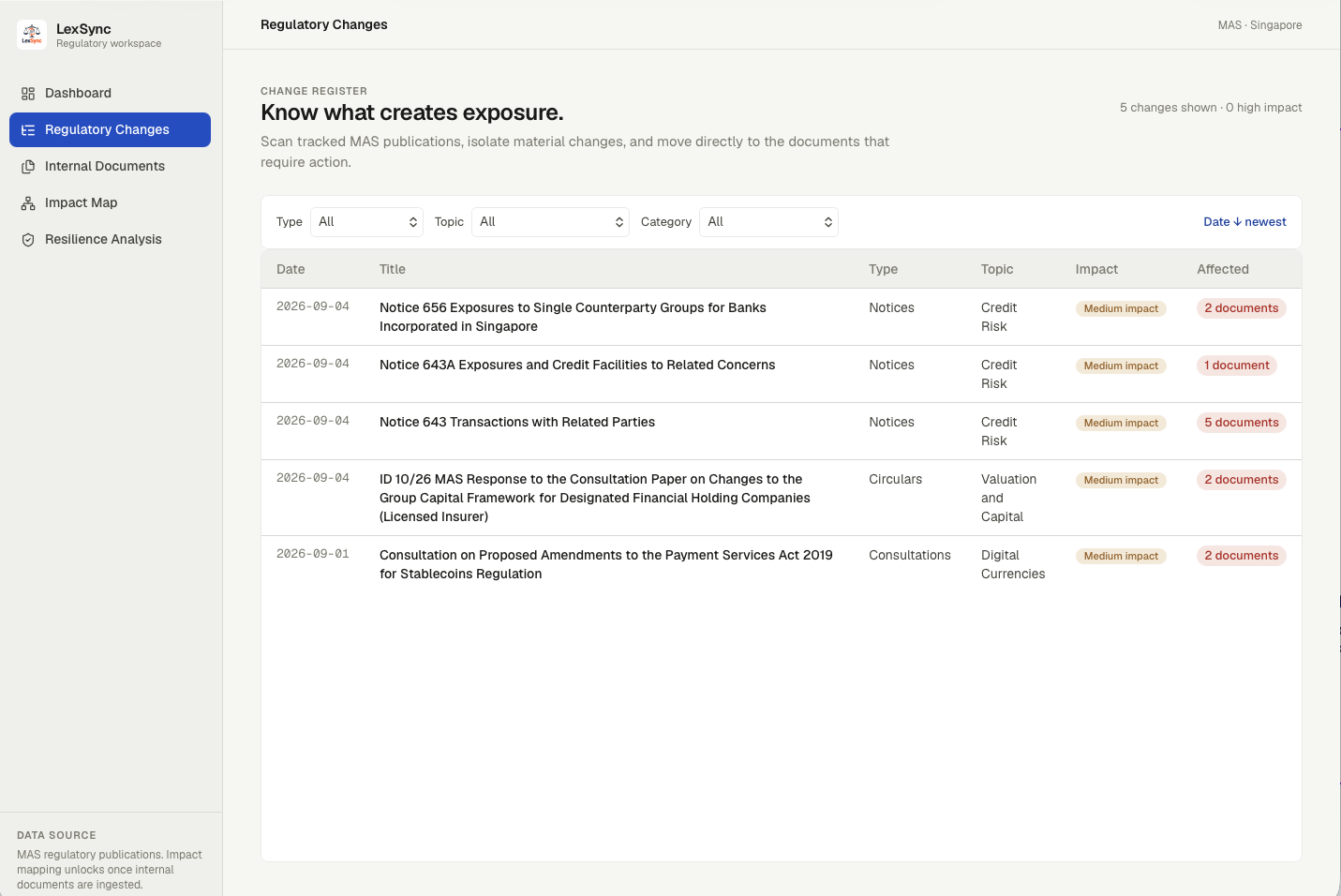
On Regulatory Changes, LexSync will flag any document that may contradict the new updated rules.
-
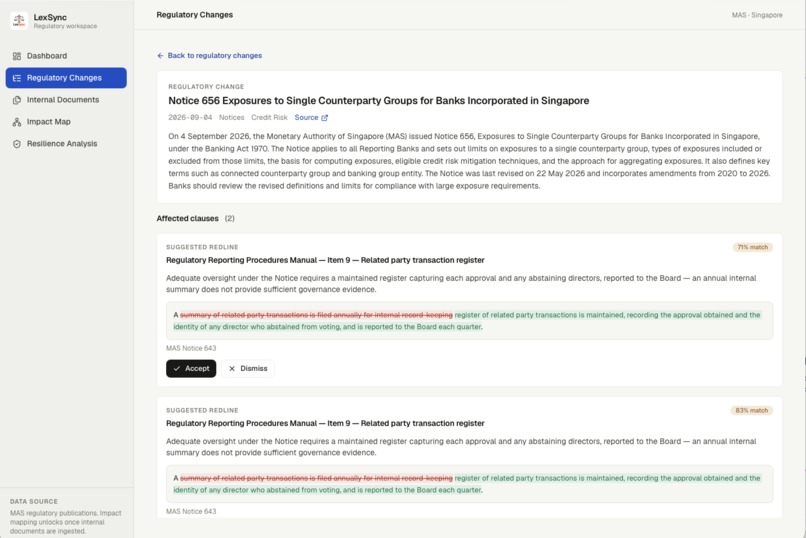
LexSync identifies and highlights the sections of internal documents that are likely to be affected by a new regulatory change.
-
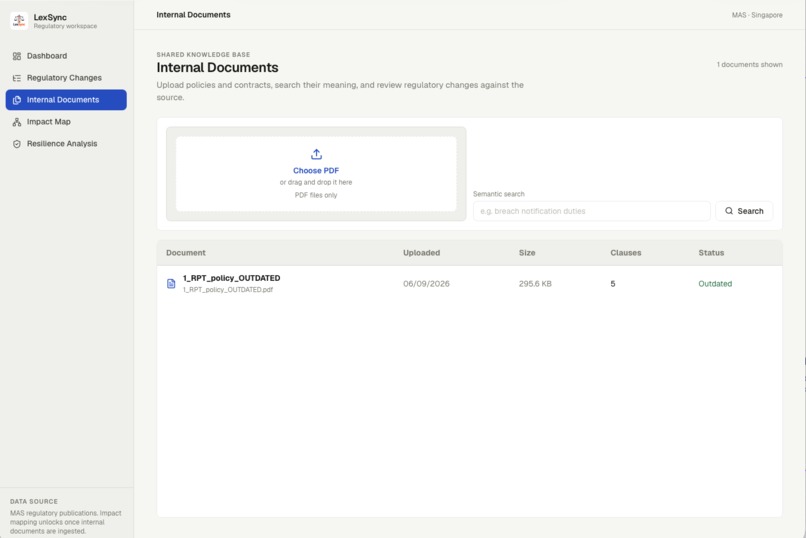
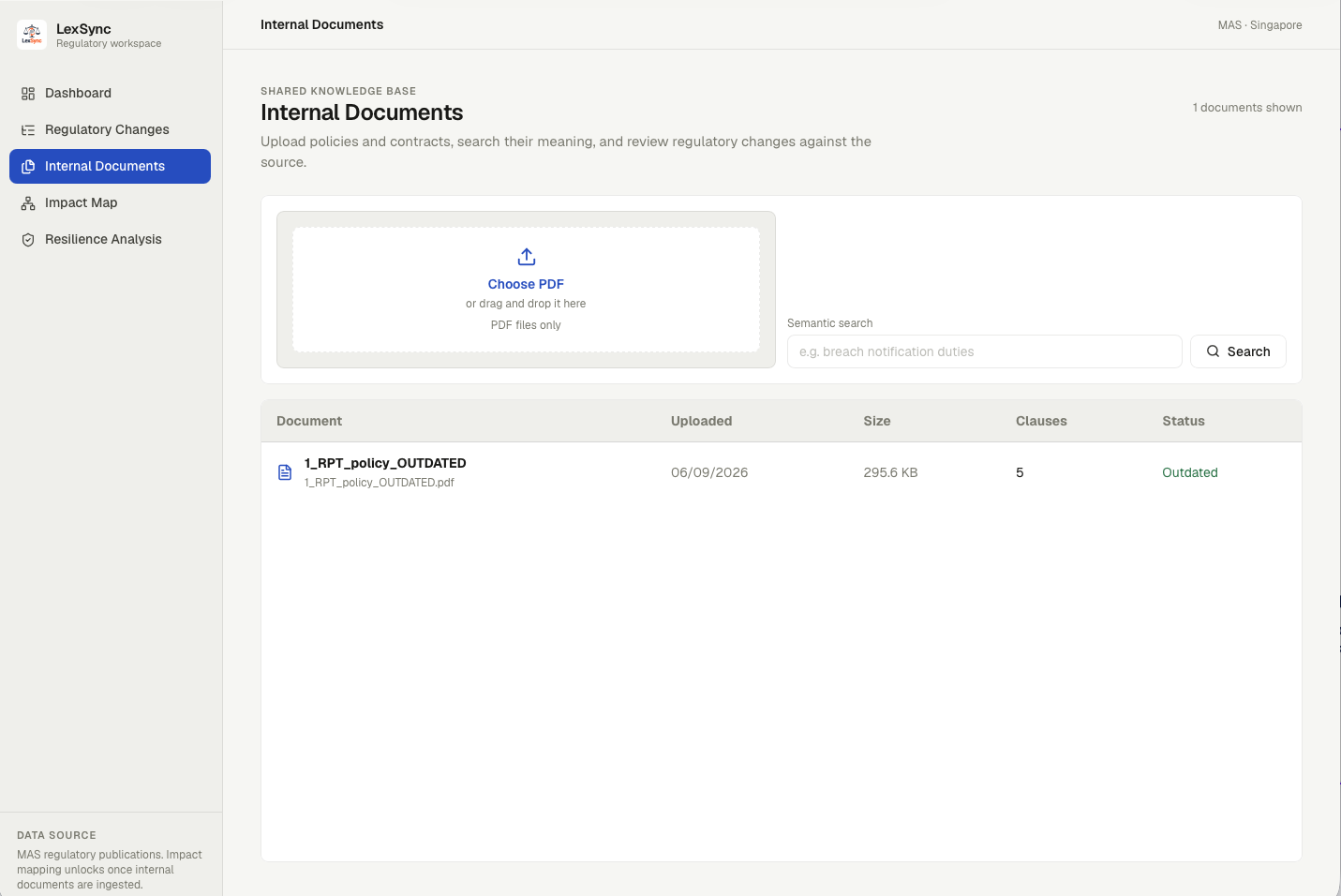
Document upload
Inspiration
Legal and regulatory requirements evolve at a pace that traditional operations cannot match. For legal and compliance teams, however, the practical challenge is not simply tracking new developments, but determining whether a change is relevant, what it affects, and whether existing documents, processes, or guidance need review.
In practice, this exercise can be highly manual. Regulatory updates must first be identified and understood before lawyers can assess their impact on existing legal content. As such, the critical bottleneck moves beyond horizon scanning and tracking regulatory change and includes the manual burden of mapping those changes across the sheer number of active playbooks, contract templates, and client advisories.
When regulatory updates outpace human review, internal legal assets become latent compliance liabilities. While current tools alert teams to new laws, they leave the work of auditing and updating operational documentation undone.
We wanted to make this process faster and more targeted by helping legal teams move from regulatory update → impact assessment → redline propagation with efficiency and agility.
This inspired LexSync, built around a simple principle:
Never advise from a stale clause.
What it does
LexSync is a regulatory monitoring and impact-identification tool designed to help legal teams identify developments that may require further review.
Instead of simply telling lawyers “the law changed,” LexSync aims to answer:
- What changed?
- What area of law does it affect?
- What existing guidance or clauses might be impacted?
- What should the legal team review or update?
LexSync connects regulatory developments to potentially affected legal documents, allowing teams to move from detection to targeted review rather than manually auditing every document.
How we built it
We built LexSync as an end-to-end regulatory monitoring and alerting system.
- Ingestion — Scrape and collect the latest regulatory updates from relevant sources.
- AI Processing — Use an LLM to summarise, synthesise, and categorise regulatory changes in an objective voice.
- Database — Store the processed legal content using PostgreSQL.
- Embeddings & Semantic Search — Convert legal text into vector embeddings and use pgvector to find semantically related content.
- Impact Identification — Connect new regulatory developments to potentially affected legal documents, processes, or tools.
- Alerts — Notify relevant legal teams when a change may require their attention.
Challenges we ran into
Our biggest challenge was time.
We had just one day to take LexSync from concept to working demo. This meant making hard scoping decisions early on.
Rather than building broad coverage across every area of law, we chose a narrow regulatory domain to prove the pipeline end-to-end.
The challenge was not simply getting each individual component to work, but connecting them into a meaningful workflow:
Regulatory change → Legal meaning → Potential impact → Actionable response
Accomplishments that we're proud of
We are proud to have built a working end-to-end prototype in just one day, bringing together regulatory ingestion, LLM processing, PostgreSQL, vector embeddings, semantic search, impact identification, and alerting.
More importantly, LexSync moves beyond simply reacting to regulatory change. It helps narrow down where that change may matter, reducing the manual effort required for legal teams to identify potentially affected content.
What we learned
One of our biggest lessons was that legal technology is not simply about applying AI to legal documents. The real challenge is building a reliable pipeline from regulatory change → legal meaning → potential impact → actionable response.
We also learned how semantic search can be particularly useful in legal contexts, where the same concept can be expressed using very different terminology.
A regulation may never use the exact words found in an existing clause, but the underlying meaning can still be closely related. This makes semantic similarity particularly valuable for identifying potentially affected legal content that keyword-based searches might miss.
What's next for LexSync
We want LexSync to move beyond simply detecting regulatory change and become a system that helps legal teams move from insight to action.
Draft suggested edits
Rather than simply flagging an affected clause, LexSync could propose a first-pass revision reflecting the regulatory change. A lawyer could then review and refine the suggested language rather than starting from scratch.
Expand source coverage
Scale the scrapers beyond our initial regulatory domain to cover more jurisdictions and areas of law, so the system's coverage matches the breadth of a real legal team's regulatory exposure.
Ultimately, we want LexSync to help legal teams spend less time finding what changed and more time deciding what to do about it.
LexSync — never advise from a stale clause.
Built With
- docker
- fastapi
- postgresql
- python
- railway
- react
