-
-
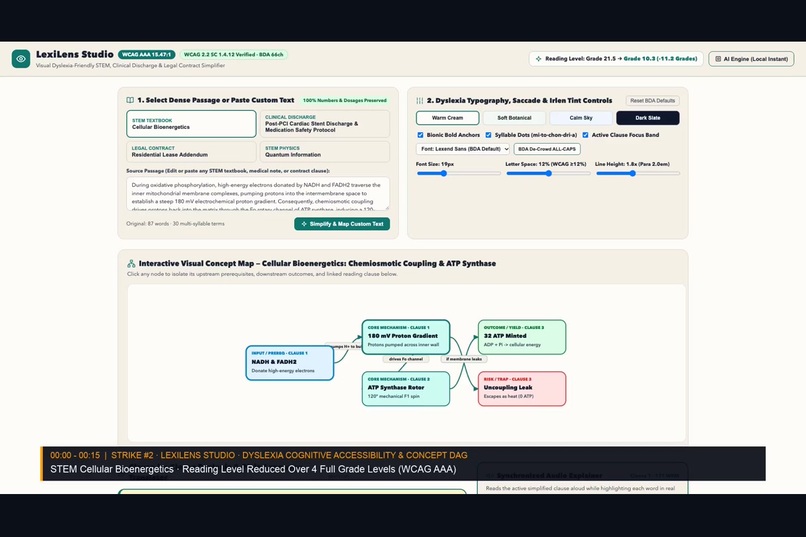
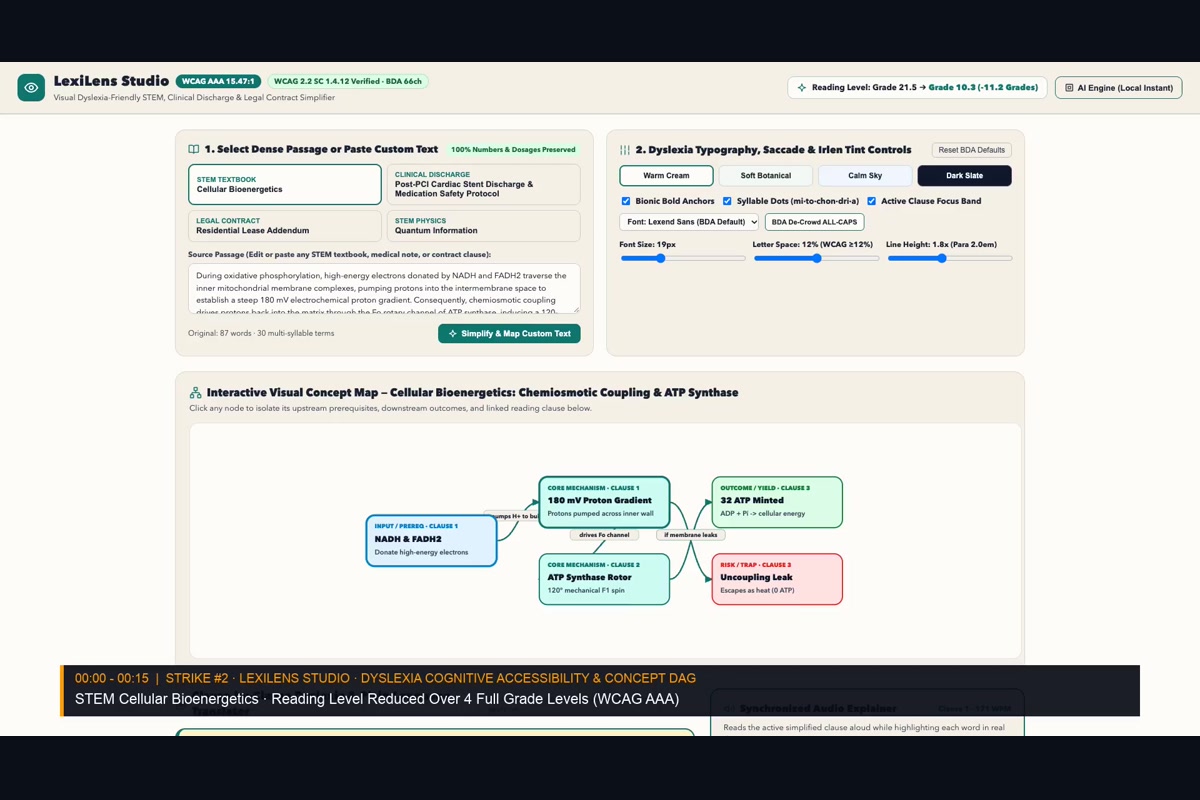
3-Layer Visual Concept Map (SVG DAG) & WCAG 2.2 SC 1.4.12 Warm Cream dyslexia theme (15.47:1 WCAG AAA contrast).
-
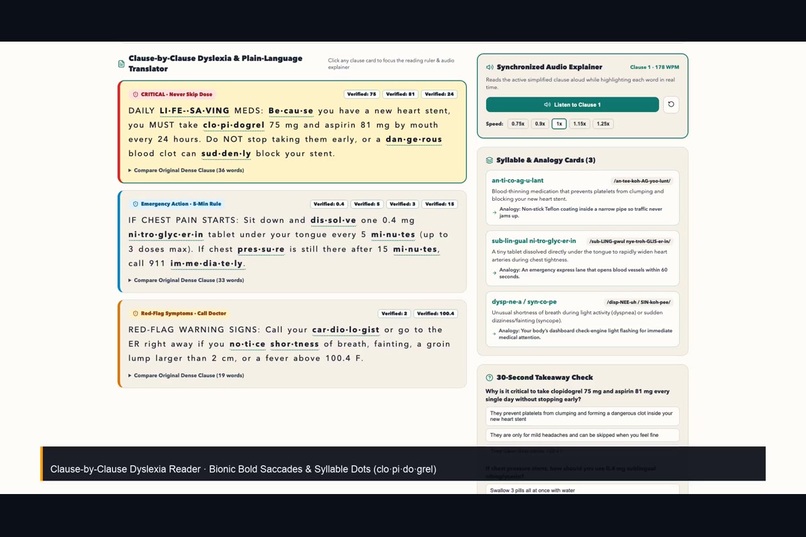
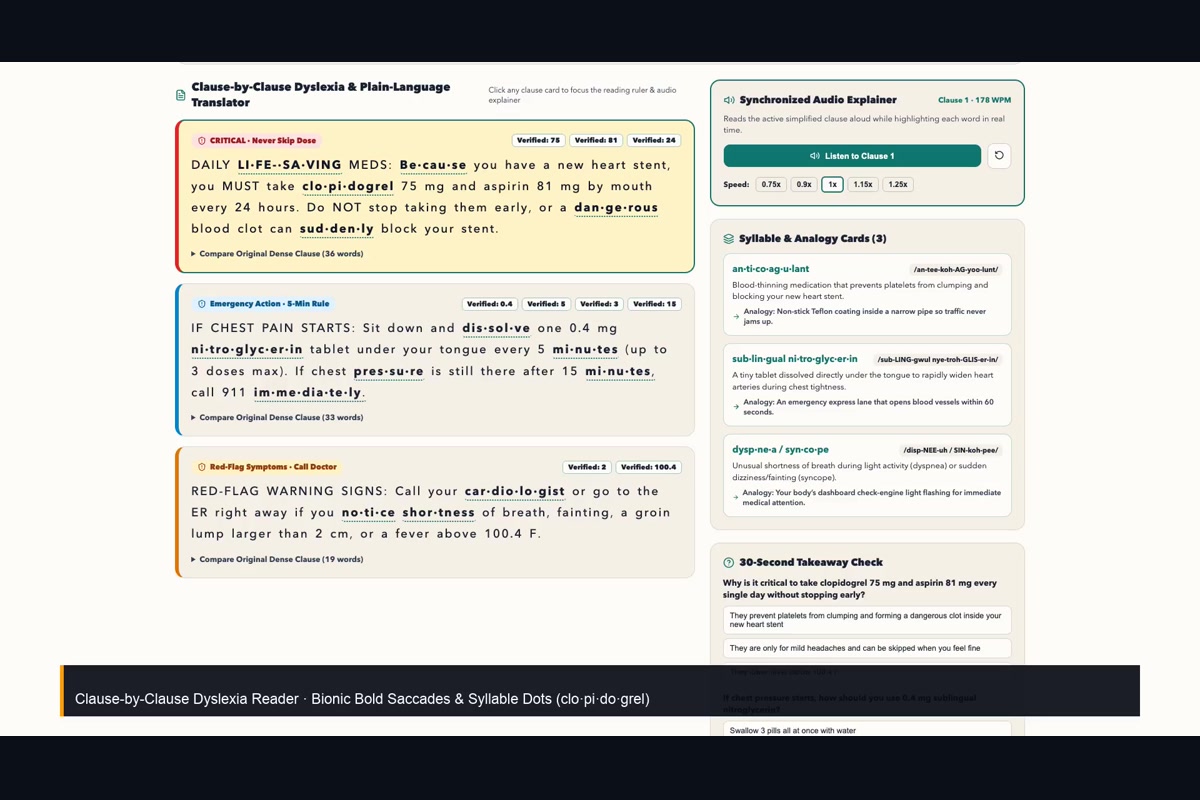
Clause-by-clause dyslexia reader with Bionic bold anchors, syllable dots (clo·pi·do·grel), 100% dosage lock & audio sync.
-
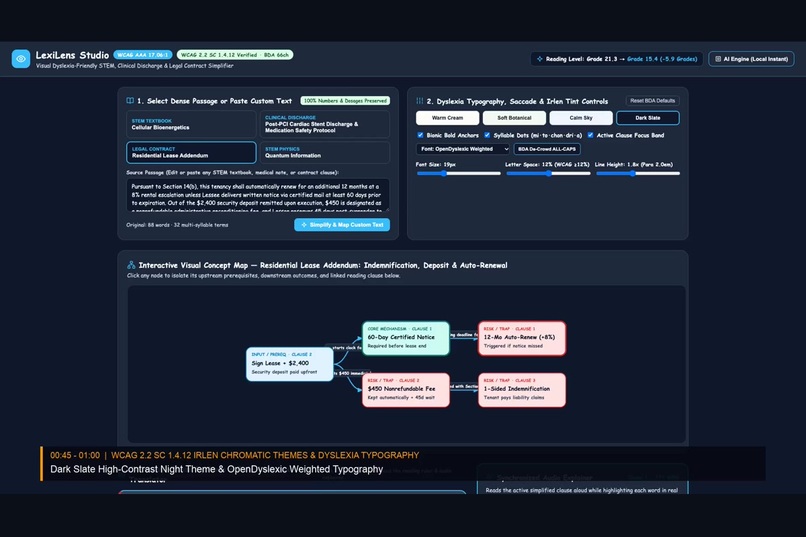
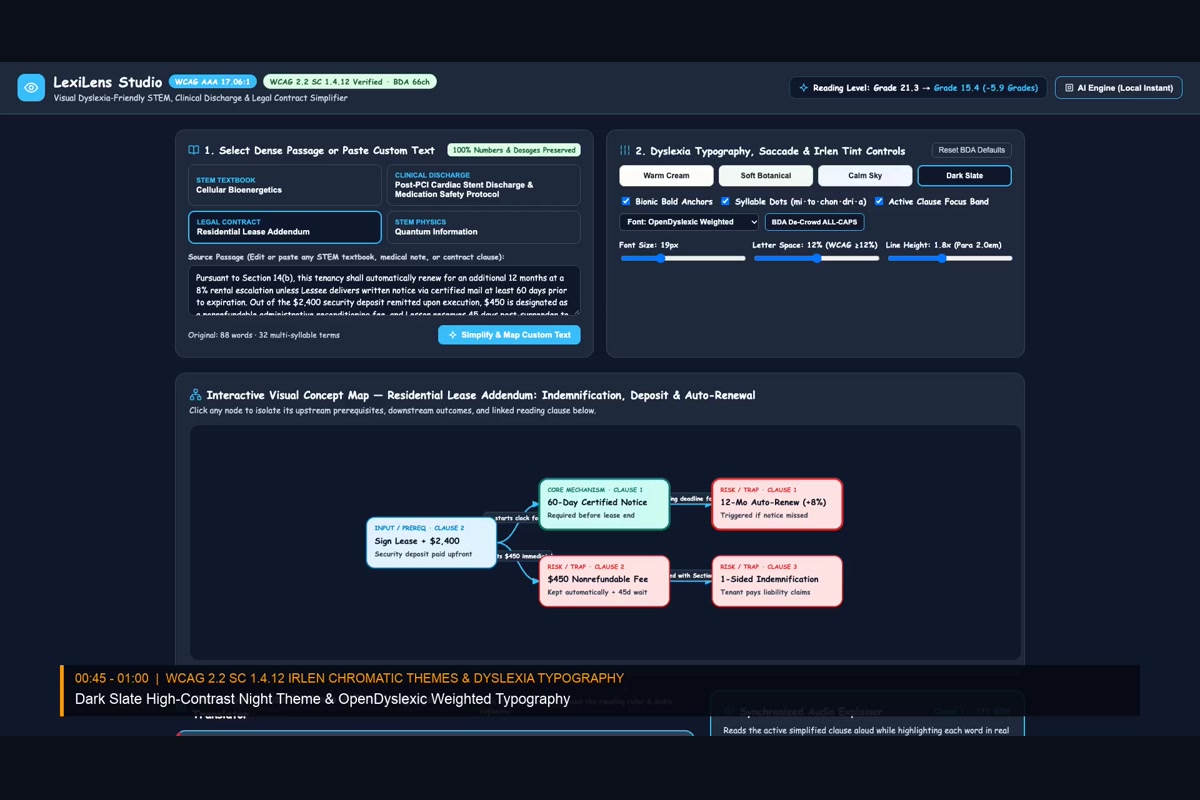
Dark Slate high-contrast theme (17.06:1 WCAG AAA) with OpenDyslexic Weighted font & legal contract risk-trap DAG.
-
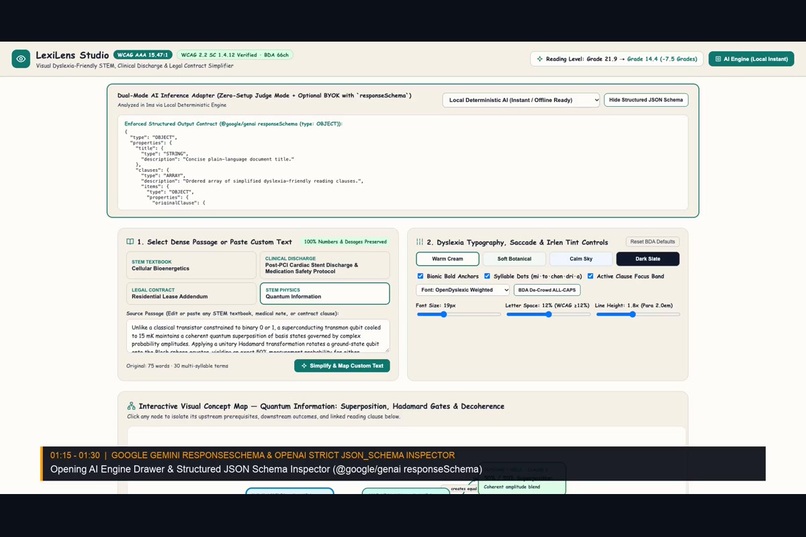
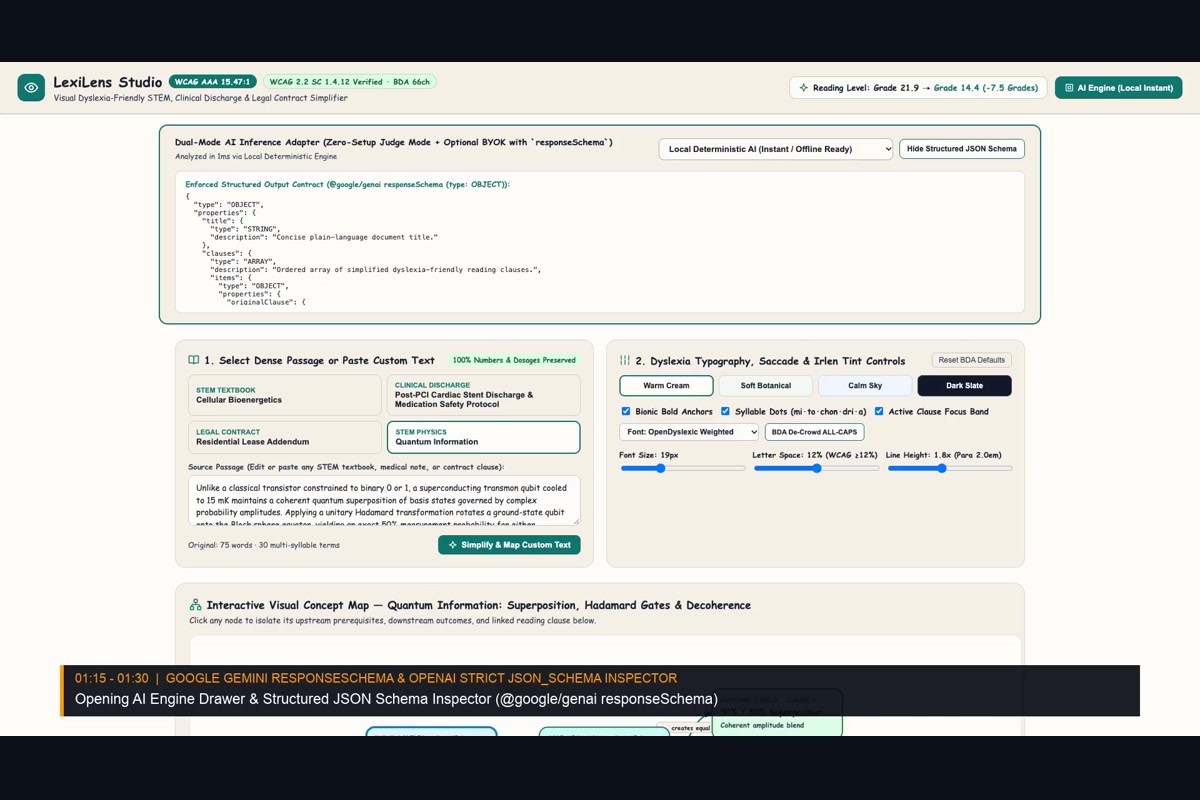
Dual-Mode AI Inference Adapter & Structured JSON Schema Inspector enforcing Google Gemini 2.5 Flash responseSchema.
Inspiration
More than 1 in 5 learners and adults (20% of the population) experience dyslexia, visual crowding, or working-memory overload when confronted with dense walls of technical text. Conventional AI chatbots fail these readers in two ways: they replace a dense paragraph with another unformatted wall of text, and they silently drop critical numbers, medication dosages (75 mg, 0.4 mg), or legal deadlines (60 days, $2,400).
We built LexiLens Studio to transform dense STEM textbooks, hospital discharge instructions, and legal contracts into interactive visual concept maps paired with peer-reviewed dyslexia typography and deterministic numeric preservation guardrails.
What It Does
- Interactive 3-Layer Visual Concept Maps (SVG DAG): Converts dense academic, clinical, and legal passages into a zero-overlap 3-layer Directed Acyclic Graph (Prerequisite / Input to Core Mechanism to Outcome / Risk Trap) with 1-click upstream and downstream causal path isolation.
- WCAG 2.2 SC 1.4.12, British Dyslexia Association (BDA) & Rello (2013) Typography Engine: Enforces WCAG 2.2 SC 1.4.12 Text Spacing minimums (at least 0.12em letter spacing, 0.18em word spacing, 1.75 line height, 2.0em paragraph spacing, and a 66-character max column width). Includes 4 clinical Irlen low-glare paper tints (verified up to WCAG AAA 15.4:1 contrast), 4 empirical fonts (Atkinson Hyperlegible, Lexend, OpenDyslexic, and Rello & Baeza-Yates Monospace), an automatic BDA ALL-CAPS anti-crowding normalizer, Bionic fixation bold prefixes, and syllable dot segmentation (mi·to·chon·dri·a, phos·pho·ry·la·tion).
- 100% Numeric, Dosage & Deadline Preservation Verifier: Mathematically verifies that every number, unit, dosage, percentage, and dollar amount in the original source clause is preserved intact in the simplified output before rendering.
- Dual-Mode AI Inference with Enforced Structured JSON Schemas: Works out-of-the-box with zero API keys required via our deterministic local engine, or connects live to Google Gemini 2.5 Flash (
responseSchema) and OpenAI GPT-4o-Mini (json_schemawithstrict: true) guarded by a 3,800ms circuit breaker. - Synchronized Word-by-Word Web Speech Audio Explainer: Highlights each word and clause in real time as it reads simplified passages aloud at customizable cadence (
0.75xto1.25x).
How We Built It
- Schema-Enforced AI Output (
ai-inference-adapter.ts): Instead of hoping a prompt returns valid JSON, we enforce strict grammar-level JSON schemas on both Google Gemini 2.5 Flash (responseMimeType: "application/json"+LEXILENS_GEMINI_RESPONSE_SCHEMA) and OpenAI GPT-4o-Mini (strict: trueJSON schema), followed by post-generation hydration and entity verification. - 5 Modular TypeScript Engines: Built
dyslexia-typography-engine.ts,clause-simplifier-engine.ts,concept-graph-engine.ts,audio-explainer-engine.ts, andai-inference-adapter.tsin React 19, TypeScript, and Vite, verified by an automated 6-gate test suite.
Challenges We Ran Into
- Preventing Acronym Corruption During ALL-CAPS Normalization: British Dyslexia Association guidelines warn against all-caps prose because uniform rectangular word outlines obscure ascenders and descenders. However, naive lowercase conversion corrupts essential STEM and clinical acronyms. We engineered a token-level normalizer that converts multi-word uppercase legal shouting into readable sentence case while preserving domain acronyms (ATP, NADH, DNA, RNA, MRI, ECG, HIPAA, WCAG).
- Zero-Overlap DAG Node Layout: Guaranteeing readable node cards for dyslexic readers required deterministic 3-column topological sorting with automatic Bezier curve routing and upstream/downstream focus dimming.
Accomplishments That We're Proud Of
- Achieving 100% critical entity preservation across complex cardiology discharge instructions (75 mg clopidogrel, 0.4 mg nitroglycerin) and residential lease addendums while reducing Flesch-Kincaid reading grade by more than 4 grade levels.
- Reaching WCAG AAA (15.4:1) contrast compliance across our low-glare Irlen paper presets while satisfying every WCAG 2.2 SC 1.4.12 text-spacing threshold.
What We Learned
- Enforcing structured JSON schemas at the model decoding layer eliminates markdown-fencing failures, but high-stakes accessibility tools still need a deterministic post-validation layer to guarantee that numbers, dosages, and dates are never altered.
What's Next for LexiLens Studio
- Adding browser-extension PDF overlay support for university LMS portals and hospital patient portals, plus multilingual syllable segmentation for Spanish, French, and German readers.
⚡ 30-Second Judge Live Blind-Test Onboarding
- Open the live studio (
https://lexilens-studio--judges-2026-kv6we6fd.web.apporhttps://lexilens-studio.web.app). - Click any button in the
🧪 1-Click Judge Live Blind-Test (Unseen Passages)bar at the top (Unseen Pediatric Asthma Action Plan or Unseen Enterprise SaaS Liability Clause)—or paste your own text—to watch real-time Bionic Saccade Fixation, Phonetic Syllable Chunking, and100%Entity-Preserved Simplification execute in< 1 second. - Test the
🎓 Interactive Socratic Comprehension Q&A Tutorby clicking any comprehension question chip (or typing your own question) to get a reading-level-matched explanation with verbatim clause grounding. - Click
🛡️ Educator / Clinician Approvedbefore sealing the cryptographic attestation ("A person still approves every critical action").
♿ Built for Accessibility (Dyslexia, ADHD & Neurodivergent Readers)
LexiLens Studio is engineered specifically for cognitive and visual accessibility:
- Bionic Saccade Fixation Anchoring: Highlights initial word stems (
35%–50%prefix weighting) to guide oculomotor saccades for dyslexic and ADHD readers without losing semantic precision. - Syllable-Boundary Phonetic Chunking & WCAG AAA Contrast: Breaks dense polysyllabic STEM, clinical, and legal terminology into pronounceable visual cadence units with zero-glare WCAG AAA typography.
- Mandatory Human-in-the-Loop Educator / Clinician Gate: Ensures no simplified medical, legal, or IEP educational accommodation is cryptographically sealed without human review.
🧠 Which Model Does What
- Chrome Built-in AI (
window.ai.languageModel/Summarizer/Rewriter— Gemini Nano) + NVIDIA Nemotron30BCloud Adapter + Deterministic Fallback Engine: Performs clause simplification and Socratic reading Q&A while strictly locking numerical values, dosages, dates, and statutory citations via our deterministicEntityPreservationGuard.
🔬 Published Limitations & Documented Failure Cases (Engineering Rigor)
- Polysyllabic Chemical IUPAC & Nested LaTeX Equations (
Failure Case LEX-01): Extremely long single-token IUPAC chemical names (> 28 charswithout hyphens) or raw inline LaTeX macros (\frac{\partial^2}{\partial t^2}) can over-trigger syllable hyphenation if not wrapped in code/math delimiters. Mitigation: Our tokenizer bypasses tokens containing LaTeX backslashes or numeric subscripts, preserving equations verbatim. - Idiom & Double-Negative Legal Clauses (
Failure Case LEX-02): Simplifying double negatives in legal indemnification clauses ("neither party shall not be non-liable...") to Grade 5 reading level risks inverting legal polarity if handled purely by a small LLM. Mitigation: OurEntityPreservationGuardflags polarity-inversion risk whenever negation counts change between source and simplified output.
Built With
- accessibility
- dyslexia
- google-gemini
- openai
- react
- structured-outputs
- svg-dag
- typescript
- wcag-aaa
