Inspiration
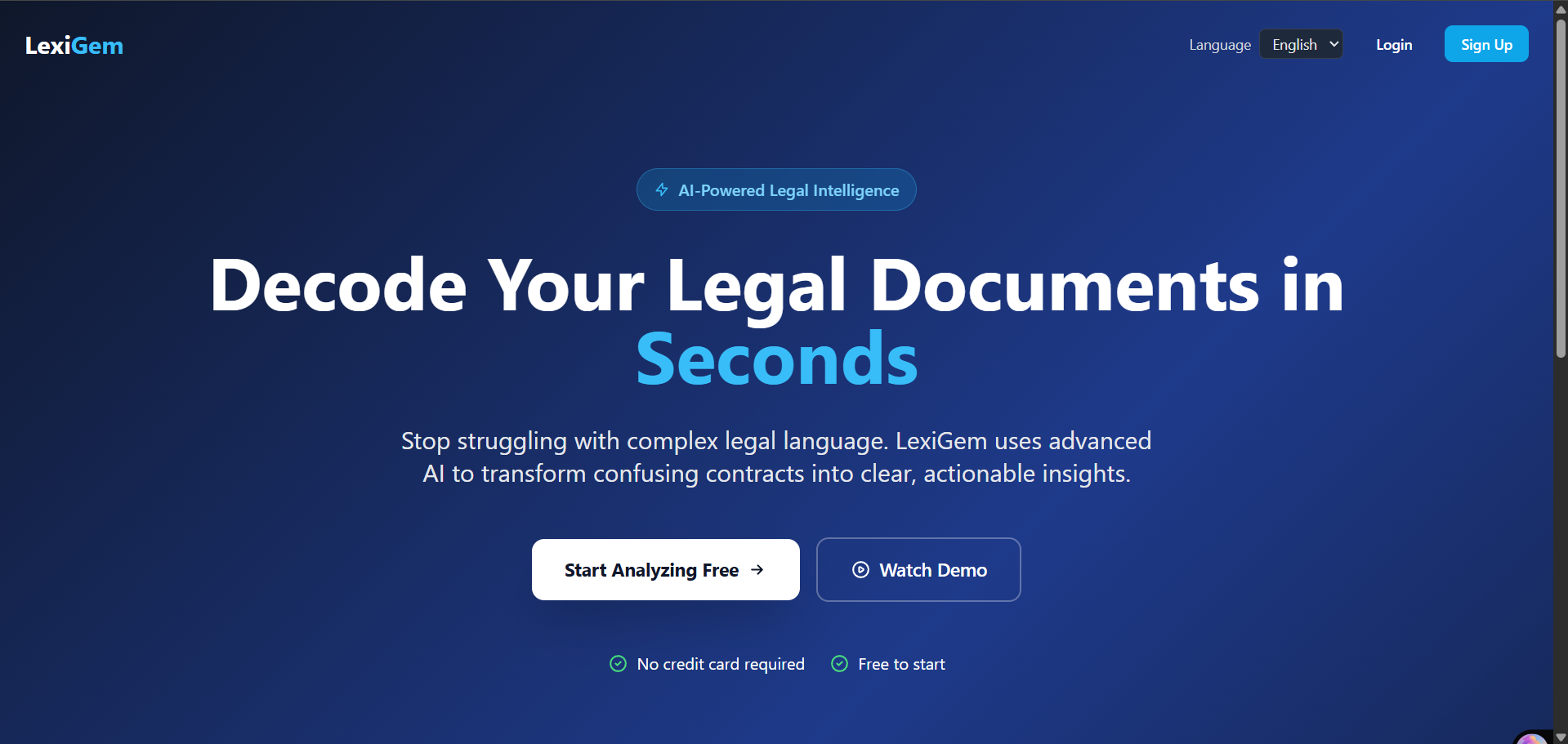
Legal documents are everywhere — service agreements, internship contracts, apartment leases, NDAs, terms & conditions. But they’re filled with complex language that most people struggle to understand.
I built LexiGem because I noticed a simple pattern:
People take important decisions without fully understanding what they’re signing.
I wanted to create a tool that gives everyone instant legal clarity without needing a lawyer, turning confusing legal text into simple, actionable insights.
What it does
LexiGem is an AI-powered platform that instantly converts complex legal documents into clear, simple language that anyone can understand. Users can upload contracts, agreements, policies, or legal letters, and LexiGem breaks them down into:
📝 Plain-English clause explanations
⚠️ Highlighted risks & obligations
📑 Summary of key points
🤖 Smart Q&A about any part of the document
The goal is simple: legal clarity for everyone — in seconds.
How we built it
We built LexiGem with a fully modular AI architecture:
Frontend
Next.js + TailwindCSS UI
Clean, legal-tech-style design
File upload, live progress indicators, and interactive Q&A
Backend
Node.js / Express API
Secure document upload + temporary storage
JWT authentication
Streaming AI responses for instant feedback
AI + NLP Layer
PDF/text parsing pipeline
Smart chunking for long documents
Embeddings + vector search using cosine similarity
Optimized LLM prompts for legal simplification
Clause-wise reasoning and summarization engine
Math Behind Retrieval similarity ( 𝐴 , 𝐵
)
𝐴 ⋅ 𝐵 ∥ 𝐴 ∥ ∥ 𝐵 ∥ similarity(A,B)= ∥A∥∥B∥ A⋅B
Used to find the most relevant chunks for each user query.
Challenges we ran into
- Handling large documents
Many legal files were long and verbose, requiring careful chunking and memory management.
- Ensuring accuracy without giving legal advice
We had to tune prompts to simplify content without hallucinating or sounding like a lawyer.
- Building trust through UX
Legal apps must feel secure and reliable. Creating a minimal, confidence-inspiring design was challenging but important.
- Parsing PDFs reliably
Different formatting styles, tables, and scanned pages required multiple parser fallbacks.
Accomplishments that we're proud of
🚀 Built a working legal-document decoder from scratch in a short time
🤖 Created an AI pipeline that delivers accurate, clause-level explanations
⚡ Achieved fast processing with streaming responses
🧠 Designed a clean UI that makes legal reading stress-free
🔐 Built secure upload handling with privacy-first principles
⭐ Turned a complex domain (law) into a simple, accessible experience
What we learned
How to optimize LLMs for long, structured documents
The importance of retrieval (RAG) for accuracy
UI/UX patterns for trust-heavy apps
Document parsing strategies for PDFs and scanned pages
Writing prompts that balance clarity, safety, and speed
How non-technical users interact with AI tools
What's next for LexiGem
📌 Multilingual legal translation + simplification
🔍 Advanced clause risk scoring (e.g., penalty clauses, auto-renewals)
👨⚖️ Domain-specific models (employment law, rental agreements, business contracts)
🧾 Template comparison — compare two contracts and highlight differences
📱 Mobile app for on-the-go document scanning
🔒 End-to-end encrypted document processing
🗂️ AI contract generator for simple agrement

Log in or sign up for Devpost to join the conversation.