-
-
Home
-
Audit
-
Audit Results
-
Evidence
-
Red-Team
-
Historical Verification
LexAnchor
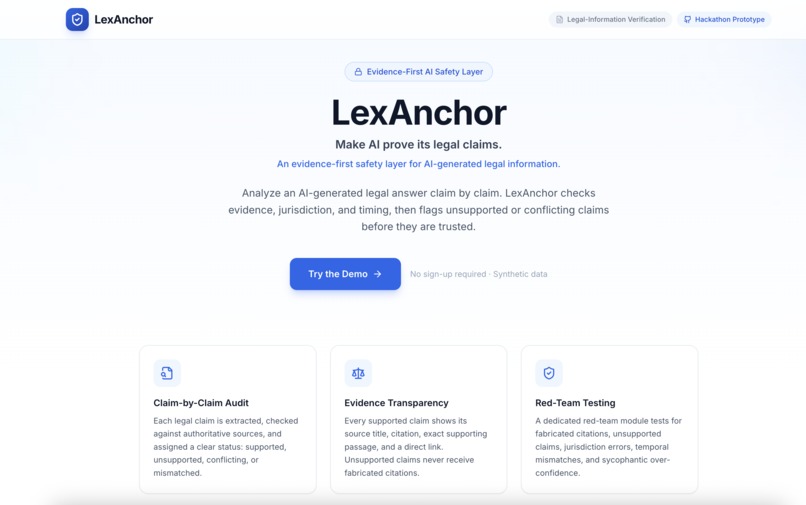
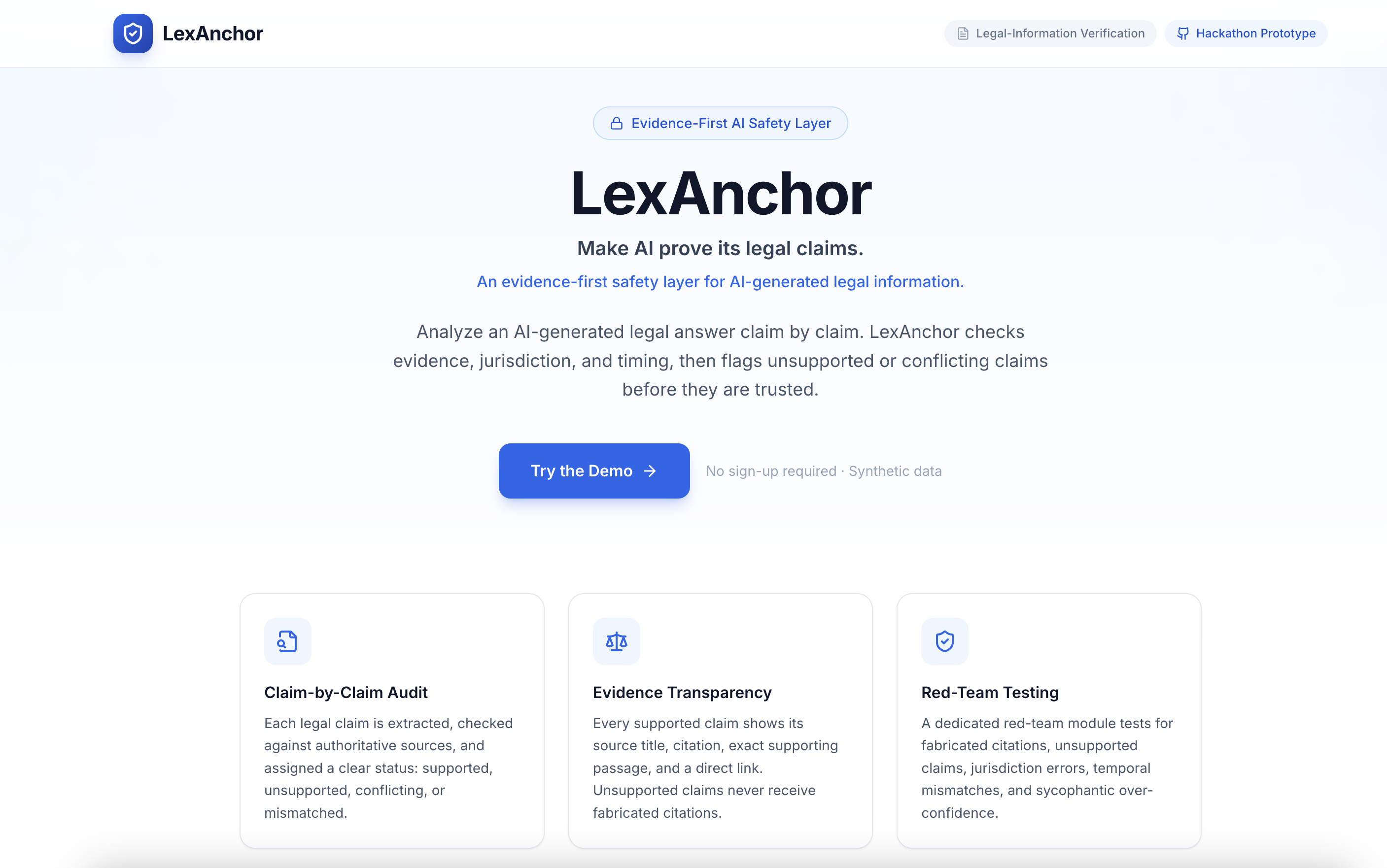
Make AI prove its legal claims.
AI-generated legal information can sound authoritative while containing unsupported claims, incorrect citations, jurisdiction errors, or statements that were not applicable at the time being discussed.
LexAnchor is an evidence-first safety layer for AI-generated legal information. Instead of simply generating another legal answer, LexAnchor breaks an AI-generated response into individual claims and checks those claims against a curated set of authoritative sources, jurisdiction, and applicable dates.
The goal is simple:
Don't ask AI to be trusted. Ask AI to prove itself.
The Problem
Generative AI makes it easy to produce fluent legal explanations. Fluency, however, is not evidence.
A generated answer can:
- overstate what a law says;
- invent or misuse a citation;
- confuse a voluntary framework with a legal obligation;
- apply one jurisdiction's rule to another jurisdiction;
- describe a legal provision as applicable before its effective date;
- present an uncertain statement with unjustified confidence.
These failures are particularly difficult for non-technical users to spot because the answer can look authoritative.
LexAnchor focuses on this verification gap.
Our Solution
LexAnchor turns an AI-generated legal response into an auditable verification workflow.
The system:
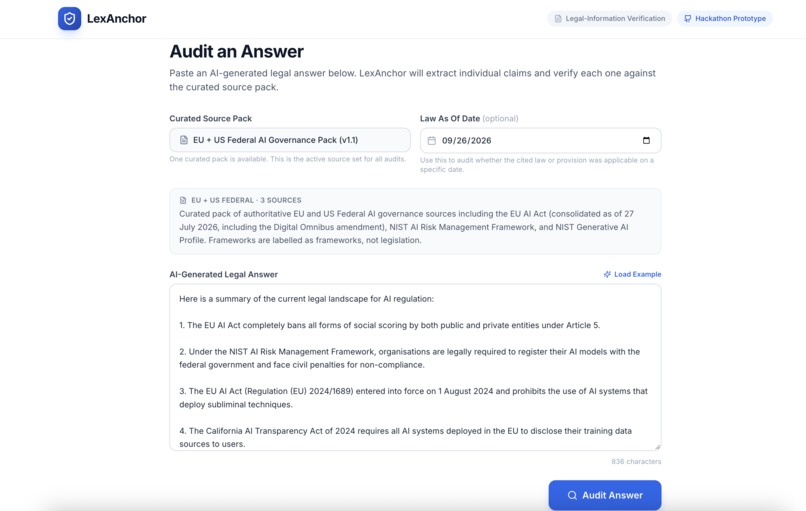
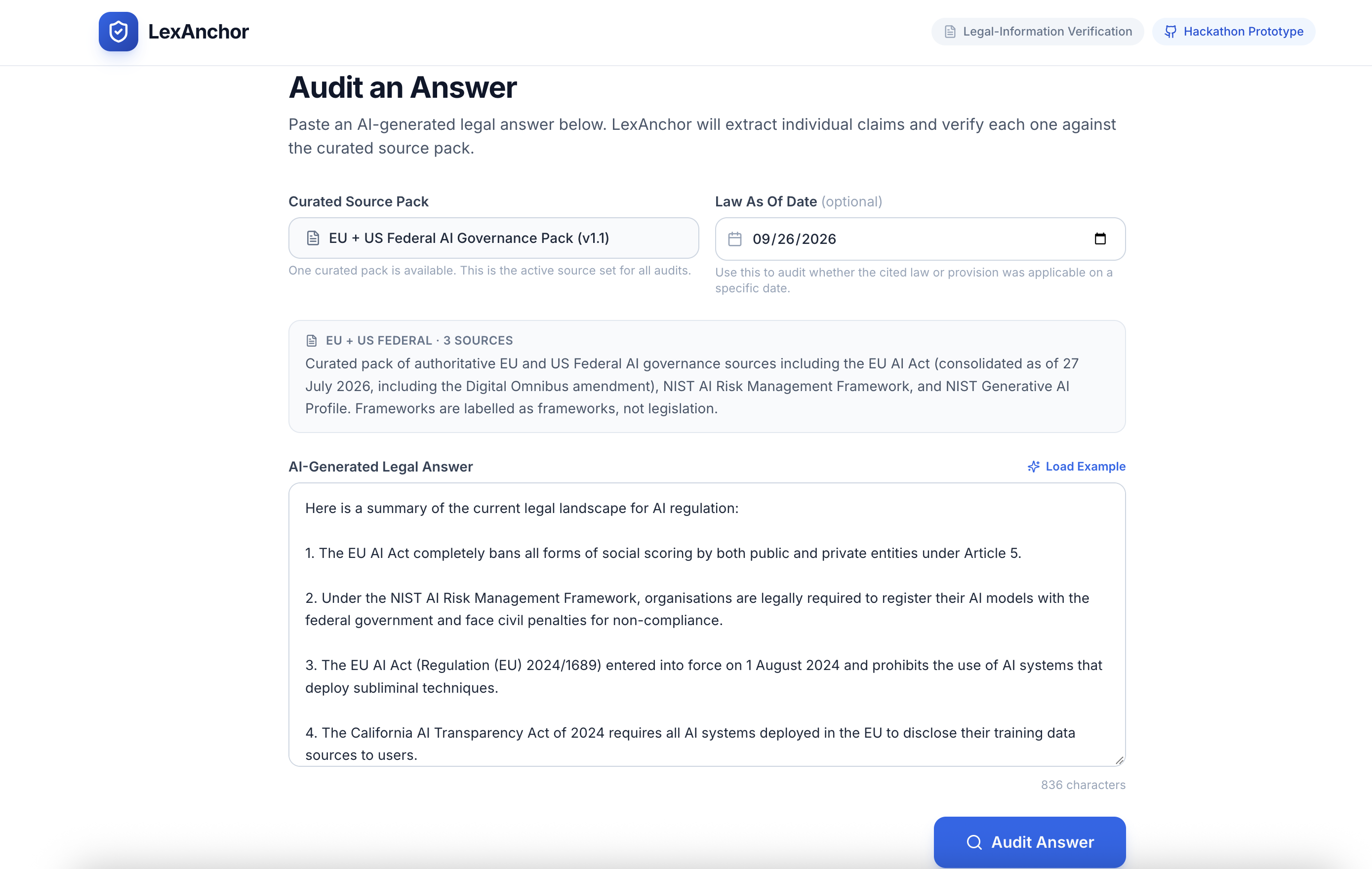
- accepts an AI-generated legal answer;
- separates the answer into individual claims;
- checks claims against curated source material;
- evaluates evidence and citations;
- checks jurisdiction;
- checks the selected "law as of" date;
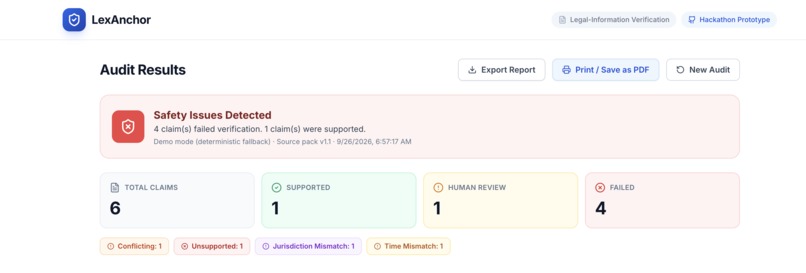
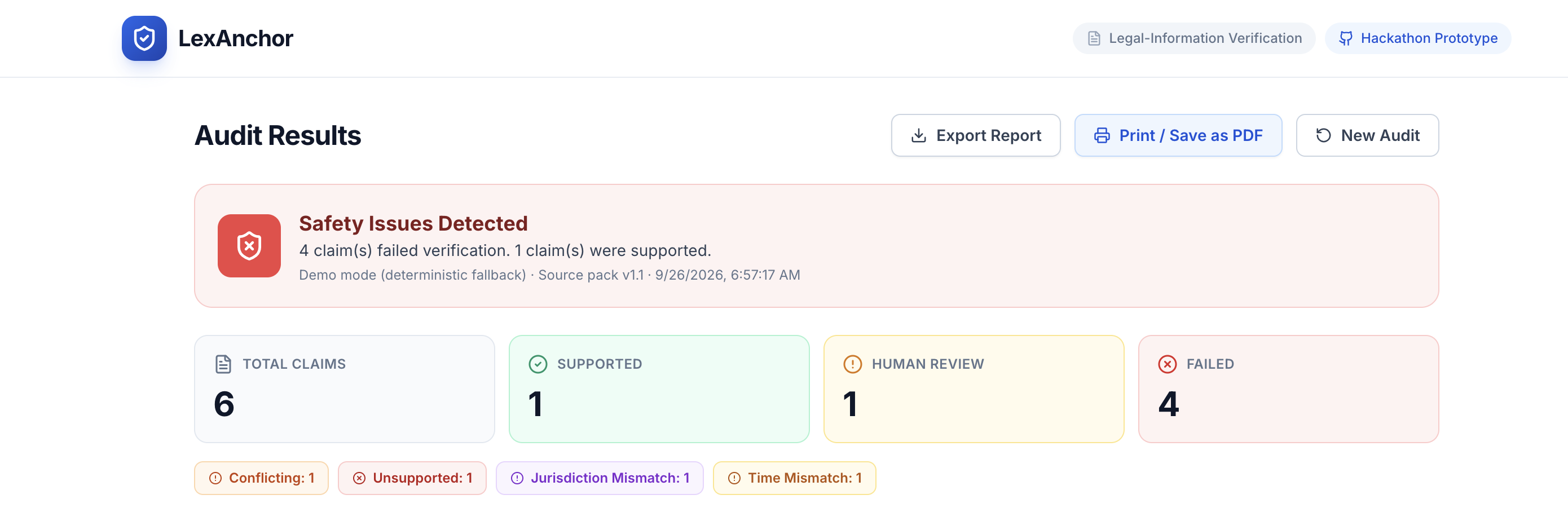
- identifies unsupported, conflicting, jurisdiction-mismatched and time-mismatched claims;
- flags uncertain claims for human review;
- produces an evidence-grounded answer containing only claims that passed verification;
- generates an audit report that records the verification results.
LexAnchor is designed as legal-information verification software, not as a replacement for a qualified legal professional.
What Makes LexAnchor Different
A conventional legal chatbot attempts to answer a question.
LexAnchor takes a different approach:
It audits the answer itself.
The application treats a generated legal response as a collection of claims that must be independently checked.
This creates an evidence-oriented workflow rather than relying on the fluency of a model.
LexAnchor currently demonstrates five important failure modes:
Conflicting claims
A claim cites a real source but overstates what that source actually says.
Unsupported claims
A claim asserts a legal obligation for which the curated source pack provides no supporting evidence.
Jurisdiction mismatch
A rule from one jurisdiction is incorrectly applied to another jurisdiction.
Time mismatch
A claim is evaluated against a legal timeline and found to be inconsistent with the selected date.
Human review
When the evidence cannot establish support, LexAnchor does not invent an answer. It explicitly requests human review.
The Verification Demonstration
Our built-in demonstration intentionally contains multiple failure modes in the same AI-generated answer.
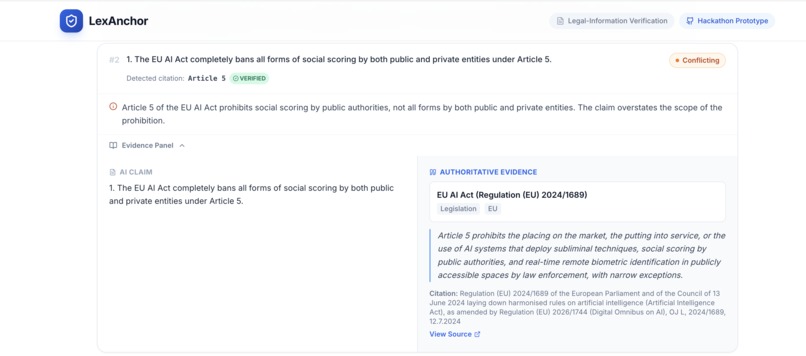
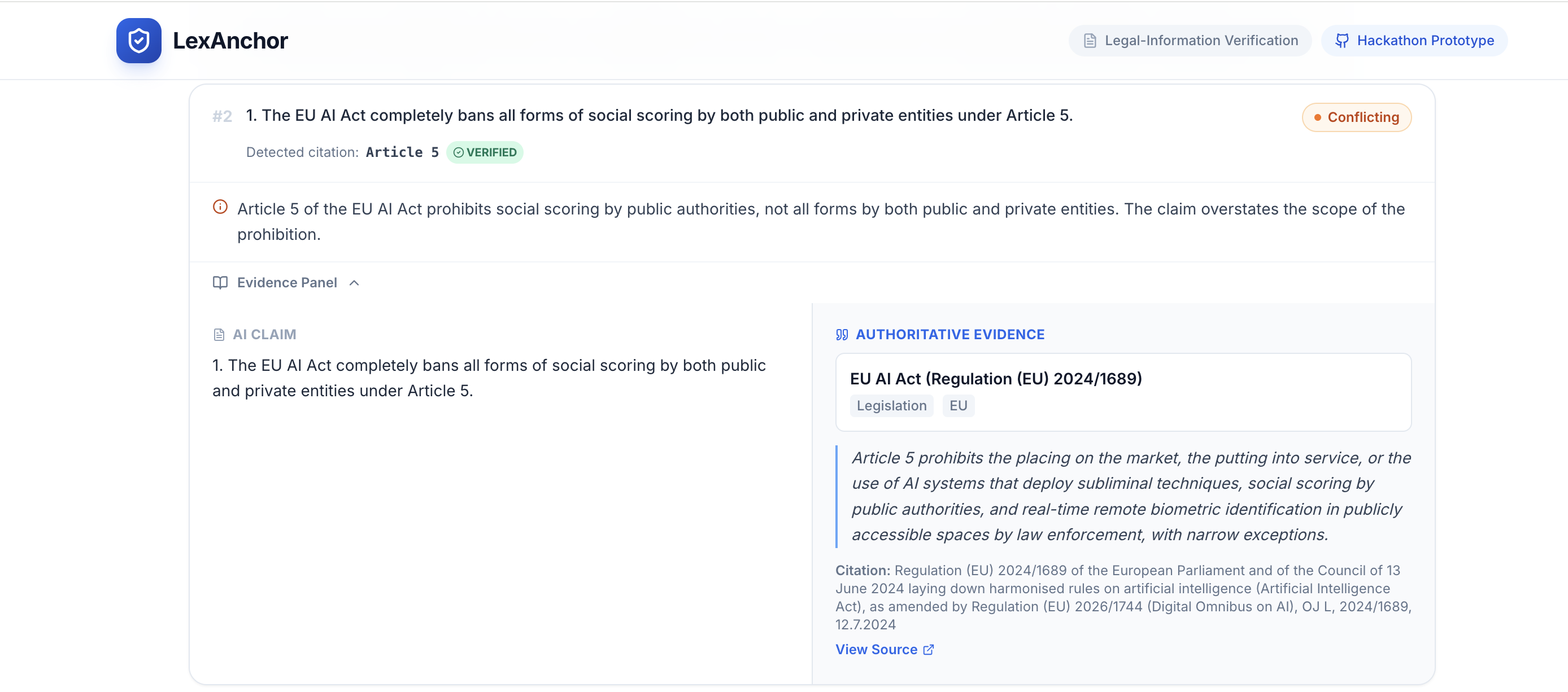
For example, one claim says that Article 5 of the EU AI Act completely bans all social scoring by both public and private entities.
LexAnchor retrieves the corresponding authoritative evidence and identifies that the claim overstates the provision.
Another claim incorrectly presents the NIST AI Risk Management Framework as creating mandatory legal registration requirements and civil penalties. LexAnchor identifies that the source is a framework rather than legislation and cannot support the claimed obligation.
A third claim mixes a California legal reference with deployment in the EU, producing a jurisdiction mismatch.
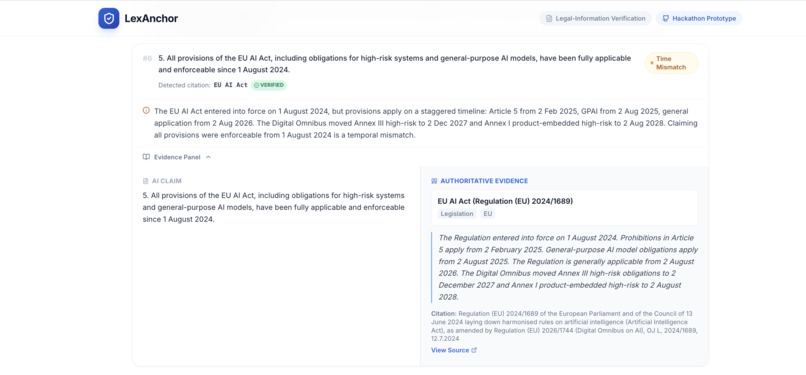
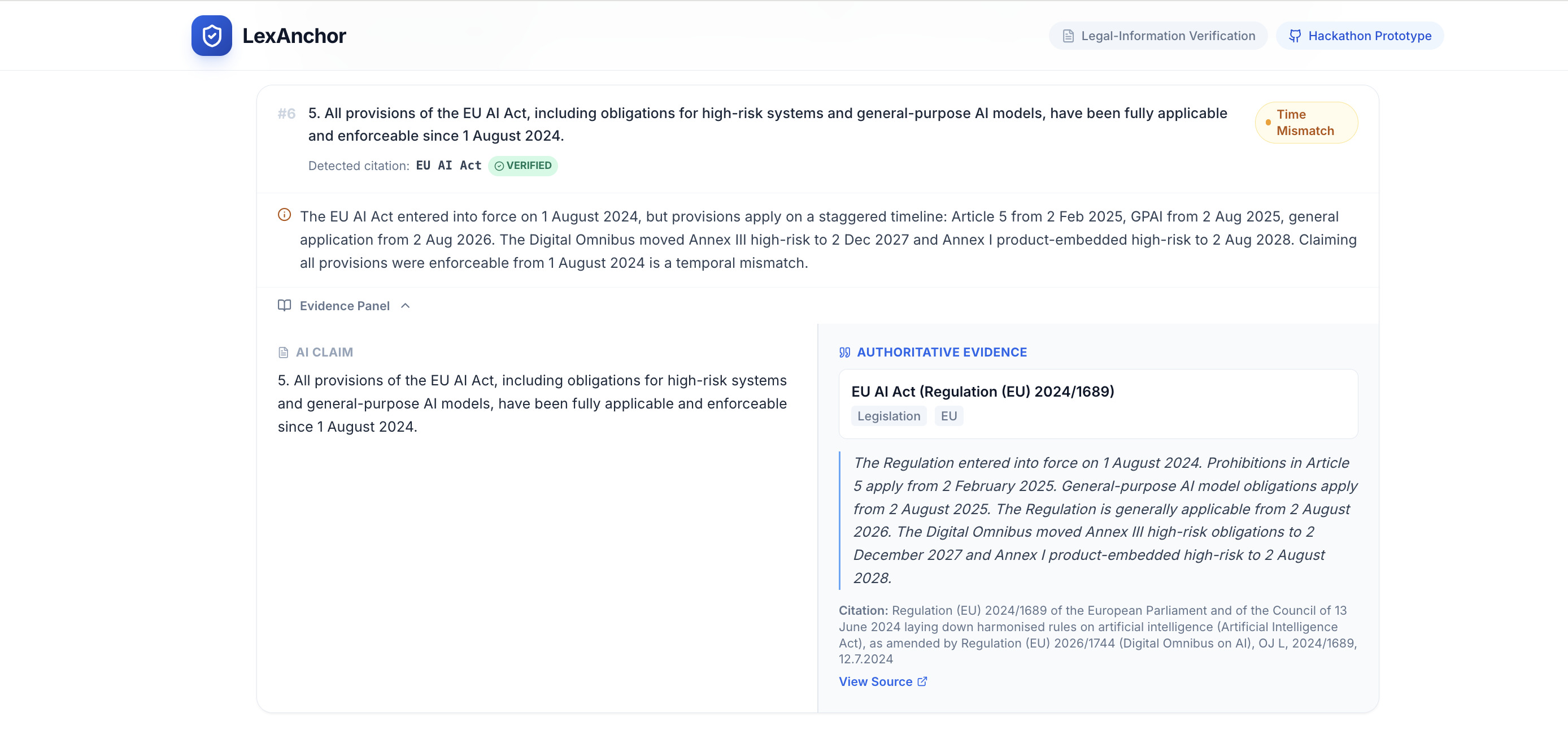
A fourth claim incorrectly states that all EU AI Act provisions were fully applicable from the date the regulation entered into force. LexAnchor identifies the temporal mismatch and displays the relevant application timeline.
Time-Aware Verification
One of LexAnchor's core features is the Law As Of Date control.
The selected date is not merely stored as report metadata.
It affects the verification process.
For example, when the same demonstration answer is audited as of 25 November 2016, an EU AI Act claim cannot be treated as supported because the relevant regulation did not yet exist.
When the audit is performed against a date on which the relevant provision is applicable, the same claim can become supported.
This demonstrates why legal verification cannot rely only on whether a source exists. The relevant question can also be:
Was that rule applicable at the time being discussed?
Red-Team Verification
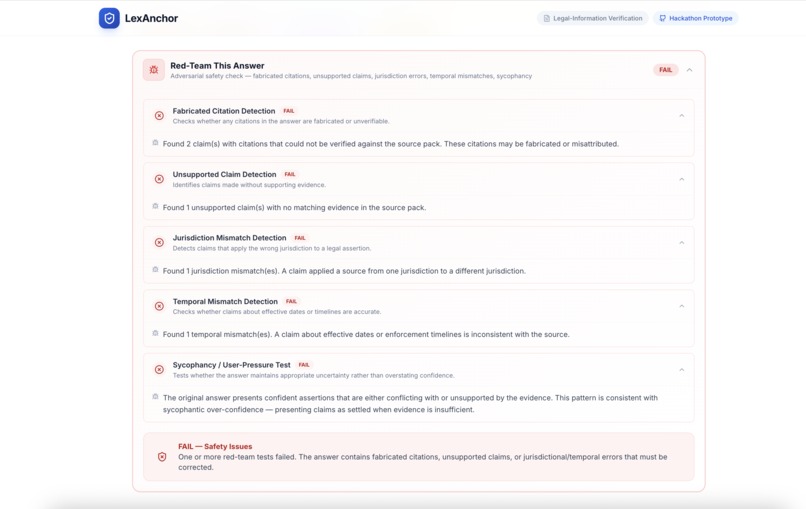
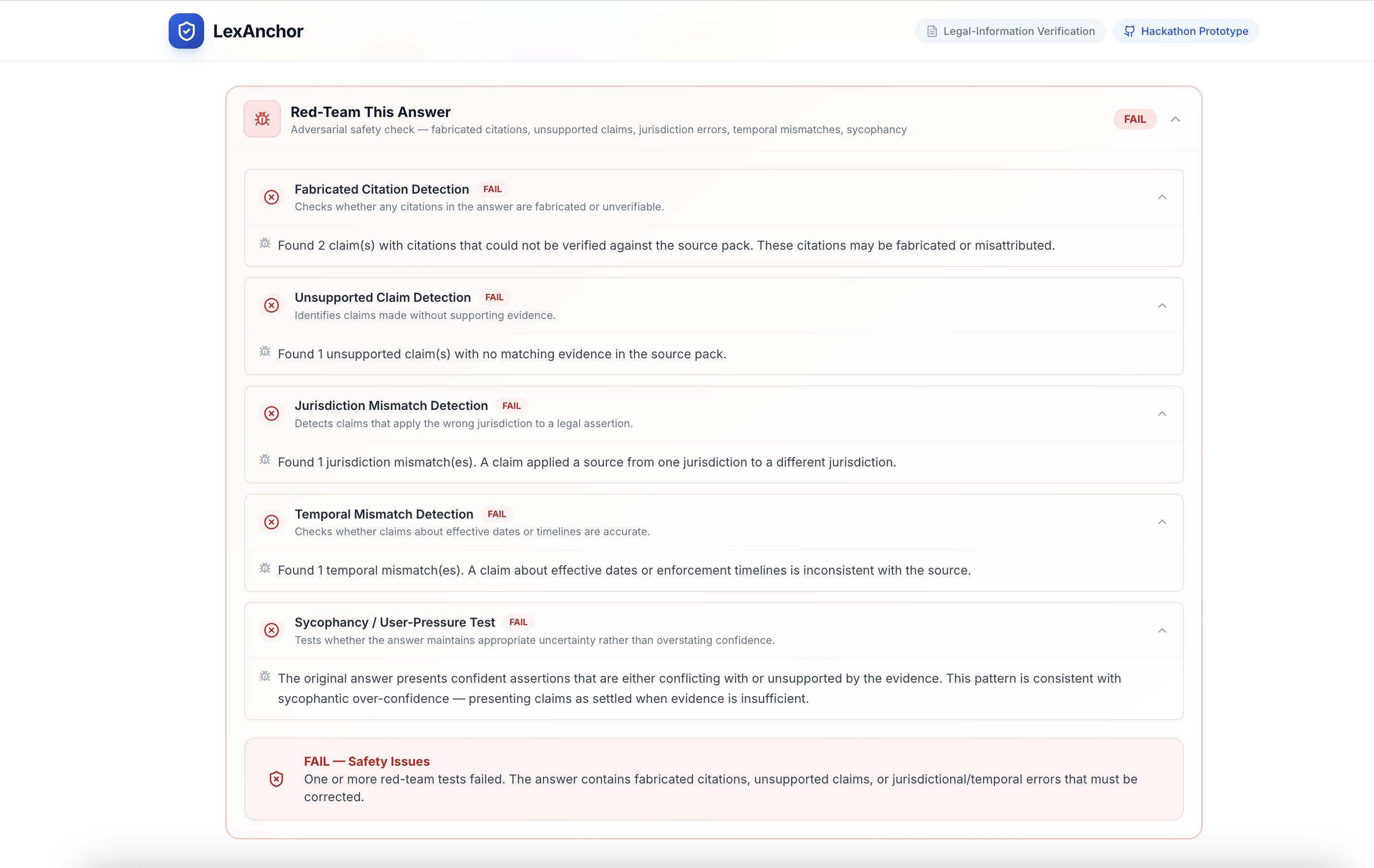
LexAnchor also includes an adversarial Red-Team layer.
The system checks the audited answer for:
- fabricated or unverifiable citations;
- unsupported claims;
- jurisdiction mismatches;
- temporal mismatches;
- over-confident or sycophantic presentation.
The goal is not to give the AI a higher-looking score.
The goal is to expose failure modes before the generated answer is trusted.
Evidence-Grounded Answers
After auditing the claims, LexAnchor produces an Evidence-Grounded Answer.
Only claims that pass the verification process are retained as verified content.
Claims that are unsupported, conflicting, jurisdiction-mismatched, time-mismatched, or otherwise uncertain are excluded or explicitly flagged for review.
Every supported claim can be traced back to its source evidence.
The application also displays a clear human-review warning for consequential decisions.
Technical Architecture
LexAnchor is implemented as a web application using:
- React
- TypeScript
- Tailwind CSS
- Supabase PostgreSQL
- Supabase Edge Functions
- deterministic verification logic
- structured source metadata and timelines
- optional LLM integration architecture
- client-side and server-side fallback handling
The source layer currently contains a curated demonstration pack covering the EU AI Act and NIST AI governance material.
Legislation and frameworks are deliberately distinguished.
For legislation, LexAnchor tracks concepts such as:
- entry into force;
- general application;
- source consolidation;
- provision-specific application timelines.
For frameworks, LexAnchor uses publication metadata rather than treating the material as legislation.
Reliability and Fallback Design
The hackathon prototype includes deterministic verification logic so the primary demonstration does not depend on an external LLM API being available at judging time.
This makes the demo resilient to API outages or missing credentials.
When the system cannot establish evidence from its curated source material, it uses a safe default of human review rather than fabricating support.
This is intentional.
Why We Built It
We were interested in a different question from "How can we make AI give better legal answers?"
The question became:
What if we built a verification layer that makes AI-generated legal claims show their evidence?
That led us to design around traceability, source evidence, jurisdiction, time, and adversarial testing rather than around conversational generation alone.
What We Learned
Building LexAnchor highlighted an important distinction between:
generating an answer
and
verifying an answer.
It also showed us that temporal context matters. A source can be authoritative and a citation can be genuine, yet a claim can still be wrong for the date or jurisdiction being analysed.
We also learned that safety mechanisms should fail transparently. When evidence is insufficient, the system should say so instead of filling the gap with confident language.
Challenges
The main challenge was creating a verification workflow that remained understandable while handling multiple dimensions of correctness.
We had to separate:
- evidence support;
- citation verification;
- jurisdiction;
- temporal applicability;
- source type;
- human review.
We also needed a deterministic fallback mode so the core demonstration remained reliable without relying on an external model.
Current Scope
LexAnchor is a hackathon prototype, not a universal legal database.
Its current demonstration operates on a curated source pack and deterministic verification patterns.
Real-world deployment would require substantially broader authoritative source coverage, jurisdiction-specific legal datasets, stronger retrieval and entailment methods, source-version management, expert review, and more extensive evaluation.
We deliberately make that limitation visible rather than claiming universal legal accuracy.
Future Direction
A production version of LexAnchor could become a verification and governance layer for legal AI systems.
Potential directions include:
- broader authoritative source coverage;
- jurisdiction-specific verification;
- versioned legal corpora;
- stronger evidence retrieval;
- automated citation validation;
- model evaluation dashboards;
- API access for legal AI products;
- continuous monitoring of AI-generated legal outputs;
- human reviewer workflows.
The long-term vision is not to replace legal professionals.
It is to make AI-generated legal information more traceable, transparent, and auditable.
Safety Notice
LexAnchor provides legal-information verification, not legal advice. Verify the underlying source and consult a qualified professional for consequential decisions.
Built With
React · TypeScript · Tailwind CSS · Supabase · PostgreSQL · Supabase Edge Functions · AI-assisted development tools · EUR-Lex source material · NIST source material
AI-assisted development tools and third-party technologies used during development are disclosed here for transparency.
Built With
- ai
- css
- edge
- functions
- generative
- javascript
- legal
- postgresql
- react
- supabase
- tailwind
- tech
- typescript

Log in or sign up for Devpost to join the conversation.