-
-
Demo Video
-

Leverage AI
-
The Problem
-
The Solution
-
Impact & Technology
-
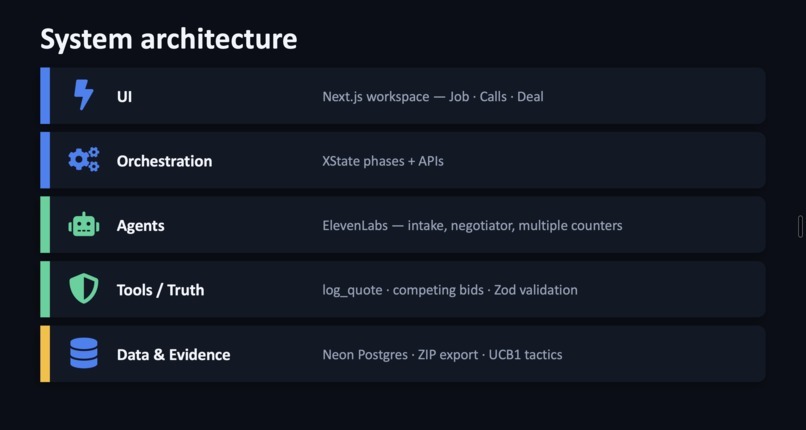
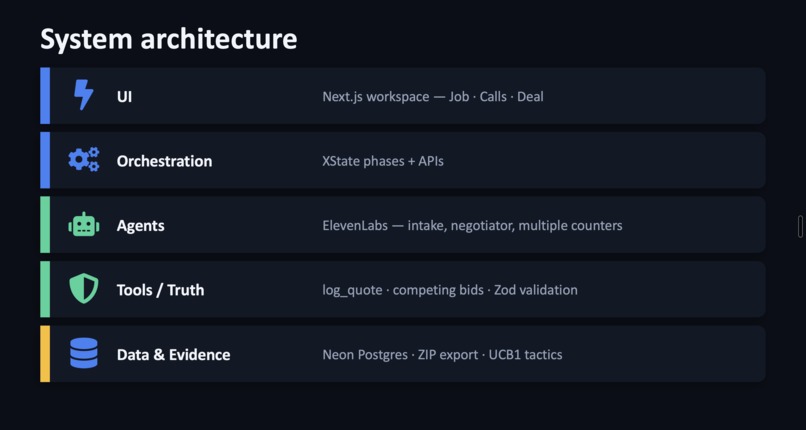
System Architecture
-
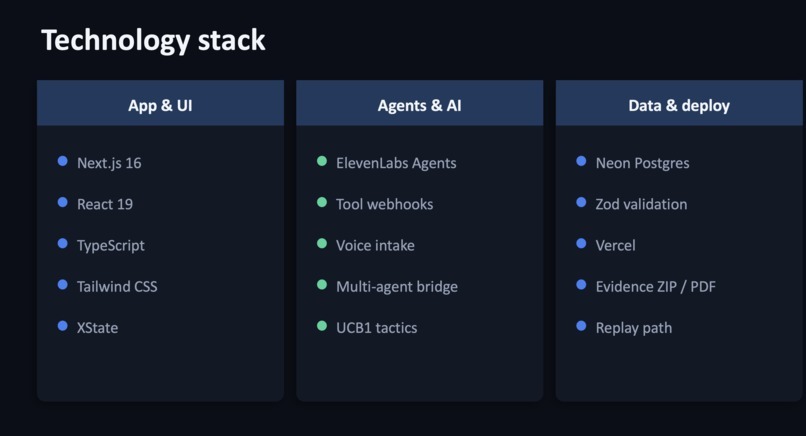
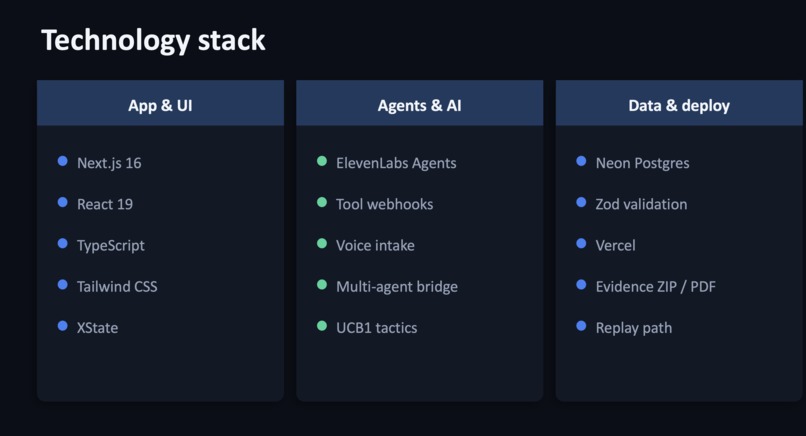
Technology Stack
-
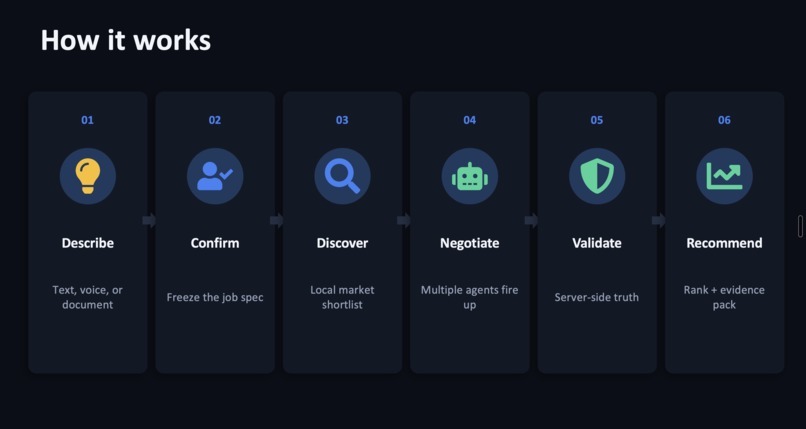
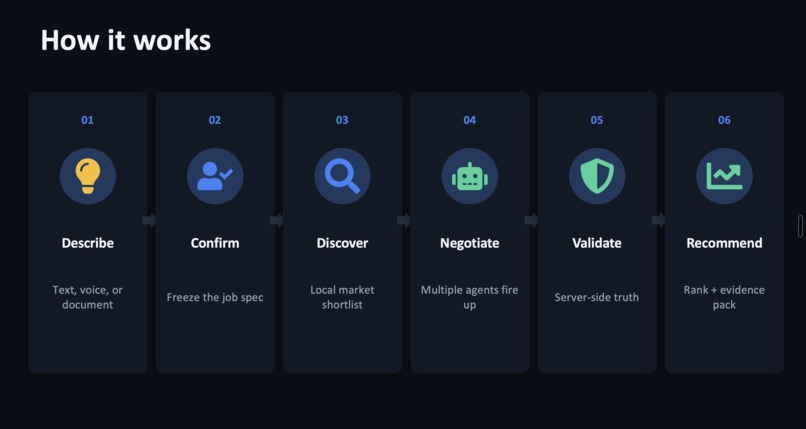
How it works
-
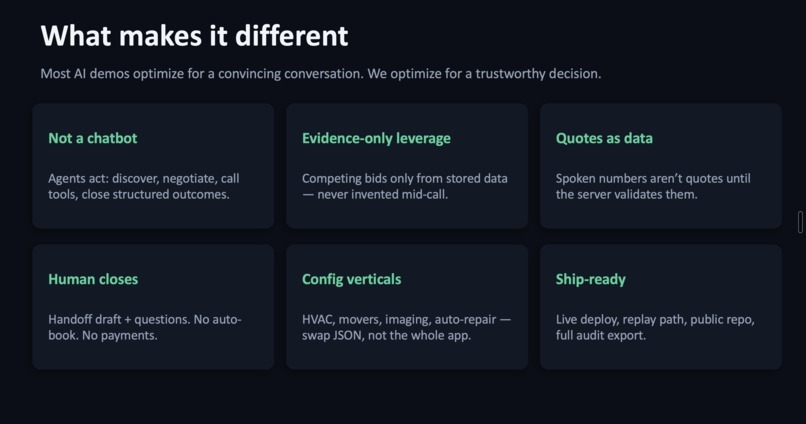
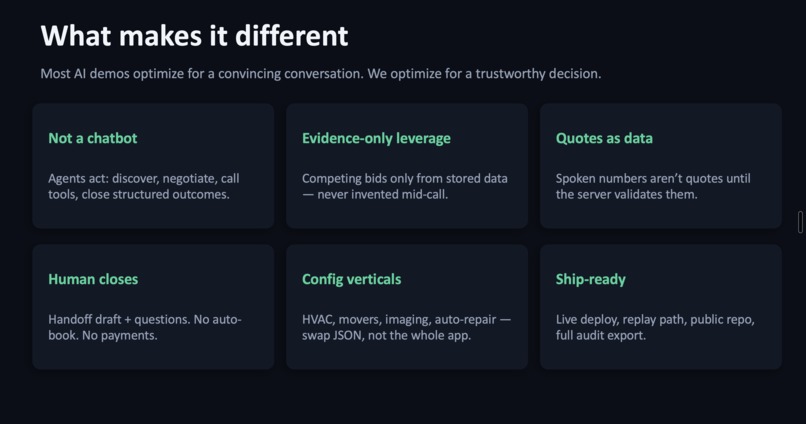
What makes it different

Inspiration
There is a quiet tax on ordinary people: whenever something expensive and urgent breaks, the market assumes you’ll take the first number you hear.
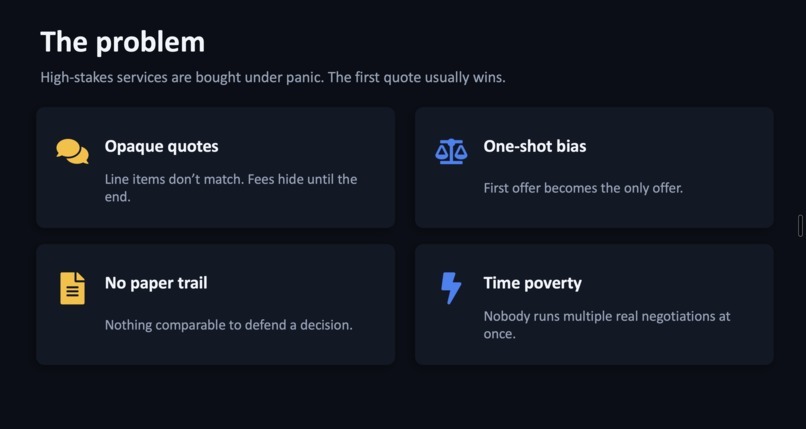
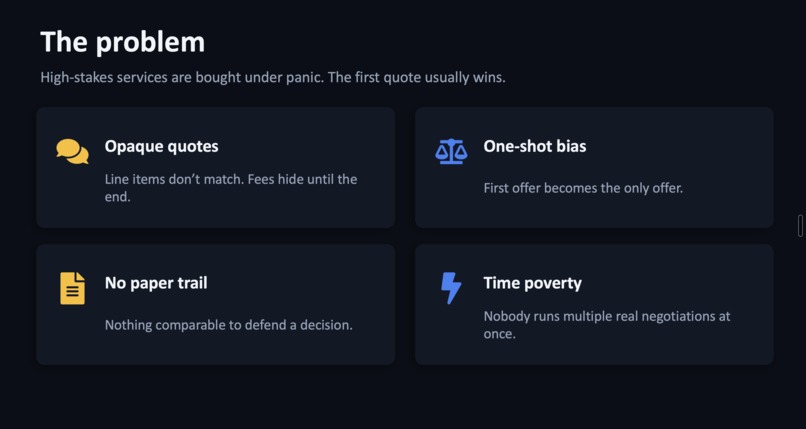
HVAC at midnight. Movers next week. Imaging because the doctor said so. Auto repair when the car won’t start. In each case the seller lives in that market every day; you don’t. Quotes arrive as theater — ballparks, packages, “depends when we open it up.” Line items don’t align. Fees show up late. You hang up with one offer and no way to know if you just overpaid by fifteen percent or forty.
That isn’t a “chatbot opportunity.” It’s an information and coordination failure. Running several real negotiations yourself means repeating the same job story, keeping mental notes, comparing incompatible scopes, and hoping you remember what they promised. Most people rationally skip it. So the first quote becomes the market clearing price by default.
LeverageAI exists for that gap: software that treats procurement of high-stakes services as a decision with evidence, not a conversation that felt productive. We didn’t start from “what can agents do?” We started from “why do buyers lose leverage the moment the phone rings?”
───
What it does
LeverageAI is a buyer-side negotiator for high-stakes local services.
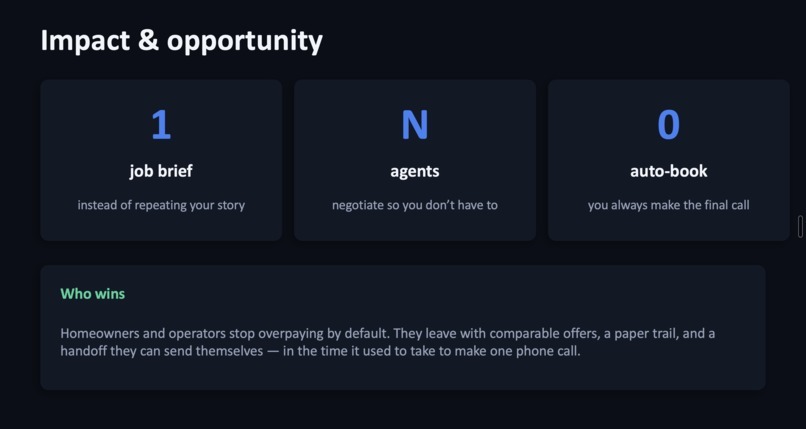
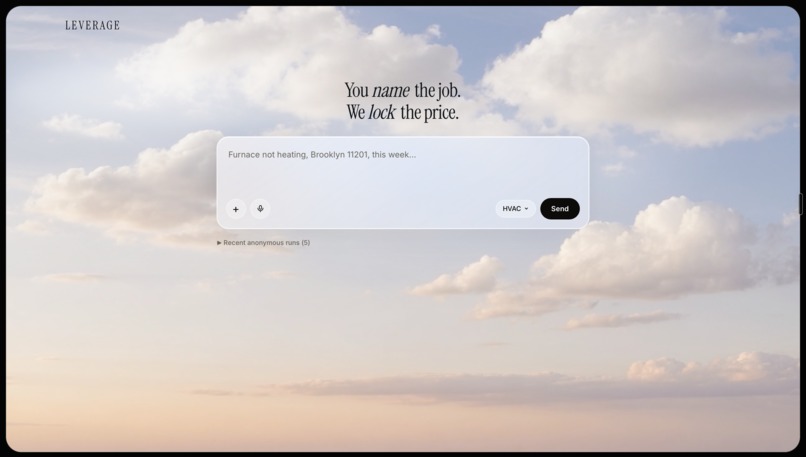
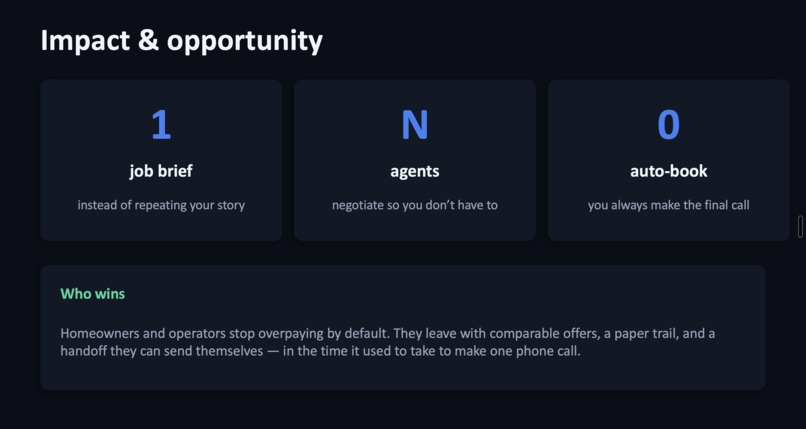
You put the job in once — text, voice, or a document. The system turns that into a structured brief and stops until you confirm. Confirmation freezes the job: every agent works from the same scope, not a drifting story.
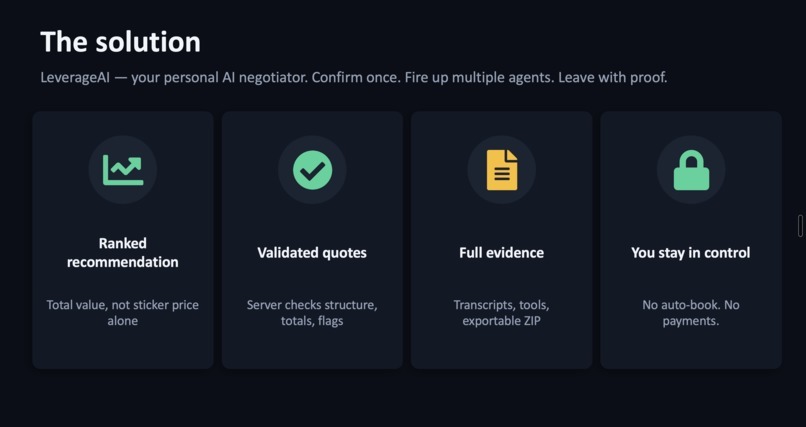
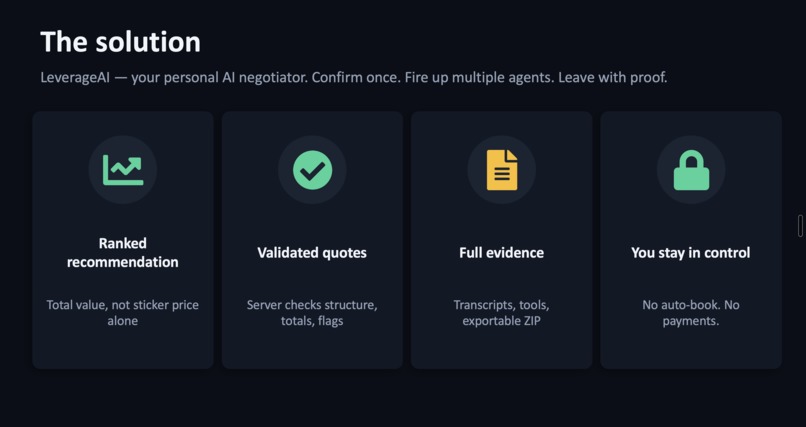
After that it discovers relevant local providers, then fires up multiple agents to negotiate for you. When the rounds end you don’t get vibes. You get:
• a recommendation ranked on total value, not the cheapest headline • itemized quotes that only count after the server accepts them (structure, totals, red flags) • evidence — transcripts, tool events, quotes, recordings when they exist • a handoff draft and questions you can send yourself before anyone books
The product never books work and never takes payment. That isn’t incomplete automation; it’s the point. For money this size, the last mile should stay human.
Users: anyone who buys expensive services under time pressure and currently loses by default.
Why it fits HackNomics: the core is economic — asymmetric information, weak price discovery, no paper trail — fixed with agents that act under rules, not slogans.
───
How we built it
Most “AI negotiation” demos stop at dialogue. We built a pipeline with a truth layer.
UI. Next.js + React + TypeScript. One screen: Job · Calls · Deal. Judges and users see the brief, the negotiations, and the outcome without hunting through tabs.
Orchestration. XState drives phases: intake → confirm → discovery → negotiate → report. The product has a spine; agents don’t freestyle the whole company.
Agents. ElevenLabs Agents for voice intake and multi-agent negotiation. Personas are isolated so counter-parties don’t leak strategy into the negotiator. The negotiator is the only side that gets database tools.
Tools as law, not decoration. Server webhooks with Zod: log quotes, pull competing bids, lookup benchmarks, close sessions with structured outcomes. Spoken dollars are not quotes. A quote exists after validation. Competing leverage is returned only from persisted rows — the model cannot invent a rival bid to sound clever.
Data & evidence. Neon Postgres for jobs, sessions, quotes, events. Export is a ZIP: PDF report, transcripts, quotes, tool trail, booking draft. Missing audio is stated as missing; we don’t fake completeness.
Learning with a fence. UCB1 can prefer tactics that move price. It cannot rewrite honesty rules, invent leverage, or unlock auto-purchase.
Ship path. Vercel deploy. Deterministic replay for demos when live agents are noisy. Verticals (HVAC, movers, imaging, auto-repair) live in config JSON so “new market” doesn’t mean rewrite the app.
The engineering bet: autonomy without audit is a parlor trick. Autonomy under validation is a product.
───
Challenges we ran into
Fluency is the enemy. A voice agent can invent a total that “sounds right.” Once you rank on that number, you’ve built a lying calculator. We had to make the pipeline distrust transcripts until quote logging accepts arithmetic and categories.
Leverage is a moral hazard. “I have a better offer elsewhere” is the oldest sales line. If the agent can say it without a row in the database, the whole economic story collapses. So competing bids are a tool result, not improvisation.
Multi-agent systems fail loud. Parallel negotiations mean race conditions, flaky sockets, and demos that die in front of judges. Bridging, turn caps, and a replay path weren’t polish — they were the difference between a story and a system.
Vertical sprawl. Hard-coding HVAC fee labels into app code would trap us. Moving schemas, benchmarks, and red flags into config was boring work that made multi-market expansion real.
Honest scope. Real shops on a discovery list and simulated counter-parties for negotiation is an MVP trade for cost, legality, and reliability. The product has to say what happened — not cosplay full PSTN.
───
Accomplishments that we're proud of
We shipped a loop that matches how a careful human would buy if they had staff: freeze the job, press the market from more than one angle, refuse incomplete numbers, rank total value, leave a paper trail.
We’re proud of the refusal surface as much as the agents. The product refuses to promote teaser prices into ranked quotes. It refuses invented leverage. It refuses to book. Those refusals are product features.
We’re proud of the one-screen workspace — the negotiation isn’t a black box behind a spinner. And of the fact that someone can open a public repo, a live deploy, and a video without a private Zoom “demo environment.”
───
What we learned
For high-stakes spend, the scarce resource isn’t words. It’s comparable structure and proof.
Agents amplify whatever you measure. If you measure “sounded persuasive,” you get theater. If you measure “validated total + evidence chain,” you get something a buyer might trust.
Multiple agents only pay off when their outputs land in the same schema. Otherwise you’ve automated confusion.
And: shipping a constrained system beats promising an unbounded “autonomous CFO” that nobody should let near a real invoice.
───
What's next for LeverageAI
Near term. Real PSTN when the unit economics and compliance story clear. Stronger “first quote vs final recommendation” savings surfacing. More verticals via config, not forks.
Product. Multi-user for households and small teams. Light procurement workflow for property managers and operators who buy the same categories repeatedly.
Company. Treat this as buyer-side infrastructure for messy local markets — expand where quote opacity is worst, keep the honesty gates non-negotiable.
Same thesis throughout: negotiate with proof, not hope.
Built With
- css
- elevenlabs
- neon
- next.js
- node.js
- postgresql
- react
- tailwind
- typescript
- vercel
- xstate
- zod


Log in or sign up for Devpost to join the conversation.