-
-
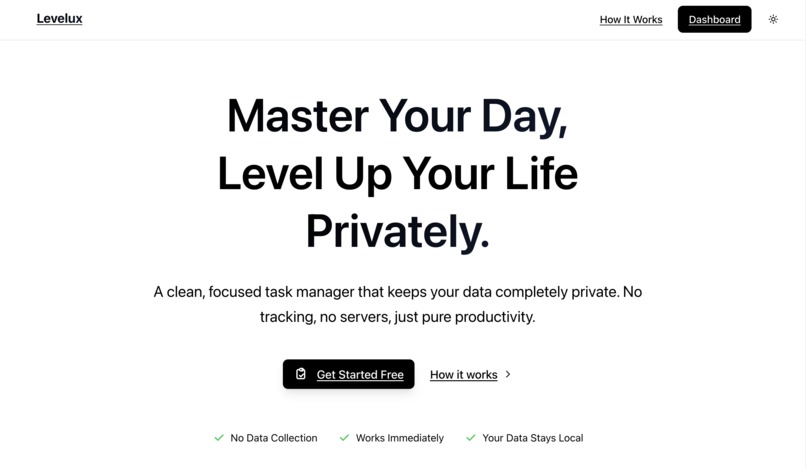
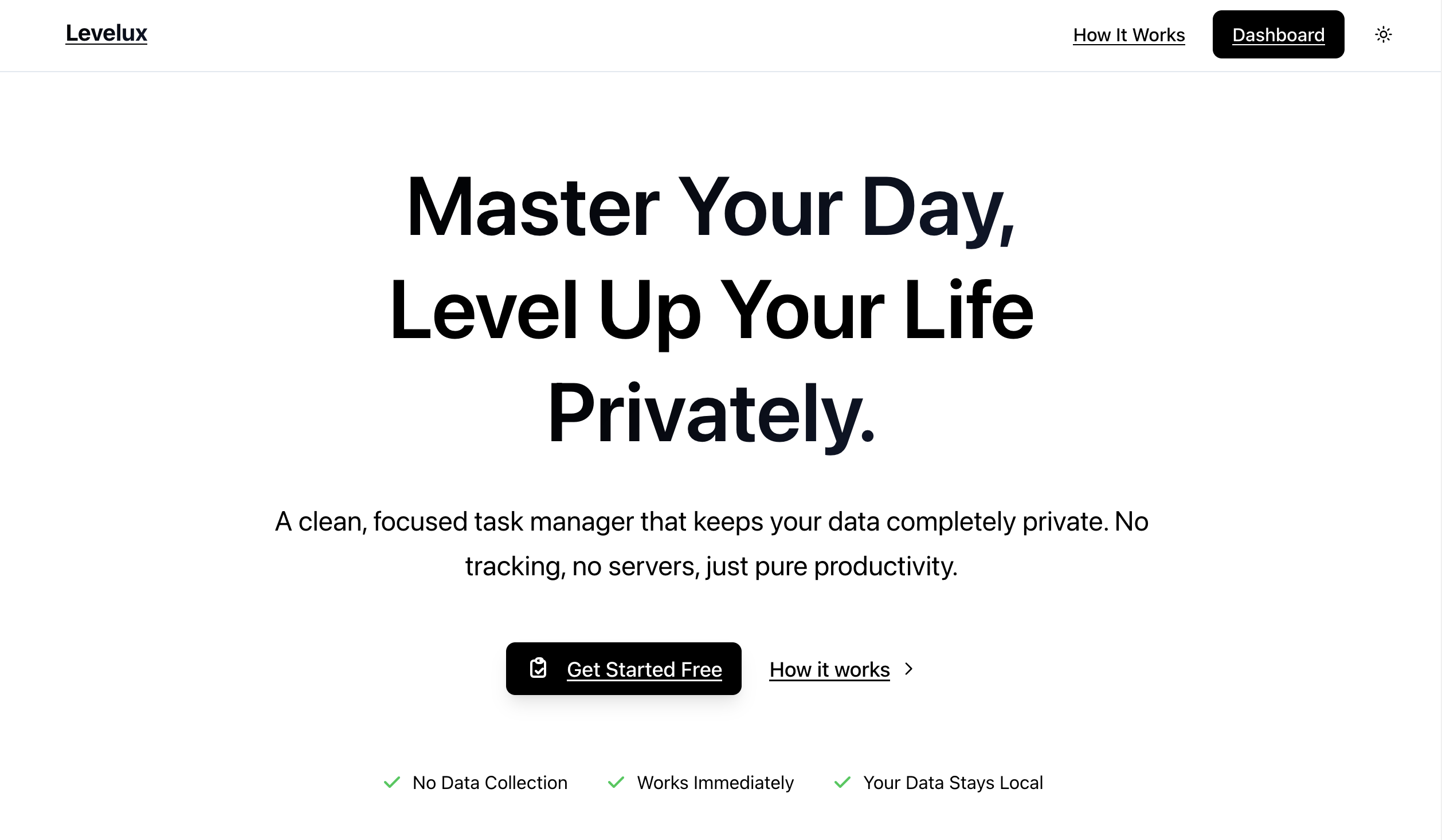
Landing page with light mode
-
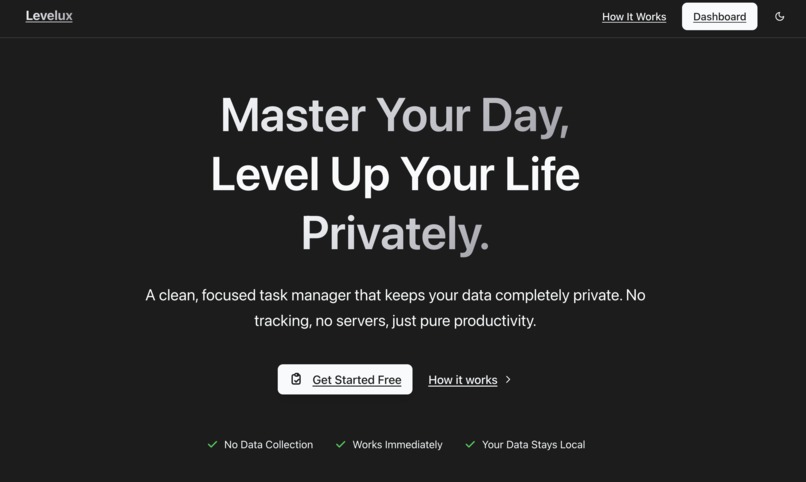
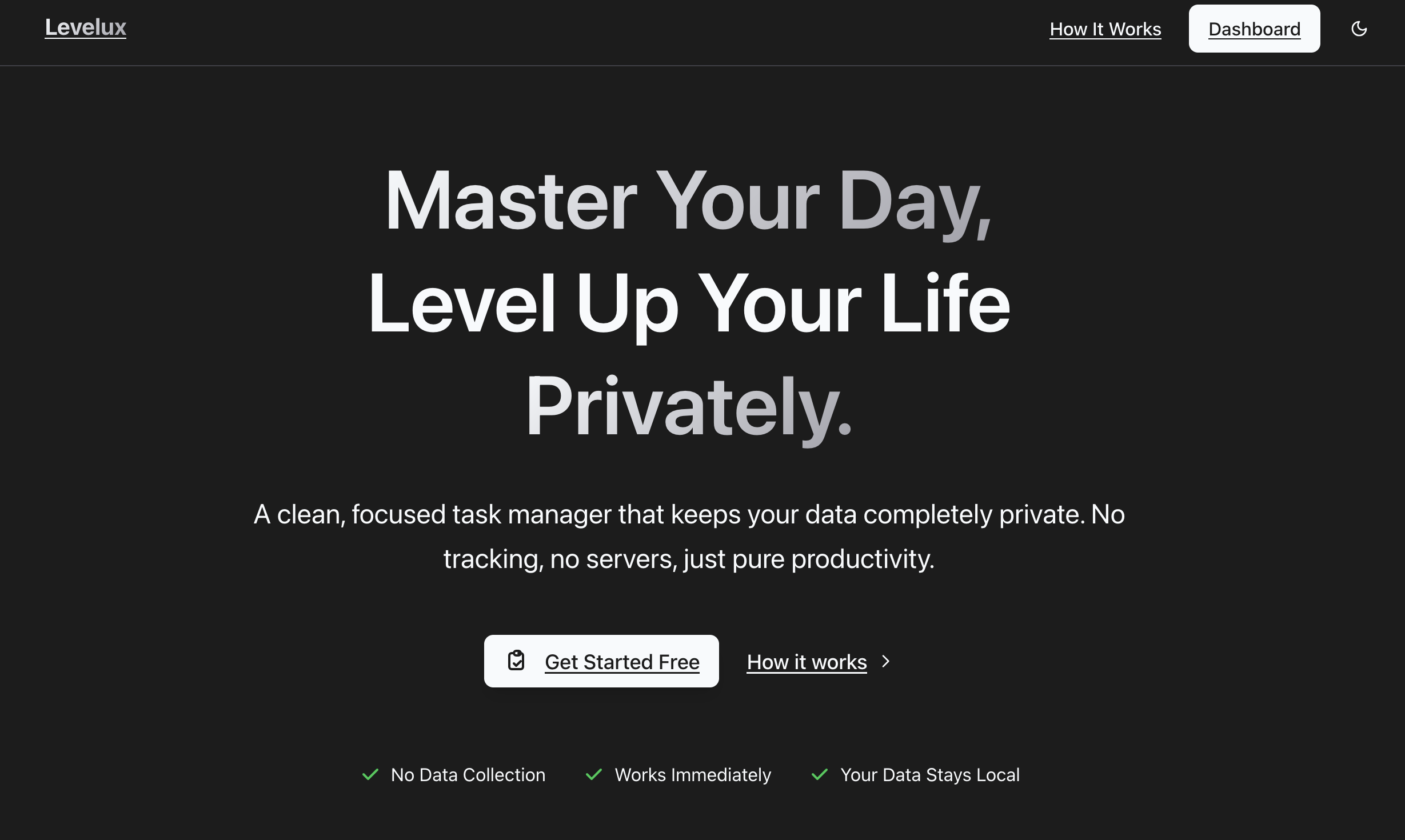
Landing page with dark mode
-
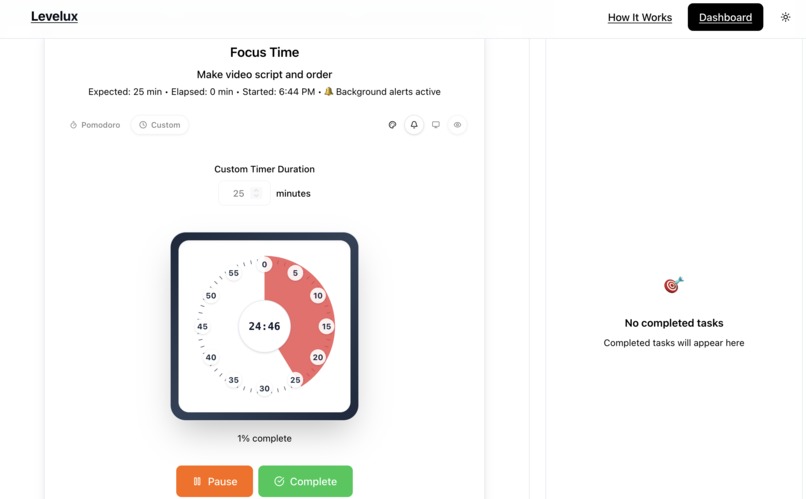
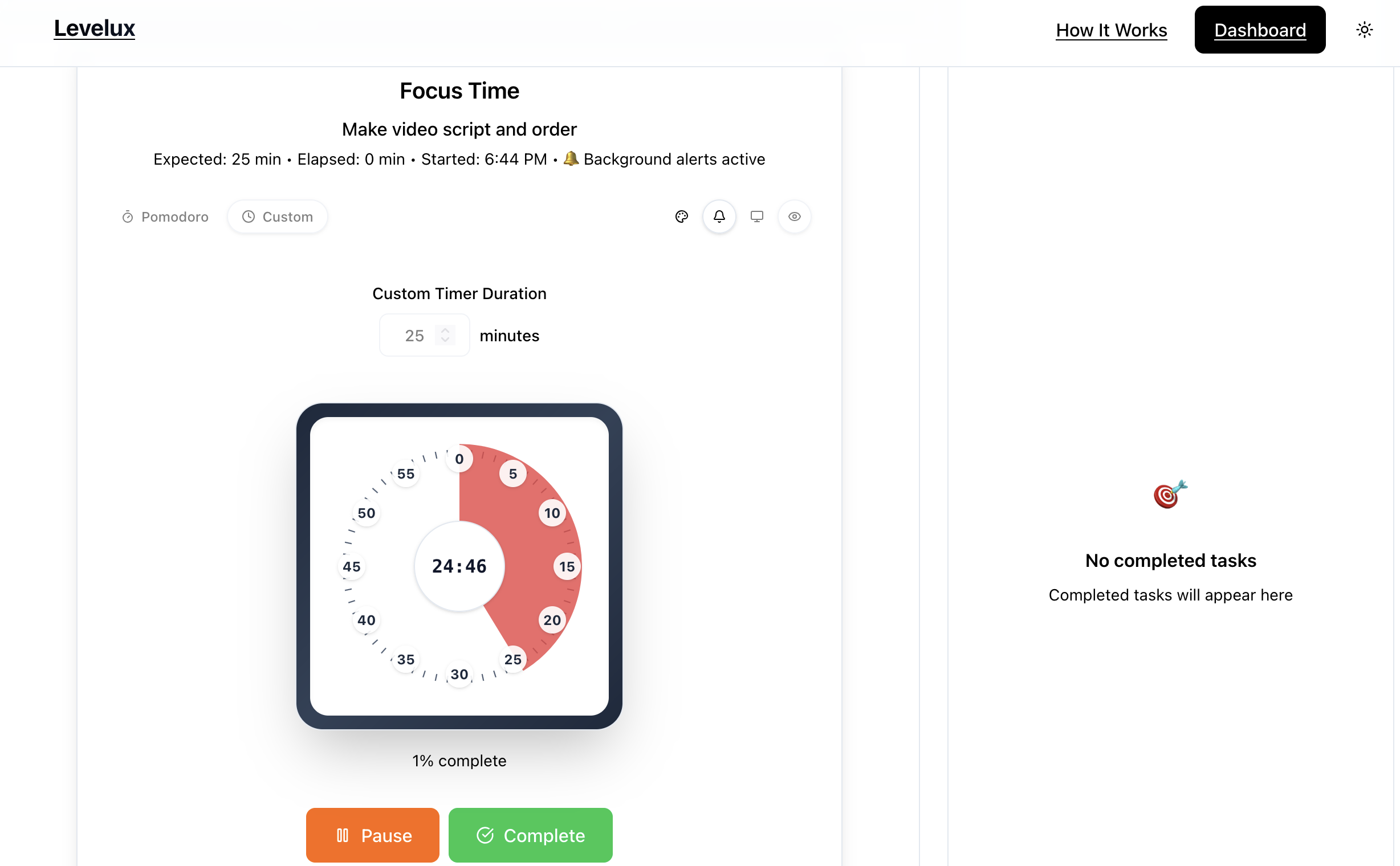
Focus mode in light mode
-
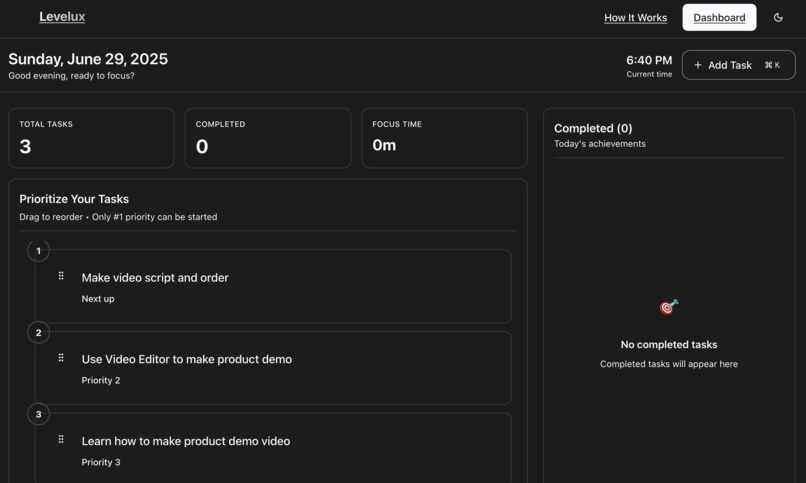
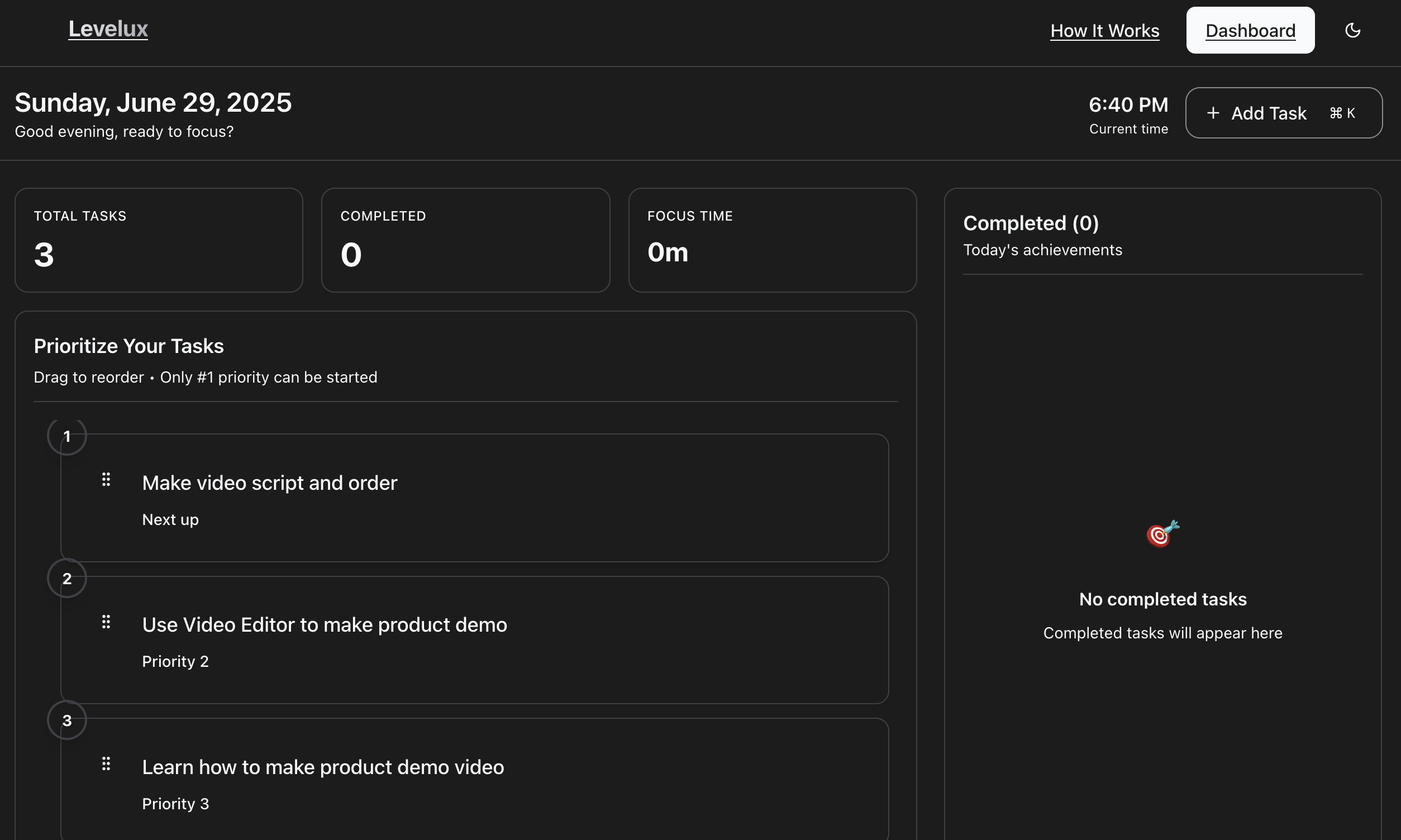
User Dashboard with dark mode
Inspiration
This project was inspired by the anime "Solo Leveling" and its idea of growing stronger step by step. Many people have probably experienced using different time or task management platforms that ended up feeling more complicated than helpful. When faced with a long list of tasks, it’s common to feel overwhelmed. We often spend more time deciding what to do than actually doing it. Levelux was built to change that. By focusing on one clearly prioritized task at a time, the goal is to help users develop healthier habits around focus and attention. This is a valuable life skill that supports long-term personal growth. instead of being distracted by multiple tasks. This kind of focus is a true life skill that supports long-term growth and personal development.
Privacy is another concern that many people share. Most popular platforms like Todoist, Notion or Asana store personal goals and work habits on their servers. That raises questions about control and trust. Our daily tasks can reveal so much about us, including our dreams, routines, and struggles. Levelux respects that by keeping everything private and stored only on the user’s own device.
There is also something missing in how we present our efforts online. Platforms like LinkedIn often highlight the final achievements, but they rarely show the consistent, quiet effort behind them. The truth is that meaningful work is built one small action at a time. Levelux was created to honor that process and to give space for real progress, not just the highlight reel.
What it does
Levelux is a focused task manager designed to help users avoid distractions and stay committed to what matters. Rather than juggling many tasks, users select one priority to work on. The interface supports this by visually locking other tasks and encouraging deep focus. When a task is completed, a small and stylized notification inspired by the Solo Leveling aesthetic adds a sense of satisfaction and motivation.
Everything runs locally in the browser. No data is uploaded or tracked. Even when switching tasks is necessary, the app gently encourages returning to one task at a time. Task data is persistently stored using localStorage, so users do not lose progress even if the browser is refreshed. Levelux is more than a to-do list. It is a tool for rebuilding focus in a distracted world.
How I built it
Originally, I used bolt.new to explore different types of frontend designs that could match the Solo Leveling theme. During the early phase, I also spent a significant amount of time trying to integrate Supabase for authentication and database features. However, I eventually realized that bolt.new had limitations when it came to backend development. After several attempts and debugging efforts, I decided to shift the direction of the project. Once I found a frontend design that fit the vision, I downloaded the code, made a few adjustments, and connected it to a GitHub repository for more structured development.
Levelux was built using bolt.new for fast and frontend-focused development. The stack includes Next.js 15, TypeScript, and TailwindCSS, with everything running in the browser. Data is saved using localStorage, and task status syncs across tabs through native browser events.
Most of the development and refinement happened directly in bolt.new to maximize the strengths of the platform. For a few technical issues that were difficult to solve through the bolt.new, such as handling detailed timing logic or improving progress report feature, I briefly used Cursor to make precise adjustments. The core experience, however, was built and polished within bolt.new.
Challenges I ran into
One of the earliest challenges was staying committed to minimalism. There were many moments when bolt.new suggested features like progress bars or colorful visual elements that went against the design direction I set from the beginning. Even after I set a custom color theme, the bolt editor often ignored it and kept introducing new styles that didn’t align with the app’s minimal and professional tone. Saying no to those distractions was an ongoing part of the process.
There were also functional limitations. Although bolt.new supports Supabase, it does not support it with Next.js, which was part of my original technical plan. Because of this, instead of building a different project, I chose to adapt Levelux by removing backend functionality and rebuilding everything using localStorage. This required creative frontend logic to handle data management and cross-tab syncing.
In addition, removing unwanted HTML elements in bolt.new sometimes led to more issues than solutions. For example, when I asked bolt.new to delete certain section tags, it introduced new linting errors and layout bugs that I eventually had to fix manually.
Previewing the project also came with frustration. I initially used Zen browser, where the preview mode frequently failed or froze. I wasted many credits trying to debug the issue before finally learning from the community that using Chrome solved the problem.
Lastly, the hardest part was not technical. It was designing for how people actually behave. Many users believe they can multitask, but they end up feeling overwhelmed or distracted. Levelux needed to feel familiar and supportive, especially for people used to jumping between many tasks. That’s why I added a feature called "Pause & Switch" to at least acknowledge and accommodate those types of users, even while promoting a single-task focus. The goal was to guide them step by step, helping them rebuild the habit of focusing on one thing at a time. Finding that gentle but effective way to change behavior was the most difficult part.
Even though I chose to use localStorage as a design choice aligned with the philosophy of minimalism and privacy, it comes with limitations. For example, if the user has the app muted or is not actively on the browser tab, it becomes difficult to notify them when the timer ends. This is one of the areas I plan to improve in future iterations to ensure the time management features remain effective without requiring constant attention.
Accomplishments that I'm proud of
Originally, Levelux started from a simple idea. As I worked through different design variations, bolt.new’s suggestions helped me narrow my direction and refine the concept into something more solid and intentional. Using this tool to bring my idea to life and watch it evolve into a fully functional and well-aligned application was one of the biggest accomplishments of the project.
Levelux proves that a frontend-only application can still feel powerful and complete. It runs smoothly, syncs between tabs, and supports a focused workflow, all without a backend or database.
What matters most, though, is the philosophy behind it. The app does not chase features. It’s built to respect your time and help you protect your focus, especially in a world full of distractions. The goal isn’t to do as much as possible. It is to make steady and meaningful progress, one task at a time.
What I learned
At the beginning, I was skeptical of the term "vibe-coding"—it sounded too vague to be practical. But through this project, I started to understand what it really means. bolt.new was able to follow my design intent surprisingly well. Its ability to understand what I was trying to build, and then apply those changes where they actually needed to happen in the code, impressed me. The way I could visually select specific elements and guide the editor to make fixes or improvements directly felt like a game-changer, especially for UI and layout tasks.
Still, I realized that a minimum level of programming knowledge and web development understanding is necessary to truly get the best out of bolt.new. Without that foundation, it becomes difficult to control the outcome or correct unexpected behaviors. I had to step in manually when things went off track, and that knowledge helped me use the platform more effectively.
One key moment in development was when I had to rethink my technical direction. Supabase was part of my original plan, but after discovering that bolt.new did not support it with Next.js, I shifted to using localStorage. What initially seemed like a setback actually turned into a strength—it aligned naturally with the minimalist and privacy-first philosophy I wanted Levelux to represent. This change reinforced the idea that a product can be simple, focused, and effective without relying on complex backend systems.
More broadly, I gained a deeper understanding of how UI decisions influence user behavior. Every interaction had to be purposeful. It had to support focus, reduce decision fatigue, and reward consistency. That mindset shaped everything from how tasks are presented to how the interface responds after completing work.
Above all, I learned that simplicity takes discipline. Staying focused during development helped me build something that encourages the same in users.
What's next for Levelux
There is more to improve. I know this application still has a lot of room to grow, both in terms of refinement and in developing a strong marketing strategy. Through this competition, my hope is to share the core idea behind Levelux with a wider audience and show its potential to make a real impact. I want this concept to evolve into a tool people actually use to build healthy focus habits and manage their time more effectively. Being selected as a winner would not only validate this direction, but also give me the momentum to develop Levelux into a fully realized tool that reaches and supports more people. Finalizing the PWA setup will let users install the app like a native tool. Background focus music, whether through Spotify or custom playlists, can create a calming work environment. Exporting tasks in formats like CSV or PDF would help with offline reviews or progress tracking per user.
One concern that comes with using localStorage is how browser updates could affect the reliability of task management features. Since there is no backend, any changes to how browsers handle storage might break the time tracking or data consistency logic. Finding a better solution to safeguard against this while still maintaining the privacy-first philosophy is a challenge I plan to explore further.
Looking ahead, Levelux will also grow in its educational mission. Writing more about focus, dopamine, and digital behavior can help users understand why the app works the way it does. Researching how users engage with it over time will guide future updates.
In the long run, the hope is to make Levelux more than just a task manager. It could become a new kind of professional platform, one that reflects real progress, not just finished products. Whether that is through wearable tech, VR/AR interfaces, or a new kind of portfolio remains open. One idea under consideration is a score or ranking system that could introduce a healthy sense of competition among users. While there is still doubt about whether such a feature, along with adding backend systems like databases and authentication, might distract from the core focus philosophy, it could also inspire more consistent daily effort and offer an alternative to platforms like LinkedIn by showcasing real-time growth and engagement. But the mission is clear: to help people focus better, work with intention, and see their effort in a new light.
Built With
- nextjs
- react
- shadcnui
- tailwindcss
- typescript

Log in or sign up for Devpost to join the conversation.