-
-
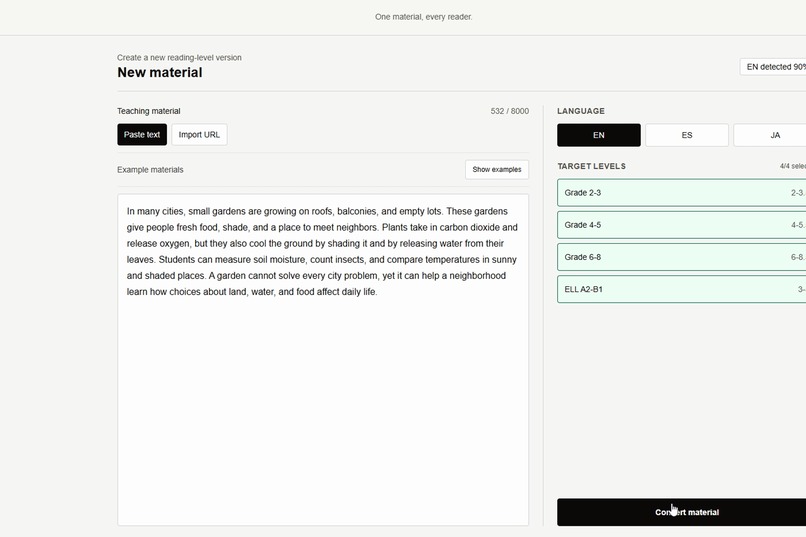
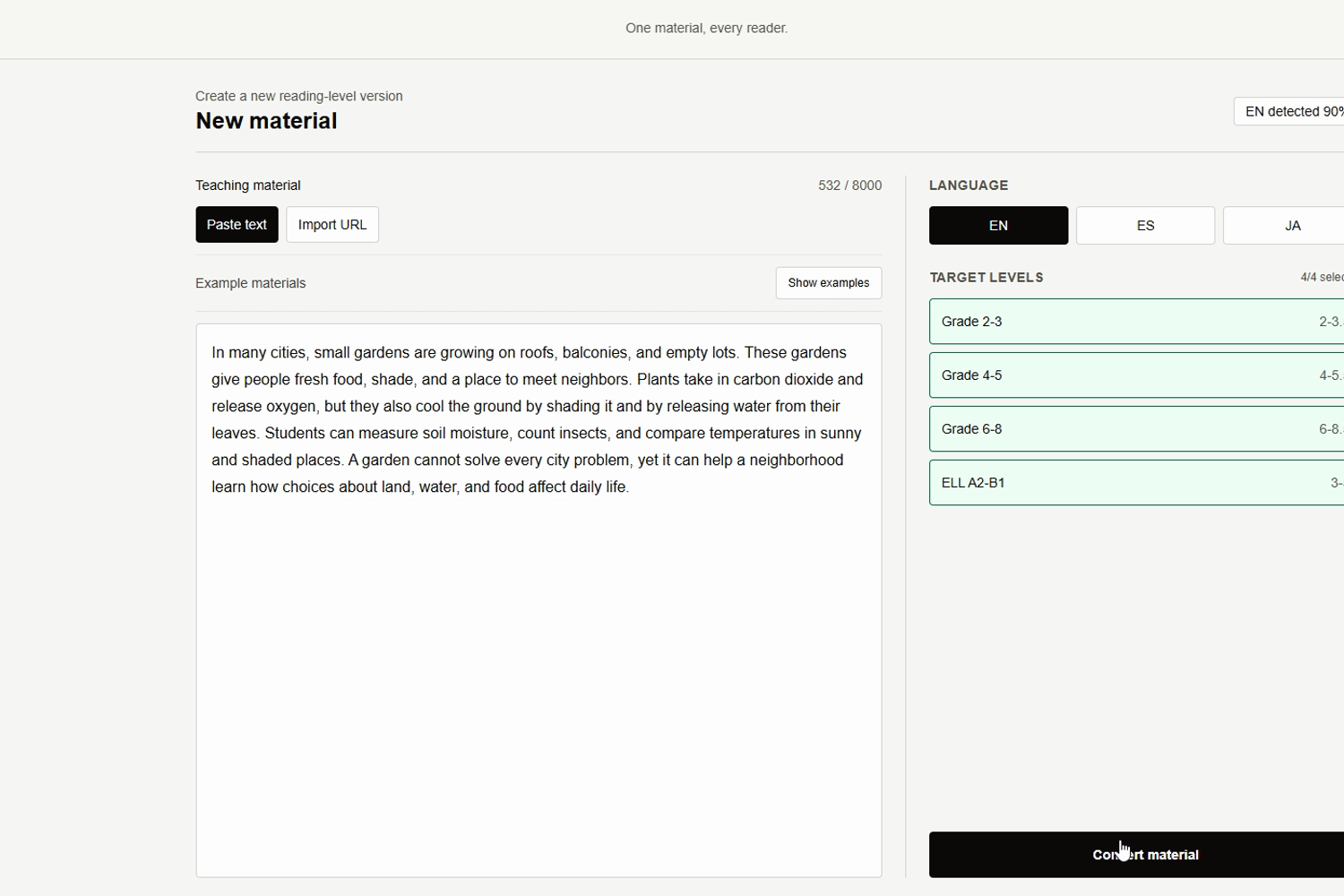
Paste an original teaching text, choose a language and target reading levels, then start conversion.
-
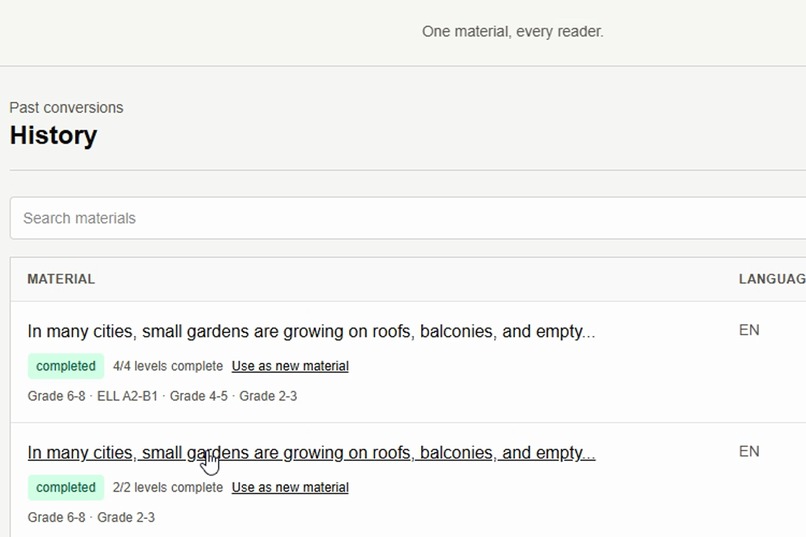
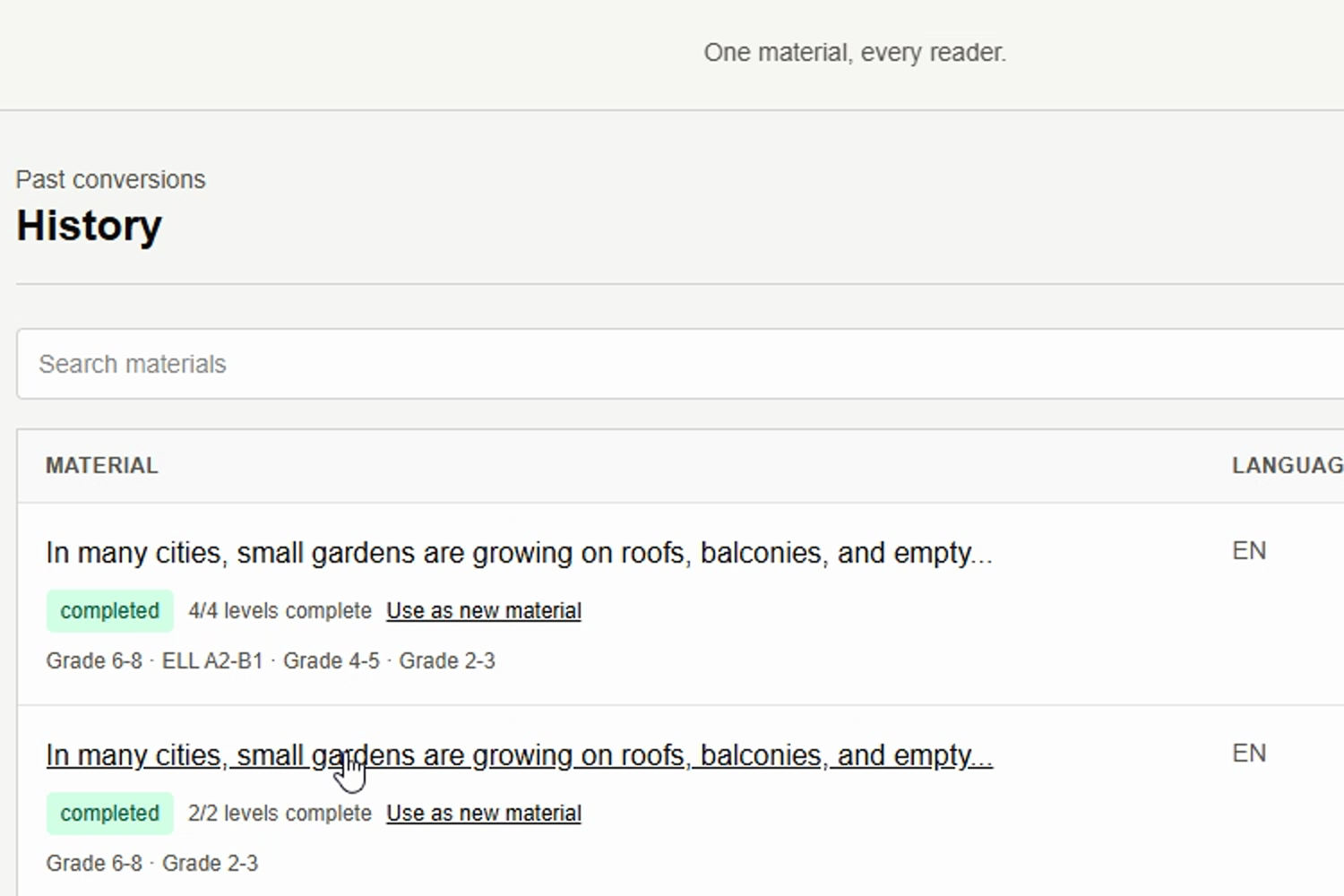
Reopen completed conversions or reuse an earlier teaching material in the same private workspace.
-
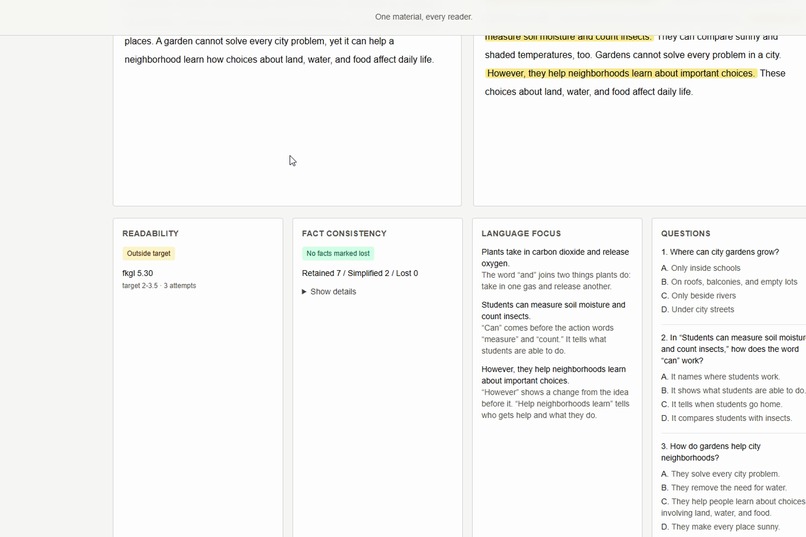
Compare original and simplified text alongside readability, fact consistency, language focus, and questions.
-
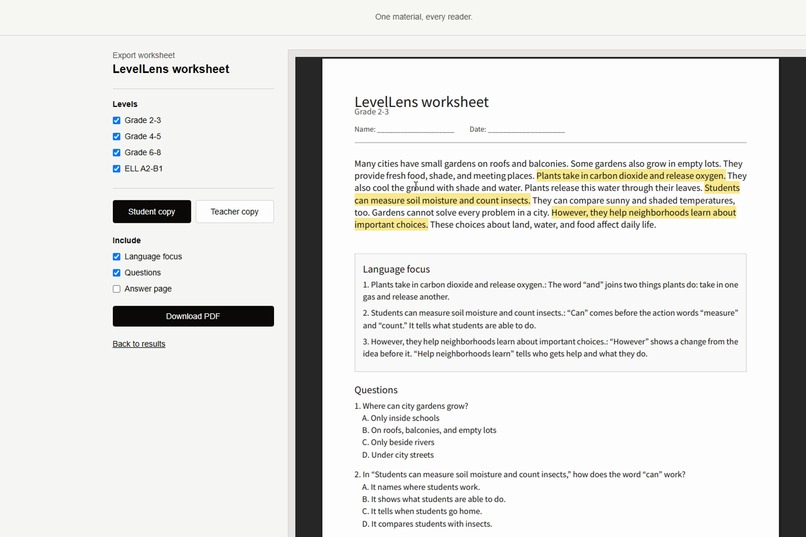
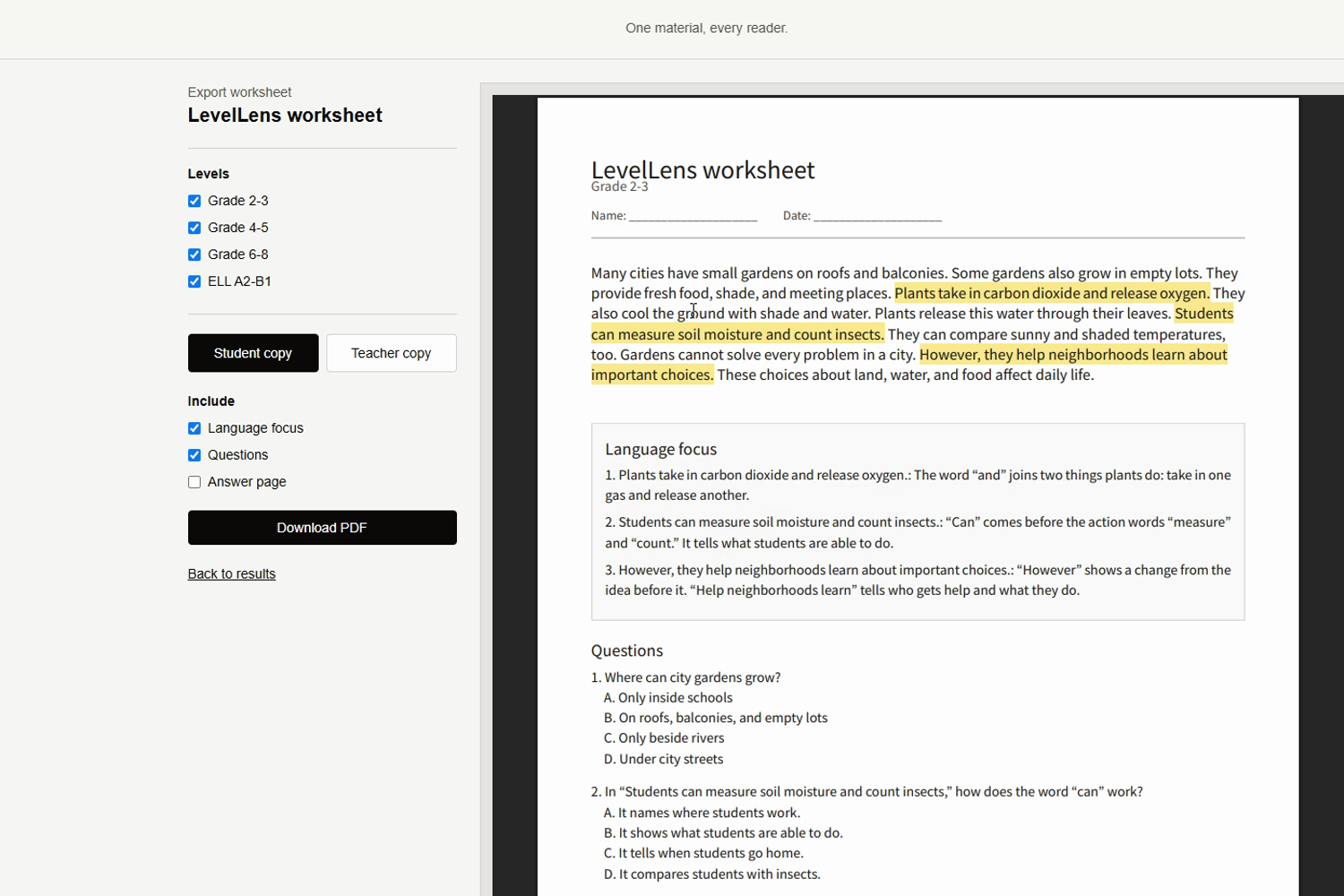
Export a classroom-ready student or teacher worksheet with language focus and comprehension questions.

## Inspiration
Teachers often teach students with very different reading abilities in the same classroom. Rewriting a text with an LLM is fast, but it does not prove that the result actually fits the intended level. I wanted to make that quality check visible and repeatable.
## What it does
LevelLens turns one teaching text into multiple verified reading-level versions in English, Spanish, and Japanese.
For every selected level, GPT-5.6 creates a draft. LevelLens then scores it on the server with a deterministic, language-specific readability metric. If the score misses the target range, the measured result becomes concrete revision feedback and the draft is regenerated up to three times.
Teachers can compare original and simplified text side by side, review fact consistency, study language patterns, use four-choice comprehension questions, export student or teacher PDF worksheets, and reopen past work from History.
## How I built it
I built LevelLens with Next.js, TypeScript, Tailwind CSS, Prisma, PostgreSQL/Neon, and the OpenAI API.
GPT-5.6 uses Structured Outputs for rewriting, fact checking, language-focus extraction, and question generation. Deterministic scoring stays outside the LLM: English uses Flesch-Kincaid Grade Level, Spanish uses Fernández-Huerta, and Japanese uses a composite heuristic based on kanji grade deviation and sentence length.
I used Codex throughout the project to build the application scaffold, scorer modules, pipeline, API routes, tests, multilingual teacher UI, PDF export, deployment safeguards, and this demo workflow.
## Challenges I ran into
The main challenge was balancing reliable verification with a practical teacher workflow. A strict scoring loop can take time, so the result screen shows every level from the beginning and progressively fills in each completed phase rather than making teachers wait on a blank page.
Japanese readability was another challenge because common English-style readability formulas do not transfer well. I implemented a lightweight composite scorer that makes the reasoning inspectable without requiring a heavy morphological analyzer.
## What I learned
I learned that the strongest use of an LLM in this workflow is not asking it to judge itself. Combining GPT-5.6 generation with deterministic measurement creates an auditable feedback loop: the model writes, the system measures, and the measured result guides the revision.
LevelLens is designed as a practical teacher tool, not just a text-generation demo.
Built With
- cheerio
- codex
- gpt-5.6
- neon
- next.js
- postgresql
- prisma
- react
- tailwind
- typescript
- vercel
- vitest

Log in or sign up for Devpost to join the conversation.