Inspiration
I'm from Kyrgyzstan. I've watched people around me lose savings to local currency devaluation with no real hedge available. Opening a US brokerage account from Central Asia is practically impossible — the paperwork, the restrictions, the rejections.
But everyone I know holds crypto. When I discovered xStocks, the connection was immediate: this is the missing piece.
What it does
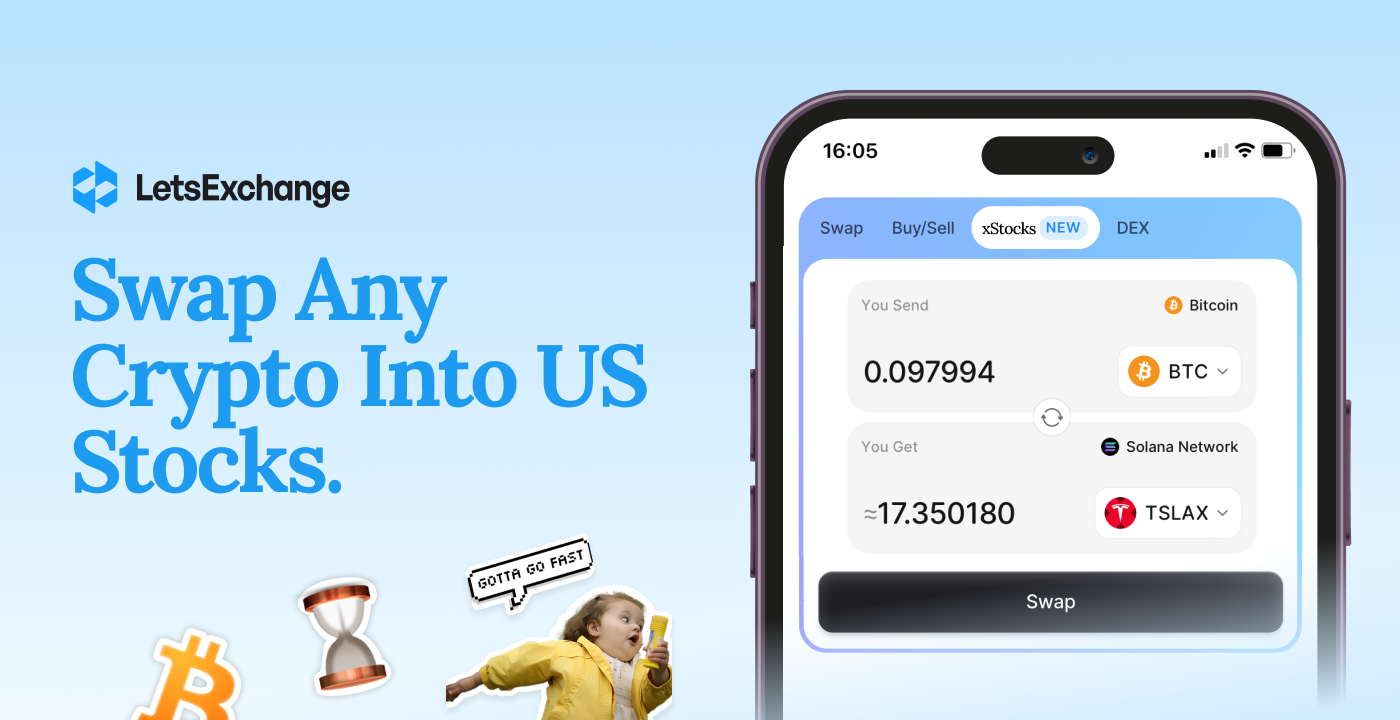
LetsExchange lets anyone swap BTC, USDT, SOL, or 5,700+ assets directly into xStocks — no borders, across 300+ blockchains. The same person who can't open a Schwab account can now rotate their BTC into TSLA in minutes.
How we built it
LetsExchange is live infrastructure we have been building — a cross-chain swap aggregator with API access for any product to integrate. For this hackathon, we extended it to support xStocks as a native asset class in the swap flow.
Challenges we ran into
The hardest problem was liquidity aggregation. xStocks sits across multiple sources — DEX liquidity from Jupiter, and parallel price discovery from CEXs — and unifying these into a single reliable swap route is non-trivial.
Pulling from several liquidity sources simultaneously means swap execution takes longer than a standard crypto-to-crypto trade. Users expect instant. We're not there yet.
This is the core problem we want to solve next: collapsing multi-source liquidity into near-instant settlement without sacrificing route quality or best price guarantees.
Accomplishments that we're proud of
We didn't build a concept — we extended live infrastructure. LetsExchange already processes real swaps across 300+ chains daily. Adding xStocks into that flow and demonstrating a working crypto to equity swap from a Central Asian user's perspective felt genuinely meaningful.
For me personally, this was the first time I could show someone from Kyrgyzstan a real path to buying Apple stock with their BTC. That's the accomplishment.
What we learned
Tokenized equities are a fundamentally different liquidity animal compared to native crypto assets. CEX and DEX sources don't reconcile cleanly — routing logic that works perfectly for BTC to USDT breaks down when equities are involved.
We also learned that the UX bar for this audience is higher. Someone using this to protect savings from inflation doesn't have tolerance for slow swaps or confusing errors. Simplicity at the frontend is as hard as the infrastructure underneath.
What's next for LetsExchange.io
Solving the liquidity aggregation latency problem is priority one — we want crypto to xStocks swaps to feel as fast as any other trade on our platform.
Beyond that: API integrations with wallets and DeFi apps so this capability is embedded where users already are. Every wallet in a developing country becomes a potential brokerage.
That's the vision we're building toward.

Log in or sign up for Devpost to join the conversation.